Learning Reciprocal Pronouns helps you show shared actions or feelings between two or more people. They’re key for writing clear, connected sentences. You’ll learn when to use each other and one another the right way. Short examples make every rule easy to understand. This knowledge fixes small mistakes in your writing. Mastering reciprocal pronouns makes your grammar a bit stronger.
Table of Contents
What Are Reciprocal Pronouns
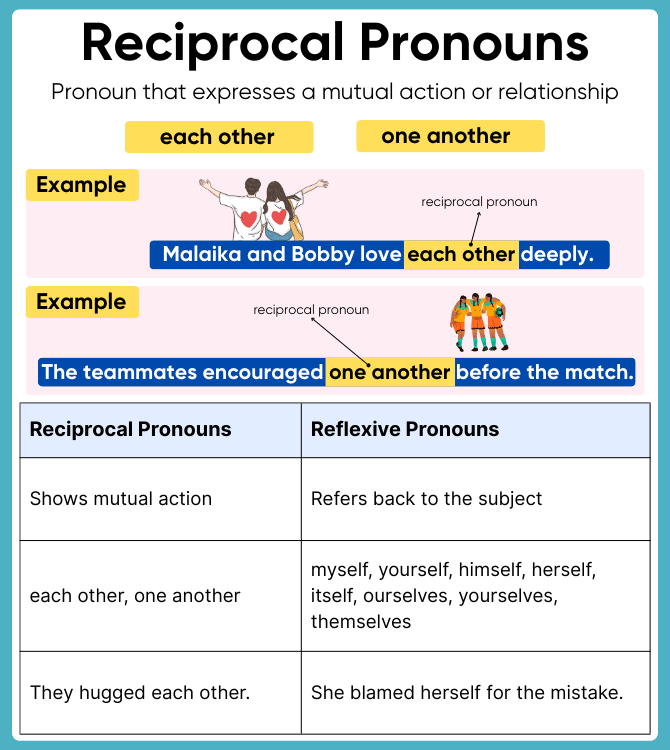
Reciprocal pronouns show a mutual action or relationship between two or more people or things. In English, the main reciprocal pronouns are each other and one another. For example: “Ali and Sara help each other.”
Types of Reciprocal Pronouns in English
English has only two reciprocal pronouns: each other and one another. While they are often used interchangeably, some style guides suggest slight differences.
1.Each Other
This is used when referring to two people or things.
- Hamza and Mariam smiled at each other.
2.One Another
This is used when referring to more than two people or things.
- The students congratulated one another after the results.
Usage of Reciprocal Pronouns in Sentences
Reciprocal pronouns are typically used as objects of the verb, not as the subject. They always follow an action that involves two or more people.
- Aisha and Bilal support each other in difficult times.
- The players congratulated one another after the match.
- Did you and Hassan call each other last night?
Rules of Using Reciprocal Pronouns Correctly
- Always use reciprocal pronouns with plural subjects.
- Do not use them as the subject of the sentence.
- Never combine them with reflexive pronouns (e.g., “each other themselves” is wrong).
- They cannot be used with prepositions like “by,” unless part of a prepositional phrase: “They sat beside each other.”
Reflexive vs. Reciprocal Pronouns
| Feature | Reflexive Pronouns | Reciprocal Pronouns |
|---|---|---|
| Definition | Refer back to the subject | Show mutual action |
| Common Forms | myself, yourself, themselves | each other, one another |
| Sentence Example | Amina helped herself. | Amina and Sara helped each other. |
| Number of People Involved | One | Two or more |
| Used As Object or Subject | Object (sometimes subject) | Only as object |
Examples of Reciprocal Pronouns in Real Sentences
understand for practice:
- Amina and Huda trust each other.
- Bilal and Ali called each other.
- The twins share with one another.
- The children played with one another.
- My parents support each other.
- Sarah and Hafsa feed each other’s pets.
- The cats groom each other.
- We forgive each other.
- Friends help one another.
- The guests greeted one another.
- Zainab and her cousin visit each other.
- Rehan and Saad covered for each other.
- The dogs bark at each other.
- Iqra and Ahsan text each other.
- They smiled at one another.
- The boys pushed each other.
- Hamza and Ahmed know each other well.
- The team members trust one another.
- People in the group support one another.
- The kids teased each other.
- The students helped one another.
- Asma and Noor hugged each other.
- The sisters remind each other.
- Neighbors greet one another every day.
- The friends laugh with each other.
- The birds chase each other.
- The classmates listen to one another.
- We respect each other.
- The cousins play with each other.
- The partners trust one another.
Test Your Knowledge with This Exercise
Fill in the blanks with “each other” or “one another”.
- Amina and Sana call __________ every evening.
- The classmates shared their notes with __________.
- Do you and Hamid understand __________?
- The neighbors smiled at __________.
- My parents respect __________ deeply.
Check your answers:
- each other
- one another
- each other
- each other
- each other
FAQs
A reciprocal pronoun shows mutual action. Example: “Zara and Hina hugged each other.”
No, reciprocal pronouns are always used with plural subjects.
Yes, in modern usage, both are generally used for mutual action regardless of the number of people.
each other and one another.
You might also like