An interrogative pronoun is a pronoun that begins a question about a person, an object or a choice. In “Who left the door open?”, the word “who” is used to ask for a person, and the answer takes its place: “Tom left the door open.”
The two choices that cause most errors are “who” against “whom” and “which” against “what”. Each choice is explained with a test that you apply to the sentence.
What Is an Interrogative Pronoun?
An interrogative pronoun is a pronoun used to ask a question. It is used in place of the noun that the answer will supply.
Compare the question with its answer. In “What did you buy?”, the pronoun “what” is used to ask for an object, and the answer “I bought a jacket” contains the noun. The question and the answer have the same structure, and the pronoun marks the missing part.
- Who is calling?
- What happened to the car?
- Which do you prefer?
- Whose is this umbrella?
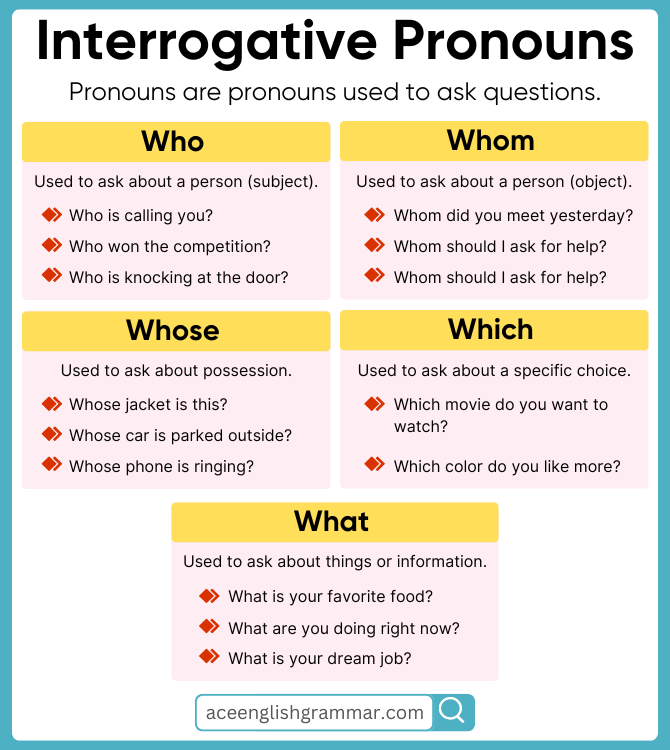
List of Interrogative Pronouns
Each interrogative pronoun is listed here with its function.
| Pronoun | Asks about | Sentence |
|---|---|---|
| Who | A person, as the subject | Who wrote this letter? |
| Whom | A person, as the object | Whom did you invite? |
| Whose | A person, as the owner | Whose is this jacket? |
| Which | A choice from a known group | Which do you want? |
| What | An object, an idea or an identity | What is your name? |
Who as an Interrogative Pronoun
“Who” is used for the person doing the action. It is the subject of the question, so the verb follows it directly.
- Who called you?
- Who is coming to dinner?
When “who” is the subject, no auxiliary verb is added: “Who called?” and not “Who did call?”
Whom as an Interrogative Pronoun
“Whom” is used for the person receiving the action. It is the object of a verb or a preposition.
- Whom did the committee elect?
- With whom did she travel?
“Whom” is formal. In speech and informal writing, “who” is used in its place.
Whose as an Interrogative Pronoun
“Whose” is used to ask who the owner is. It is used alone, in place of the owner.
- Whose is that bag?
- Whose are these keys?
Which as an Interrogative Pronoun
“Which” is used for a choice from a limited, known group of people or objects.
- Which of the two routes is shorter?
- Which do you like, the blue or the green?
What as an Interrogative Pronoun
“What” is used for an object, an idea or an identity, with no set group in view.
- What do you want for lunch?
- What is the capital of Peru?
- What does she do? (She is a nurse.)
Compound Interrogative Pronoun Forms
Adding “-ever” to a pronoun forms the compound interrogative pronouns “whoever”, “whomever”, “whatever” and “whichever”. They are used in questions that express surprise or frustration.
- Whatever are you doing?
- Whoever left this mess?
In statements these words are not interrogative, as in “Take whichever you like.”
Who vs Whom
The choice depends on the role of the pronoun in the question. “Who” is the subject, and “whom” is the object.
To choose, follow these steps.
- Answer the question in your head with “he” or “him”.
- If the answer is “he”, the pronoun is “who”.
- If the answer is “him”, the pronoun is “whom”.
Take “Who/Whom did you call?” The answer is “I called him”, so the pronoun is “whom”. Take “Who/Whom called you?” The answer is “He called me”, so the pronoun is “who”.
- ❌ Whom is knocking at the door?
- ✅ Who is knocking at the door?
In informal English, “who” is used in place of “whom” at the start of a question, as in “Who did you call?”. Formal writing keeps “whom”.
Which vs What
Choose “which” when the choices are limited and known, and “what” when they are open.
- Which of these two dresses do you prefer? (Two dresses are in view.)
- What do you prefer? (Any preference is possible.)
“Which” can refer to people as well as objects, and “what” refers to objects, ideas and identities.
Whose vs Who’s
“Whose” is the possessive form and asks about ownership. “Who’s” is a contraction of “who is” or “who has”.
- Whose is this scarf?
- Who’s at the door? (Who is)
- Who’s been using my laptop? (Who has)
To check, expand “who’s” to “who is” or “who has”. If the sentence still makes sense, the contraction is correct. If it does not, the word is “whose”.
Interrogative Pronoun With Prepositions
A preposition is placed before “whom” in formal English and at the end of the question in informal English.
- Formal: To whom did you speak?
- Informal: Who did you speak to?
“To who” is not used in either style. After a preposition, the pronoun is always “whom”.
- ❌ To who did you speak?
- ✅ To whom did you speak?
Interrogative Pronoun in Direct and Indirect Questions
A direct question ends in a question mark and puts the auxiliary verb before the subject. An indirect question is part of a statement and follows statement word order.
| Direct question | Indirect question |
|---|---|
| What did he say? | I wonder what he said. |
| Whom is she calling? | Tell me whom she is calling. |
| Which is correct? | I don’t know which is correct. |
An indirect question takes no auxiliary “do” and no question mark, unless the main clause is itself a question: “Do you know who called?”
Interrogative Pronoun vs Interrogative Adjective
An interrogative pronoun is used alone. An interrogative adjective, formed from the same words, comes before a noun.
| Word | As a pronoun | As an adjective |
|---|---|---|
| Which | Which is yours? | Which bag is yours? |
| What | What do you need? | What size do you need? |
| Whose | Whose is this? | Whose phone is this? |
To tell them apart, check whether a noun follows the word. A word followed by a noun is an adjective, and a word used alone is a pronoun.
Interrogative adverbs: Questions also begin with these words:
- When, for time
- Where, for place
- Why, for reason
- How, for manner
They are adverbs and not pronouns, because they do not replace a noun.
Relative pronouns: The same forms are used to introduce clauses in statements. In “The man who called is my uncle”, “who” is used to join a clause to a noun, and no question is asked.
Common Mistakes With Interrogative Pronouns
Who for whom: Write “To whom did you speak?”, not “To who did you speak?”. A pronoun after a preposition is an object.
Whom for who: Write “Who called you?”, not “Whom called you?”. The pronoun is the subject.
Whose and who’s: Write “Whose bag is this?”, not “Who’s bag is this?”. Ownership needs “whose”.
Extra auxiliary: Write “Who called?”, not “Who did call?”. A subject question takes no “do”.
Which for open choices: Write “What do you want to eat?” when no menu is in view. “Which” is used only for a known group.
Interrogative Pronoun Exercises
Choose the correct word or complete the sentence.
- Choose the correct pronoun: (Who / Whom) wrote this poem?
- Choose the correct pronoun: (Who / Whom) did you invite?
- Choose the correct word: (Whose / Who’s) coming to the party?
- Choose the correct pronoun: There are two exits. (Which / What) is nearer?
- Correct the sentence: To who did you give the keys?
- Choose the correct pronoun: (Which / What) is your favorite color?
- Is “which” a pronoun or an adjective: Which is your seat?
- Is “which” a pronoun or an adjective: Which seat is yours?
- Change to an indirect question: What did she buy?
- Choose the correct word: (Whose / Who’s) shoes are these?
Answers:
- Who: the answer is “he wrote it”, so “who” is the subject.
- Whom: the answer is “I invited him”.
- Who’s: the sentence expands to “who is coming”.
- Which: the choice is limited to two exits.
- To whom did you give the keys: a pronoun after a preposition is “whom”.
- What: the choice is open.
- Pronoun: “which” is used alone.
- Adjective: “which” comes before the noun “seat”.
- I wonder what she bought: statement word order is used.
- Whose: the sentence is about ownership.
FAQs
Q1. What are the interrogative pronouns?
They are “who”, “whom” and “whose” for people, and “which” and “what” for choices and objects. The compound forms with “-ever” are covered under compound interrogative pronoun forms.
Q2. Are interrogative pronouns the same as relative pronouns?
No. An interrogative pronoun begins a question, as in “Who called?”, while a relative pronoun begins a clause inside a statement, as in “The man who called is my uncle”. The words “who”, “whom”, “whose” and “which” belong to both classes.
Q3. Is “how” an interrogative pronoun?
No. “How” is an interrogative adverb, because it asks about manner or degree and does not replace a noun. The same applies to “when”, “where” and “why”.
Q4. Is “whose” an interrogative pronoun?
Yes, when it is used alone, as in “Whose is this bag?”. Before a noun, as in “Whose bag is this?”, it is an interrogative adjective.
Q5. How many interrogative pronouns are there?
The number is five in the base list, and the “-ever” compounds bring the total to nine.
Q6. What is the antecedent of an interrogative pronoun?
None is needed, because an interrogative pronoun does not replace an earlier noun. In “Who called?”, no earlier word is replaced.
Q7. When do we use interrogative pronouns?
They are used to ask about a person, an object, an owner or a choice. The pronoun comes at the start of the question, and the answer takes its place.
Read More