A possessive pronoun shows ownership and replaces a noun phrase. Instead of repeating my book in a sentence, you can say This book is mine. The word mine stands alone because it already carries the meaning of my book.
The main possessive pronouns are mine, yours, his, hers, ours, and theirs. You also see whose in questions and relative clauses, as in Whose is this? and the woman whose keys were missing. These pronouns point to the owner without placing a noun after them.
The easiest way to understand a possessive pronoun is to watch what happens to the noun. If the ownership word comes before a noun, use my, your, her, our, or their. If the ownership word stands alone, use mine, yours, hers, ours, or theirs.
What Is A Possessive Pronoun?
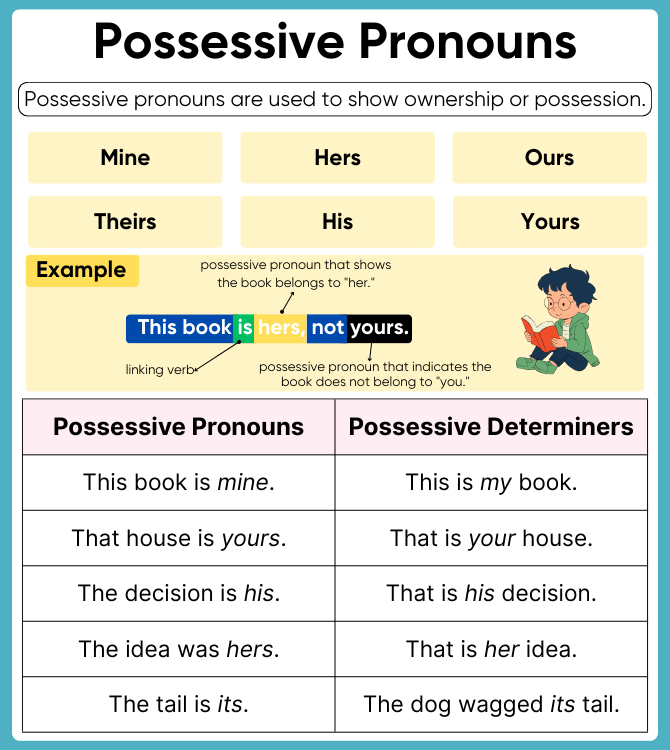
A possessive pronoun is a word that shows who owns something and replaces the noun or noun phrase in the sentence.
Compare these two sentences:
- This is my laptop.
- This laptop is mine.
In the first sentence, my comes before the noun laptop. In the second sentence, mine replaces my laptop. You do not need to say the noun again because the reader already knows what you mean.
That same pattern works in many everyday sentences:
- That red coat is hers.
- The front seats are ours.
- The blue backpack is his.
- This phone is yours.
- The empty table near the window is theirs.
Notice the position of each pronoun. Mine, yours, his, hers, ours, and theirs stand alone. They do not sit before a noun.
Possessive Pronouns List
Before using these pronouns in sentences, connect each form with its owner. The pronoun changes with the owner, not with the object being owned.
| Person | Possessive pronoun | Example |
|---|---|---|
| I | mine | This phone is mine. |
| You | yours | The choice is yours. |
| He | his | The jacket is his. |
| She | hers | The notebook is hers. |
| We | ours | The house is ours. |
| They | theirs | The idea was theirs. |
| Who | whose | Whose is this? |
The object can be singular or plural, but the pronoun still follows the owner.
- This pencil is mine.
- These pencils are mine.
Both sentences use mine because the owner is still I. The number of pencils does not change the possessive pronoun.
How Possessive Pronouns Work In Sentences
Once the noun is already known, a possessive pronoun often comes after verbs like is, are, was, and were. This pattern sounds natural because the sentence first names the thing, then tells who owns it.
- This pen is mine.
- Those shoes are yours.
- The mistake was theirs.
- The final decision was ours.
Each sentence has the same basic movement: the thing comes first, and the owner comes after the verb.
A possessive pronoun can also come after of.
- She is a friend of mine.
- That cousin of yours called again.
- A neighbor of theirs moved to London.
This pattern is common in natural English. A friend of mine sounds smoother than repeating my friend after the person or relationship is already understood.
Possessive Pronouns Vs Possessive Adjectives
This is where many mistakes begin. Possessive pronouns and possessive adjectives point to ownership, but they sit in different places in a sentence.
A possessive adjective comes before a noun. A possessive pronoun stands alone.
| Possessive adjective | Possessive pronoun |
|---|---|
| This is my book. | This book is mine. |
| That is your seat. | That seat is yours. |
| This is his coat. | This coat is his. |
| That is her phone. | That phone is hers. |
| This is our room. | This room is ours. |
| That is their car. | That car is theirs. |
The noun position gives you the answer. If a noun comes right after the ownership word, you need the adjective form.
- my book
- your seat
- her phone
- our room
- their car
If the ownership word stands alone, you need the possessive pronoun.
- The book is mine.
- The seat is yours.
- The phone is hers.
- The room is ours.
- The car is theirs.
The test is quick: noun after it means adjective form; no noun after it means pronoun form.
Possessive Pronoun Rules
A possessive pronoun follows one main idea: it replaces the noun phrase. Once that idea is clear, the rules become much easier to apply.
Use A Possessive Pronoun When The Noun Is Already Known
A possessive pronoun works when the reader or listener already knows the thing being discussed.
- My room is upstairs. Yours is downstairs.
- I found my ticket, but Sara lost hers.
- Our table is near the window. Theirs is near the door.
In the first sentence, yours means your room. In the second, hers means her ticket. In the third, theirs means their table.
Do Not Add A Noun After It
This rule comes from the same idea. The pronoun has already taken the noun’s place, so another noun after it is wrong.
Wrong: Is this yours bag?
Right: Is this your bag?
Right: Is this bag yours?
Wrong: That is hers phone.
Right: That is her phone.
Right: That phone is hers.
If a noun comes right after the ownership word, choose my, your, her, our, or their. If the word stands alone, choose mine, yours, hers, ours, or theirs.
Do Not Use Apostrophes
Possessive pronouns do not take apostrophes.
- Wrong: your’s
Right: yours - Wrong: her’s
Right: hers - Wrong: our’s
Right: ours - Wrong: their’s
Right: theirs
Apostrophes show ownership with nouns, as in Sarah’s book or the teacher’s desk. Possessive pronouns already show ownership, so they do not need apostrophes.
Match The Pronoun To The Owner
Choose the possessive pronoun by looking at the owner, not the thing being owned.
- I own the bike. The bike is mine.
- She owns the bike. The bike is hers.
- They own the bike. The bike is theirs.
The same pronoun can refer to one object or many objects.
- This notebook is mine.
- These notebooks are mine.
The owned thing changes from singular to plural, but mine stays the same because the owner is still I.
Use The Right Verb With The Thing Owned
When a possessive pronoun becomes the subject of a sentence, the verb depends on the hidden noun.
- Mine is on the table.
- Mine are on the table.
Both sentences can be correct. The first may mean my book is on the table. The second may mean my keys are on the table. The pronoun stays the same, but the verb changes because the hidden noun changes.
Common Mistakes With Possessive Pronouns
Most mistakes happen because two forms point to the same owner. The difference is not the owner. The difference is where the word sits in the sentence.
My Vs Mine
Use my before a noun. Use mine alone.
Wrong: This is mine bag.
Right: This is my bag.
Right: This bag is mine.
The mistake happens because my and mine both point to the speaker. Only my can sit before the noun bag.
Your Vs Yours
Use your before a noun. Use yours alone.
Wrong: Is this yours notebook?
Right: Is this your notebook?
Right: Is this notebook yours?
Do not write your’s. The correct form is yours.
Her Vs Hers
Use her before a noun. Use hers alone.
Wrong: That is hers phone.
Right: That is her phone.
Right: That phone is hers.
The mistake happens because her and hers point to the same owner, but only her can come before a noun.
Their Vs Theirs
Use their before a noun. Use theirs alone.
Wrong: This is theirs car.
Right: This is their car.
Right: This car is theirs.
Do not write their’s. The correct form is theirs.
Our Vs Ours
Use our before a noun. Use ours alone.
Wrong: This is ours house.
Right: This is our house.
Right: This house is ours.
Do not write our’s. The correct form is ours.
Its Vs It’s
Its usually comes before a noun.
- The cat licked its paw.
- The company changed its logo.
- The tree lost its leaves.
It’s means it is or it has.
- It’s raining.
- It’s been a long day.
In modern English, its rarely stands alone as a possessive pronoun. For most writing, use its before a noun and avoid sentences like The bowl is its.
Whose Vs Who’s
Whose asks about ownership.
- Whose is this?
- Whose bag is on the chair?
Who’s means who is or who has.
- Who’s coming today?
- Who’s finished the work?
Use whose when the sentence is about ownership.
Examples Of Possessive Pronouns In Sentences
The examples below show how each possessive pronoun replaces a noun phrase. Read the sentence first, then notice which noun phrase has disappeared.
Mine
- The black laptop is mine.
- Your coffee is on the left, and mine is on the right.
- I forgot my notebook, so I borrowed one of mine from the car.
Here, mine replaces phrases such as my laptop, my coffee, and my notebook. The noun is already understood, so it does not need to appear again.
Yours
- This seat is yours.
- My answer is different from yours.
- The decision is yours, but think carefully before you choose.
In these examples, yours points back to something that belongs to you: your seat, your answer, or your decision.
His
- The blue jacket is his.
- I found my passport, but he lost his.
- Her desk is near the window, and his is near the door.
His can stand alone, but it can also come before a noun. That is why his jacket and The jacket is his are both correct.
Hers
- The red scarf is hers.
- My handwriting is messy, but hers is neat.
- I brought my lunch, and Maria brought hers.
Here, hers replaces her scarf, her handwriting, and her lunch. Do not place a noun after hers.
Ours
- The house at the corner is ours.
- Their room is smaller than ours.
- We checked the tickets, and ours were for the evening show.
Ours points to something that belongs to us. It can refer to one thing, such as our house, or many things, such as our tickets.
Theirs
- The white car is theirs.
- Our garden is small, but theirs is huge.
- I returned my books, but theirs are still on the table.
Theirs points to something that belongs to them. The noun may be singular or plural, but the owner stays the same.
Whose
- Whose is this umbrella?
- Whose are these glasses?
- The student whose phone was missing spoke to the teacher.
Whose is used for ownership in questions and relative clauses. It is not the same as who’s, which means who is or who has.
Where Possessive Pronouns Sound Natural
Possessive pronouns often appear when people compare things, correct ownership, or avoid repeating a noun. They are common in daily speech because ownership comes up in small moments all the time.
At home, you might say:
- This towel is mine.
- The room upstairs is ours.
- That charger is yours, not mine.
At school, you might say:
- My answer is different from hers.
- The red folder is his.
- Our project is finished, but theirs is not.
At work, you might say:
- The final report is ours.
- This desk is mine for today.
- Their meeting starts after yours.
The same rule works in every setting. If the noun is already known, the possessive pronoun can replace it.
Possessive Pronouns Exercises
Before you answer, find the owner first. Then check whether a noun comes after the blank. If no noun comes after it, you need a possessive pronoun.
- This phone belongs to me. It is ______.
- That car belongs to Aisha. It is ______.
- We bought this house. It is ______.
- This decision is up to you. It is ______.
- This book belongs to Ahmed. It is ______.
- Those bags belong to the girls. They are ______.
- I found my keys, but Ali lost ______.
- My seat is near the front. Where is ______?
- Sara brought her lunch, and I brought ______.
- Our tickets are digital, but ______ are printed.
Answers
- mine
- hers
- ours
- yours
- his
- theirs
- his
- yours
- mine
- theirs
FAQs
A possessive pronoun is a word that shows ownership and replaces a noun or noun phrase. In This bag is mine, the word mine replaces my bag.
The main possessive pronouns are mine, yours, his, hers, ours, and theirs. Whose is also used for ownership in questions and relative clauses.
A possessive adjective comes before a noun, while a possessive pronoun stands alone.
This is my pen.
This pen is mine.
My comes before pen. Mine replaces my pen.
Its usually works as a possessive adjective before a noun, as in its tail or its color. It rarely stands alone in modern English, so most learners should use it before a noun.
No. Possessive pronouns do not use apostrophes. Write yours, hers, ours, and theirs, not your’s, her’s, our’s, or their’s.
His can work both ways.
His phone is new.
The phone is his.
In the first sentence, his comes before a noun. In the second sentence, his stands alone as a possessive pronoun.
Use a possessive pronoun when the owned thing is already known. Do not add a noun after it.
Wrong: This is yours book.
Right: This is your book.
Right: This book is yours.
Read More