Reflexive pronouns end in -self or -selves and refer back to the subject of the same clause. In “She taught herself to code”, the pronoun “herself” refers to the subject “she”.
Each of the reflexive pronouns matches its subject in person and number, so “I” is paired with “myself” and “they” is paired with “themselves”. The form is fixed by the subject. The first heading takes up the definition of reflexive pronouns.
What Are Reflexive Pronouns?
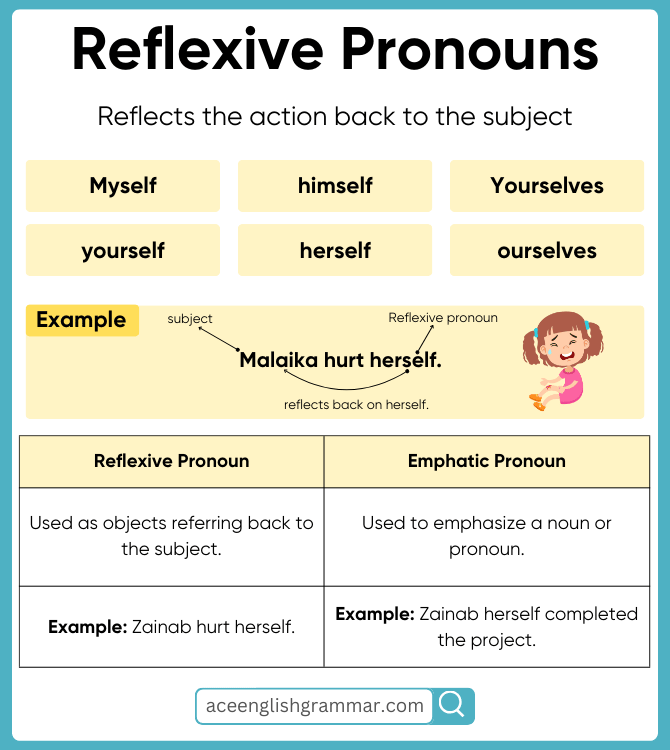
A reflexive pronoun is a pronoun that ends in -self or -selves and refers back to the subject of the same clause. It is used when the subject and the object of a verb are the same noun phrase, as in “He blamed himself for the delay”.
Reflexive pronouns are also called reflexives. Each member of the class matches one subject pronoun in person and number.
- I made myself a cup of tea.
- She taught herself to code.
- They enjoyed themselves at the party.
List of Reflexive Pronouns
The reflexive pronouns are paired with the subject pronouns they match.
| Person | Subject pronoun | Reflexive pronoun | Example |
|---|---|---|---|
| First person singular | I | Myself | I cut myself while cooking. |
| Second person singular | You | Yourself | You should be proud of yourself. |
| Third person singular | He | Himself | He locked himself out. |
| Third person singular | She | Herself | She reminded herself to call. |
| Third person singular | It | Itself | The cat cleaned itself. |
| First person plural | We | Ourselves | We prepared ourselves for the exam. |
| Second person plural | You | Yourselves | Help yourselves to some food. |
| Third person plural | They | Themselves | They introduced themselves. |
Possessive or object pronoun + -self/-selves
The first-person and second-person forms are formed from possessive pronouns, as in “my” + “self”. The third-person forms are made with object pronouns, as in “him” + “self”.
The singular forms end in -self, and the plural forms end in -selves. The word “yourself” is used for one person, and “yourselves” is used for two or more.
What Type of Pronoun Is Myself?
The words “myself”, “himself” and “themselves” are pronouns, because each is used in place of a noun phrase. They belong to the class of reflexive pronouns, which is separate from the class of personal pronouns.
Reflexive Pronoun Rules
All reflexive pronouns refer to the subject of their own clause. They occur as objects, after prepositions and in phrases with “by”.
Reflexive Pronouns as Objects
A reflexive pronoun is the direct or indirect object of a verb when the subject performs the action on itself.
- He hurt himself playing football.
- She bought herself a new laptop.
- We taught ourselves the basics.
Reflexive Pronouns After Prepositions
A reflexive pronoun follows a preposition when the object of the preposition is the subject of the clause.
- She is proud of herself.
- He talks to himself when he is nervous.
- They looked after themselves.
A preposition of place is followed by an object pronoun and not by a reflexive pronoun.
- She put the bag next to her.
The Phrase By Myself
The phrase “by” + reflexive pronoun means alone or without help.
- He traveled to Karachi by himself.
- I finished the project by myself.
Reflexive Pronouns Examples
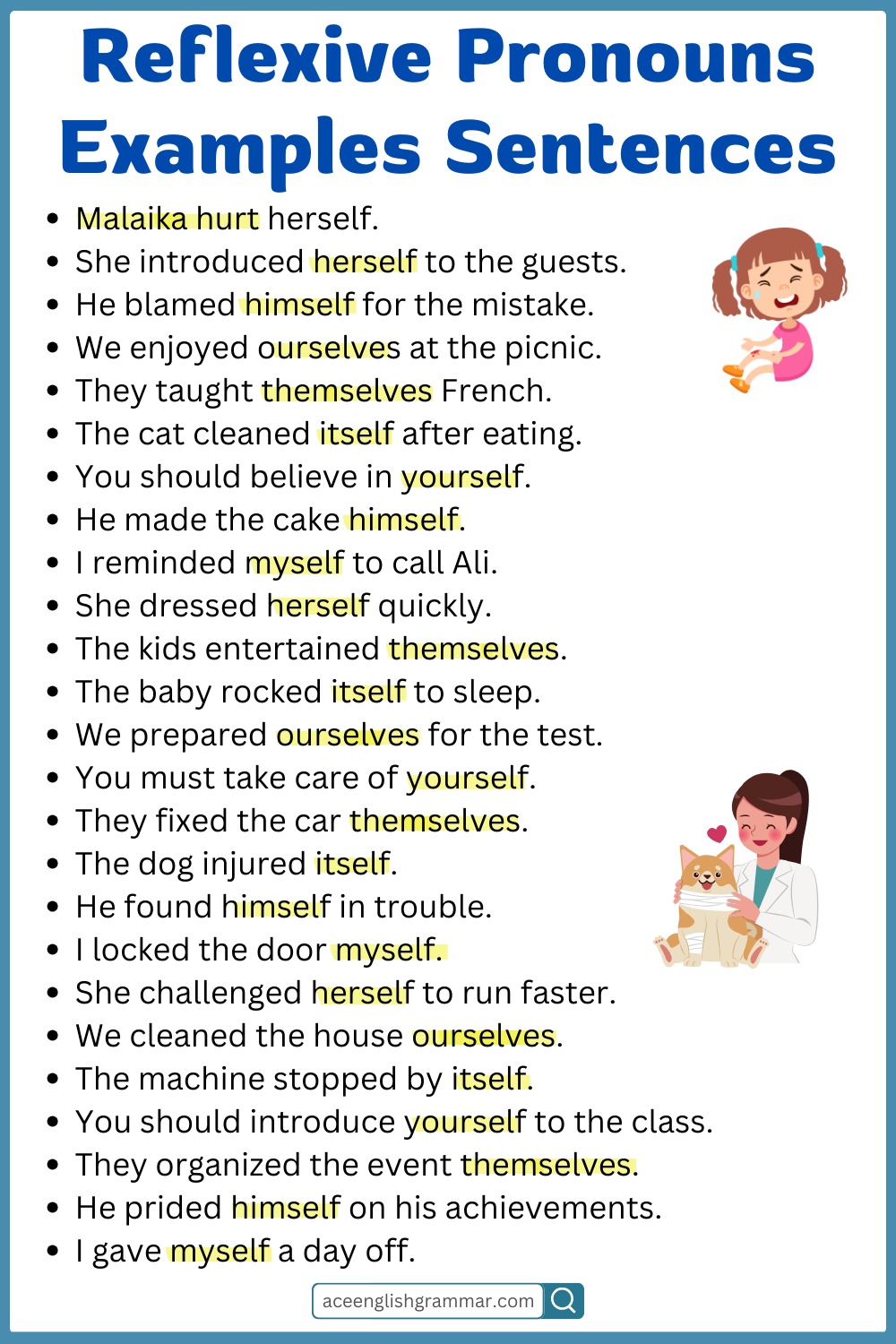
These reflexive pronouns examples show each sentence with the use it illustrates.
| Use | Sentence |
|---|---|
| Direct object | She introduced herself to the class. |
| Direct object | The children dressed themselves quickly. |
| Direct object | I reminded myself to lock the door. |
| Indirect object | He made himself a sandwich. |
| Indirect object | We gave ourselves an extra hour. |
| After a preposition | They are proud of themselves. |
| After a preposition | You should talk to yourself kindly. |
| After a preposition | The machine switches itself off. |
| With by | I live by myself. |
| With by | She completed the course by herself. |
| Plural subject | We enjoyed ourselves at the concert. |
| Plural subject | Help yourselves to the snacks, everyone. |
| Singular they | Each student should check themself before the exam. |
Reflexive Verbs in English
A reflexive verb is a verb used with a reflexive pronoun that refers to the subject. The pronoun is the object of the verb.
| Verb | Sentence |
|---|---|
| Blame | He blamed himself for the mistake. |
| Enjoy | They enjoyed themselves on the trip. |
| Behave | The guests behaved themselves. |
| Hurt | She hurt herself on the stairs. |
| Introduce | I introduced myself to the manager. |
| Teach | He taught himself to play the guitar. |
| Express | You express yourself well in writing. |
Verbs such as “concentrate”, “feel” and “meet” take no reflexive pronoun in English.
- ✅ Concentrate on the exercise.
- ❌ Concentrate yourself on the exercise.
- ✅ We meet at noon.
- ❌ We meet ourselves at noon.
Use of Myself
The pronoun “myself” is used only when “I” is the subject of the same clause. When another person is the subject, or when the pronoun follows “and” or “or” in a coordinate phrase, “I” or “me” is used.
- ✅ Mary and I finished the report.
- ❌ Mary and myself finished the report.
- ✅ Please send the file to John or me.
- ❌ Please send the file to John or myself.
Themselves vs Themself
The form “themselves” is the reflexive pronoun for a plural subject. For singular “they”, the reflexive pronoun is “themself”, which marks one person.
- The students prepared themselves for the exam.
- Someone locked themself in the room.
Singular “they” takes either form. The form “themselves” is the established spelling, and “themself” is accepted in current usage.
Reflexive vs Intensive Pronouns
An intensive pronoun is identical in form to a reflexive pronoun and is used for emphasis on a noun or pronoun. It is not required by the grammar of the sentence.
| Type | Function | Sentence | Removable |
|---|---|---|---|
| Reflexive | Object of a verb or preposition | She blamed herself. | No |
| Intensive | Emphasis on a noun or pronoun | The manager herself called me. | Yes |
| Reciprocal | Mutual action between two or more | They helped each other. | No |
Removing “herself” from “She blamed herself” leaves an incomplete clause. Removing “herself” from “The manager herself called me” leaves a complete clause.
Common Mistakes With Reflexive Pronouns
Hisself and theirselves: Among reflexive pronouns, write “himself” and “themselves”, not “hisself” and “theirselves”. The third-person forms are made with the object pronouns.
Myself as the subject: Write “My brother and I”, not “My brother and myself”. Reflexive pronouns are never the subject of their own clause.
Myself for politeness: Write “Please contact me”, not “Please contact myself”. The pronoun “me” is used when another person is the subject.
Yourself for several people: Write “You two should be proud of yourselves”, not “of yourself”. The plural form is used for more than one person.
Concentrate: Write “Concentrate on the task”, not “Concentrate yourself on the task”. The verb takes no reflexive object.
Different clause: Write “Sara said that she was late”, not “Sara said that herself was late”. A reflexive pronoun refers to the subject of its own clause.
Reflexive Pronouns Exercises
Complete each sentence with the correct reflexive pronoun, or choose the correct form.
- She taught ____ to swim.
- We enjoyed ____ at the concert.
- The children dressed ____ quickly.
- Choose the correct form: Mary and (I / myself) went home.
- He looked at ____ in the mirror.
- You two should be proud of ____.
- I finished the project by ____.
- Choose the correct form: Please send the report to John or (me / myself).
- The cat washed ____.
- Correct the sentence: They blamed theirselves.
Answers:
- Herself: the subject is “she”.
- Ourselves: the subject is “we”.
- Themselves: the subject is “the children”.
- I: “myself” is never the subject.
- Himself: the subject is “he”.
- Yourselves: “you two” is plural.
- Myself: the phrase is “by myself”.
- Me: “John or me” follows the verb “send”.
- Itself: the subject is “the cat”.
- They blamed themselves: “theirselves” is non-standard.
FAQs
Q1. Is yourself a pronoun?
Yes, “yourself” is a pronoun. It is the second-person singular reflexive pronoun and refers back to the subject “you”, as in “You hurt yourself”.
Q2. Is himself a personal pronoun?
No, “himself” is a reflexive pronoun and not a personal pronoun. Personal pronouns such as “he” and “him” denote the person, while “himself” refers back to the subject of the clause.
Q3. Is an intensive pronoun required in a sentence?
No, an intensive pronoun is not required by the grammar of the sentence. In “The manager herself called me”, the sentence is complete without “herself”.
Q4. Is yourself singular or plural?
The word “yourself” is singular, and “yourselves” is plural. The singular form refers to one person, and the plural form refers to two or more.
Q5. Is hisself a word?
No, “hisself” is a non-standard form. The standard form is “himself”, and the plural counterpart is “themselves”, not “theirselves”.
Q6. Are reflexive pronouns ever the subject of a sentence?
No, reflexive pronouns are never the subject of its own clause. A sentence such as “Myself went home” is replaced by “I went home”.
Q7. What does by myself mean?
The phrase “by myself” means alone or without help, as in “I finished the report by myself”. The phrase “on my own” is used with the same meaning.
Q8. Is ourself a word?
The standard form is “ourselves”. The form “ourself” is rare and marks one person speaking for a group, as in a royal “we”.
Read More
- Reflexive and Intensive Pronouns
- Intensive Pronouns
- Emphatic Pronouns in English
- Pronouns
- Objective Personal Pronouns