Emphatic pronouns are words like myself, yourself, himself, herself, and themselves that stress who did an action. In the sentence I myself checked the answer, the word myself adds emphasis to I.
They look the same as reflexive pronouns, but they do a different job. A reflexive pronoun receives the action, while an emphatic pronoun only adds stress and can be removed without breaking the sentence.
You need this difference most when using words like myself and herself in writing, questions, and everyday speech. A few sentence tests make the rule much easier to remember.
What Are Emphatic Pronouns?

An emphatic pronoun is a self-form pronoun that points back to a noun or pronoun already present in the sentence and adds emphasis to it. The noun or pronoun it refers to is its antecedent. An emphatic pronoun does not act as the object of the verb, and removing it does not damage the basic sentence structure.
Consider this sentence:
- “Sarah herself cleaned the room.”
In this sentence, herself points back to Sarah and stresses that Sarah personally performed the action. Without herself, the sentence remains complete:
- “Sarah cleaned the room.”
The sentence keeps its core meaning, but the emphasis on Sarah’s personal action disappears. That difference is the central role of an emphatic pronoun.
Emphatic Pronouns List
English uses the same self-form pronouns for emphatic and reflexive use. Their role depends on sentence structure, not spelling.
| Personal Pronoun | Emphatic Pronoun | Example |
|---|---|---|
| I | myself | I myself made the decision. |
| You | yourself | You yourself said it was wrong. |
| He | himself | He himself repaired the bike. |
| She | herself | She herself wrote the letter. |
| It | itself | The door itself opened slowly. |
| We | ourselves | We ourselves planned the event. |
| You | yourselves | You yourselves must answer this. |
| They | themselves | They themselves built the cabin. |
The singular forms end in self: myself, yourself, himself, herself, itself.
The plural forms end in selves: ourselves, yourselves, themselves.
After the forms are clear, the more important point is how these pronouns behave inside real sentences.
How Emphatic Pronouns Work In A Sentence
An emphatic pronoun does not replace the subject and does not receive the action. It adds emphasis to the person or thing already named.
- “I myself called the office.”
- “The doctor himself spoke to the patient.”
- “We ourselves checked every answer.”
In these sentences, the emphatic pronoun adds the idea of personal involvement. The speaker wants to stress that the named person or group performed the action directly.
The same sentences remain grammatically complete without the emphatic pronoun:
- “I called the office.”
- “The doctor spoke to the patient.”
- “We checked every answer.”
The structure remains intact, but the sentence loses force. That distinction matters because emphatic pronouns add emphasis; they do not supply an essential grammatical role.
The Removal Test
A reliable test for an emphatic pronoun is removal. Take the self-form pronoun out of the sentence and check whether the sentence still has a complete meaning.
| Sentence With Emphasis | Sentence Without Emphasis |
|---|---|
| I myself cooked dinner. | I cooked dinner. |
| She herself signed the form. | She signed the form. |
| They themselves chose the design. | They chose the design. |
| The owner himself opened the shop. | The owner opened the shop. |
When the sentence still works after removal, the pronoun is probably emphatic. It was adding stress, not completing the grammar.
This test matters because the same self-form pronouns can be emphatic in one sentence and reflexive in another. The form alone is not enough; the function decides the answer.
Where To Place Emphatic Pronouns
Emphatic pronouns usually stay close to the noun or pronoun they stress, but sentence position can slightly change the force of the statement.
After The Noun Or Pronoun: This position strongly emphasizes the subject.
- “I myself heard the announcement.”
- “You yourself made that promise.”
- “The principal herself welcomed the guests.”
- “The children themselves cleaned the classroom.”
This placement often sounds direct and firm. It works well when the speaker is correcting an idea, stressing responsibility, or making a contrast.
Near The End Of The Sentence: An emphatic pronoun can also appear later in the sentence.
- “I heard the announcement myself.”
- “You made that promise yourself.”
- “The principal welcomed the guests herself.”
- “The children cleaned the classroom themselves.”
This position often stresses personal action or independence. The subject performed the action directly instead of leaving it to someone else.
Compare these two sentences:
- “You yourself should answer the question.”
- “You should answer the question yourself.”
The first sentence stresses you, not another person. The second sentence puts more weight on doing the action personally.
Placement shows where the emphatic pronoun can appear, but function shows what kind of pronoun it is. That distinction becomes essential when emphatic pronouns are compared with reflexive pronouns.
Emphatic Pronouns Vs Reflexive Pronouns
Because emphatic and reflexive pronouns share the same forms, the difference comes from sentence function, not spelling.
| Point | Emphatic Pronoun | Reflexive Pronoun |
|---|---|---|
| Main role | Adds emphasis | Receives the action |
| Can be removed? | Yes | No |
| Sentence meaning | Still complete without it | Breaks or changes without it |
| Example | I myself cooked dinner. | I burned myself. |
Compare the same word in two different sentence structures:
- “I myself fixed the chair.”
- “I hurt myself while fixing the chair.”
In the first sentence, myself is emphatic because it stresses I. The sentence “I fixed the chair” remains complete.
In the second sentence, myself is reflexive because it receives the action of hurt. The sentence “I hurt” does not carry the same meaning.
Another pair shows the same contrast:
- “She herself opened the gate.”
- “She blamed herself for the mistake.”
In “She herself opened the gate,” herself adds emphasis. In “She blamed herself for the mistake,” herself is the object of blamed.
The main distinction is sentence function: an emphatic pronoun strengthens a noun or pronoun already named, while a reflexive pronoun receives the action of the verb.
Examples Of Emphatic Pronouns In Sentences
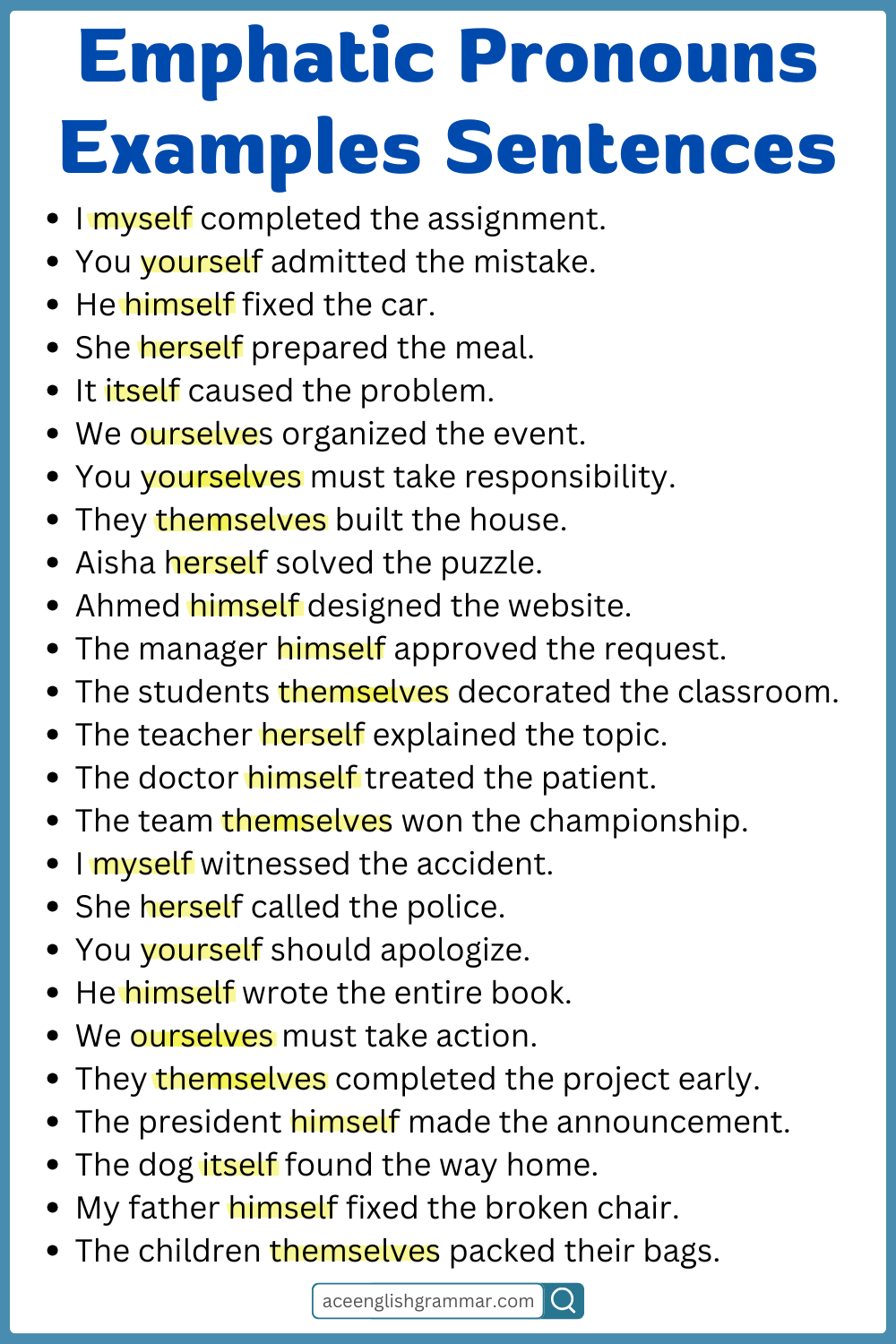
The examples below show different reasons for emphasis: personal responsibility, contrast, surprise, direct confirmation, and independent action.
- “I myself spoke to the customer.”
- “You yourself agreed to the rule.”
- “He himself carried the bags upstairs.”
- “She herself painted the kitchen wall.”
- “The cat itself pushed the door open.”
- “We ourselves prepared the final draft.”
- “You yourselves created this problem.”
- “They themselves asked for more time.”
- “The teacher herself checked the homework.”
- “The mayor himself confirmed the news.”
- “My father himself built this table.”
- “The students themselves arranged the chairs.”
- “Aisha herself organized the event.”
- “The company itself admitted the error.”
- “We ourselves will handle the matter.”
Each sentence keeps its core meaning if the emphatic pronoun is removed. What changes is the strength and focus of the statement.
Common Mistakes With Emphatic Pronouns
Most mistakes happen when a self-form pronoun is used as a formal-sounding replacement for a normal subject or object pronoun. Words like myself and yourself may sound polished, but they are wrong when the sentence requires I, me, you, or another ordinary pronoun.
Do Not Use Myself As The Subject: Myself cannot stand alone as the subject of a sentence.
Incorrect:
- “Myself will call you tomorrow.”
Correct:
- “I will call you tomorrow.”
Correct with emphasis:
- “I myself will call you tomorrow.”
Use I as the subject. Add myself only when the sentence has a genuine need for emphasis.
Do Not Use Myself Instead Of Me: When the pronoun is the object of a verb or preposition, use me, not myself.
Incorrect:
- “Please send the file to myself.”
Correct:
- “Please send the file to me.”
In this sentence, me is the object of the preposition to. Myself does not belong in that object position.
Do Not Add Emphasis Twice: One emphatic pronoun is enough.
Weak:
- “I myself personally wrote the email myself.”
Better:
- “I myself wrote the email.”
The stronger sentence gives emphasis without repeating the same idea too heavily.
Do Not Confuse Emphatic And Reflexive Use: The same word can have two different grammar roles.
- “The chef himself served the meal.”
- “The chef cut himself.”
In the first sentence, himself adds emphasis to the chef. In the second sentence, himself receives the action of cut.
When To Use Emphatic Pronouns
Use an emphatic pronoun when the sentence needs to show personal responsibility, direct involvement, contrast, confirmation, or independent action.
| Use | Example |
|---|---|
| Personal responsibility | I myself made the final call. |
| Contrast | The director herself rejected the idea. |
| Surprise | The child himself solved the puzzle. |
| Confirmation | The witness herself gave the statement. |
| Independent action | They built the shed themselves. |
Emphatic pronouns work best when the sentence has a real reason for emphasis. When they appear too often, the writing starts to feel heavy and unnatural.
Emphatic Pronouns In Questions And Negative Sentences
Emphatic pronouns also work in questions and negative sentences. These forms are less central than the main rule, but they matter because emphasis often appears in direct questions, denials, and statements of surprise.
In Questions: The emphatic pronoun can ask whether the subject personally saw, heard, confirmed, decided, or did something.
- “Did you yourself see the accident?”
- “Can she herself confirm the details?”
- “Will they themselves pay for the damage?”
- “Did the manager himself approve this?”
“Did you yourself see it?” is stronger than “Did you see it?” It asks whether you had direct knowledge, not whether you heard the information from someone else.
In Negative Sentences: The same emphasis works when the sentence denies an action, belief, expectation, or fact.
- “I myself did not know the answer.”
- “He himself did not believe the story.”
- “The owner herself did not attend the meeting.”
- “They themselves did not expect the result.”
These sentences stress that even the named person or group did not know, believe, attend, or expect something.
Quick Practice: Emphatic Or Reflexive?
Short practice is valuable after the main rule, placement, comparison, and common mistakes are clear. Focus on sentence function, not just the pronoun form.
Decide whether the self-form pronoun is emphatic or reflexive.
- “I myself cleaned the garage.”
- “She taught herself French.”
- “The president himself answered the question.”
- “They blamed themselves for the delay.”
- “We ourselves chose the topic.”
Answers:
- Emphatic
- Reflexive
- Emphatic
- Reflexive
- Emphatic
The emphatic pronouns can leave the sentence without damaging the grammar. The reflexive pronouns are required because they receive the action of the verb.
Conclusion
Emphatic pronouns add emphasis without changing the basic meaning of a sentence. If you remove myself, yourself, himself, herself, or another self-form and the sentence still works, the word is emphatic.
The main distinction is sentence function: an emphatic pronoun strengthens a noun or pronoun already named, while a reflexive pronoun receives the action of the verb. With that distinction in mind, sentences such as “I myself wrote it” and “I hurt myself” become much easier to separate.
Download PDF
Get a free PDF with clear rules and examples of emphatic pronoun. Ideal for students and English learners. Download now!👇👇
FAQs
An emphatic pronoun is a self-form pronoun that adds stress to a noun or pronoun already named in the sentence. In “I myself saw the mistake,” myself emphasizes I.
The emphatic pronouns are myself, yourself, himself, herself, itself, ourselves, yourselves, and themselves. These are the same forms used for reflexive pronouns.
An emphatic pronoun adds emphasis and can be removed. A reflexive pronoun receives the action and cannot be removed without changing or breaking the sentence.
Examples:
Emphatic: “I myself closed the door.”
Reflexive: “I hurt myself.”
Yes. An emphatic pronoun can be removed, and the sentence will still make sense.
Example:
“She herself wrote the speech.”
“She wrote the speech.”
The meaning stays complete, but the emphasis is gone.
No. Myself can be emphatic or reflexive.
Examples:
“I myself made the mistake.”
“I blamed myself for the mistake.”
Its role depends on how it works in the sentence.
No. An emphatic pronoun adds stress to a noun or pronoun already named, but it does not act as the object of the verb or preposition.
Incorrect:
“Please call myself.”
Correct:
“Please call me.”
Yes. Emphatic pronouns can appear in questions when the speaker wants to stress personal action, direct knowledge, or direct responsibility.
Example:
“Did you yourself read the report?”
This asks whether you personally read it.
Read More