
Learning a Transitive Verbs List helps you use verbs that need direct objects. It’s vital for building clear sentences in English grammar. By knowing these verbs, you can match subjects and objects correctly. You’ll learn the rules and see real examples for better understanding. Each example shows how transitive verbs link to direct objects. This makes writing and speaking more accurate and confident.
Table of Contents
Common Transitive Verbs in English
- Eat
- Drink
- Take
- Give
- Send
- Buy
- Sell
- Make
- Tell
- Show
- Ask
- Answer
- Call
- Help
- Hold
- Carry
- Read
- Write
- Find
- Catch
- Use
- Wear
- Open
- Close
- Cut
- Fix
- Drive
- Push
- Pull
- Build
- Paint
- Clean
- Cook
- Watch
- Invite
- Teach
- Learn
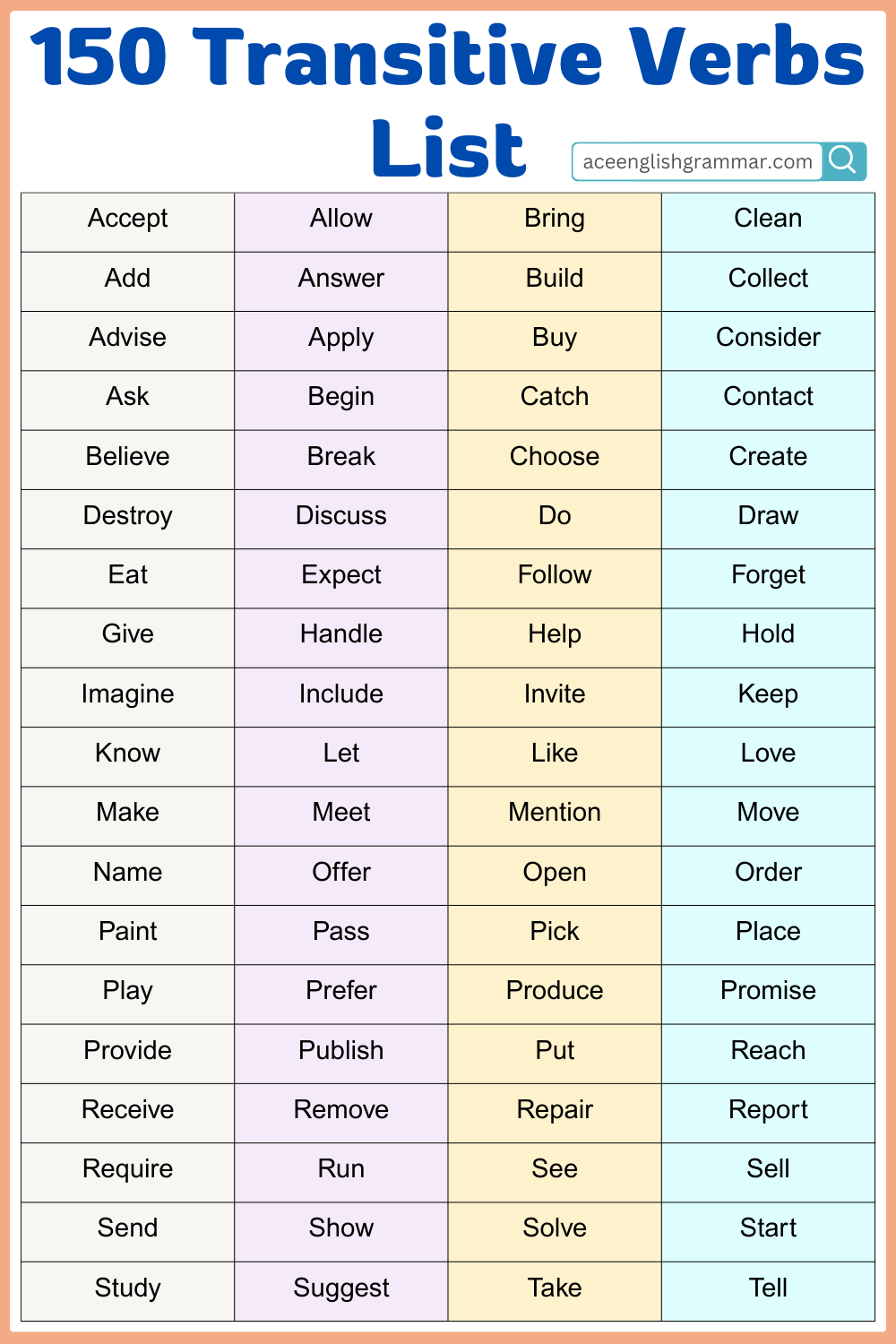
150 Transitive Verbs List in English
- Accept
- Add
- Advise
- Allow
- Answer
- Apply
- Ask
- Begin
- Believe
- Break
- Bring
- Build
- Buy
- Catch
- Choose
- Clean
- Collect
- Consider
- Contact
- Create
- Destroy
- Discuss
- Do
- Draw
- Eat
- Expect
- Follow
- Forget
- Give
- Handle
- Help
- Hold
- Imagine
- Include
- Invite
- Keep
- Know
- Let
- Like
- Love
- Make
- Meet
- Mention
- Move
- Name
- Offer
- Open
- Order
- Paint
- Pass
- Pick
- Place
- Play
- Prefer
- Produce
- Promise
- Provide
- Publish
- Put
- Reach
- Receive
- Remove
- Repair
- Report
- Require
- Run
- See
- Sell
- Send
- Show
- Solve
- Start
- Study
- Suggest
- Take
- Teach
- Tell
- Test
- Think
- Throw
- Use
- Visit
- Wait
- Want
- Watch
- Work
- Write
Everyday Transitive Verbs List for Daily Use
- Eat
- Drink
- Read
- Write
- Open
- Close
- Bring
- Take
- Buy
- Sell
- Cook
- Clean
- Wash
- Watch
- Listen
- Call
- Help
- Know
- Meet
- Love
- Like
- Hate
- Carry
- Wear
- Fix
- Hold
- Catch
- Drive
- Use
- Charge
Verbs That Can Be Both Transitive and Intransitive
| Verb | Transitive Example | Intransitive Example |
|---|---|---|
| Run | She ran the marathon. | He likes to run in the mornings. |
| Drive | She drove the car to the office. | He loves to drive fast. |
| Eat | They ate the pizza for dinner. | We like to eat together. |
| Play | He played the piano beautifully. | The children play in the park. |
| Read | I read a book yesterday. | She reads every day. |
Transitive Verbs List with Meanings
| Transitive Verb | Meaning |
|---|---|
| Accept | To receive something offered |
| Add | To combine or join with something else |
| Ask | To request information or action |
| Buy | To acquire something by paying for it |
| Catch | To seize or capture |
| Give | To transfer possession of something |
| Make | To create or form something |
| See | To perceive with the eyes |
| Send | To dispatch or deliver |
| Take | To acquire possession of something |
| Teach | To impart knowledge or skills |
| Write | To form letters, words, or symbols |
| Move | To change position or place |
| Open | To make accessible by removing a barrier |
| Love | To have strong affection for something |
| Call | To speak or shout to attract attention |
| Help | To assist or make easier |
| Find | To discover something |
| Watch | To observe something attentively |
| Run | To move swiftly on foot |
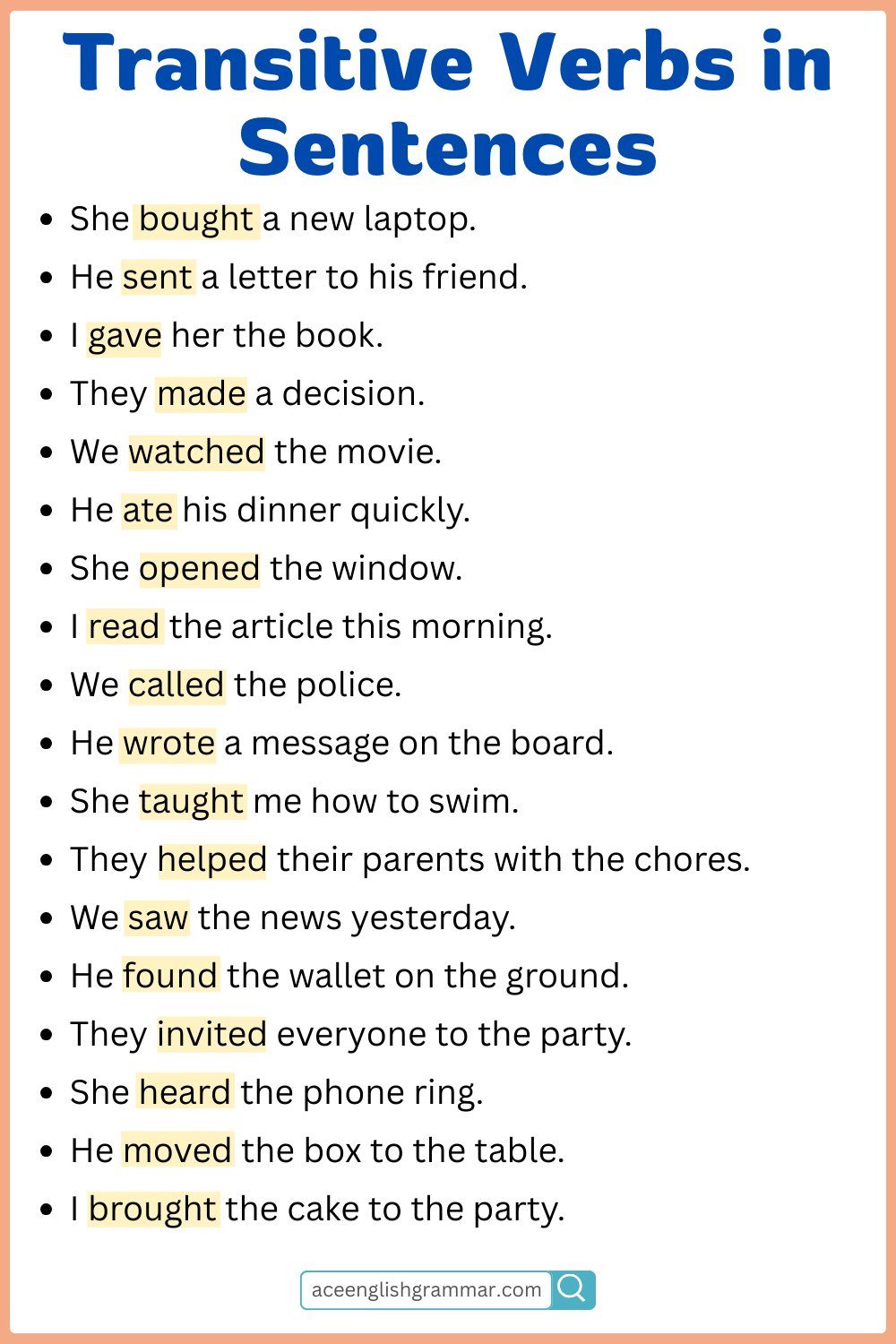
Transitive Verbs Used in Sentences
- She bought a new laptop.
- He sent a letter to his friend.
- I gave her the book.
- They made a decision.
- We watched the movie.
- He ate his dinner quickly.
- She opened the window.
- I read the article this morning.
- We called the police.
- He wrote a message on the board.
- She taught me how to swim.
- They helped their parents with the chores.
- We saw the news yesterday.
- He found the wallet on the ground.
- They invited everyone to the party.
- She heard the phone ring.
- He moved the box to the table.
- I brought the cake to the party.
- She loved her new dress.
- He played the guitar at the concert.
FAQs
A transitive verb is a verb that requires a direct object to complete its meaning, such as “give,” “see,” and “eat.”
No, not all verbs are transitive. Some verbs are intransitive, meaning they do not require a direct object, such as “sleep” or “arrive.”
Yes, some verbs can be used both transitively and intransitively, depending on the context. For example, “eat” can be transitive (“She ate the cake”) and intransitive (“She eats every morning”).
Twenty common transitive verbs list including words like eat, bring, take, give, write, read, make, find, buy, send, open, close, tell, ask, show, carry, wear, call, love, and help. These verbs always need a direct object to complete their meaning.
You might also like

Leave a Comment