
An Intransitive Verbs List is useful when you know what the verb is doing in the sentence. Verbs like sleep, arrive, happen, and rain do not need a direct object. You can write The baby slept, The train arrived, A problem happened, or It rained without adding something that receives the action.
Still, an intransitive sentence does not always stop at the verb. You may see extra details about place, time, direction, or manner. In She walked home, the word home tells direction. In He waited outside, the word outside tells place. Neither one is a direct object.
The key is to watch the sentence, not just the verb. Some verbs are usually intransitive, while others change use depending on what follows them.
What Is An Intransitive Verb?
An intransitive verb is a verb that does not take a direct object. The action or state stays with the subject instead of passing to another person or thing.
Examples
- She slept.
- The guests arrived.
- The flowers bloomed.
- It snowed.
- A problem occurred.
In each sentence, the verb makes sense without answering what? or whom? after it. Nothing receives the action.
Compare these two sentences:
- She slept peacefully.
- She slept the baby.
The first sentence works because peacefully tells how she slept. The second sentence does not work in normal English because sleep does not pass its action to a direct object in that meaning.
How To Identify An Intransitive Verb
The quickest test is to ask what? or whom? after the verb. If no direct answer makes sense, the verb is intransitive.
| Sentence | Question after the verb | Result |
|---|---|---|
| The child laughed. | Laughed what? | No direct object |
| The sun rose. | Rose what? | No direct object |
| They waited outside. | Waited what? | No direct object |
| She arrived early. | Arrived what? | No direct object |
Extra words after the verb do not automatically create an object. In They waited outside, the word outside tells where they waited. It does not receive the action.
Keep that test in mind as you read the verbs below. The verb matters, but the full sentence decides how the verb works.
Intransitive Verb Sentence Pattern
The basic intransitive sentence pattern is:
Subject + Intransitive Verb
Examples
- Birds fly.
- Babies cry.
- Rain falls.
- Flowers bloom.
- Time passes.
You can also add details after the verb:
Subject + Intransitive Verb + Extra Detail
Examples
- Birds fly south.
- Babies cry at night.
- Rain falls in winter.
- Flowers bloom in spring.
- Time passes quickly.
The extra detail adds meaning, but it does not turn the verb into a transitive verb.
Common Intransitive Verbs List
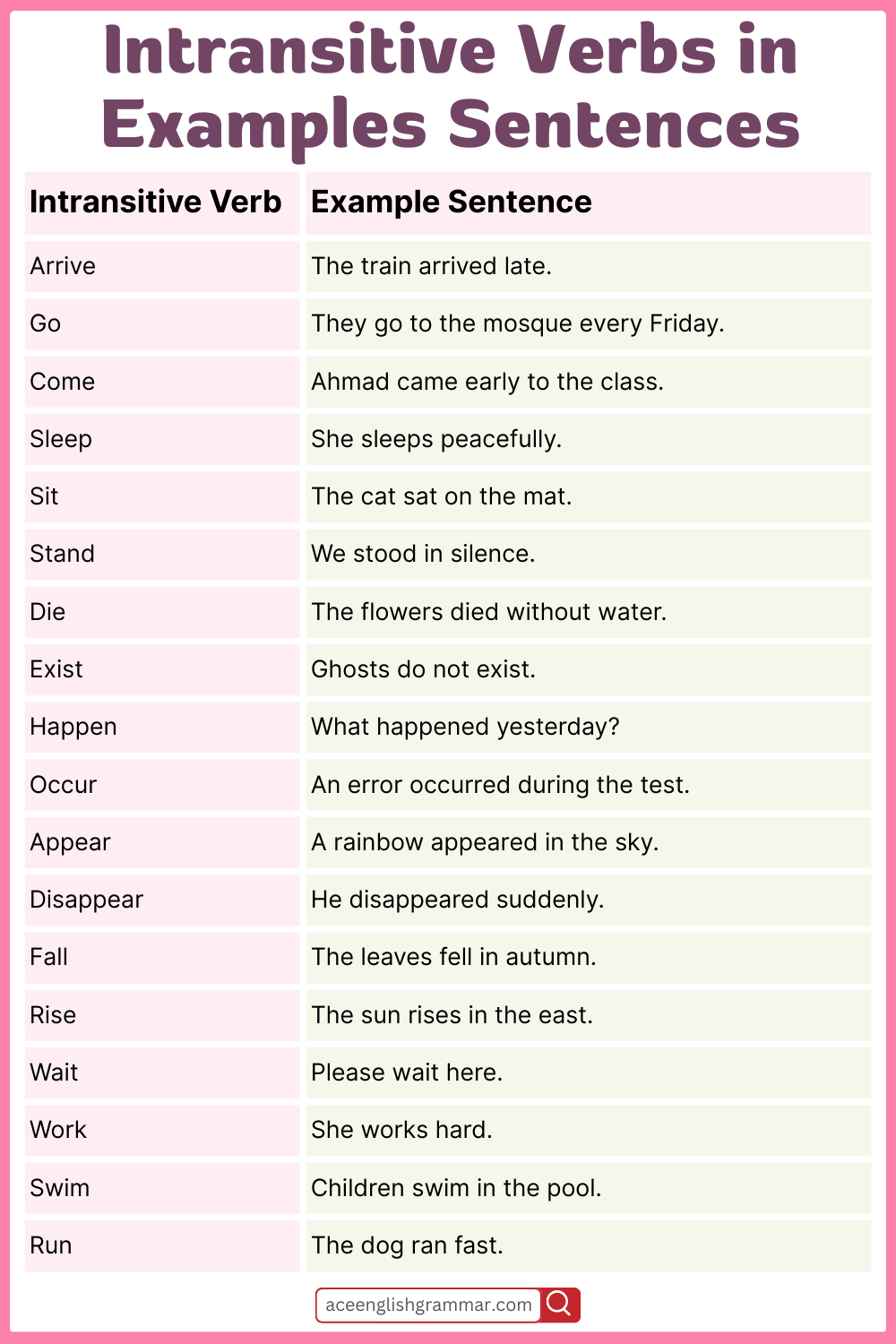
Many common intransitive verbs appear in short everyday sentences: She arrived, He smiled, It happened, and They waited. Some take extra details after them, but they still do not need a direct object.
| Verb | Verb | Verb |
|---|---|---|
| Arrive | Go | Come |
| Sleep | Sit | Stand |
| Die | Fall | Appear |
| Happen | Exist | Laugh |
| Cry | Depart | Run |
| Swim | Jump | Rise |
| Occur | Wait | Walk |
| Work | Grow | Resign |
| Respond | Stay | Lie |
| Live | Escape | Yawn |
| Hesitate | Wander | Travel |
| Vanish | Tremble | Bark |
| Cough | Snore | Protest |
| Explode | Smile | Faint |
| Retire | Collapse | Apologize |
| Disappear | Remain | Belong |
| Emerge | Fade | Float |
| Jog | Shout | Sneeze |
| Kneel | Reside | Revolve |
| Leak | Thrive | Relax |
| Drown | Age | Persist |
| Rain | Snow | Hail |
| React | Stumble | Itch |
| Proceed | Retreat | Shiver |
| March | Sneer | Drift |
| Advance | Last | Bloom |
Use the list as a starting point, then test the verb inside a sentence. If a direct object follows the verb, the sentence may be using that verb in a different way.
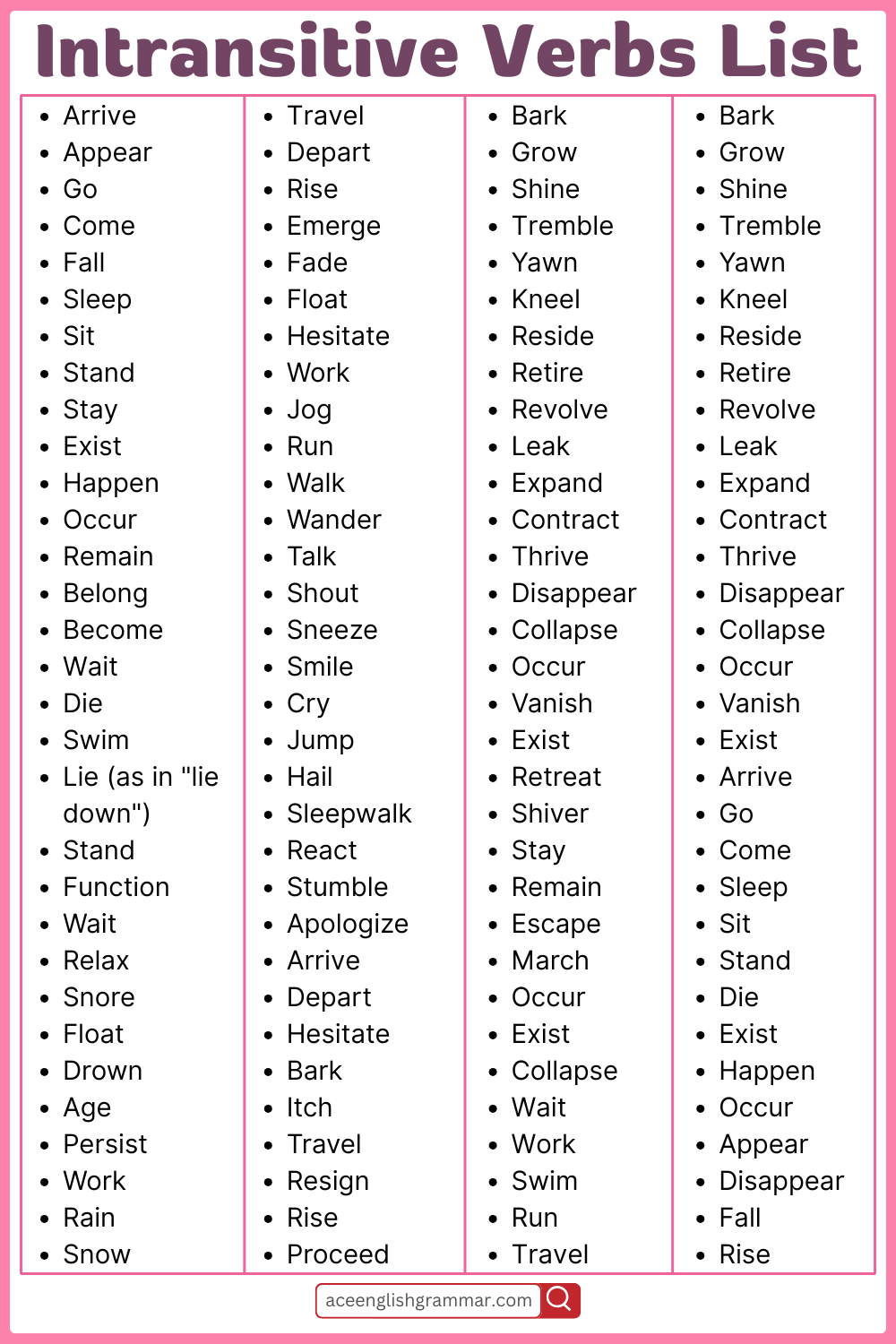
100 Intransitive Verbs In English
This larger Intransitive Verbs List gives more verbs that often stand without a direct object. Some verbs may also work transitively in other sentences, so always check the sentence pattern.
| Intransitive verbs | Intransitive verbs | Intransitive verbs |
|---|---|---|
| Arrive | Appear | Go |
| Come | Fall | Sleep |
| Sit | Stand | Stay |
| Exist | Happen | Occur |
| Remain | Belong | Wait |
| Die | Swim | Travel |
| Depart | Rise | Emerge |
| Fade | Float | Hesitate |
| Work | Jog | Run |
| Walk | Wander | Talk |
| Shout | Sneeze | Smile |
| Cry | Jump | Bark |
| Grow | Shine | Tremble |
| Yawn | Kneel | Reside |
| Retire | Revolve | Leak |
| Expand | Contract | Thrive |
| Disappear | Collapse | Vanish |
| Lie | Function | Relax |
| Snore | Drown | Age |
| Persist | Rain | Snow |
| Hail | Sleepwalk | React |
| Stumble | Apologize | Itch |
| Resign | Proceed | Retreat |
| Shiver | Escape | March |
| Cough | Sneer | Zoom |
| Drift | Advance | Last |
| Bloom | Glitter | Sparkle |
| Quake | Rust | Rot |
| Flow | Drizzle | Thunder |
| Storm | Freeze | Melt |
| Glow | Burn | Recover |
| Continue | Progress | Improve |
| Worsen | Return | Exit |
| Hop | Crawl | Climb |
| Slide | Flutter | Soar |
| Roar | Sigh | Whisper |
| Panic | Blush | Suffer |
| Succeed | Fail | Survive |
| Flourish | Linger | Pause |
A long verb table is easier to use when you notice what each verb describes. Some show movement, some show change, and others show weather, sound, body action, or reaction.
Intransitive Verbs By Meaning And Use
Intransitive verbs often become easier to recognize when you group them by meaning. The grammar stays the same: the verb does not send its action to a direct object.
Movement And Position Verbs
Movement verbs often show where someone or something goes, rises, falls, sits, or stands. The words after the verb usually tell place or direction.
Examples
- The train arrived late.
- She walked across the bridge.
- They ran toward the gate.
- The balloon floated away.
- He sat beside the window.
Notice that across the bridge, toward the gate, and beside the window give place or direction. They do not answer what? or whom?
| Verb | Example |
|---|---|
| Arrive | The guests arrived before dinner. |
| Go | They went home early. |
| Come | She came by bus. |
| Walk | He walked slowly. |
| Run | The dog ran outside. |
| Swim | We swam across the lake. |
| Travel | They traveled for weeks. |
| Fly | The plane flew low. |
| Crawl | The baby crawled under the table. |
| Jump | He jumped over the puddle. |
| Stand | They stood in silence. |
| Sit | She sat near the door. |
| Rise | Smoke rose from the fire. |
| Fall | Leaves fell everywhere. |
| Return | He returned yesterday. |
| Exit | The actor exited quietly. |
| Stumble | She stumbled on the path. |
| Float | The leaf floated downstream. |
| Drift | Clouds drifted across the sky. |
| Slide | The child slid down the hill. |
| Hop | The rabbit hopped away. |
| Jog | They jogged along the trail. |
| Climb | He climbed slowly. |
Time, Change, And State Verbs
Some intransitive verbs show what happens over time. A person grows, a color fades, a problem occurs, or a condition improves. Something changes, but no direct object receives the action.
Examples
- The child grew quickly.
- The meeting began late.
- The pain faded after an hour.
- The plan improved with time.
- The flowers bloomed in spring.
Change verbs can feel tricky because something is happening, but that does not mean the verb has an object. In The color faded, the color is the subject. Nothing receives the action after the verb.
| Verb | Example |
|---|---|
| Age | He aged well. |
| Die | The plant died in winter. |
| Occur | A mistake occurred. |
| Happen | Something happened outside. |
| Begin | The show began at eight. |
| End | The game ended suddenly. |
| Grow | The puppy grew fast. |
| Increase | Prices increased again. |
| Decrease | Attendance decreased this year. |
| Improve | Her health improved slowly. |
| Worsen | The weather worsened overnight. |
| Emerge | A new problem emerged. |
| Vanish | The sound vanished. |
| Appear | A rainbow appeared. |
| Fade | The color faded. |
| Evolve | The idea evolved over time. |
| Last | The storm lasted for hours. |
| Persist | The smell persisted all day. |
| Remain | He remained calm. |
| Stay | They stayed quiet. |
| Continue | The noise continued. |
| Progress | The work progressed slowly. |
| Recover | She recovered after rest. |
| Bloom | The roses bloomed early. |
Weather And Nature Verbs
Weather verbs are usually intransitive because the weather action does not pass to a direct object. Many of them use it as the subject, as in It rained or It snowed.
Examples
- It rained all night.
- It snowed for hours.
- Thunder roared above the hills.
- The river flooded after the storm.
- The ground froze overnight.
In weather sentences, it often fills the subject position. The verb still does not need an object after it.
| Verb | Example |
|---|---|
| Rain | It rained yesterday. |
| Snow | It snowed in the mountains. |
| Hail | It hailed after sunset. |
| Thunder | It thundered all evening. |
| Storm | It stormed through the night. |
| Freeze | The lake froze in January. |
| Melt | The ice melted by noon. |
| Shine | The sun shone brightly. |
| Glow | The coals glowed in the dark. |
| Erupt | The volcano erupted suddenly. |
| Quake | The ground quaked. |
| Tremble | The branches trembled in the wind. |
| Burn | The fire burned for hours. |
| Flow | The river flowed south. |
| Rust | The old gate rusted. |
| Rot | The fruit rotted in the heat. |
| Flood | The valley flooded after heavy rain. |
| Drizzle | It drizzled before dawn. |
| Sparkle | The water sparkled in sunlight. |
| Flutter | Leaves fluttered in the breeze. |
Sound, Reaction, And Body Verbs
Many sound and body-action verbs describe what the subject does. You can add where, when, or how the action happened, but the verb still does not need something to receive the action.
Examples
- The baby cried.
- They laughed loudly.
- He coughed during the speech.
- The dog barked at night.
- She smiled at the news.
In They laughed loudly, the word loudly tells how they laughed. It is not an object.
| Verb | Example |
|---|---|
| Laugh | They laughed together. |
| Cry | The child cried softly. |
| Bark | The dog barked outside. |
| Cough | He coughed again. |
| Snore | My uncle snored loudly. |
| Sneeze | She sneezed twice. |
| Smile | He smiled politely. |
| Yawn | The students yawned after lunch. |
| Shiver | She shivered in the cold. |
| Tremble | His hands trembled. |
| React | The crowd reacted quickly. |
| Apologize | He apologized after the meeting. |
| Protest | The workers protested peacefully. |
| Faint | She fainted in the hallway. |
| Kneel | He kneeled beside the chair. |
| Relax | They relaxed after dinner. |
| Sneer | He sneered at the remark. |
| Sigh | She sighed with relief. |
| Whisper | They whispered in the corner. |
| Panic | The crowd panicked suddenly. |
Intransitive Verbs Used In Sentences
Now apply the object test to full sentences. Some verbs stand alone, while others take time, place, direction, or manner details.
Verbs Standing Alone
These sentences end naturally after the verb because the subject and verb already make a full idea.
- The baby slept.
- The sun rose.
- The dog barked.
- The flowers bloomed.
- The guests arrived.
- The noise stopped.
Verbs With Time Details
Time words tell when or how long the action happened. They do not receive the action.
- He arrived late.
- The meeting began yesterday.
- It rained all night.
- The storm lasted for hours.
- She returned yesterday.
- The pain disappeared later.
Verbs With Place Or Direction
Place and direction phrases often come after intransitive verbs. They answer where? or where to?, not what? or whom?
- They went home early.
- She came by bus.
- I lay on the grass.
- The cat stumbled out of bed.
- The balloon floated away.
- Smoke drifted through the air.
Verbs With Manner Details
Manner words tell how the action happened. They describe the verb without creating a direct object.
- I walked slowly.
- He slept deeply.
- They laughed loudly.
- She climbed carefully.
- The light faded slowly.
- The crowd reacted strongly.
Verbs That Can Be Transitive Or Intransitive
Once the basic rule feels familiar, the next point is important: do not judge a verb from the word alone. Judge it from the sentence.
Some English verbs are intransitive in one sentence and transitive in another. A verb is intransitive when it has no direct object. The same verb becomes transitive when something receives the action.
| Verb | Intransitive use | Transitive use |
|---|---|---|
| Run | She runs every morning. | She runs a bakery. |
| Fly | Birds fly south. | He flew a kite. |
| Change | The weather changed. | She changed the plan. |
| Open | The door opened. | He opened the door. |
| Break | The glass broke. | She broke the glass. |
| Grow | The child grew quickly. | They grow tomatoes. |
| Melt | The snow melted. | Heat melted the snow. |
| Burn | The fire burned. | He burned the paper. |
| Improve | Her writing improved. | Practice improved her writing. |
| Stop | The car stopped. | She stopped the car. |
Look closely at The door opened and He opened the door. In the first sentence, the door is the subject, and nothing receives the action after the verb. In the second sentence, the door receives the action, so opened is transitive.
Common Mistakes With Intransitive Verbs
Most mistakes happen when a learner sees words after the verb and assumes one of them must be an object. The object test prevents that confusion.
Mistake 1: Treating A Prepositional Phrase As A Direct Object
In She walked across the road, the phrase across the road gives direction. It does not answer walked what? or walked whom?
Correct
- She walked across the road.
- They waited at the station.
- He slept on the sofa.
Mistake 2: Forcing Passive Voice With A Pure Intransitive Verb
Passive voice needs a direct object from the active sentence. Since arrive has no direct object in He arrived late, there is nothing to move into the subject position.
Incorrect
- The room was arrived by him.
- The event was happened yesterday.
Correct
- He arrived in the room.
- The event happened yesterday.
Mistake 3: Thinking Every Verb Has Only One Grammar Type
A verb can change use. Run is intransitive in He runs daily, but transitive in He runs a company. The sentence decides the verb type.
Mistake 4: Confusing Linking Verbs With Action Verbs
Linking verbs do not take direct objects, but they connect the subject to more information.
Examples
- She is tired.
- He became nervous.
- The soup smells fresh.
The words tired, nervous, and fresh describe the subject. They are not direct objects.
Quick Check For Intransitive Verbs
Use this short check when a sentence feels confusing:
- Find the verb.
- Ask what? or whom? after the verb.
- Look for a direct answer.
- If there is no direct object, the verb is intransitive.
- If the words after the verb show time, place, direction, or manner, they are extra details, not objects.
Example
The children played outside.
Ask: played what? There is no direct object. The word outside tells where they played, so played is intransitive in this sentence.
FAQs
An intransitive verb is a verb that does not take a direct object. It can stand with the subject and still express a full idea.
Examples
She slept.
The sun rose.
A problem occurred.
Ten common intransitive verbs are:
Arrive
Sleep
Go
Come
Happen
Occur
Die
Laugh
Wait
Rain
Yes. Some verbs work both ways.
Examples
She runs every morning.
She runs a business.
In the first sentence, runs has no direct object. In the second sentence, a business receives the action.
No. Pure intransitive verbs do not form normal passive sentences because they have no direct object.
Correct
He arrived late.
The accident happened yesterday.
Incorrect
Late was arrived by him.
Yesterday was happened by the accident.
Yes, linking verbs are often treated as intransitive because they do not take direct objects. They connect the subject to a description, name, or condition.
Examples
She seems tired.
He became quiet.
The room feels warm.
Find the verb and ask what? or whom? after it. If the question has no direct answer, the verb is intransitive.
Example
The dog barked loudly.
Ask: barked what? There is no direct object, so barked is intransitive.
Yes. Go is usually intransitive.
Examples
They went home.
She goes to school.
We went outside.
The words after go show place or direction, not a direct object.
Yes. Sleep is intransitive in normal use.
Examples
The baby slept.
He slept well.
They slept in the guest room.
A transitive verb takes a direct object. An intransitive verb does not.
Examples
She opened the window.
The window opened.
In the first sentence, the window receives the action. In the second sentence, the window is the subject, and no object follows the verb.
You might also like

Leave a Comment