A phrasal verb is a verb combined with an adverb or a preposition to form a meaning that differs from the verb alone.
In a list of phrasal verbs, each verb is paired with a meaning and an example sentence, as in “give up”, which means to stop trying. Reading the verb in a sentence and then writing one of your own is how the meaning and the correct particle are learned.
What Are Phrasal Verbs?
A phrasal verb is a verb combined with an adverb or a preposition, called the particle, to form a new meaning. In “The meeting was called off”, the phrasal verb “call off” expresses cancellation, and the meaning is not derived from “call” or “off” alone.
Phrasal verbs are the standard vocabulary of spoken English, so a list of phrasal verbs is a working tool for speaking and listening. The full grammar of the form is covered in phrasal verbs in English.
- She looks after her grandmother.
- The plane took off at six.
- Please fill in the form.
A to Z List of Phrasal Verbs
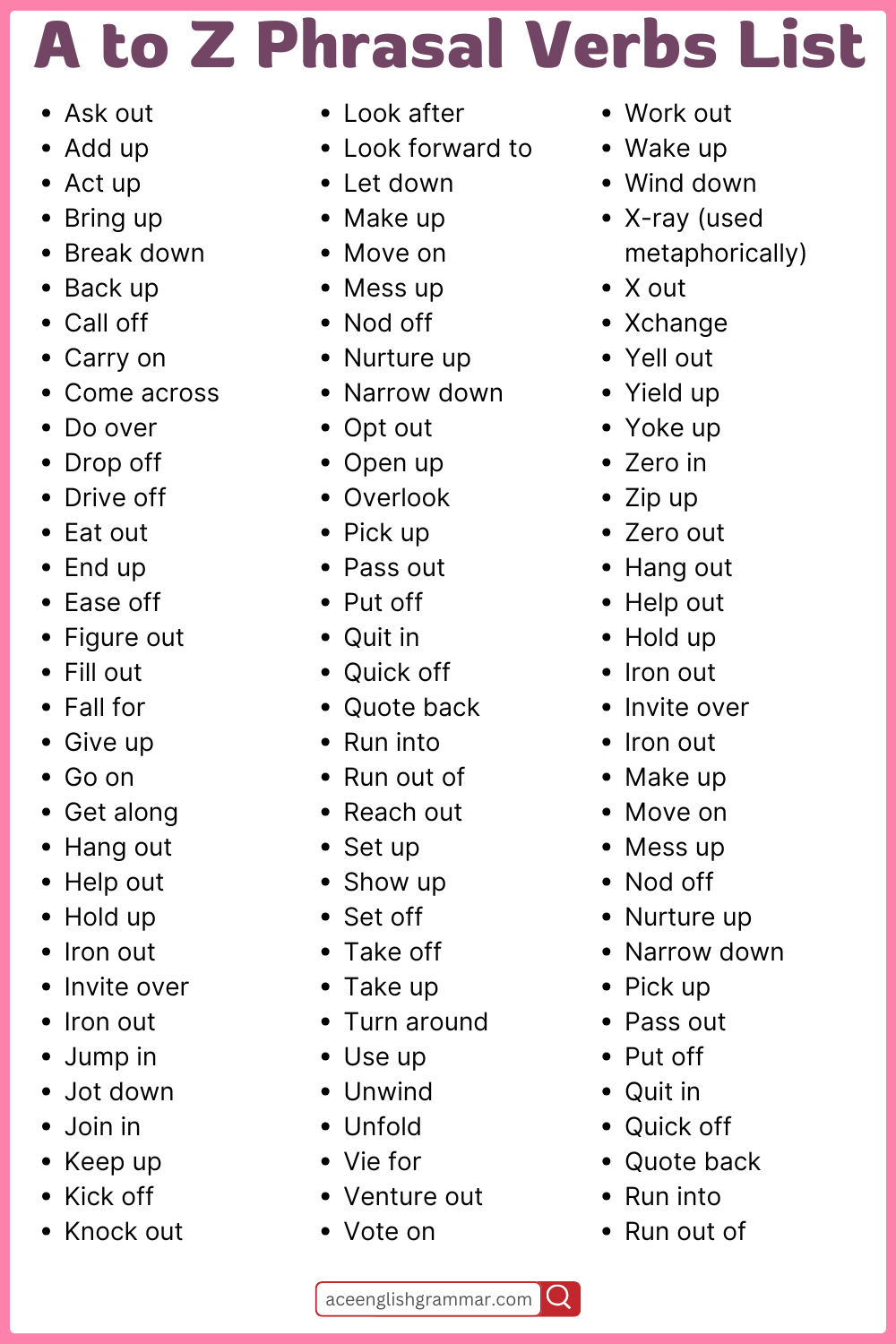
Each phrasal verb is paired with its meaning and a sample sentence.
Phrasal Verbs That Start With A
| Phrasal verb | Meaning | Sentence |
|---|---|---|
| Act up | Malfunction or misbehave | The old engine acted up on the hill. |
| Add up | Total or make sense | The costs added up to two hundred dollars. |
| Ask out | Invite on a date | He asked her out to dinner. |
Phrasal Verbs That Start With B
| Phrasal verb | Meaning | Sentence |
|---|---|---|
| Back up | Save a copy or support | Please back up your files. |
| Blow up | Explode | The balloon blew up. |
| Break down | Stop working | Our car broke down on the highway. |
| Bring up | Raise a topic | She brought up the budget at the meeting. |
Phrasal Verbs That Start With C
| Phrasal verb | Meaning | Sentence |
|---|---|---|
| Call off | Cancel | They called off the match. |
| Calm down | Become relaxed | Calm down and breathe slowly. |
| Carry on | Continue | Carry on with your work. |
| Check in | Register on arrival | We checked in at noon. |
| Cheer up | Become happier | A phone call cheered her up. |
| Come across | Find by chance | I came across an old photo. |
| Cut down | Reduce | He cut down on sugar. |
Phrasal Verbs That Start With D
| Phrasal verb | Meaning | Sentence |
|---|---|---|
| Deal with | Handle | The manager dealt with the complaint. |
| Dress up | Wear formal clothes | They dressed up for the wedding. |
| Drop off | Deliver | I dropped off the parcel. |
Phrasal Verbs That Start With E
| Phrasal verb | Meaning | Sentence |
|---|---|---|
| Eat out | Dine at a restaurant | We eat out on Fridays. |
| Eat up | Finish all the food | Eat up before it gets cold. |
| End up | Reach a final situation | He ended up in Dubai. |
Phrasal Verbs That Start With F
| Phrasal verb | Meaning | Sentence |
|---|---|---|
| Fall apart | Break into pieces | The old chair fell apart. |
| Figure out | Solve or understand | I figured out the answer. |
| Fill in | Complete a form | Fill in your name and address. |
| Find out | Discover | She found out the truth. |
Phrasal Verbs That Start With G
| Phrasal verb | Meaning | Sentence |
|---|---|---|
| Get along | Be on friendly terms | The two sisters get along well. |
| Give up | Stop trying | Never give up on your goals. |
| Go on | Continue | The show went on after the storm. |
| Grow up | Become an adult | He grew up in Lahore. |
Phrasal Verbs That Start With H
| Phrasal verb | Meaning | Sentence |
|---|---|---|
| Hand in | Submit | Hand in your essays on Monday. |
| Hang out | Spend time socially | We hang out after class. |
| Hold on | Wait | Hold on a minute. |
| Hurry up | Move faster | Hurry up or we will miss the bus. |
Phrasal Verbs That Start With I, J
| Phrasal verb | Meaning | Sentence |
|---|---|---|
| Invite over | Ask to visit a home | She invited us over for tea. |
| Iron out | Resolve small problems | We ironed out the details. |
| Join in | Take part | Everyone joined in the chorus. |
| Jot down | Write quickly | Jot down the number. |
Phrasal Verbs That Start With K
| Phrasal verb | Meaning | Sentence |
|---|---|---|
| Keep up | Maintain the pace | Keep up the good work. |
| Kick off | Begin | The festival kicks off on Friday. |
| Knock out | Eliminate from a contest | The underdogs knocked out the champions. |
Phrasal Verbs That Start With L
| Phrasal verb | Meaning | Sentence |
|---|---|---|
| Let down | Disappoint | He let me down. |
| Log in | Enter a system | Log in with your password. |
| Look after | Take care of | She looks after her brother. |
| Look up | Search for information | Look up the word in a dictionary. |
Phrasal Verbs That Start With M
| Phrasal verb | Meaning | Sentence |
|---|---|---|
| Make up | Invent | He made up an excuse. |
| Mix up | Confuse | I mixed up the two names. |
| Move on | Proceed to the next stage | Let us move on to the next question. |
Phrasal Verbs That Start With N, O
| Phrasal verb | Meaning | Sentence |
|---|---|---|
| Narrow down | Reduce the choices | We narrowed down the list to three. |
| Nod off | Fall asleep | He nodded off during the film. |
| Open up | Become willing to talk | He opened up about his fear. |
| Opt out | Choose not to take part | Several customers opted out of the plan. |
| Own up | Admit | She owned up to the mistake. |
Phrasal Verbs That Start With P
| Phrasal verb | Meaning | Sentence |
|---|---|---|
| Pass out | Faint | She passed out in the heat. |
| Pay back | Repay | I will pay you back on Monday. |
| Pick up | Collect | Pick up the tickets at the desk. |
| Point out | Draw attention to | He pointed out the error. |
| Put off | Postpone | They put off the trip. |
| Put on | Wear | Put on your coat. |
Phrasal Verbs That Start With Q, R
| Phrasal verb | Meaning | Sentence |
|---|---|---|
| Queue up | Form a line | Fans queued up outside the gate. |
| Quiet down | Become less noisy | The class quieted down. |
| Round up | Gather or approximate | The teacher rounded up the students. |
| Rule out | Exclude | Doctors ruled out an infection. |
| Run out | Be used up | We ran out of milk. |
Phrasal Verbs That Start With S
| Phrasal verb | Meaning | Sentence |
|---|---|---|
| Set up | Establish | They set up a company. |
| Show off | Display proudly | He showed off his new watch. |
| Shut down | Stop operating | The factory shut down. |
| Sign up | Enroll | I signed up for the course. |
| Sort out | Resolve | We sorted out the problem. |
| Stand out | Be noticeable | Her red coat stood out. |
Phrasal Verbs That Start With T
| Phrasal verb | Meaning | Sentence |
|---|---|---|
| Take off | Leave the ground | The plane took off. |
| Throw away | Discard | Do not throw away the receipt. |
| Try on | Test clothes | Try on the jacket. |
| Turn down | Reject | She turned down the offer. |
| Turn off | Switch off | Turn off the lights. |
Phrasal Verbs That Start With U, V
| Phrasal verb | Meaning | Sentence |
|---|---|---|
| Use up | Consume completely | We used up all the paper. |
| Usher in | Introduce a new period | The invention ushered in a new era. |
| Veg out | Relax without effort | We vegged out in front of the television. |
| Vote down | Reject by voting | The council voted down the plan. |
Phrasal Verbs That Start With W
| Phrasal verb | Meaning | Sentence |
|---|---|---|
| Wake up | Stop sleeping | I wake up at six. |
| Warm up | Prepare for exercise | Warm up before the run. |
| Wear out | Become unusable from use | My shoes wore out. |
| Work out | Exercise or solve | He works out every morning. |
| Write down | Record on paper | Write down the address. |
Phrasal Verbs That Start With X, Y
| Phrasal verb | Meaning | Sentence |
|---|---|---|
| X out | Cross out with an X | Please X out the wrong answer. |
| Yank out | Pull sharply | She yanked out the weed. |
| Yell out | Shout loudly | He yelled out a warning. |
Phrasal Verbs That Start With Z
| Phrasal verb | Meaning | Sentence |
|---|---|---|
| Zip up | Close with a zipper | Zip up your jacket. |
| Zone out | Stop paying attention | I zoned out during the lecture. |
| Zoom in | Magnify a view | Zoom in on the map. |
List of Phrasal Verbs by Base Verb
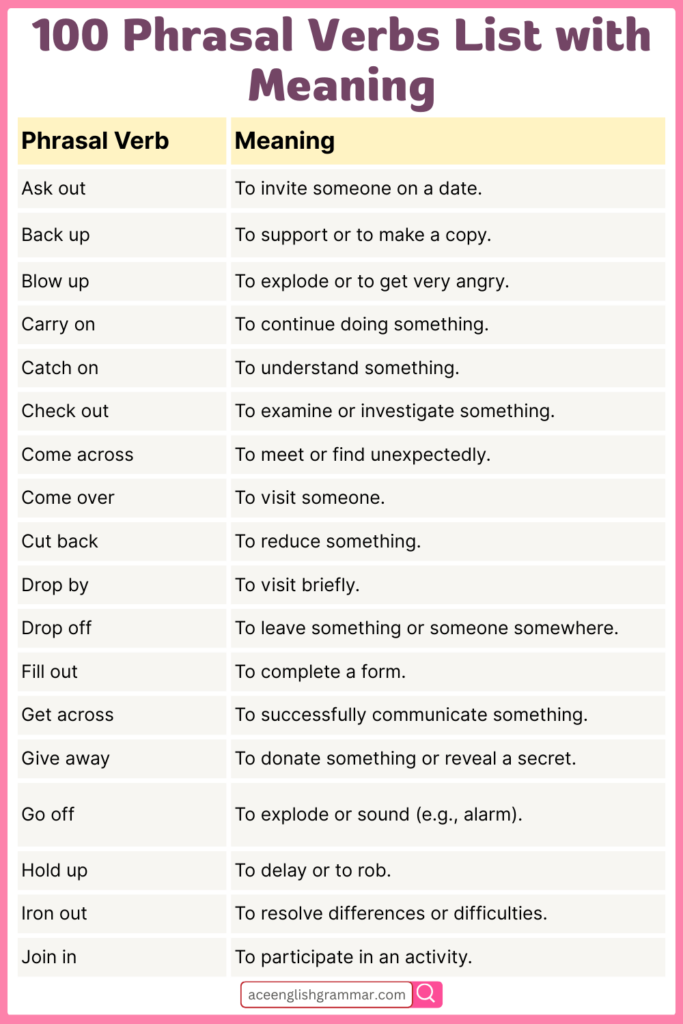
A base verb forms many phrasal verbs, and a different meaning is formed with each particle. The groups for “get”, “take” and “go” are the largest, and “come”, “look” and “put” follow.
Phrasal Verbs With Get
| Phrasal verb | Meaning | Sentence |
|---|---|---|
| Get away | Escape | The thief got away. |
| Get back | Return | We got back at midnight. |
| Get by | Manage with little | She gets by on a small salary. |
| Get on | Board a vehicle | They got on the train. |
| Get over | Recover from | He got over the flu. |
| Get through | Finish or survive | I got through the exam. |
Phrasal Verbs With Take
| Phrasal verb | Meaning | Sentence |
|---|---|---|
| Take after | Resemble a relative | She takes after her mother. |
| Take apart | Separate into pieces | He took apart the clock. |
| Take in | Absorb or deceive | The story took everyone in. |
| Take on | Accept a task | She took on extra work. |
| Take over | Assume control | A new manager took over. |
| Take up | Begin a hobby | I took up painting. |
Phrasal Verbs With Go
| Phrasal verb | Meaning | Sentence |
|---|---|---|
| Go ahead | Proceed | Go ahead and start. |
| Go back | Return | We went back to the hotel. |
| Go off | Explode or ring | The alarm went off. |
| Go out | Leave home for fun | They go out every weekend. |
| Go over | Review | Go over your notes tonight. |
| Go through | Experience or examine | She went through a hard year. |
Phrasal Verbs With Come
| Phrasal verb | Meaning | Sentence |
|---|---|---|
| Come back | Return | Come back soon. |
| Come down with | Fall ill with | He came down with a cold. |
| Come in | Enter | Please come in. |
| Come out | Be published or appear | The book came out in May. |
| Come over | Visit | Come over for dinner. |
| Come up with | Think of | She came up with a plan. |
Phrasal Verbs With Look
| Phrasal verb | Meaning | Sentence |
|---|---|---|
| Look around | Examine a place | We looked around the shop. |
| Look for | Search | I am looking for my keys. |
| Look forward to | Anticipate with pleasure | I look forward to the trip. |
| Look into | Investigate | Police are looking into the case. |
| Look out | Be careful | Look out for the step. |
| Look over | Check quickly | Look over the report before lunch. |
Phrasal Verbs With Put
| Phrasal verb | Meaning | Sentence |
|---|---|---|
| Put away | Store | Put away your toys. |
| Put down | Place on a surface | She put down the cup. |
| Put forward | Propose | He put forward a new idea. |
| Put out | Extinguish | Firefighters put out the blaze. |
| Put together | Assemble | We put together the desk. |
| Put up with | Tolerate | I cannot put up with the noise. |
List of Business Phrasal Verbs
Phrasal verbs for planning, reporting and management are used in the workplace.
| Phrasal verb | Meaning | Sentence |
|---|---|---|
| Buy out | Purchase full ownership | The firm bought out its rival. |
| Carry out | Perform | The team carried out the survey. |
| Cut back | Reduce spending | The company cut back on travel. |
| Draw up | Prepare a document | The lawyer drew up the contract. |
| Follow up | Contact again | I will follow up with the client. |
| Phase out | Remove in stages | The bank phased out paper checks. |
| Roll out | Launch | They rolled out the new app. |
| Scale up | Expand | The startup scaled up production. |
| Step down | Resign from a position | The director stepped down in June. |
| Wrap up | Finish | Let us wrap up the meeting. |
List of Separable and Inseparable Phrasal Verbs
The position of the object depends on whether the phrasal verb is separable or inseparable. A pronoun is always placed between the verb and the particle of a separable verb, as in “turn it off”.
Separable Phrasal Verbs
Verb + object + particle
The particle is also placed before a noun object, so both “She turned the radio off” and “She turned off the radio” are correct. A pronoun is placed in one position only.
| Phrasal verb | Noun object | Pronoun |
|---|---|---|
| Fill in | Fill in the form. | Fill it in. |
| Hand in | Hand in your essay. | Hand it in. |
| Pick up | Pick up the keys. | Pick them up. |
| Put on | Put on your coat. | Put it on. |
| Throw away | Throw away the box. | Throw it away. |
| Try on | Try on the shoes. | Try them on. |
| Turn off | Turn off the lights. | Turn them off. |
| Write down | Write down the address. | Write it down. |
- ✅ Pick it up.
- ❌ Pick up it.
Inseparable Phrasal Verbs
Verb + particle + object
The object always follows the particle, so “She looks after the children” is correct and “She looks the children after” is not.
| Phrasal verb | Sentence |
|---|---|
| Come across | I came across an old letter. |
| Come up with | She came up with a solution. |
| Deal with | He deals with every complaint. |
| Get over | They got over the delay. |
| Look after | Neighbors look after the garden. |
| Look forward to | I look forward to the holiday. |
| Put up with | We put up with the noise. |
| Run into | I ran into an old friend. |
- ✅ I ran into an old friend.
- ❌ I ran an old friend into.
List of Phrasal Verbs Exercises
Complete each sentence or choose the correct form.
- Complete the sentence with a phrasal verb: Please ____ your shoes before entering. (take off / take after)
- Choose the correct order: She (picked it up / picked up it).
- Choose the correct order: I (looked the word up / looked up the word).
- Correct the sentence: She gave smoking last year.
- Replace “put off” with a single verb: They put off the wedding.
- Is “get over” separable or inseparable: She got over the flu?
- Complete the sentence: The alarm ____ at six. (went off / went over)
- Choose the correct form: We ran (out of / out) coffee.
- Is “come across” separable or inseparable: I came across an old photo?
- Replace “carry out” with a single verb: The team carried out the test.
Answers:
- Take off: it means to remove clothing.
- Picked it up: a pronoun is placed between the verb and the particle.
- Both are correct, because “look up” is separable and the object is a noun.
- She gave up smoking last year: the particle “up” is required.
- Postponed.
- Inseparable: the object follows “over”.
- Went off: it expresses ringing.
- Out of: “run out of” is the full phrasal verb.
- Inseparable: the object follows “across”.
- Performed.
FAQs
Q1. What are phrasal verbs?
Phrasal verbs are verbs combined with an adverb or a preposition to form a new meaning, as in “give up”, “turn off” and “look after”. The meaning of the whole differs from the meaning of the verb alone.
Q2. How many phrasal verbs are there in English?
No exact count exists, because new phrasal verbs enter English continually. The common ones number in the hundreds, and the full total is several thousand.
Q3. Are phrasal verbs formal or informal?
Yes, in register. Phrasal verbs are standard in speech and everyday writing, and formal reports replace many of them with single verbs, as in “postpone” for “put off”.
Q4. Are all phrasal verbs separable?
No. Only phrasal verbs with an object, such as “turn off” and “hand in”, are separable, while “look after” is inseparable and “take off” is used without an object.
Q5. What is the difference between a phrasal verb and an idiom?
The difference is that a phrasal verb is built from a verb and a particle, while an idiom is a fixed expression of any form. “Give up” is a phrasal verb, and “break the ice” is an idiom.
Q6. Which base verbs form the most phrasal verbs?
The base verbs “get”, “take” and “go” form the largest groups of phrasal verbs. “Come”, “look” and “put” follow closely.
Q7. How do you identify a phrasal verb?
The test is whether the two words are replaced by one verb with the same meaning, as “give up” is replaced by “quit” and “turn down” by “reject”. A verb that keeps its own meaning before a preposition, as “looked” does in “She looked at the sky”, is not a phrasal verb.
Read More