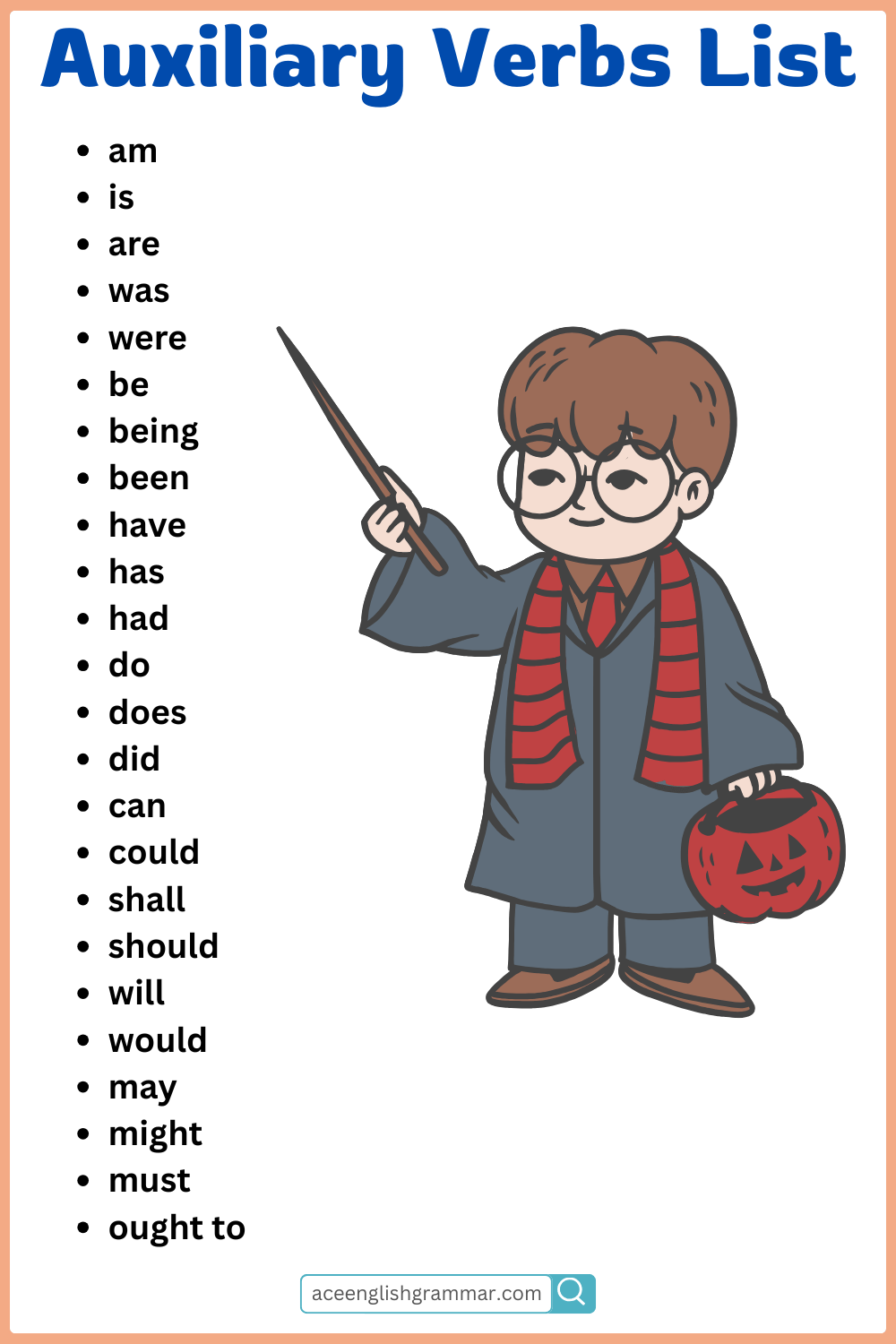
The auxiliary verbs list contains 24 forms, and each one goes in front of a main verb to build a tense, a question, a negative, or a passive. All 24 belong to just twelve verbs, because be alone has eight forms. Have has four forms, do has three, and the nine modals have one each.
Auxiliary Verbs List With All 24 Forms
Twelve verbs produce these 24 forms, because be alone contributes eight of them. The forms split into two groups: the primary auxiliaries be, have, and do, which change for person and tense, and the nine modals, which never change at all.
| No. | Form | Base verb | Function | Example |
|---|---|---|---|---|
| 1 | Am | Be | Continuous | I am working. |
| 2 | Is | Be | Continuous, passive | She is reading. |
| 3 | Are | Be | Continuous, passive | They are waiting. |
| 4 | Was | Be | Past continuous, passive | He was driving. |
| 5 | Were | Be | Past continuous, passive | We were told. |
| 6 | Be | Be | After a modal | It will be done. |
| 7 | Being | Be | Passive continuous | It is being repaired. |
| 8 | Been | Be | Perfect | She has been ill. |
| 9 | Have | Have | Present perfect | I have finished. |
| 10 | Has | Have | Present perfect | He has left. |
| 11 | Had | Have | Past perfect | They had gone. |
| 12 | Having | Have | Participle phrase | Having eaten, we left. |
| 13 | Do | Do | Questions, negatives | Do you agree? |
| 14 | Does | Do | Questions, negatives | She does not smoke. |
| 15 | Did | Do | Past questions, negatives | Did he call? |
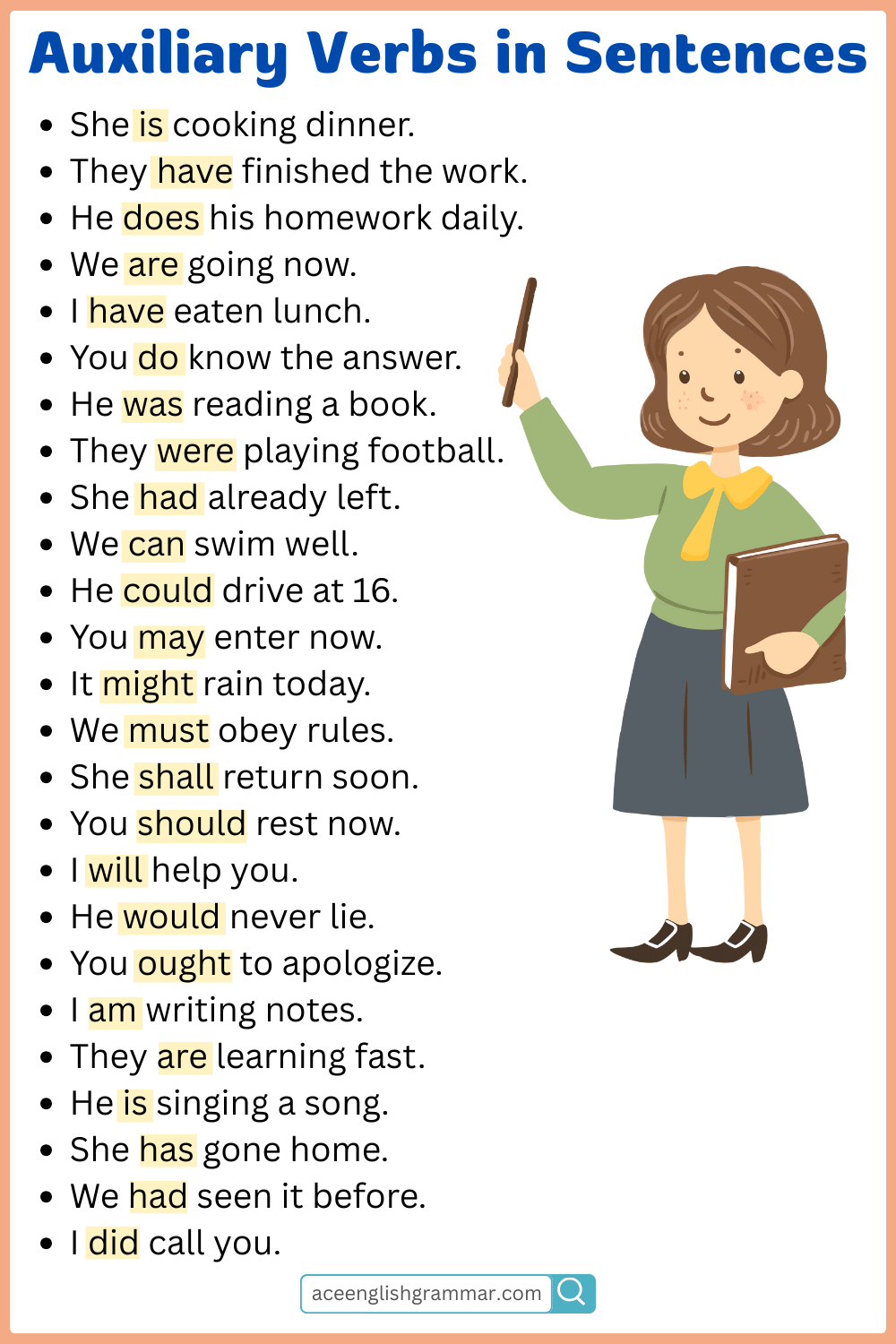
| 16 | Can | Modal | Ability, permission | She can swim. |
| 17 | Could | Modal | Past ability, requests | Could you help? |
| 18 | May | Modal | Permission, possibility | You may go. |
| 19 | Might | Modal | Weaker possibility | It might rain. |
| 20 | Must | Modal | Obligation, deduction | You must sign. |
| 21 | Shall | Modal | Offers, formal future | Shall I begin? |
| 22 | Should | Modal | Advice, expectation | You should rest. |
| 23 | Will | Modal | Future, willingness | She will come. |
| 24 | Would | Modal | Conditional, politeness | I would agree. |
Note that no form here stands as the whole verb of a clause. “She is writing” needs both words, and removing either one leaves the sentence incomplete.
Auxiliary Verbs From A To Z
The same 24 forms in alphabetical order, for looking up one verb rather than reading the set.
| Letter | Auxiliary verbs |
|---|---|
| A | Am, are |
| B | Be, been, being |
| C | Can, could |
| D | Did, do, does |
| H | Had, has, have, having |
| I | Is |
| M | May, might, must |
| S | Shall, should |
| W | Was, were, will, would |
Note that D and H each hold the forms of a single base verb. The three beginning with D are all forms of do, and the four beginning with H are all forms of have.
Primary Auxiliary Verbs
Be, have, and do are the primary auxiliaries, and each also works as an ordinary main verb. A second verb marks the difference: where one follows and the first supports it, the first is an auxiliary.
- She has a headache. (main verb, meaning suffers from)
- She has taken an aspirin. (auxiliary, supporting taken)
Forms Of Be
Be takes eight forms and builds two structures: the continuous tenses, with a present participle after it, and the passive voice, with a past participle.
| Form | Subject | Structure | Example |
|---|---|---|---|
| Am | Singular, first person | Present continuous | I am studying. |
| Is | Singular, third person | Present continuous | She is studying. |
| Are | Plural, and you | Present continuous | They are studying. |
| Was | Singular | Past continuous | He was sleeping. |
| Were | Plural, and you | Past continuous | They were sleeping. |
| Be | Any | After a modal | It will be checked. |
| Being | Any | Passive continuous | The road is being resurfaced. |
| Been | Any | After have, has, or had | I have been waiting. |
Note that be and been never appear alone. Be follows a modal and been follows a form of have, so each needs a second auxiliary in front of it.
Forms Of Have
Have takes four forms. Three build the perfect tenses with a past participle after them, while having opens a participle phrase instead.
| Form | Subject | Structure | Example |
|---|---|---|---|
| Have | Plural, I, and you | Present perfect | We have arrived. |
| Has | Singular, third person | Present perfect | He has resigned. |
| Had | Any | Past perfect | She had already eaten. |
| Having | Any | Participle phrase | Having eaten, we left. |
Note that the participle after have never changes for person or number. We say “He has gone” and “They have gone,” where only the auxiliary shifts.
Forms Of Do
Do supplies an auxiliary where the sentence has none. “She smokes” has nothing to move or negate, so the question and negative forms borrow do to fill that position.
| Form | Subject | Use | Example |
|---|---|---|---|
| Do | Plural, I, and you | Question or negative | Do they know? |
| Does | Singular, third person | Question or negative | She does not agree. |
| Did | Any | Past tense | Did you finish? |
Compare:
- ✓ Did she go? ✗ Did she went?
- ✓ Is she coming? ✗ Does she be coming?
Note that do takes the tense once borrowed, so the main verb returns to its base form. Do never appears beside another auxiliary, since be, have, and the modals already fill that position.
Modal Auxiliary Verbs
The nine modals mark the speaker’s attitude to an action rather than its timing. Each takes the bare infinitive, so no “to” follows it and no -s is added in the third person.
| Modal | Meaning | Example | Related form |
|---|---|---|---|
| Can | Ability, permission | She can drive. | Could |
| Could | Past ability, polite request | Could you wait? | None |
| May | Permission, possibility | You may sit. | Might |
| Might | Weaker possibility | He might agree. | None |
| Must | Obligation, deduction | You must stop. | Had to |
| Shall | Offer, formal future | Shall we start? | Should |
| Should | Advice, expectation | You should apply. | None |
| Will | Future, willingness | They will arrive. | Would |
| Would | Conditional, politeness | I would prefer tea. | None |
Compare:
- ✓ She can drive. ✗ She cans drive.
- ✓ He must leave. ✗ He must to leave.
Note that the pairs in the last column are not past tenses in the ordinary sense. “She could swim” reports a past ability, while “Could you wait” makes a present request. The full range of meanings belongs with modal and auxiliary verbs.
Having And The Two Counts
Dropping having from the list leaves the shorter count of 23. Have, has, and had each build a perfect tense, while having builds none and opens a participle phrase instead.
- Having finished the report, she went home.
- Having been warned, he said nothing.
| Count | What it includes |
|---|---|
| 24 | All four forms of have, including having |
| 23 | Leaves having out, since it forms no tense |
Note that both totals cover the same verbs, so neither is an error. Pick one convention and hold to it through a document.
Semi-Modal Verbs Outside The List
Five verbs carry modal meanings while breaking at least one modal pattern, which keeps them off the list of 24.
| Semi-modal | Pattern break | Example |
|---|---|---|
| Ought to | Takes “to” before the infinitive | You ought to apologise. |
| Used to | Takes “to”, and past reference only | She used to cycle. |
| Need | Auxiliary only in negatives and questions | You needn’t wait. |
| Dare | Same restricted pattern | How dare you. |
| Had better | Two words in a fixed form | You had better hurry. |
Note that need and dare also work as ordinary main verbs, taking “to” and adding -s. “She needs to leave” is the main-verb pattern; “She needn’t leave” is the auxiliary one.
Auxiliary Verbs By Tense And Voice
Each tense draws on a fixed auxiliary, so the list doubles as a map of the tense system. The auxiliary marks the tense while the main verb keeps its participle form unchanged.
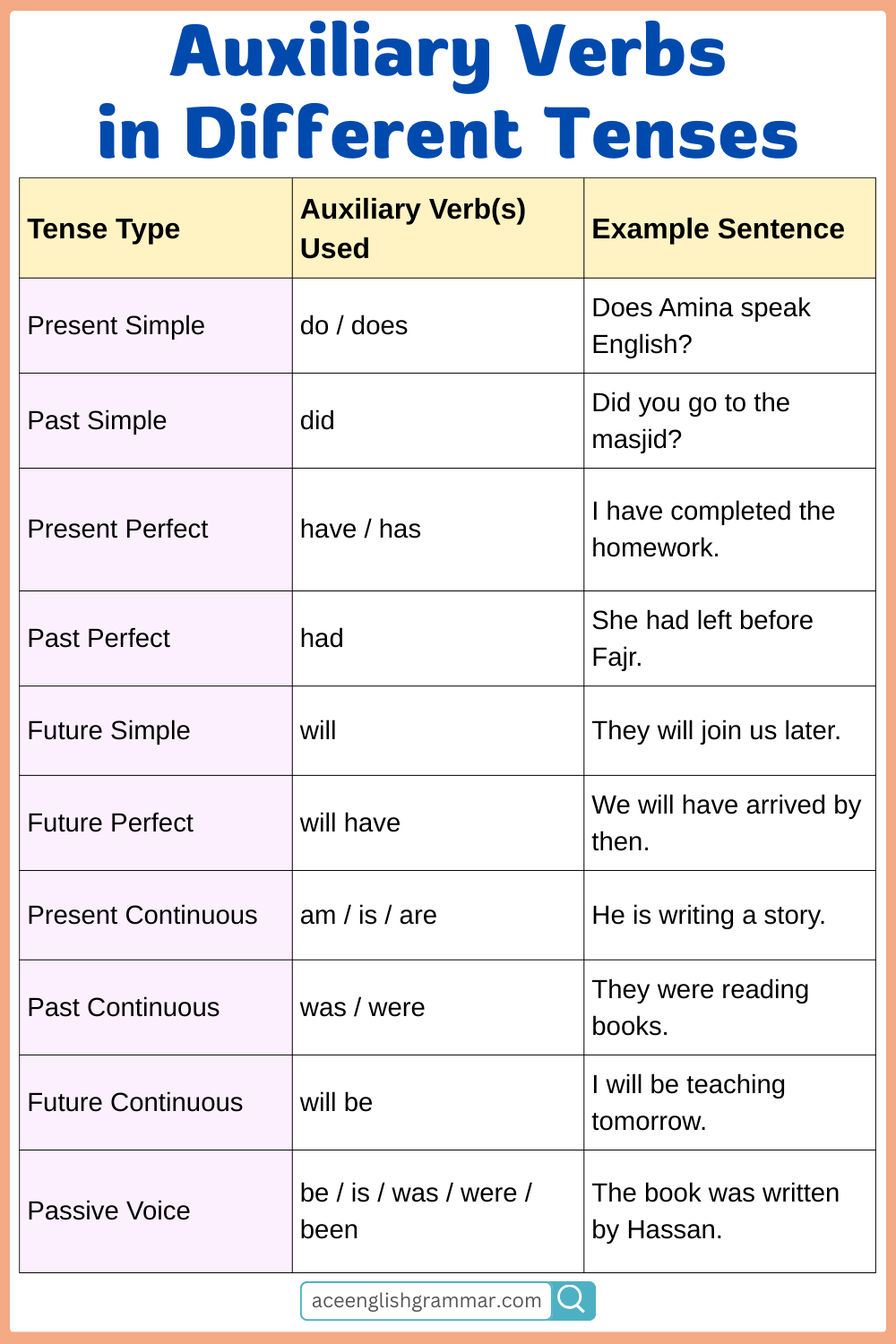
| Structure | Auxiliary | Example |
|---|---|---|
| Present continuous | Am, is, are | She is reading. |
| Past continuous | Was, were | They were sleeping. |
| Present perfect | Have, has | I have finished. |
| Past perfect | Had | He had left. |
| Perfect continuous | Have plus been | She has been waiting. |
| Future simple | Will | We will begin. |
| Passive voice | Be forms | The door was locked. |
The same mapping runs through every one of the English tenses.
Auxiliary Verbs In Questions And Negatives
An auxiliary moves in front of the subject to ask a question and takes “not” after it to form a negative. No main verb in English does either, which makes this the clearest test of an auxiliary.
| Statement | Question | Negative | Tag |
|---|---|---|---|
| She is working. | Is she working? | She is not working. | isn’t she? |
| They have arrived. | Have they arrived? | They have not arrived. | haven’t they? |
| He can swim. | Can he swim? | He cannot swim. | can’t he? |
| You like coffee. | Do you like coffee? | You do not like coffee. | don’t you? |
Note that do also appears in positive statements for emphasis, as in “I did warn you.” The stress falls on the auxiliary rather than the main verb.
Contracted Auxiliary Forms
Auxiliaries contract forward with the subject and backward with “not”. Contracted forms belong to speech and informal writing.
| Full form | Contraction | Full form | Contraction |
|---|---|---|---|
| I am | I’m | Is not | Isn’t |
| You are | You’re | Are not | Aren’t |
| He is, he has | He’s | Have not | Haven’t |
| We have | We’ve | Had not | Hadn’t |
| They will | They’ll | Do not | Don’t |
| She would, she had | She’d | Did not | Didn’t |
| It is, it has | It’s | Cannot | Can’t |
| I will | I’ll | Will not | Won’t |
Note that some contractions are ambiguous alone. “He’s” stands for either “he is” or “he has”, and only what follows separates them: “He’s tired” uses is, “He’s finished” uses has.
Auxiliary Verb Or Main Verb
Be, have, and do appear in both roles with identical spelling, so position decides the role. One question resolves every case: is there a second verb for this one to support?
| Sentence | Role | Reason |
|---|---|---|
| She has a car. | Main verb | No second verb follows |
| She has bought a car. | Auxiliary | Supports bought |
| They were late. | Main verb | Links subject to adjective |
| They were waiting. | Auxiliary | Supports waiting |
| I did the washing. | Main verb | Means performed |
| I did warn you. | Auxiliary | Adds emphasis |
Note that a modal never works in the main-verb role. Each of the nine needs another verb beside it, which is why “I can French” is wrong where “I can speak French” is correct.
Common Errors With Auxiliary Verbs
Five errors account for nearly every misuse, and each comes from applying a main-verb rule where an auxiliary rule belongs.
| Error | Correct form | Reason |
|---|---|---|
| She cans swim. | She can swim. | A modal adds no -s |
| He must to leave. | He must leave. | A modal takes the bare infinitive |
| Did she went? | Did she go? | Did already marks the tense |
| They was waiting. | They were waiting. | The auxiliary agrees with the subject |
| I have finish. | I have finished. | The perfect needs a past participle |
Note that the fourth is an agreement error rather than an auxiliary one. Be changes for person and number exactly as a main verb does, following the same rule as subject verb agreement.
Practice Questions
Name the auxiliary in each sentence, or mark the sentence as having none.
- She has been studying since morning.
- They did not attend the meeting.
- He owns three bookshops.
- The report was written by the committee.
- You ought to call her back.
- Having read the contract, she signed it.
Answers: 1. Has and been, forming the present perfect continuous. 2. Did, forming the negative. 3. None, since owns is the main verb. 4. Was, forming the passive. 5. Ought to, a semi-modal. 6. Having, opening a participle phrase.
FAQs
Q1. What is the auxiliary verbs list in English?
The auxiliary verbs list holds 24 forms: am, is, are, was, were, be, being, been, have, has, had, having, do, does, did, can, could, may, might, must, shall, should, will, and would. Each supports a main verb and supplies tense, voice, mood, or question structure.
Q2. Are there 24 or 23 auxiliary verbs?
The difference is the participle having. The list of 24 includes it for its role in participle phrases such as “Having finished, she left,” and the list of 23 leaves it out because having forms no tense.
Q3. What is the difference between auxiliary verbs and helping verbs?
There is no difference in meaning. Helping verb is the classroom name and auxiliary verb is the technical one, and both cover the same 24 forms.
Q4. What are the three primary auxiliary verbs?
The primary auxiliaries are be, have, and do. Be forms the continuous tenses and the passive voice, have forms the perfect tenses, and do forms questions and negatives in the simple tenses. All three also function as main verbs.
Q5. How many forms does the verb be have as an auxiliary?
Be contributes eight forms: am, is, are, was, were, be, being, and been. That is more than any other auxiliary and explains how twelve verbs produce a list of 24.
Q6. Which auxiliary verbs start with D and H?
Three start with D and they are all forms of do: did, do, and does. Four start with H and they are all forms of have: had, has, have, and having.
Q7. Are ought to and used to on the auxiliary verbs list?
No, both are semi-modals and fall outside the 24. They carry modal meanings but take “to” before the infinitive, and that break in the pattern keeps them off the list.
You might also like