
Some verbs do not feel complete by themselves. If you say She bought, the listener naturally waits for the rest of the sentence: bought what? That missing answer is the direct object.
A Transitive Verbs List gives you verbs that work with direct objects, such as buy a phone, open the door, write a letter, and watch a movie. The verb sends the action to a person, place, thing, or idea.
Once you learn to spot the object after the verb, transitive verbs become much easier to use in real sentences.
What Is A Transitive Verb?
A transitive verb is a verb that needs a direct object to complete its meaning. The subject does the action, and the direct object receives that action.
Think about this sentence:
She opened the window.
The subject is She. The verb is opened. The direct object is the window because it receives the action. If you only say She opened, the sentence feels unfinished. The reader still wants to know what she opened.
| Sentence | Transitive verb | Direct object |
|---|---|---|
| She bought a laptop | bought | a laptop |
| He opened the door | opened | the door |
| They watched the match | watched | the match |
| I wrote a letter | wrote | a letter |
| We cleaned the kitchen | cleaned | the kitchen |
The basic pattern is:
Subject + transitive verb + direct object
That pattern is the heart of transitive verbs. The verb does not just show an action. It carries that action to something or someone.
Common Transitive Verbs List
Now that the direct object test is easier to see, the common verbs below will make more sense. Notice how each verb is followed by the thing or person that receives the action.
| Verb | Example with direct object |
|---|---|
| Accept | accept the offer |
| Answer | answer the question |
| Ask | ask a question |
| Bring | bring the keys |
| Buy | buy groceries |
| Call | call your friend |
| Carry | carry a bag |
| Catch | catch the ball |
| Clean | clean the room |
| Close | close the window |
| Cook | cook dinner |
| Cut | cut the paper |
| Drive | drive a car |
| Eat | eat breakfast |
| Find | find the answer |
| Give | give a gift |
| Hold | hold the baby |
| Invite | invite guests |
| Make | make a cake |
| Open | open the box |
| Read | read a book |
| Send | send a message |
| Show | show the picture |
| Teach | teach a lesson |
| Use | use a pencil |
| Watch | watch a movie |
| Wear | wear a jacket |
| Write | write a story |
Try reading each pair as a short sentence. She opened the box. They watched a movie. He carried a bag. The verb and object work together, so the sentence has a complete meaning.
150 Transitive Verbs List
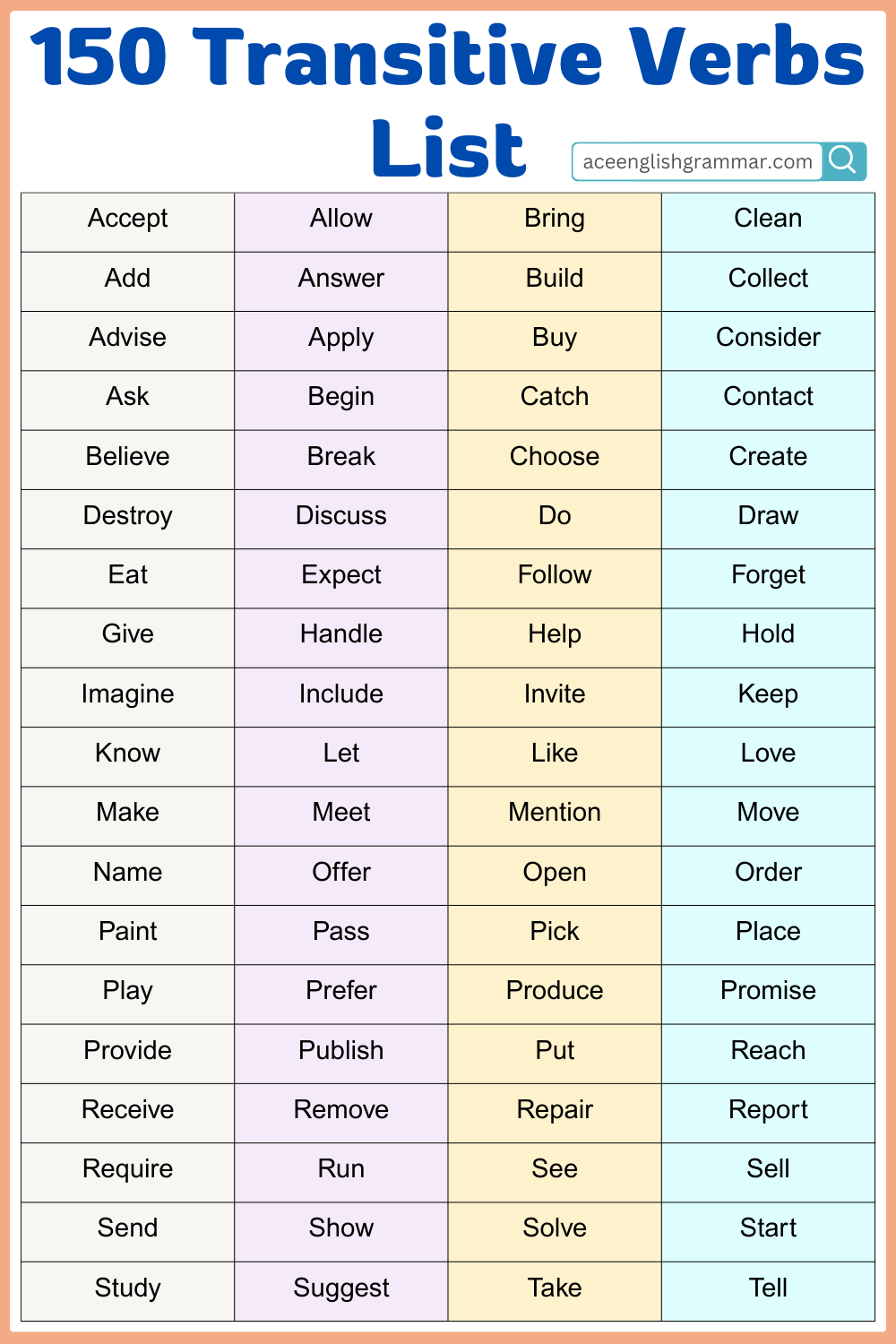
This larger Transitive Verbs List is best used after you understand the direct object test. Read each verb with a noun after it, such as choose a seat, repair the roof, or write a note.
| Accept | Add | Admire |
| Advise | Allow | Answer |
| Arrange | Ask | Bake |
| Believe | Borrow | Break |
| Bring | Build | Buy |
| Call | Carry | Catch |
| Change | Choose | Clean |
| Close | Collect | Color |
| Complete | Cook | Copy |
| Count | Create | Cut |
| Deliver | Describe | Design |
| Destroy | Draw | Drive |
| Drop | Eat | Enjoy |
| Explain | Feed | Fill |
| Find | Finish | Fix |
| Fold | Follow | Forget |
| Forgive | Give | Grab |
| Guide | Handle | Hate |
| Hear | Hold | Imagine |
| Invite | Join | Keep |
| Kick | Know | Learn |
| Like | Lift | Love |
| Make | Mark | Measure |
| Mention | Move | Name |
| Need | Notice | Offer |
| Open | Order | Own |
| Pack | Paint | Pass |
| Pick | Plan | Play |
| Prefer | Prepare | |
| Produce | Protect | Pull |
| Push | Raise | Read |
| Receive | Record | Reduce |
| Remember | Remove | Repair |
| Replace | Report | Request |
| Respect | Return | Ride |
| Save | See | Select |
| Sell | Send | Serve |
| Share | Show | Sign |
| Solve | Spend | Start |
| Study | Suggest | Take |
| Teach | Tell | Test |
| Throw | Touch | Trust |
| Try | Turn | Understand |
| Update | Use | Visit |
| Want | Warn | Wash |
| Watch | Water | Wear |
| Weigh | Welcome | Win |
| Wipe | Write | Wrap |
Some of these verbs may also appear in other sentence patterns. The sentence decides the use. If the verb has a direct object, it is transitive in that sentence.
Everyday Transitive Verbs With Direct Objects
Everyday transitive verbs often name actions you do to food, objects, messages, schoolwork, and people. The examples below show the object right after the verb.
Food And Home Verbs
- Eat: She ate an apple after lunch.
- Drink: He drank a glass of water.
- Cook: We cooked rice and chicken.
- Wash: I washed the dishes.
- Clean: They cleaned the living room.
- Open: She opened the fridge.
- Close: He closed the gate.
- Cut: I cut the bread into slices.
School And Writing Verbs
- Read: He read the chapter before class.
- Write: She wrote a paragraph.
- Answer: I answered the question.
- Ask: They asked the teacher a question.
- Study: We studied English grammar.
- Learn: She learned new verbs.
- Teach: He taught the lesson.
- Copy: I copied the sentence into my notebook.
Work And Daily Action Verbs
- Send: She sent an email.
- Call: He called his manager.
- Fix: They fixed the computer.
- Use: I used the printer.
- Carry: He carried the boxes.
- Find: She found the file.
- Make: We made a plan.
- Finish: I finished the task.
Before moving to meanings, keep one question in mind: what receives the action? That question will make the next section easier to read.
Transitive Verbs With Meanings And Examples
A meaning becomes stronger when you see the verb inside a sentence. In each example below, the object receives the action.
| Transitive verb | Meaning | Example |
|---|---|---|
| Accept | To take something offered | She accepted the job offer |
| Add | To put one thing with another | Add sugar to the tea |
| Ask | To request information or action | He asked a question |
| Buy | To get something by paying for it | I bought a new phone |
| Catch | To stop or take hold of something moving | The boy caught the ball |
| Choose | To pick one thing from others | She chose the blue dress |
| Clean | To remove dirt from something | They cleaned the floor |
| Close | To shut something | Please close the door |
| Collect | To gather things together | He collected old coins |
| Create | To make something new | The artist created a mural |
| Cut | To divide something with a sharp tool | She cut the ribbon |
| Describe | To tell what something is like | He described the accident |
| Draw | To make a picture with lines | The child drew a cat |
| Drive | To control a vehicle | She drove the car home |
| Eat | To put food in the mouth and swallow it | We ate dinner early |
| Enjoy | To take pleasure in something | I enjoyed the concert |
| Find | To discover something | He found his wallet |
| Fix | To repair something | She fixed the chair |
| Follow | To go after someone or something | The dog followed its owner |
| Give | To hand something to someone | He gave me the keys |
| Hear | To notice a sound | I heard the alarm |
| Hold | To keep something in your hand or arms | She held the baby |
| Invite | To ask someone to come somewhere | We invited our friends |
| Keep | To continue having something | He kept the receipt |
| Know | To have information about something | She knows the answer |
| Like | To feel pleased by something | I like this song |
| Love | To feel strong affection for someone or something | He loves his family |
| Make | To create or prepare something | She made breakfast |
| Move | To change the place of something | They moved the table |
| Need | To require something | I need a pencil |
| Notice | To see or become aware of something | She noticed the mistake |
| Open | To make something no longer closed | He opened the box |
| Paint | To cover something with paint | They painted the wall |
| Pass | To give something to someone nearby | Please pass the salt |
| Play | To perform a game, sport, or instrument | He played the piano |
| Read | To look at words and understand them | I read the message |
| Receive | To get something | She received a letter |
| Remove | To take something away | He removed his shoes |
| Repair | To fix something broken | They repaired the roof |
| See | To notice with the eyes | We saw a rainbow |
| Sell | To give something for money | She sold her bike |
| Send | To cause something to go somewhere | I sent the package |
| Show | To let someone see something | He showed the photo |
| Solve | To find the answer to a problem | She solved the puzzle |
| Take | To get or carry something | He took the umbrella |
| Teach | To give knowledge or skill | My father taught me chess |
| Tell | To give information in words | She told the truth |
| Throw | To send something through the air by hand | He threw the ball |
| Use | To do something with a tool or object | I used a ruler |
| Visit | To go and see someone or a place | They visited the museum |
| Want | To desire something | I want a sandwich |
| Watch | To look at something for a period of time | We watched the match |
| Wear | To have clothing on the body | She wore a red coat |
| Write | To form words on paper or a screen | He wrote a poem |
Do not memorize the verb alone. Read the verb with its object. Repair the roof teaches more than repair because it shows the verb doing its job inside a sentence.
Transitive Verbs Used In Sentences
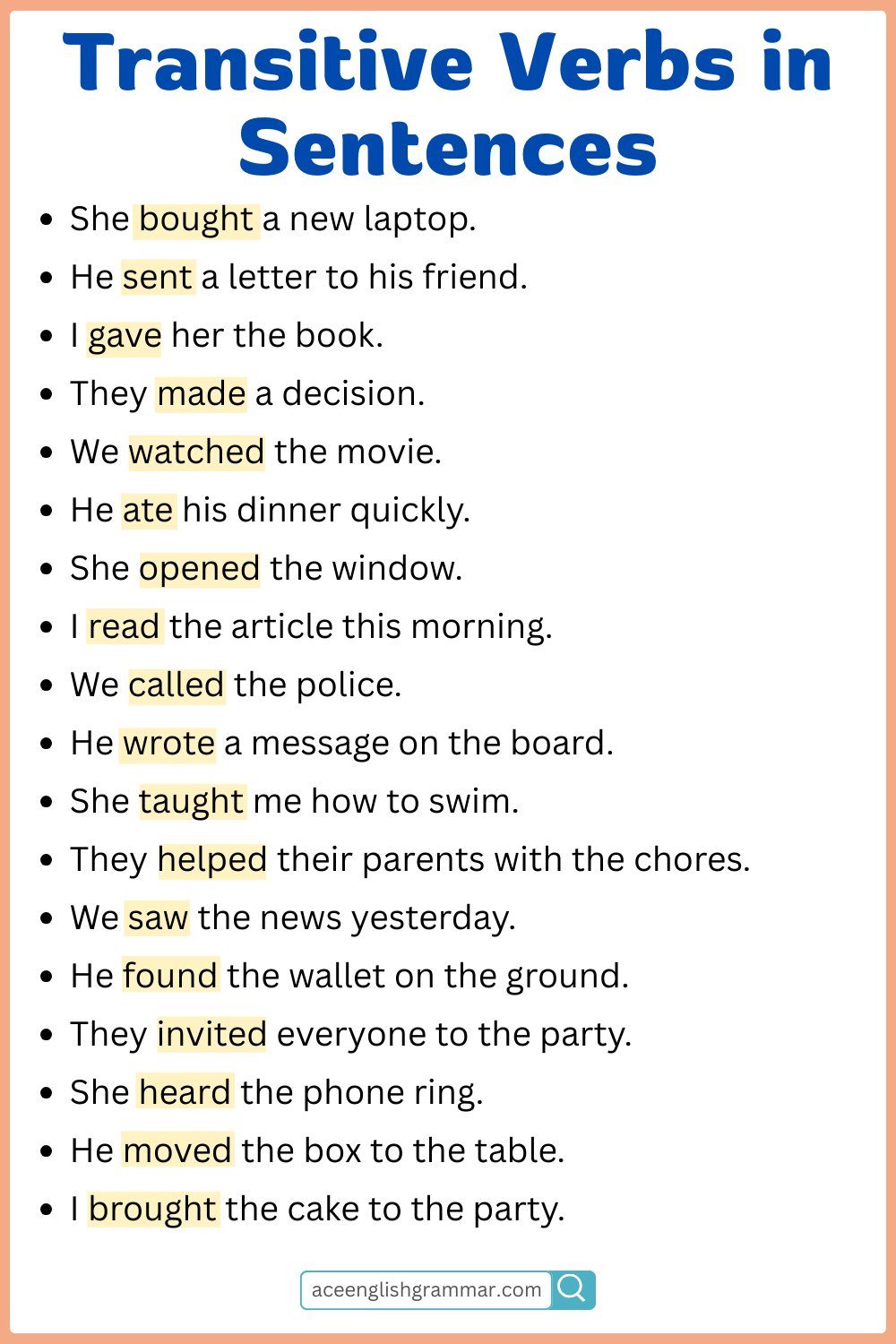
The examples below show transitive verbs with direct objects. The direct object is marked in italics.
- She bought a new laptop.
- He sent a letter to his friend.
- I gave her the book.
- They made a decision.
- We watched the movie.
- He ate his dinner quickly.
- She opened the window.
- I read the article this morning.
- We called the police.
- He wrote a message on the board.
- She taught me Spanish.
- They helped their parents with the chores.
- We saw the news yesterday.
- He found the wallet on the ground.
- They invited everyone to the party.
- She heard the phone ring.
- He moved the box to the table.
- I brought the cake to the party.
- She loved her new dress.
- He played the guitar at the concert.
- We painted the fence on Sunday.
- I answered the email after breakfast.
- She washed the cups before dinner.
- He repaired the bicycle.
- They chose the smaller room.
Take the first sentence: She bought a new laptop. Ask, bought what? The answer is a new laptop. That is the direct object.
Now look at We called the police. Ask, called whom? The answer is the police. The same test works for people and things.
Verbs That Can Be Transitive Or Intransitive
So far, the examples have shown verbs with direct objects. But English verbs can change by sentence. A verb may take an object in one sentence and stand alone in another, so the sentence context matters.
| Verb | Transitive use | Intransitive use |
|---|---|---|
| Run | She runs a small shop | He runs every morning |
| Drive | He drove the car home | She drives carefully |
| Eat | They ate the pizza | We ate early |
| Play | He played the piano | The children played outside |
| Read | I read the letter | She reads every night |
| Write | He wrote a poem | She writes often |
| Cook | We cooked dinner | He cooks well |
| Open | She opened the door | The shop opens at nine |
| Break | He broke the glass | The glass broke suddenly |
| Change | They changed the plan | The weather changed quickly |
Look at They ate the pizza and We ate early. In the first sentence, the pizza receives the action. In the second sentence, early tells when the action happened. It is not an object.
That is why you should not label a verb as transitive by the verb alone. Read the whole sentence and check for the direct object.
Direct Objects And Indirect Objects
Do not rush this part. Some sentences have two objects, but only one of them directly receives the thing being given, sent, shown, or told.
| Sentence | Verb | Indirect object | Direct object |
|---|---|---|---|
| She gave her brother a gift | gave | her brother | a gift |
| He sent me a message | sent | me | a message |
| They taught the students grammar | taught | the students | grammar |
| I showed my friend the photo | showed | my friend | the photo |
| She told us the story | told | us | the story |
The direct object answers what? The indirect object often answers to whom? or for whom?
In She gave her brother a gift, ask, gave what? The answer is a gift, so that is the direct object. Now ask, gave it to whom? The answer is her brother, so that is the indirect object.
This pattern often appears with verbs such as give, send, show, teach, tell, offer, and bring.
Common Mistakes With Transitive Verbs
Most transitive verb mistakes come from ignoring the object test. Ask what? or whom? before you decide whether the verb is transitive.
Leaving Out The Direct Object
Some verbs leave the reader waiting when the object is missing.
| Weak sentence | Better sentence |
|---|---|
| She carried | She carried the bag |
| He opened | He opened the window |
| They repaired | They repaired the roof |
| I bought | I bought a notebook |
| We watched | We watched the match |
The better sentences work because the object is present. The bag, the window, the roof, a notebook, and the match all receive the action.
Calling Every Action Verb Transitive
Not every action verb is transitive. A verb needs a direct object to be transitive.
| Intransitive sentence | Why it is not transitive |
|---|---|
| He slept early | No direct object receives the action |
| She arrived late | The verb does not take a direct object |
| They laughed loudly | No object answers what or whom |
| We waited outside | No direct object follows the verb |
| The baby cried | The action does not pass to an object |
These sentences still make sense, but they do not have direct objects.
Confusing Direct Objects With Prepositional Phrases
A direct object comes after the verb without a preposition. A prepositional phrase starts with words such as to, for, at, about, or with.
| Sentence | Correct reading |
|---|---|
| She listened to music | To music is a prepositional phrase |
| He waited for the bus | For the bus is a prepositional phrase |
| They talked about the movie | About the movie is a prepositional phrase |
| She looked at the painting | At the painting is a prepositional phrase |
Now compare those with transitive sentences:
- She heard music.
- He missed the bus.
- They discussed the movie.
- She studied the painting.
In the second group, the nouns come directly after the verbs and receive the action.
Strong Transitive Verb Pairs For Practice
Use these pairs to build full sentences. Do not leave the verb and object as separate words. Turn answer a question into She answered a question after class.
| Verb | Direct object |
|---|---|
| Accept | an invitation |
| Answer | a question |
| Bake | a cake |
| Bring | your passport |
| Build | a house |
| Catch | the train |
| Choose | a seat |
| Close | the drawer |
| Cook | a meal |
| Cut | the rope |
| Draw | a map |
| Drive | a truck |
| Enjoy | the music |
| Find | the keys |
| Fix | the leak |
| Follow | the path |
| Hold | the handle |
| Invite | a guest |
| Keep | the change |
| Learn | a skill |
| Make | a mistake |
| Move | the chair |
| Need | more time |
| Notice | a problem |
| Paint | the ceiling |
| Read | the sign |
| Repair | the machine |
| Sell | a car |
| Send | a parcel |
| Solve | the case |
| Take | a photo |
| Teach | a class |
| Throw | a stone |
| Use | a knife |
| Watch | the game |
| Write | a note |
A good practice habit is to say the whole phrase aloud. If the object sounds natural after the verb, the pattern becomes easier to remember.
Transitive Verb Examples By Sentence Pattern
A transitive verb can appear in different sentence patterns. The object is still the main thing to watch.
Subject + Verb + Object
This is the most common transitive pattern.
- The chef cooked dinner.
- The boy kicked the ball.
- My sister painted the door.
- The teacher checked the homework.
- The company launched a new product.
Each sentence has one direct object. Ask what? after the verb, and the answer appears right away.
Subject + Verb + Person + Object
Some verbs take a person and a thing in the same sentence.
- She gave him a ticket.
- He sent me a photo.
- They taught us a lesson.
- I showed her the map.
- Mom told the children a story.
In these sentences, the thing is usually the direct object. In He sent me a photo, he sent what? A photo. He sent it to whom? Me.
Subject + Verb + Object + Extra Information
Sometimes the direct object comes first, and extra information follows it.
- She placed the vase on the shelf.
- He put the keys in his pocket.
- They moved the sofa into the hall.
- I wrote my name on the paper.
- We carried the boxes upstairs.
The extra words tell where, when, or how something happened. The direct object still answers what? or whom? after the verb.
Final Tip For Using Transitive Verbs
When you are unsure about a verb, do not start by memorizing a label. Read the full sentence and ask what the action reaches.
She opened the window. Opened what? The window.
That one habit will guide you through most transitive verbs in English. A Transitive Verbs List becomes more valuable when every verb is tied to a real object and a real sentence.
FAQs
A transitive verb is a verb that needs a direct object. In She closed the door, closed is transitive because the door receives the action.
Ask what? or whom? after the verb. In He fixed the bike, ask fixed what? The answer is the bike, so fixed is transitive.
Twenty common transitive verbs are eat, bring, take, give, write, read, make, find, buy, send, open, close, tell, ask, show, carry, wear, call, love, and watch.
Yes. Some verbs change by sentence. In She runs a shop, runs is transitive because a shop is the direct object. In She runs every morning, runs is intransitive because there is no direct object.
A direct object receives the action. An indirect object receives the direct object. In He sent me a message, a message is the direct object, and me is the indirect object.
Listen is usually intransitive because it often uses a preposition. In She listened to music, to music is a prepositional phrase, not a direct object. A transitive alternative is hear, as in She heard music.
Wait is usually intransitive. In We waited for the bus, for the bus is a prepositional phrase. The verb does not take a direct object in that sentence.
A transitive verb sends its action to someone or something. Without that object, the sentence often feels unfinished. She brought leaves a question in the reader’s mind, but She brought the tickets completes the meaning.
You might also like

Leave a Comment