An adverb is a word that adds information about a verb, an adjective, another adverb, or even a whole sentence. In She speaks softly, the adverb softly tells how she speaks. In The room is very quiet, very changes the strength of the adjective quiet.
Adverbs often answer questions such as how, when, where, how often, and to what extent. Words like quickly, yesterday, here, often, and almost all work as adverbs in the right sentence.
By the end, you will know how to identify adverbs, place them correctly, compare actions with adverbs, and avoid common mistakes such as confusing good with well or placing an adverb in the wrong part of a sentence.
What Is An Adverb?
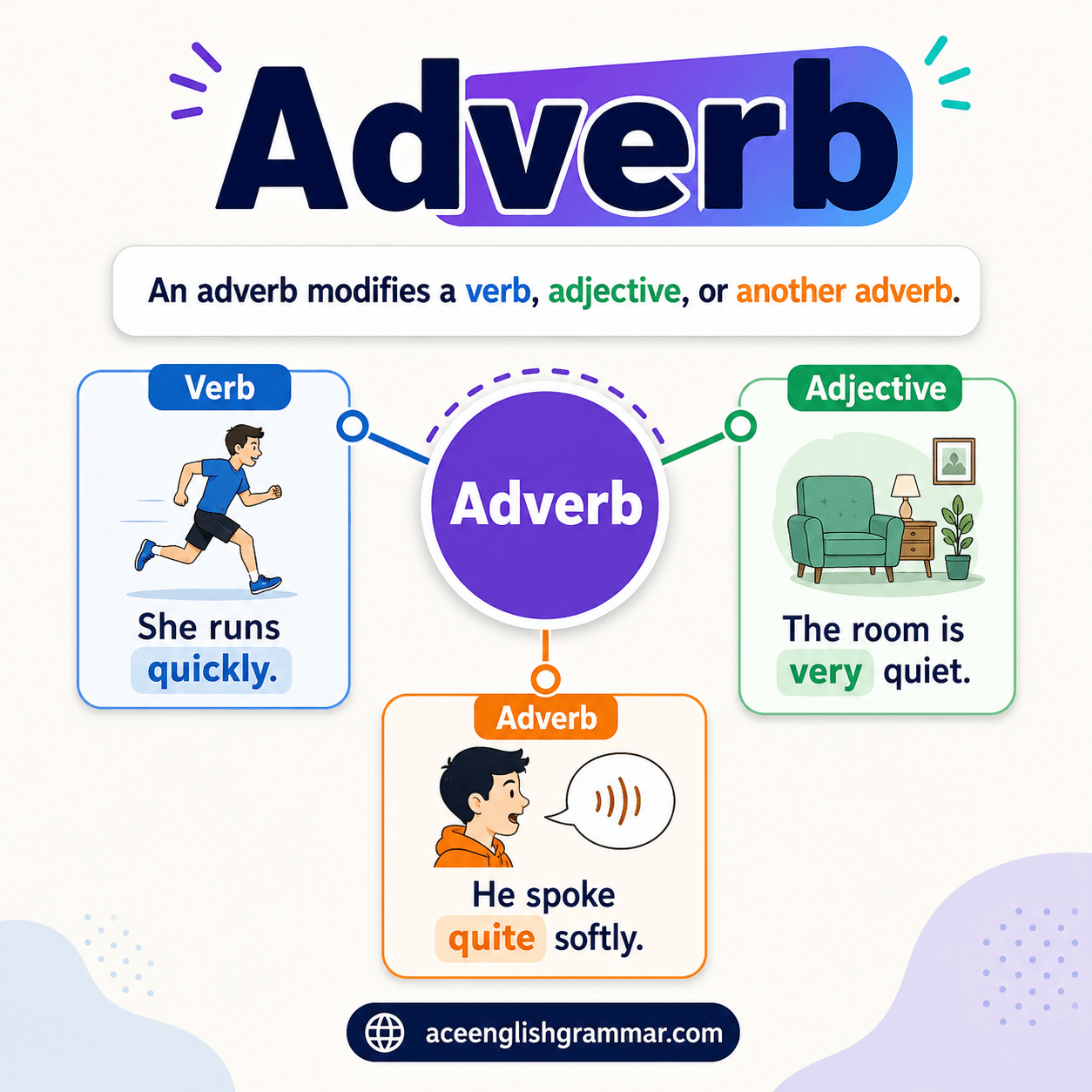
An adverb is a part of speech that adds information to another word or to a whole statement. Most adverbs answer one of these questions:
- How?
- When?
- Where?
- How often?
- How much?
- How sure?
Look at these sentences:
- She spoke softly.
- He arrived early.
- They waited outside.
- I often read at night.
- The room is too warm.
- Fortunately, nobody was hurt.
In the first sentence, softly modifies the verb spoke. It tells how she spoke. In the sentence The room is too warm, the adverb too modifies the adjective warm and shows degree. In Fortunately, nobody was hurt, the adverb comments on the whole statement.
The safest way to identify an adverb is not to look only for -ly. Many adverbs do end in -ly, but the real test is what the word does in the sentence.
What Adverbs Modify In A Sentence
An adverb does not always attach to the same kind of word. Sometimes it describes an action, sometimes it changes the strength of a describing word, and sometimes it comments on the whole idea.
| Adverb Modifies | Sentence | Adverb’s Job |
|---|---|---|
| Verb | She answered quickly. | Tells how she answered |
| Adjective | The soup is very hot. | Shows the degree of hot |
| Another adverb | He ran extremely fast. | Strengthens fast |
| Whole sentence | Honestly, I disagree. | Shows the speaker’s attitude |
This is why adverbs are more flexible than many other parts of speech. An adjective usually describes a noun or pronoun, but an adverb can work across different parts of the sentence.
- The child gave a quick reply.
Here, quick is an adjective because it describes the noun reply. - The child replied quickly.
Here, quickly is an adverb because it describes the verb replied.
Once you know what the adverb modifies, its type becomes much easier to identify.
Main Types Of Adverbs
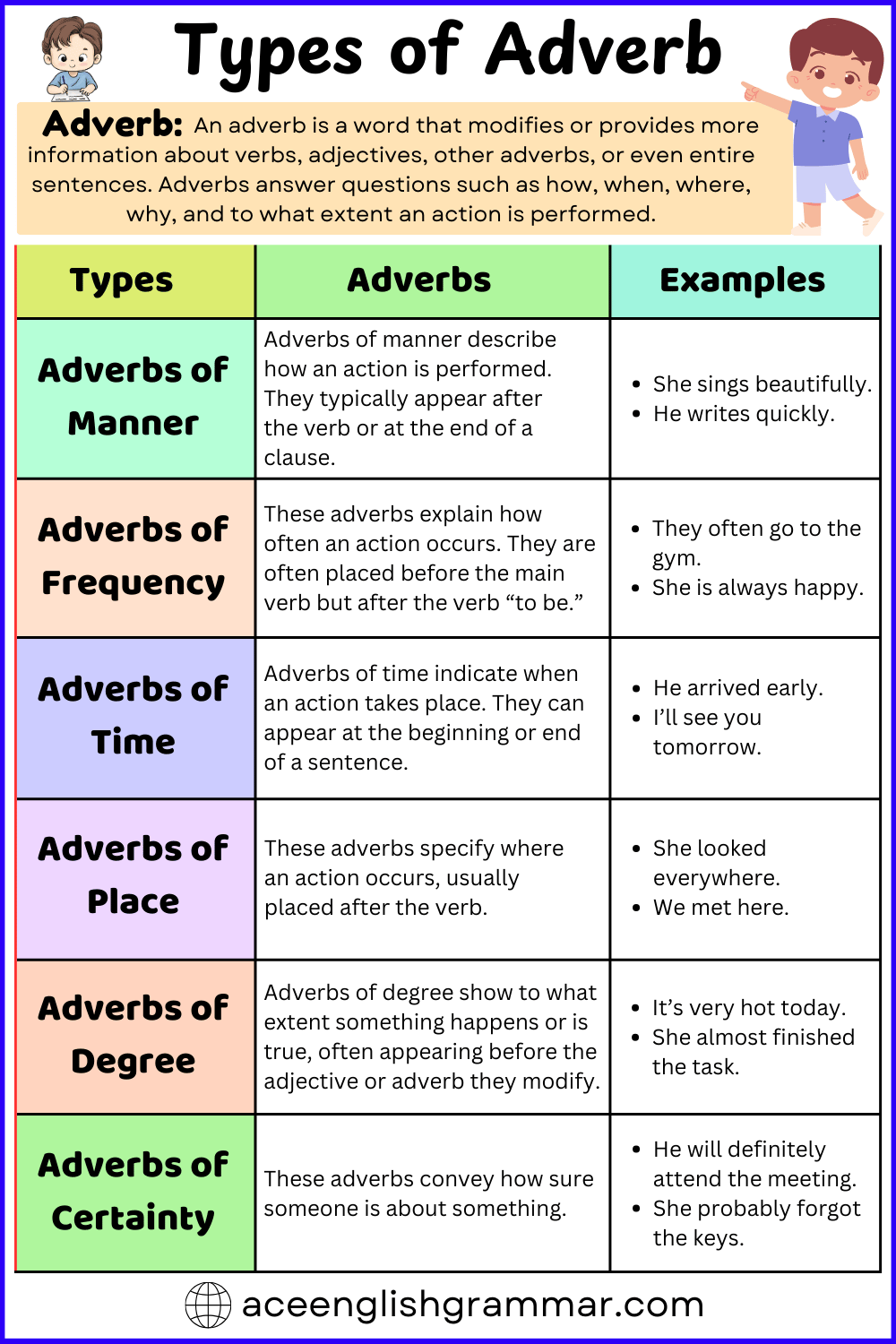
Adverbs are often named by the question they answer. Some tell how an action happens, while others tell when, where, how often, how much, or how sure the speaker is.
| Type Of Adverb | Question It Answers | Common Examples |
|---|---|---|
| Manner | How? | carefully, loudly, well |
| Time | When? | today, soon, yesterday |
| Place | Where? | here, outside, nearby |
| Frequency | How often? | always, often, rarely |
| Degree | How much? | very, almost, quite |
| Certainty | How sure? | definitely, probably, surely |
| Conjunctive | How are ideas connected? | however, therefore, meanwhile |
Adverbs of manner describe how an action happens. They usually come after the verb or after the object.
- She explained the rule carefully.
- The singer performed beautifully.
- He handled the glass gently.
- The team played well.
When the verb has an object, the adverb usually comes after the object.
- She read the letter carefully. ✅
- She read carefully the letter. ❌
The incorrect sentence breaks the natural verb-object pattern. In standard English, the object usually stays close to the verb, and the manner adverb comes after it.
Adverbs of time show when something happens. They can point to the past, present, or future.
- We met yesterday.
- She is leaving tomorrow.
- He called earlier.
- I will finish the report soon.
Time adverbs often appear at the beginning or end of a sentence.
- Yesterday, we visited the museum.
- We visited the museum yesterday.
Both sentences are correct. The first version places more attention on the time.
Adverbs of place describe the location or direction of an action. They often answer where something happens or where the subject moves.
- Please sit here.
- The children played outside.
- She looked everywhere.
- The bird flew away.
Some place adverbs show position, while others show movement.
- They waited nearby.
- He walked upstairs.
- The dog ran inside.
These words do not name places as nouns do. They describe where the action happens or where it goes.
Adverbs of frequency show how often an action happens. They usually come before the main verb.
- She always checks her work.
- They often travel in summer.
- I sometimes drink tea at night.
- He rarely misses a meeting.
With the verb to be, the adverb usually comes after the verb.
- She is always polite.
- They are usually busy.
- The room is often quiet.
Notice the difference in placement:
- He usually eats breakfast at seven. ✅
- He eats usually breakfast at seven. ❌
The first sentence sounds natural because the frequency adverb sits before the main verb.
Adverbs of degree show intensity, amount, or extent. They often modify adjectives or other adverbs.
- The coffee is very hot.
- She almost finished the project.
- He is quite confident.
- The answer is completely wrong.
Some degree adverbs strengthen meaning:
- extremely
- really
- completely
- absolutely
Others reduce or limit meaning:
- slightly
- barely
- almost
- somewhat
Compare these sentences:
- The room is extremely cold.
- The room is slightly cold.
The adjective is the same, but the adverb changes the strength of the description.
Adverbs of certainty show how sure the speaker is about something.
- She will definitely attend the meeting.
- He probably forgot the address.
- They certainly deserve credit.
- Maybe we should wait.
Some certainty adverbs show confidence, while others show possibility.
| Strong Certainty | Medium Certainty | Uncertainty |
|---|---|---|
| definitely | probably | maybe |
| certainly | likely | perhaps |
| surely | presumably | possibly |
These adverbs often shape the whole statement, not only one verb.
- The train has probably already left.
- She will certainly remember your name.
Conjunctive adverbs connect complete ideas. They show contrast, result, sequence, or addition.
- The road was closed; therefore, we took another route.
- She wanted to join us. However, she had to work late.
- Finish the form now; otherwise, the office may reject it.
Words such as however, therefore, meanwhile, and nevertheless are not ordinary description words. They guide the relationship between two ideas.
Where Adverbs Go In A Sentence
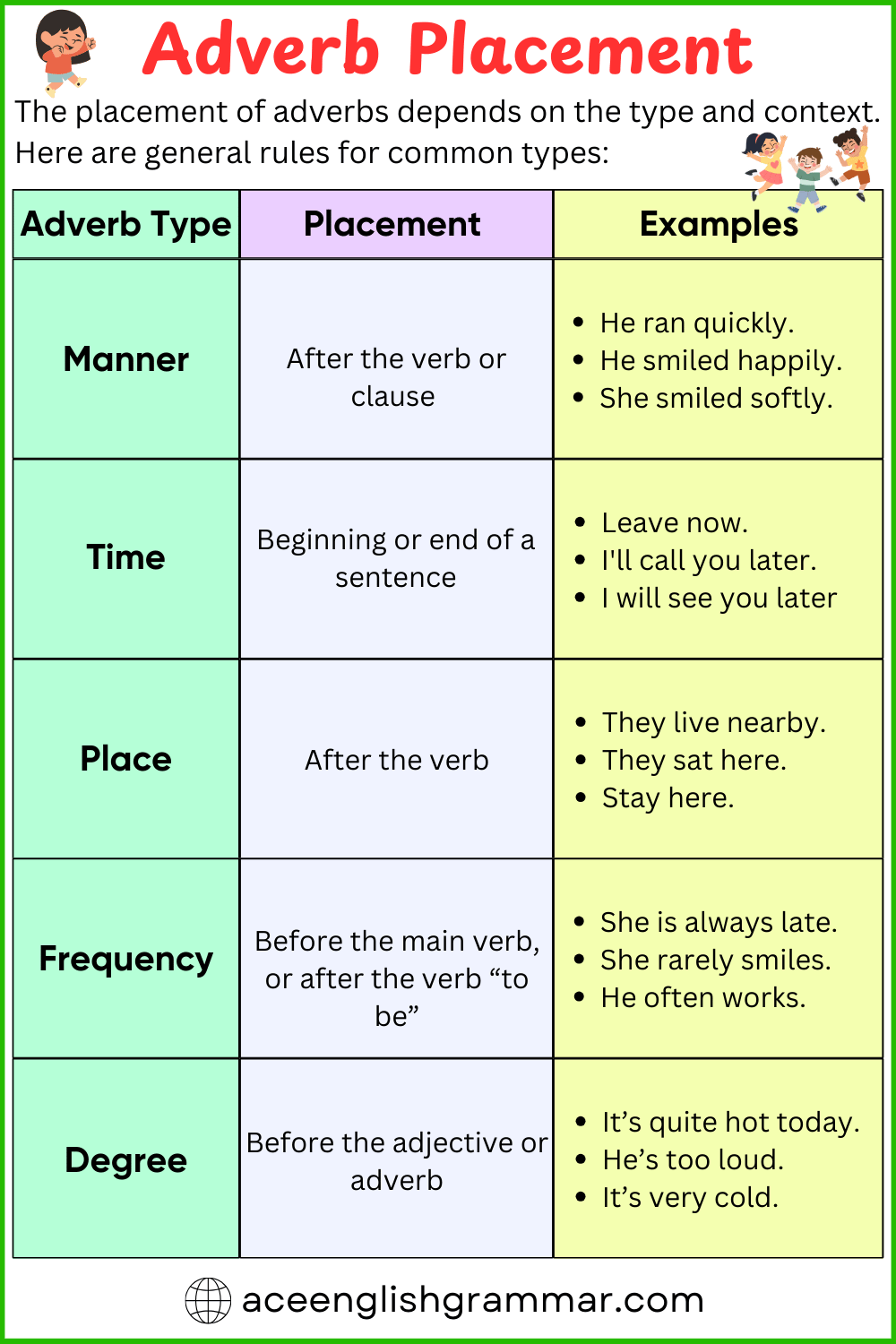
Adverb placement depends on meaning and sentence pattern. A frequency adverb usually sits near the main verb, while a manner adverb often comes after the verb or object. Time and place adverbs are more flexible.
| Position | Common Use | Sentence |
|---|---|---|
| Beginning | Time, attitude, transition | Tomorrow, we will leave early. |
| Middle | Frequency, certainty, degree | She often works late. |
| End | Manner, place, time | He spoke calmly. |
Front position means the adverb appears at the beginning of the sentence.
- Today, we are reviewing the contract.
- Unfortunately, the shop was closed.
- Later, they changed their decision.
Front-position adverbs often set the time, attitude, or connection before the main clause begins.
Mid position places the adverb near the main verb.
- She often walks to work.
- They have already eaten.
- He will probably call tonight.
With auxiliary verbs, the adverb often comes after the first auxiliary.
- She has never visited Canada.
- They will soon announce the result.
With be, the adverb usually follows the verb.
- She is always calm.
- The office is usually busy.
End position places the adverb after the verb, object, or full clause.
- He drives carefully.
- She placed the keys there.
- We will meet tomorrow.
End position is common for adverbs of manner, place, and time.
When a sentence has several adverbs, the usual order is manner, place, then time.
- She worked quietly in her room last night.
That order is not absolute, but it often gives the sentence a natural rhythm.
Adverb Forms And Comparisons
Many adverbs are formed by adding -ly to adjectives.
| Adjective | Adverb |
|---|---|
| quick | quickly |
| careful | carefully |
| beautiful | beautifully |
| honest | honestly |
| sudden | suddenly |
Some spelling changes happen before -ly is added.
| Adjective | Adverb |
|---|---|
| happy | happily |
| gentle | gently |
| true | truly |
| automatic | automatically |
Not every word ending in -ly is an adverb. Words such as friendly, lovely, and lonely are usually adjectives.
- She is a friendly person.
- That was a lovely evening.
- He felt lonely after moving away.
Not every adverb ends in -ly either. Some adverbs have the same form as adjectives.
- He runs fast.
- She works hard.
- They arrived late.
- Come near.
These forms are common in modern English, so it is better to judge the word by its sentence role instead of its ending.
Adverbs can also compare actions. The comparative form compares two actions, while the superlative form compares three or more.
| Form | Sentence |
|---|---|
| Positive | He runs fast. |
| Comparative | He runs faster than Ali. |
| Superlative | He runs the fastest in the race. |
Short adverbs often take -er and -est.
- fast, faster, fastest
- hard, harder, hardest
- late, later, latest
Many -ly adverbs use more and most.
- She spoke carefully.
- She spoke more carefully than before.
- She spoke most carefully during the interview.
Do not mix both comparison patterns.
- She spoke more carefully. ✅
- She spoke more carefuler. ❌
Some adverbs have irregular comparison forms.
| Positive | Comparative | Superlative |
|---|---|---|
| well | better | best |
| badly | worse | worst |
| far | farther or further | farthest or furthest |
Adverb Phrases And Adverb Clauses
A single adverb can add meaning to a sentence, but longer word groups can do the same job. These groups are called adverb phrases and adverb clauses.
An adverb phrase is a group of words that works like an adverb but does not contain both a subject and a verb.
- He worked with great care.
- She arrived after lunch.
- They walked through the narrow street.
Each phrase adds information about how, when, or where something happened.
An adverb clause is a group of words that works like an adverb and contains both a subject and a verb.
- Although it was raining, they continued the match.
- Call me when you arrive.
- She smiled because she understood the joke.
Adverb clauses often begin with words such as because, although, when, while, before, after, and if.
| Clause Type | Sentence | Meaning |
|---|---|---|
| Reason | He left because he was tired. | Why he left |
| Time | Call me when you arrive. | When to call |
| Contrast | Although it was late, we stayed. | Opposing idea |
| Condition | If it rains, we will wait inside. | Condition |
Adverb phrases and clauses matter because they let a sentence carry fuller information without depending only on one-word adverbs.
Adverb Vs Adjective
Adverbs and adjectives are often confused because both add detail. The difference is what they modify.
An adjective describes a noun or pronoun.
- She is a careful driver.
- That is a beautiful painting.
- He gave a quick answer.
An adverb modifies a verb, adjective, another adverb, or whole statement.
- She drives carefully.
- The painting is incredibly beautiful.
- He answered quickly.
The word being modified decides whether you need an adjective or an adverb.
| Correct Sentence | Why It Works |
|---|---|
| She is a careful writer. | Careful describes the noun writer. |
| She writes carefully. | Carefully describes the verb writes. |
| He gave a quick reply. | Quick describes the noun reply. |
| He replied quickly. | Quickly describes the verb replied. |
Linking verbs need special attention. Verbs such as be, seem, feel, look, sound, taste, and smell often take adjectives because they describe the subject.
- The soup tastes good. ✅
- The soup tastes well. ❌
The soup is not performing the action of tasting. The sentence describes the soup, so the adjective good is correct.
The same pattern appears here:
- She looks happy. ✅
- She looks happily. ❌
The sentence describes her appearance or state, not the action of looking.
Common Adverb Mistakes
Adverb mistakes usually happen when the writer focuses on the word ending instead of the word’s sentence role. The following errors are common in English writing and speech.
Using good instead of well
Good is usually an adjective. Well is usually an adverb.
- He writes well. ✅
- He writes good. ❌
Use good when describing a noun.
- He is a good writer. ✅
Use well when describing an action.
- He writes well. ✅
One exception is health. Well can work as an adjective when it means healthy.
- I do not feel well today.
Confusing hard and hardly
Hard can be an adverb meaning with effort.
- She worked hard.
Hardly means almost not.
- She hardly worked.
These sentences have opposite meanings. Worked hard means she made strong effort. Hardly worked means she did very little work.
Putting an adverb between a verb and its object
Most manner adverbs should not interrupt the verb-object pattern.
- He explained the rule clearly. ✅
- He explained clearly the rule. ❌
In the correct sentence, the object the rule stays close to the verb explained. The adverb comes after the object.
Using an adverb after a linking verb
Use an adjective after a linking verb when the word describes the subject.
- The flowers smell fresh. ✅
- The flowers smell freshly. ❌
The sentence describes the flowers, not the action of smelling.
Adding a redundant adverb
Some adverbs repeat meaning already carried by the verb.
- He whispered quietly.
- He whispered.
A whisper is already quiet, so the adverb adds little unless the sentence needs contrast.
The same issue appears in these sentences:
- She shouted loudly.
- He sprinted quickly.
- They completely finished the task.
Choose an adverb when it adds meaning, not when it repeats what the verb already says.
Overusing very and really
Words such as very and really can weaken writing when they repeat too often.
- The answer is very important.
- The answer is essential.
The second sentence is stronger because essential carries the meaning without extra padding.
Common Adverbs In Sentences
The best way to understand common adverbs is to see how they work inside real sentences.
| Adverb Type | Common Adverbs |
|---|---|
| Manner | carefully, quickly, slowly, loudly, gently |
| Time | today, tomorrow, soon, later, already |
| Place | here, there, outside, nearby, everywhere |
| Frequency | always, often, usually, sometimes, rarely |
| Degree | very, too, quite, almost, completely |
| Certainty | definitely, probably, surely, maybe, perhaps |
Here are common adverbs in natural sentences:
- She answered politely during the interview.
- The train arrived early this morning.
- He rarely eats breakfast before work.
- They searched everywhere for the missing key.
- The movie was surprisingly emotional.
- I almost dropped the glass.
- She speaks English very confidently.
- Unfortunately, the meeting ended late.
- He will probably visit next week.
- The children played outside after lunch.
To identify the adverb, ask what information the word adds.
In She answered politely, the adverb politely tells how she answered. In He rarely eats breakfast, rarely tells how often he eats breakfast. In The movie was surprisingly emotional, surprisingly shapes the meaning of the adjective emotional and shows the speaker’s reaction.
FAQs
Q1. What Is An Adverb?
An adverb is a word that modifies a verb, adjective, another adverb, or whole clause. It often tells how, when, where, how often, how much, or how sure something is.
- She sings beautifully.
- He arrived yesterday.
- The room is very warm.
Q2. What Are The Main Types Of Adverbs?
The main types of adverbs are adverbs of manner, time, place, frequency, degree, certainty, and connection.
- Slowly tells how.
- Tomorrow tells when.
- Here tells where.
- Often tells how often.
- Very tells how much.
Q3. Where Do Adverbs Go In A Sentence?
Adverb placement depends on the type of adverb and what it modifies. Frequency adverbs often come before the main verb, while manner adverbs usually come after the verb or after the object.
- She often reads at night.
- He closed the door quietly.
- Tomorrow, we will leave early.
Q4. What Is The Difference Between An Adverb And An Adjective?
An adjective describes a noun or pronoun. An adverb modifies a verb, adjective, another adverb, or whole statement.
- She is a careful driver.
- She drives carefully.
In the first sentence, careful describes the noun driver. In the second sentence, carefully describes the verb drives.
Q5. Is Fast An Adverb Or An Adjective?
Fast can be both an adjective and an adverb.
- He drives a fast car.
Here, fast is an adjective because it describes the noun car.
- He drives fast.
Here, fast is an adverb because it describes the verb drives.
Q6. Is Well An Adverb?
Well is usually an adverb when it describes how an action is done.
- She writes well.
- He performed well under pressure.
It can also be an adjective when it means healthy.
- I feel well today.
Q7. What Are Common Mistakes With Adverbs?
Common adverb mistakes include using good instead of well, placing an adverb between a verb and its object, confusing hard with hardly, and using an adverb after a linking verb when an adjective is needed.
- She sings well. ✅
- She sings good. ❌
- The soup tastes good. ✅
- The soup tastes well. ❌
Adverbs are strongest when they add real meaning to a sentence. Use them to show manner, time, place, frequency, degree, certainty, and connection, but avoid adding them where the verb or adjective already carries the full idea.
Read More