English does not treat every noun as a separate object that can be counted one by one. You can count three books, five chairs, or several students because each word names an individual unit. Nouns such as water, rice, furniture, advice, and knowledge work differently. These are mass nouns, and English grammar treats them as whole amounts, materials, substances, conditions, or abstract ideas rather than separate countable items.
That difference changes the sentence around the noun. A mass noun usually stays singular, does not take a direct number, and does not normally follow a or an. Instead of writing an advice or three waters in standard grammar, English uses expressions such as some advice, a piece of advice, three bottles of water, or two cups of coffee.
Once you understand this grammar pattern, mass nouns become much easier to use. The important point is not only whether the noun names a liquid, material, or idea. The real grammar question is how English lets that noun behave inside a sentence.
Quick Answer
A mass noun is a noun that names something English treats as an uncountable amount, substance, material, condition, activity, or abstract concept rather than as separate countable units.
Common examples of mass nouns are:
- Water.
- Rice.
- Furniture.
- Advice.
- Knowledge.
- Music.
- Sugar.
- Traffic.
- Bread.
- Happiness.
Mass nouns usually follow these grammar patterns:
- They take singular verbs.
- They do not normally take direct numbers.
- They do not usually follow a or an.
- They use quantifiers or unit expressions when you need to show amount.
What Is A Mass Noun?
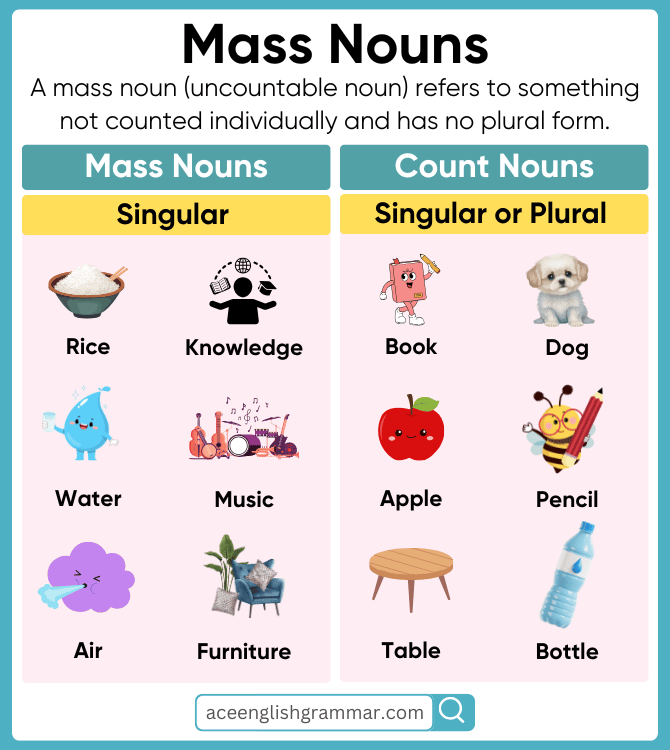
A mass noun is a noun that names something English grammar presents as a whole amount rather than as individual countable units. The noun may refer to a physical substance, such as water or sand; a material, such as wood or steel; a food amount, such as rice or bread; or an abstract idea, such as knowledge, patience, or happiness.
The grammar behavior is the key. A mass noun normally remains singular in form and does not combine directly with a number.
- ✅ Water is essential for life.
- ✅ Her advice was helpful.
- ✅ The furniture looks expensive.
In these sentences, water, advice, and furniture do not refer to one separate object that can be counted directly. English treats each noun as a whole amount or category, so the verb remains singular.
The term mass noun is often used with uncountable noun in learner grammar. In many English lessons, both terms refer to nouns that cannot normally be counted directly. In more technical grammar, mass noun often points especially to substances and materials, while uncountable noun may also cover abstract ideas and broader non-count categories. For practical English usage, the sentence pattern is the part learners need most: no direct number, no regular plural form, and singular agreement.
Examples Of Mass Nouns By Category
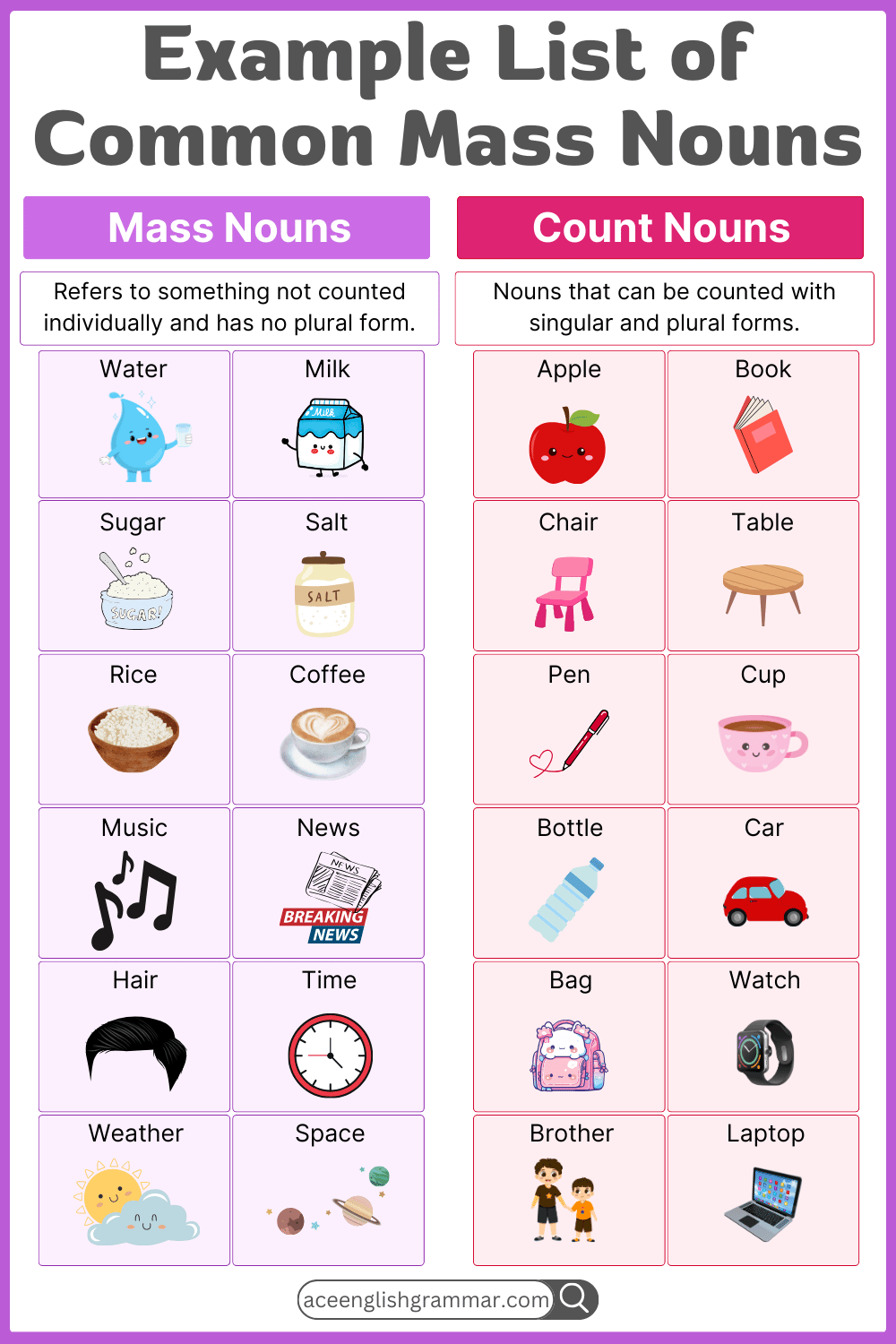
Mass nouns appear in several natural groups. These categories help you recognize them, but remember that the grammar pattern matters more than the label. Whether the noun names a liquid, a material, a food, or an idea, English usually treats it as an uncountable whole.
Liquids And Substances
Liquids and flowing substances are common mass nouns because they are usually measured by amount, container, or volume rather than counted as separate objects.
- Water.
- Milk.
- Oil.
- Juice.
- Coffee.
- Honey.
- Ink.
- Gasoline.
Example sentences:
- The water flowed across the road after the storm.
- She poured milk into the cup.
- Fresh coffee filled the kitchen with a strong smell.
Food And Ingredients
Many foods behave as mass nouns when English refers to them as ingredients, portions, or general food amounts. You can eat bread, rice, cheese, or soup, but you usually count them through containers, slices, bowls, or pieces.
- Rice.
- Bread.
- Butter.
- Cheese.
- Sugar.
- Salt.
- Pasta.
- Soup.
Example sentences:
- Rice is a staple food in many countries.
- The soup needs more salt.
- Fresh bread was baking in the kitchen.
Materials And Building Substances
Material nouns often behave as mass nouns because they name what something is made from, not the separate object made from it.
- Wood.
- Plastic.
- Steel.
- Cotton.
- Gold.
- Silver.
- Glass.
- Cement.
Example sentences:
- The table is made of wood.
- Steel is used in large construction projects.
- Glass breaks easily under pressure.
Abstract Ideas And Qualities
Abstract mass nouns name qualities, states, emotions, and ideas. They cannot be touched or divided into visible units, so English usually treats them as singular concepts.
- Happiness.
- Courage.
- Advice.
- Knowledge.
- Education.
- Patience.
- Honesty.
- Love.
Example sentences:
- Knowledge grows through reading and experience.
- Her advice helped me avoid a serious mistake.
- Patience is important when learning a new language.
Natural Elements And Conditions
Weather and natural conditions are also often mass nouns because they describe a state, force, or condition rather than a countable object.
- Rain.
- Fog.
- Air.
- Heat.
- Smoke.
- Weather.
- Snow.
- Oxygen.
Example sentences:
- Thick fog covered the highway early in the morning.
- The weather changed suddenly.
- Fresh air entered through the open window.
How Mass Nouns Work In Sentences
After you can recognize common mass nouns, the next point is sentence behavior. Mass nouns do not only name uncountable things. They also control the article, verb, number expression, and quantifier that can appear with them.
No direct numbers. A mass noun usually cannot follow a number directly because the noun does not name a separate countable unit.
- ❌ Three waters.
- ✅ Three bottles of water.
- ❌ Two breads.
- ✅ Two loaves of bread.
In the correct versions, bottles and loaves are the countable nouns. The mass nouns water and bread remain uncountable.
No normal use of a or an. The articles a and an point to one countable item, so they usually sound wrong before a mass noun.
- ❌ An advice.
- ✅ Some advice.
- ❌ A furniture.
- ✅ A piece of furniture.
The correction depends on meaning. If you want an unspecified amount, use some. If you want one unit, use a measurement expression such as a piece of.
Singular verb agreement. A mass noun normally takes a singular verb because English treats it as one whole quantity or concept.
- The furniture is expensive.
- The information was useful.
- Rice grows well in this region.
The noun may refer to many objects in the real world, especially with words like furniture or luggage, but its grammar remains singular.
Quantity words. Mass nouns work naturally with quantifiers that express amount rather than number.
- Some water.
- Much information.
- A little sugar.
- A lot of traffic.
- Plenty of rice.
Use much and little with mass nouns when the sentence focuses on amount. Use many and few with count nouns when the sentence focuses on number.
- ❌ There is many sugar in the jar.
- ✅ There is much sugar in the jar.
How To Count Mass Nouns With Unit Expressions
Mass nouns are not counted directly, but English can still talk about exact quantities. The sentence does this by adding a unit expression, which gives the mass noun a countable shape.
Think of the mass noun as the material, substance, food, or idea. The unit expression is the countable form you give it in the sentence.
| Mass Noun | Unit Expression |
|---|---|
| Water | A bottle of water |
| Bread | A loaf of bread |
| Advice | A piece of advice |
| Rice | A bowl of rice |
| Coffee | A cup of coffee |
| Furniture | A piece of furniture |
| Chocolate | A bar of chocolate |
| Cheese | A slice of cheese |
The number belongs to the countable unit, not to the mass noun itself.
- ✅ Two cups of coffee.
- ✅ Three bottles of water.
- ✅ Four pieces of furniture.
- ✅ A slice of cheese.
This pattern is important because it explains many corrections in English. Two coffees can be natural in a café because it means two cups of coffee, but in formal grammar the countable meaning comes from an implied serving. The liquid itself remains a mass noun.
Mass Nouns That Can Become Countable
Some nouns can shift between mass and count usage depending on meaning. This does not mean the grammar rule disappears. It means English is using the same word in a different sense.
Coffee
As a mass noun, coffee refers to the drink or substance in general.
- Coffee keeps me awake at night.
As a count noun, coffee can mean one cup or serving.
- We ordered two coffees.
The plural form is natural in a restaurant or café because the context supplies the countable unit: two cups or servings.
Chicken
As a mass noun, chicken refers to meat.
- She cooked chicken for dinner.
As a count noun, chicken refers to the animal.
- A chicken walked across the road.
The grammar changes because the meaning changes. Meat is treated as a food amount; the animal is treated as one countable creature.
Paper
As a mass noun, paper refers to the material.
- The printer needs more paper.
As a count noun, paper can mean a document, article, exam, or academic work.
- He published three papers this year.
This is why context matters. A noun is not always countable or uncountable in every sentence. Its grammar depends on the meaning the sentence gives it.
Difference Between Mass Nouns And Count Nouns
Mass nouns and count nouns differ in how English structures the noun phrase. A count noun names a separate item, so it can take numbers and plural forms. A mass noun names an amount, material, or concept, so it usually remains singular and needs a quantifier or unit expression when amount matters.
| Feature | Mass Nouns | Count Nouns |
|---|---|---|
| Basic Meaning | Whole amount, substance, material, or concept | Separate person, place, thing, or unit |
| Direct Numbers | Not normally used | Used directly |
| Singular And Plural Forms | Usually singular | Singular and plural |
| A Or An | Usually not used | Used with singular nouns |
| Verb Agreement | Usually singular | Singular or plural |
| Examples | Water, furniture, rice, advice | Chair, student, apple, book |
Compare the sentence patterns:
- I bought some bread.
- I bought three sandwiches.
The noun bread behaves as a mass noun because English treats it as a food amount. The noun sandwiches behaves as a count noun because each sandwich is a separate item.
Mass Nouns Vs Collective Nouns
Mass nouns and collective nouns are sometimes confused because both may take singular verbs. Their meanings, however, are different.
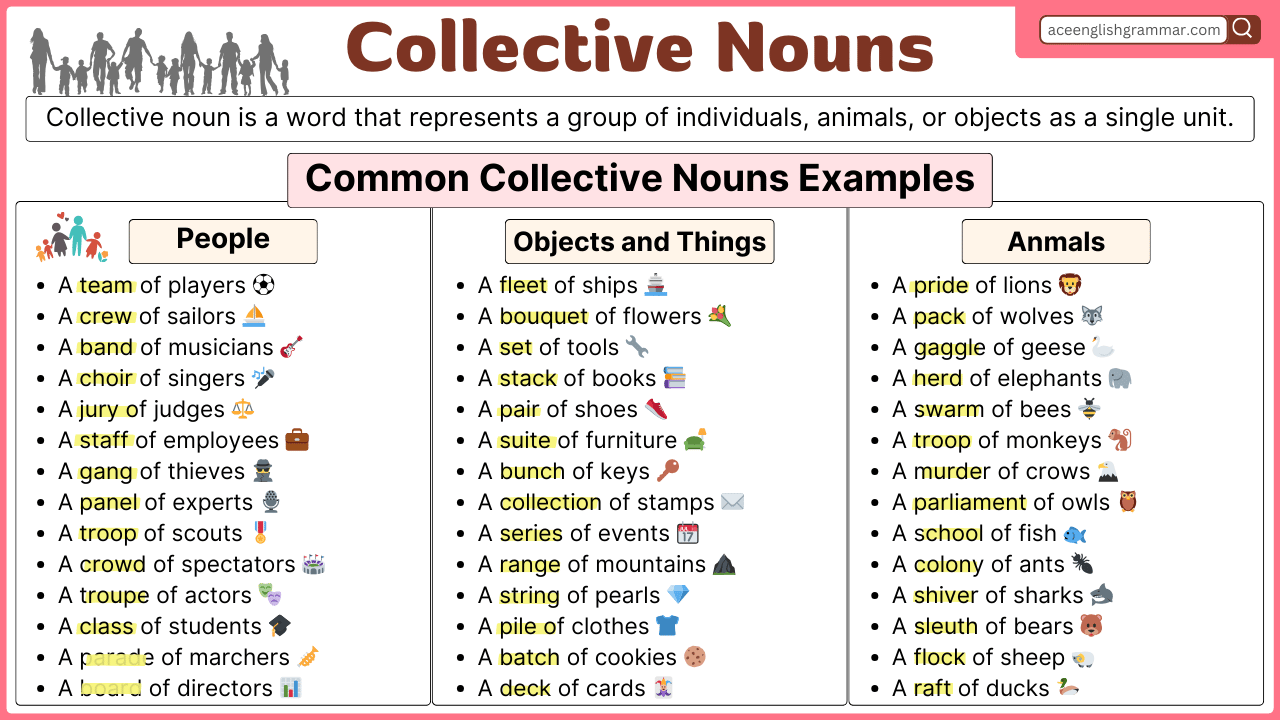
A mass noun names an undivided amount, substance, material, or idea. A collective noun names a group of people, animals, or things viewed as one unit.
| Mass Nouns | Collective Nouns |
|---|---|
| Name an uncountable amount or category | Name a group as one unit |
| Usually cannot be counted directly | Usually can be counted as groups |
| Usually have no regular plural in that meaning | Often have singular and plural forms |
| Examples: water, furniture, rice | Examples: team, family, committee |
Compare these examples:
- The furniture is old.
- The team is celebrating a victory.
The noun furniture refers to objects as one uncountable category. The noun team refers to a group of people. You can say two teams, but you would not normally say two furnitures.
Common Mistakes With Mass Nouns
Most mass noun mistakes happen when a learner gives the noun countable grammar. The correction usually requires one of three changes: remove a/an, use a singular verb, or add a unit expression.
Using a or an before a mass noun.
- ❌ She gave me an advice.
- ✅ She gave me some advice.
- ✅ She gave me a piece of advice.
The noun advice is not used as a regular count noun in standard English, so an advice sounds unnatural. Use some for an amount or a piece of for one item of advice.
Adding a plural ending to a mass noun.
- ❌ The furnitures are expensive.
- ✅ The furniture is expensive.
Although furniture may refer to many chairs, tables, and beds, English treats the word itself as singular and uncountable.
Using many instead of much.
- ❌ There is many traffic on the road.
- ✅ There is much traffic on the road.
- ✅ There is a lot of traffic on the road.
In everyday English, a lot of traffic often sounds more natural than much traffic in affirmative sentences.
Using a plural verb.
- ❌ The information are useful.
- ✅ The information is useful.
The noun information remains singular in grammar, even when it refers to many facts or details.
Examples Of Mass Nouns In Sentences
The following examples show how mass nouns work with singular verbs, quantifiers, and natural sentence patterns.
- The furniture in the office looks modern.
- We need more information before making a decision.
- Traffic becomes heavy during the evening.
- Sugar dissolves quickly in hot tea.
- The weather feels pleasant today.
- She gave me useful advice before the interview.
- Knowledge improves confidence over time.
- Fresh bread was baking in the kitchen.
- Air entered the room through the open door.
- The luggage was too heavy to carry.
Notice the pattern across these sentences. The noun may name many real things, a large amount, or an abstract idea, but the grammar treats it as singular.
FAQs
Q1. What Is A Mass Noun?
A mass noun is a noun that names an amount, material, substance, condition, activity, or abstract idea that English does not normally count as separate units. Examples are water, rice, advice, furniture, and knowledge.
Q2. Are Mass Nouns And Uncountable Nouns The Same?
In everyday grammar teaching, mass noun and uncountable noun are often used for the same kind of noun. Both terms refer to nouns that usually do not take direct numbers or regular plural forms. In technical grammar, mass noun may focus more on substances and materials, while uncountable noun can be a broader label.
Q3. Can Mass Nouns Become Countable?
Yes. Some mass nouns become countable when the meaning changes to a unit, serving, type, or specific item.
- Two coffees can mean two cups of coffee.
- Three papers can mean three documents or academic articles.
- A chicken means one animal, while chicken can mean meat.
Q4. Why Do Mass Nouns Use Singular Verbs?
Mass nouns use singular verbs because English presents them as one whole amount or concept rather than separate countable items.
- The furniture is expensive.
- The information was helpful.
- The rice is ready.
Q5. How Do You Count Mass Nouns?
You count mass nouns by using measurement phrases, containers, portions, or unit expressions.
- A bottle of water.
- A piece of advice.
- A loaf of bread.
- Two cups of tea.
- Three bags of rice.
Download PDF
Get a free PDF with definitions, rules, and examples of mass nouns. Perfect for students and English learners. Download now!
Conclusion
Mass nouns describe substances, materials, foods, conditions, and ideas that English treats as whole amounts rather than separate countable units. Their grammar pattern is consistent: they usually stay singular, avoid direct numbers, and use quantifiers or unit expressions when the sentence needs quantity.
The easiest way to use them accurately is to look at the noun phrase. If the noun itself cannot be counted directly, give it a natural measure: a piece of advice, a bowl of rice, a bottle of water, or a slice of cheese. That small grammar choice keeps the sentence natural, precise, and fluent.
Read More