
English sentences often contain groups of words that work together as one unit. A single noun can become the old wooden chair, a basic place can become under the kitchen table, and a short action idea can become to finish the work before noon. These word groups are called phrases, and they shape how sentences name, describe, modify, and connect ideas.
A phrase does not carry the full subject-verb structure of a clause. Instead, it works inside a larger sentence. In the tall building near the station, the words combine to name one thing with extra detail. In after the meeting, the phrase gives time information, but it does not form a complete sentence by itself.
By the end, you should be able to identify common phrase types in real sentences, understand what each phrase is doing, and avoid confusing phrases with clauses when you analyze or write English.
What Is A Phrase?
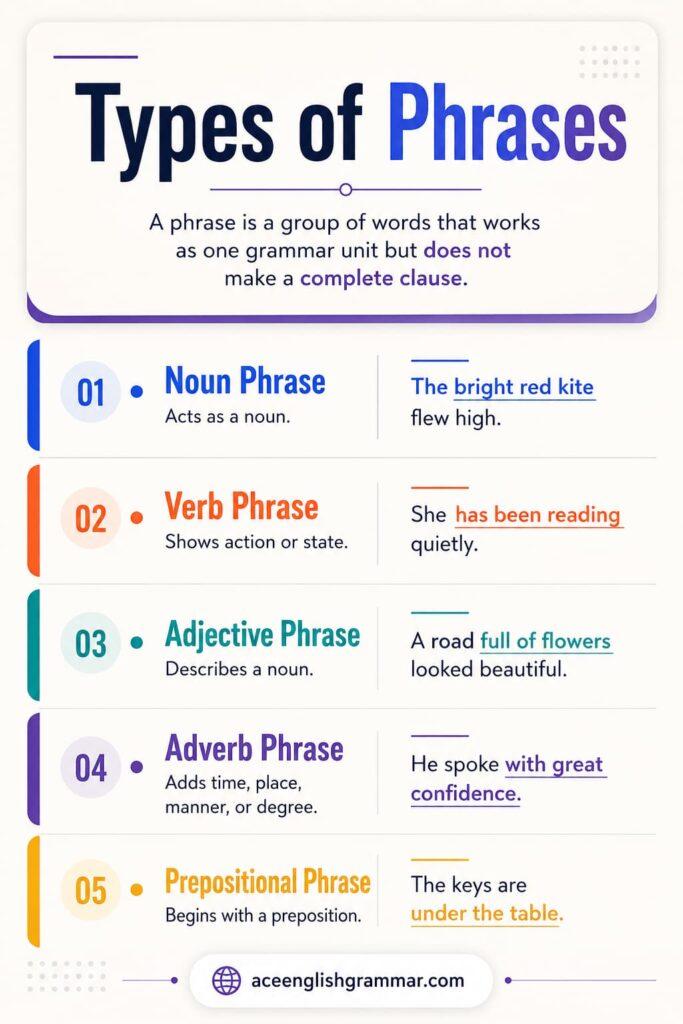
A phrase is a group of related words that functions as one grammatical unit inside a sentence but does not contain the complete subject-verb structure of a clause.
Look at this sentence:
- The big red apple fell from the tree.
The phrase the big red apple works as the subject because the whole group names what fell. The adjectives big and red stay inside the noun phrase and add detail to apple.
Another example:
- She sat near the window.
The phrase near the window gives location information. It does not have its own subject and complete verb, so it cannot stand alone as a sentence.
Phrases make sentences more specific. They can name something, describe something, show time or place, complete a verb, or add background detail.
Phrase Vs Clause
Many learners confuse phrases and clauses because both are groups of words. The difference is the sentence structure inside the group.
| Feature | Phrase | Clause |
|---|---|---|
| Subject and verb | Does not contain a complete subject-verb structure | Contains a subject and verb |
| Complete thought | Does not express a full thought alone | May express a full thought |
| Sentence role | Works inside a sentence | Can work inside or as a sentence |
| Example | After the meeting | The meeting ended |
Compare these examples:
- After the meeting
- We left after the meeting ended.
The first word group is a phrase because it gives time information but has no complete subject and verb. The second sentence contains the clause the meeting ended because meeting is the subject and ended is the verb.
This difference matters because phrases add information, while clauses carry a fuller grammar pattern.
Main Types Of Phrases
Once the basic meaning is clear, the next step is to look at the job a phrase performs in a sentence. A phrase may name something, describe something, show an action pattern, or add time and place information. That sentence role is what gives each phrase type its name.
| Phrase Type | Main Role | Short Example |
|---|---|---|
| Noun phrase | Names a person, place, thing, or idea | The small child |
| Verb phrase | Shows a complete action or state | Has been working |
| Adjective phrase | Describes a noun or pronoun | Very difficult to solve |
| Adverb phrase | Modifies a verb, adjective, or adverb | With great care |
| Prepositional phrase | Shows place, time, direction, or relationship | Under the table |
| Infinitive phrase | Begins with to + verb | To learn French |
| Gerund phrase | Begins with an -ing verb form and acts as a noun | Swimming in the ocean |
| Participial phrase | Uses a participle to describe a noun | Covered in dust |
| Appositive phrase | Renames or explains a noun | A skilled editor |
| Absolute phrase | Adds sentence-level background detail | The weather being cold |
Noun Phrase
A noun phrase works as a noun in a sentence. It usually contains a noun with words that describe, limit, or identify it.
- The black cat slept on the sofa.
- A beautiful old house stood near the river.
- My favorite book is missing.
In the first sentence, the black cat works as the subject. The whole phrase names the animal that slept, not just the word cat.
Common noun phrase patterns include:
| Pattern | Example |
|---|---|
| Article + noun | A teacher |
| Article + adjective + noun | The blue car |
| Possessive + noun | Her bag |
| Number + noun | Three students |
Noun phrases often appear as subjects, objects, or complements.
- The new student answered the question.
- I met a famous writer.
- Her brother is a talented musician.
Verb Phrase
A verb phrase contains a main verb and any helping verbs that belong to the action or state.
- She is reading a novel.
- They have been waiting for hours.
- He will finish the project tomorrow.
In They have been waiting for hours, the complete verb phrase is have been waiting. The helping verbs have and been support the main verb waiting and show the tense pattern.
Verb phrases often include:
- Helping verbs such as is, are, has, have, and been.
- Modal verbs such as can, should, will, and might.
- A main verb that carries the central action or state.
Adjective Phrase
An adjective phrase describes a noun or pronoun. It gives more information about quality, condition, degree, or description.
- The movie was extremely entertaining.
- She wore a dress full of bright colors.
- The exam seemed too difficult to complete quickly.
In the first sentence, extremely entertaining describes the movie. The phrase works like an adjective because it tells what kind of movie it was.
Adjective phrases may appear after linking verbs such as be, seem, look, feel, or become.
- The room looked ready for guests.
- His answer was hard to understand.
Adverb Phrase
An adverb phrase modifies a verb, adjective, or another adverb. It often shows how, when, where, how often, or to what degree something happens.
- She spoke with great confidence.
- The train moved very slowly.
- We finished the task in the morning.
In She spoke with great confidence, the phrase explains how she spoke. It modifies the verb spoke.
Adverb phrases can give different kinds of information:
- Manner: with great care.
- Time: after dinner.
- Place: near the entrance.
- Degree: very slowly.
Prepositional Phrase
A prepositional phrase begins with a preposition and includes the object of that preposition.
- The keys are on the table.
- They walked through the park.
- We met after dinner.
In The keys are on the table, the phrase on the table tells where the keys are. The preposition on connects the keys to a place.
Prepositional phrases commonly show:
- Place: under the bed.
- Time: before sunrise.
- Direction: toward the door.
- Relationship: with her brother.
Common prepositions include:
| Place | Time | Direction |
|---|---|---|
| On | After | Toward |
| Under | Before | Into |
| Near | During | Across |
| Behind | Since | Through |
Infinitive Phrase
An infinitive phrase begins with to + base verb and may include objects or modifiers.
- She wants to learn French.
- We decided to visit the museum.
- He plans to start a business.
In She wants to learn French, the phrase to learn French works as the object of wants. It tells what she wants.
Infinitive phrases can act as nouns, adjectives, or adverbs.
- To travel alone requires confidence.
- She needs a place to study quietly.
- He saved money to buy a laptop.
Gerund Phrase
A gerund phrase begins with an -ing verb form and acts as a noun.
- Swimming in the ocean relaxes her.
- He enjoys reading mystery novels.
- Cooking dinner every evening takes time.
In Swimming in the ocean relaxes her, the whole phrase acts as the subject. The phrase names an activity, not an action happening in the sentence.
This is why gerund phrases often appear where nouns appear:
- As a subject: Reading every night improves focus.
- As an object: She enjoys painting landscapes.
- After a preposition: He is interested in learning Spanish.
Participial Phrase
A participial phrase begins with a participle and describes a noun. Present participles often end in -ing, while past participles often end in -ed, -en, or another past-participle form.
- Covered in mud, the players walked off the field.
- The dog, wagging its tail excitedly, greeted the visitors.
- Shocked by the news, she remained silent.
In Covered in mud, the players walked off the field, the phrase describes the players. The phrase must sit close enough to the noun it describes, or the sentence may become confusing.
Appositive Phrase
An appositive phrase renames or explains a noun beside it.
- My brother, a talented musician, plays the piano.
- Paris, the capital of France, attracts millions of tourists.
- Our teacher, an experienced writer, published a new book.
In the first sentence, a talented musician renames my brother. It gives extra identity information without starting a new clause.
Appositive phrases are often set off with commas when the information is extra rather than essential.
Absolute Phrase
An absolute phrase usually contains a noun plus a participle or modifier and adds background detail to the whole sentence.
- The storm having passed, we went outside.
- Her homework completed, Maya watched television.
- The sun setting behind the hills, the village became quiet.
In The sun setting behind the hills, the village became quiet, the phrase creates a background scene for the main clause. It does not rename one noun or modify one verb directly. It comments on the wider situation.
Absolute phrases are more common in descriptive or formal writing than in everyday speech.
How Phrases Work In Sentences
Phrases expand sentences without always adding new clauses. They help you build detail around a basic idea.
Compare these sentences:
- The boy ran.
- The boy with the blue backpack ran.
- The boy with the blue backpack ran across the field.
- Running across the field, the boy dropped his bag.
The sentence begins with a simple subject and verb: the boy ran. The phrase with the blue backpack identifies the boy more clearly. The phrase across the field adds movement and place. The phrase running across the field describes the boy while the action happens.
Phrases can:
- Add description to a noun.
- Show time, place, reason, or manner.
- Complete the meaning of a verb.
- Rename or explain a noun.
- Create smoother sentence flow.
Good phrase use gives the reader more information without making every idea into a separate sentence.
Rules For Using Phrases
Phrases are flexible, but they still need clear placement and sentence support.
A phrase does not form a complete sentence.
A phrase may sound meaningful, but it does not express a complete thought by itself.
- After the movie. ❌
- We went home after the movie. ✅
Place phrases close to the words they describe.
A misplaced phrase can make the wrong noun seem connected to the description.
- Running quickly, the backpack fell from his shoulder. ❌
- Running quickly, he dropped the backpack from his shoulder. ✅
The first sentence makes it sound as if the backpack was running. The corrected sentence places the action with he, the person doing the running.
Do not overload one sentence with too many phrases.
Too many phrase layers can make the sentence heavy.
- The boy with the blue jacket near the tall building beside the market waited after school. ❌
- The boy in the blue jacket waited beside the market after school. ✅
The revised sentence keeps the useful details and removes the crowded structure.
Use parallel structure in phrase lists.
When several phrases appear in a series, keep their grammatical shape balanced.
- She enjoys reading novels, watching films, and playing chess.
Each phrase begins with an -ing form, so the list sounds balanced and natural.
Common Mistakes With Phrases
Confusing Phrases With Clauses
A phrase does not contain a complete subject-verb pattern. A clause does.
- After the class → phrase
- After the class ended → clause
The word ended gives the second group a verb, and class becomes the subject of that verb.
Misplacing Participial Phrases
A participial phrase should clearly describe the correct noun.
- Walking through the park, the flowers looked beautiful. ❌
- Walking through the park, we noticed the beautiful flowers. ✅
The incorrect sentence suggests that the flowers were walking. The corrected sentence makes we the people walking through the park.
Using Phrase Fragments As Sentences
A phrase can add useful detail, but it still needs a complete sentence around it.
- Near the old bridge. ❌
- We stopped near the old bridge. ✅
The phrase near the old bridge gives location, but the full sentence needs a subject and verb.
Repeating The Same Phrase Pattern Too Often
Phrase repetition can make writing sound flat.
- The man in the coat near the door with the suitcase beside the counter waited quietly. ❌
- The man in the coat waited quietly near the counter. His suitcase stood beside him. ✅
Sometimes the best fix is not another phrase. A second sentence can make the meaning clearer.
How To Identify A Phrase
To identify a phrase, look at how the word group behaves inside the sentence.
Ask these questions:
- Does the group work together as one unit?
- Is it missing a complete subject-verb pattern?
- Does it name, describe, modify, rename, or add detail?
- Does it depend on the rest of the sentence for complete meaning?
If the answer is yes, the word group is probably a phrase.
Look at this sentence:
- The children played in the garden after lunch.
The phrase in the garden tells where they played. The phrase after lunch tells when they played. Both phrases depend on the main clause the children played.
FAQs
Q1. What is a phrase in English grammar?
A phrase is a group of related words that works as one grammatical unit inside a sentence but does not contain the full subject-verb structure of a clause.
Q2. What are the main types of phrases?
The main types include noun phrases, verb phrases, adjective phrases, adverb phrases, prepositional phrases, infinitive phrases, gerund phrases, participial phrases, appositive phrases, and absolute phrases.
Q3. What is the difference between a phrase and a clause?
A phrase does not contain a complete subject-verb pattern. A clause contains a subject and a verb, and an independent clause can stand alone as a sentence.
Q4. Can a phrase be a complete sentence?
No. A phrase cannot stand alone as a complete sentence because it does not express a full thought with a complete subject and verb.
Q5. What is a noun phrase?
A noun phrase is a word group centered around a noun. It can work as a subject, object, or complement in a sentence.
Q6. How do you identify a prepositional phrase?
A prepositional phrase begins with a preposition and includes the object of that preposition, such as on the table, after dinner, or through the park.
Conclusion
Phrases give English sentences structure, detail, and movement without creating complete clauses. When you know what a phrase is doing, naming something, describing something, modifying an action, or adding time and place information, you can read sentence structure with more control and write with clearer sentence flow.
Read More

Leave a Comment