English sentences often contain ideas that behave like a single noun even though they include a subject and a verb. In sentences like What she said surprised everyone or I know that he is honest, the highlighted parts work as complete units inside the sentence. These structures are called noun clauses.
A noun clause adds detail, explanation, or information that a single noun cannot always express clearly. Instead of using one word, English sometimes uses a full clause to act as the subject, object, complement, or appositive in a sentence.
Understanding noun clauses helps you build more natural sentences, understand complex grammar patterns, and improve both spoken and written English.
What Is A Noun Clause?
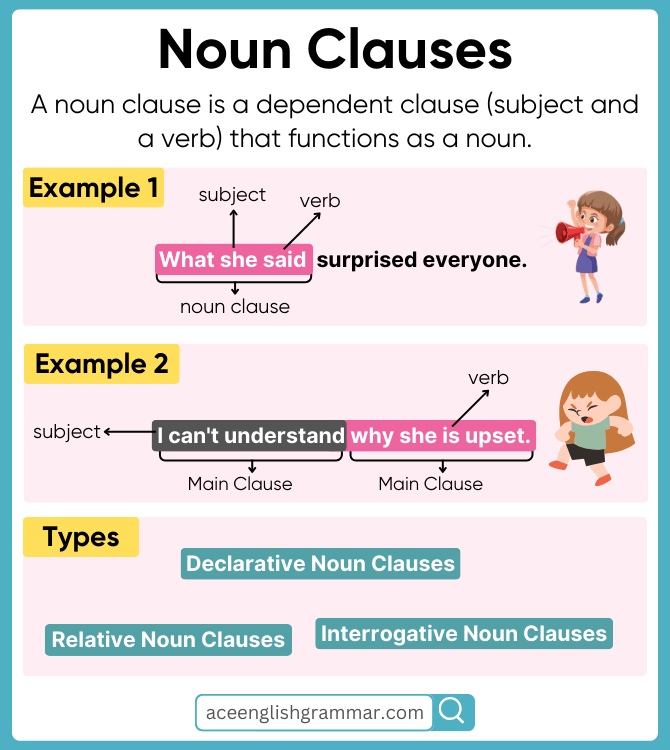
A noun clause is a dependent clause that functions as a noun in a sentence. It usually begins with words such as that, what, who, whether, if, why, where, or how.
Unlike a simple noun, a noun clause contains its own subject and verb.
- What he said upset the team.
- She believes that the plan will work.
- Nobody knows where they went.
Even though these clauses contain complete grammatical structures, they cannot stand alone because they depend on the main sentence.
Incorrect:
- What he said. ❌
Correct:
- What he said upset the team. ✅
The entire clause behaves as one noun unit inside the sentence.
How Noun Clauses Work In Sentences
A noun clause performs the same jobs that a noun normally performs.
Compare these examples:
| Noun | Noun clause |
|---|---|
| The news shocked everyone. | What she said shocked everyone. |
| I know the answer. | I know why he left. |
| The problem is his attitude. | The problem is that nobody agrees. |
The clause replaces a noun while adding more information.
Common Words That Introduce Noun Clauses
Noun clauses usually begin with subordinating words that connect the clause to the rest of the sentence.
| Word | Function | Example |
|---|---|---|
| That | Introduces statements or facts | I believe that she is right. |
| What | Refers to things or information | Tell me what you need. |
| Who | Refers to people | I know who called. |
| Whether/If | Introduces uncertainty or choices | She asked whether we were ready. |
| Why | Introduces reasons | Nobody understands why he left. |
| Where | Refers to place | We know where they live. |
| When | Refers to time | I remember when we met. |
| How | Refers to method or manner | She explained how the machine works. |
| Whoever/Whatever | Refers to indefinite people or things | Whoever arrives first will win. |
These words signal that the clause is introducing information rather than standing alone as an independent sentence.
Functions Of Noun Clauses
Noun clauses can perform several grammatical roles.
As A Subject
A noun clause can act as the subject of a sentence.
- What she said surprised everyone.
- How he solved the problem remains unclear.
- Why they left early is still a mystery.
In these examples, the entire clause performs the action or becomes the focus of the sentence.
As A Direct Object
A noun clause can receive the action of the verb.
- They know where he went.
- I understand why she was upset.
- She admitted that she made a mistake.
The verb depends on the noun clause to complete its meaning.
As A Subject Complement
A noun clause can rename or explain the subject.
- The truth is that he never lied.
- My concern is whether they will arrive on time.
- The problem is that nobody listened carefully.
The noun clause completes the meaning after linking verbs such as is, was, or seems.
As An Object Of A Preposition
A noun clause can follow a preposition.
- They talked about what happened yesterday.
- She is interested in how the project succeeded.
- We argued over who should lead the team.
The clause works as the object connected to the preposition.
As An Appositive
A noun clause can rename a noun by giving more information about it.
- The fact that he apologized impressed everyone.
- Her belief that hard work matters inspired the students.
- The idea that we should leave early made sense.
The clause explains the noun that comes before it.
Types Of Noun Clauses
Noun clauses appear in several common patterns.
That-Clauses
These noun clauses introduce facts, opinions, or statements.
- I believe that she is honest.
- He admitted that he forgot the meeting.
- The teacher explained that the exam would be difficult.
In informal English, that is sometimes omitted.
- I believe she is honest.
Wh-Clauses
These noun clauses begin with question words such as what, who, where, when, why, and how.
- I wonder where they live.
- Nobody knows why the machine stopped.
- Tell me what you need.
These often appear as indirect questions.
If And Whether Clauses
These noun clauses express uncertainty, doubt, or alternatives.
- She asked whether we were ready.
- I do not know if he will come.
- They debated whether the plan would succeed.
Whoever And Whatever Clauses
These noun clauses refer to unknown or indefinite people or things.
- Whoever studies hard will improve quickly.
- She accepted whatever they offered.
- Whatever happens should stay confidential.
How To Identify A Noun Clause
A noun clause can be difficult to recognize at first because it looks like part of a larger sentence. These steps make identification easier.
Step 1: Look For A Clause Starter
Check for words such as:
- That
- What
- Who
- Whether
- If
- Why
- How
- Where
- When
Example:
- I know why he left.
Step 2: Find The Subject And Verb
A noun clause must contain its own subject and verb.
- Why he left
- What she said
- Whether they will arrive
If the structure contains both a subject and a verb, it may be a clause.
Step 3: Check The Function
Replace the clause mentally with a noun.
- I know the answer.
- I know why he left.
Both structures function as objects.
If the clause works as a noun in the sentence, it is a noun clause.
Noun Clause Vs Noun Phrase
Learners often confuse noun clauses with noun phrases because both can function as nouns.
| Noun phrase | Noun clause |
|---|---|
| A talented student | What she achieved |
| The old building | That he succeeded |
| My best friend | Why they argued |
A noun phrase does not contain a full subject-verb structure.
- The tall boy
- My new teacher
A noun clause contains both a subject and a verb.
- What the teacher explained
- Why the team lost
Noun Clause Vs Relative Clause
A noun clause functions as a noun, while a relative clause functions like an adjective.
| Noun clause | Relative clause |
|---|---|
| I know who called. | The man who called is waiting outside. |
| She explained why she left. | The reason why she left surprised us. |
The noun clause replaces a noun role.
The relative clause describes a noun.
Examples Of Noun Clauses
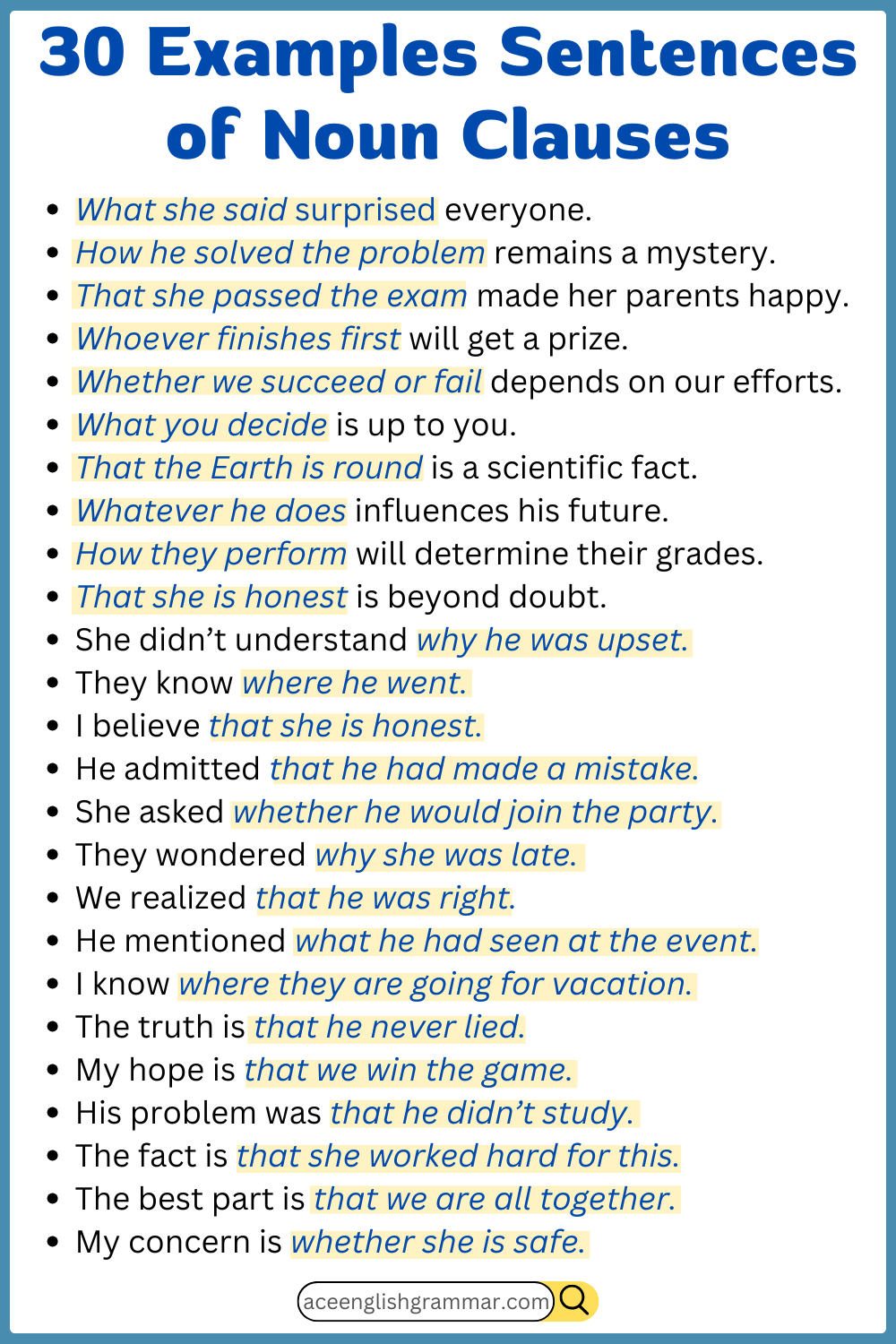
Here are common noun clause examples used in natural sentences.
- I do not know who called me.
- The teacher explained why the sky is blue.
- We were curious about what he meant.
- Where they are going remains unclear.
- She wondered if they would arrive on time.
- He admitted that he made a mistake.
- Tell me what you need.
- They discussed who would lead the project.
- I cannot decide which book to read.
- We forgot when the meeting starts.
- The judge ruled that the evidence was valid.
- Why she left remains a mystery.
Notice how each clause acts as one grammatical unit inside the sentence.
Common Mistakes With Noun Clauses
Noun clause mistakes usually happen when learners confuse independent and dependent structures or omit important connecting words.
Using A Complete Sentence Instead Of A Noun Clause
- I do not know. He is coming. ❌
- I do not know if he is coming. ✅
The noun clause connects the ideas into one sentence.
Forgetting The Clause Marker
- I do not understand you said. ❌
- I do not understand what you said. ✅
The word what introduces the noun clause.
Using Double Connectors
- I do not know that where she went. ❌
- I do not know where she went. ✅
Only one connector is needed.
Using Question Word Order Incorrectly
Noun clauses use statement word order, not direct-question word order.
- I know where is he. ❌
- I know where he is. ✅
The noun clause follows normal subject-verb order.
Practice Exercise
Choose the noun clause in each sentence.
- What she said shocked the audience.
- I know where they live.
- She asked whether the train had arrived.
- The problem is that nobody listened carefully.
- We discussed who should lead the team.
Answers
- What she said
- where they live
- whether the train had arrived
- that nobody listened carefully
- who should lead the team
FAQs
Q1. What is a noun clause in simple words?
A noun clause is a dependent clause that works like a noun inside a sentence.
Q2. How do you identify a noun clause?
Look for a clause with a subject and verb that functions as a subject, object, complement, or appositive.
Q3. What is the difference between a noun phrase and a noun clause?
A noun phrase does not contain a full subject and verb, while a noun clause does.
Q4. Can a noun clause stand alone?
No. A noun clause is dependent and needs a main clause to complete the sentence.
Q5. Are noun clauses and relative clauses the same?
No. Noun clauses function as nouns, while relative clauses describe nouns.
Conclusion
Noun clauses allow English sentences to express detailed ideas in a compact and natural way. Because they work as nouns while containing their own subject and verb, they help speakers explain thoughts, beliefs, questions, uncertainty, and information more precisely. Once you understand how noun clauses function, it becomes much easier to recognize complex sentence structures and write more fluent English.
Download PDF
Click bellow to Download the PDF version of this guide for future reference!
Read More