English sentences often need more than a subject and a verb. They need details that show where something happens, when it happens, how movement takes place, or how one idea relates to another. In the sentence The keys are on the table, the words on the table give the sentence a clear location. That group of words is a prepositional phrase.
Prepositional phrases appear constantly in natural English because they add detail without creating a new clause. They can describe a noun, modify an action, set a time, show direction, or explain a relationship between words in a sentence.
By the end, you should be able to spot prepositional phrases in real sentences, identify what they modify, place them more naturally, and avoid the errors that make sentence meaning unclear.
What Is A Prepositional Phrase?
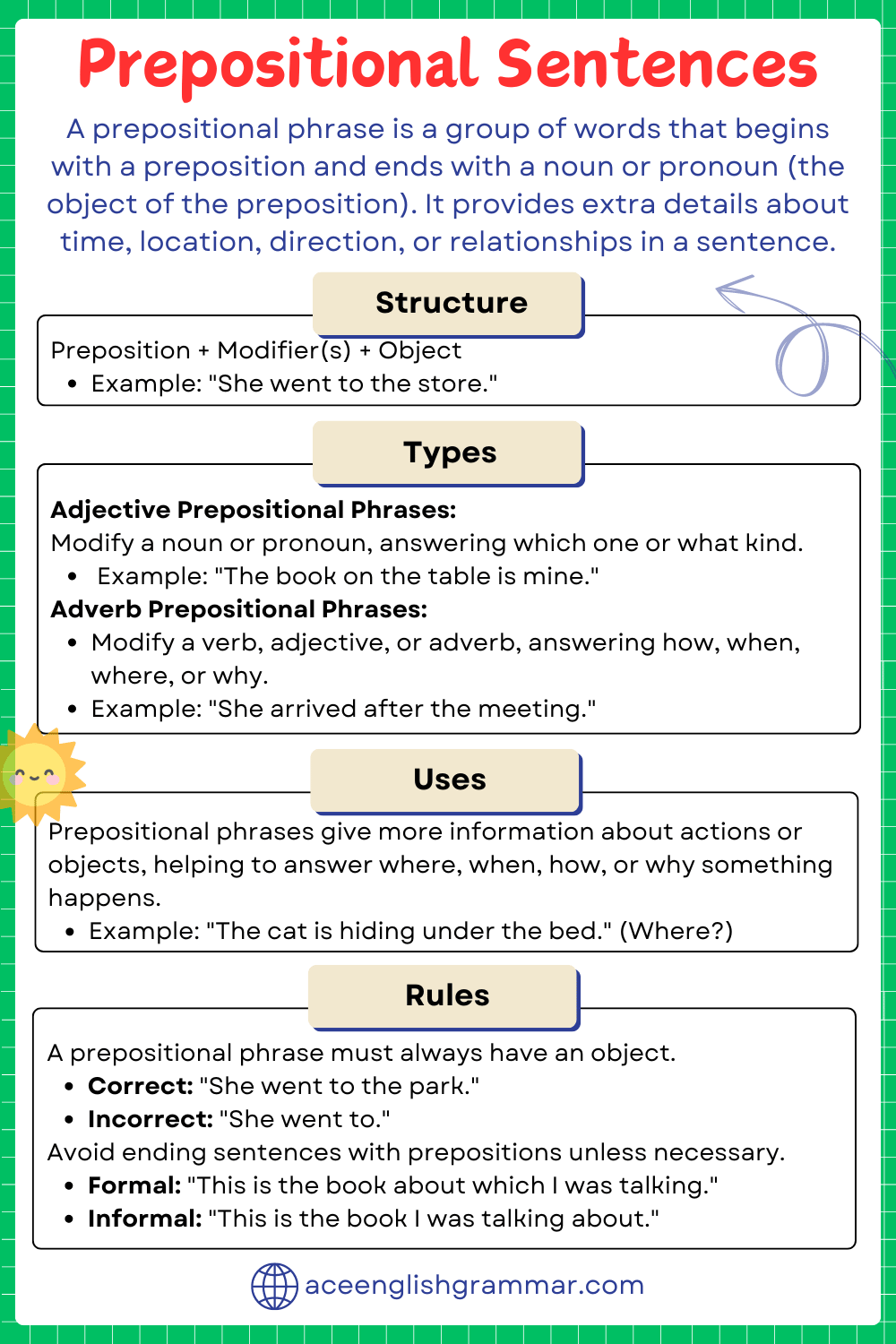
A prepositional phrase is a grammar structure that begins with a preposition and ends with the object of that preposition. The object is usually a noun, pronoun, or noun phrase.
Look at this sentence:
- The cat slept under the bed.
In this sentence:
- Preposition: under
- Object of the preposition: the bed
- Complete prepositional phrase: under the bed
The phrase under the bed tells where the cat slept. If you remove it, the sentence still works, but the location disappears.
- The cat slept.
That difference shows the value of the phrase. It does not create the main sentence, but it gives the sentence sharper meaning.
Structure Of A Prepositional Phrase
Every prepositional phrase needs a preposition and an object. Some phrases also contain modifiers that describe the object more precisely.
| Part | Function | Example |
|---|---|---|
| Preposition | Shows the relationship | under |
| Modifier | Adds detail to the object | the old |
| Object | Completes the preposition | bridge |
Full phrase:
- Under the old bridge
A short phrase may contain only a preposition and an object.
- At school
- Near the river
- During lunch
A longer phrase may add modifiers before the object.
- Under the old bridge
- Inside the large building
- Through the narrow hallway
The important point is that the preposition must have an object. A word like under, near, or during cannot form a complete prepositional phrase by itself.
Common Prepositions In Prepositional Phrases
Prepositions show different kinds of relationships. Some point to location, some show time, and others show movement or connection.
| Relationship | Common prepositions | Example phrase |
|---|---|---|
| Location | in, on, at, under, beside, near | under the bed |
| Direction | to, into, through, across, toward | through the park |
| Time | before, after, during, since, until | after the meeting |
| Relationship | with, without, about, for, concerning | about the project |
These words become part of a prepositional phrase only when they connect to an object.
- She walked through the park.
- They met after the movie.
- He spoke about the project.
After the structure is clear, the next question is not just where the phrase begins. The better question is what the phrase does in the sentence.
Types Of Prepositional Phrases
Prepositional phrases can work like adjectives, adverbs, and sometimes nouns. The type depends on the role the phrase plays, not only on the preposition itself.
Adjective Prepositional Phrases
An adjective prepositional phrase modifies a noun or pronoun. It usually answers which one or what kind.
- The book on the shelf belongs to me.
The phrase on the shelf identifies which book the speaker means. It modifies the noun book, so it works like an adjective.
More examples:
- The man in the black jacket smiled politely.
- The house near the lake looks beautiful at sunset.
- Students from the science department joined the competition.
In each sentence, the phrase gives more information about a noun.
Adverb Prepositional Phrases
An adverb prepositional phrase modifies a verb, adjective, or adverb. It often answers where, when, how, or why.
- She arrived after the meeting.
The phrase after the meeting explains when she arrived. It modifies the verb arrived, so it works like an adverb.
More examples:
- The children played in the garden.
- He spoke with confidence during the interview.
- They traveled through the mountains by train.
These phrases add circumstances around the action. They tell the reader where something happened, when it happened, or how it happened.
Noun Prepositional Phrases
Some prepositional phrases can function like nouns within larger sentence structures. This use is less common, but it appears in natural English.
- Before sunrise is the best time for photography.
The phrase before sunrise acts as the subject of the sentence.
More examples:
- After dinner is usually our quietest time.
- During the holidays can be a busy season for travel.
Most learners will use adjective and adverb prepositional phrases more often, but noun-like prepositional phrases are worth recognizing when they appear.
Prepositional Phrases In Different Sentence Positions
A prepositional phrase can appear at the beginning, middle, or end of a sentence. Its position often changes emphasis and rhythm.
At the beginning:
- After the storm, the streets were flooded.
- In the morning, the market becomes crowded.
A beginning phrase often sets time, place, or context before the main sentence begins.
In the middle:
- The teacher from our school won the award.
- The painting above the fireplace looked antique.
A middle phrase usually adds detail to a noun.
At the end:
- The children ran across the field.
- She left her bag near the door.
An ending phrase often feels natural because it completes the action with location, direction, or time.
Rules For Using Prepositional Phrases
Prepositional phrases are flexible, but several rules keep the sentence clear and grammatically correct.
Keep the preposition connected to its object.
A preposition needs an object to complete the phrase.
- She walked into. ❌
- She walked into the room. ✅
The first sentence feels unfinished because into has no object.
Do not let the object of the preposition control the verb.
The subject controls subject-verb agreement, not the noun inside the prepositional phrase.
- The basket of apples were heavy. ❌
- The basket of apples was heavy. ✅
The subject is basket, not apples, so the singular verb was is correct.
Keep the phrase close to the word it modifies.
A misplaced phrase can make the sentence confusing.
- She saw a dog walking through the window. ❌
- Through the window, she saw a dog walking. ✅
The corrected sentence makes it clear that the person looked through the window. The dog was not walking through it.
Avoid stacking too many phrases together.
Several prepositional phrases in one sentence can make writing heavy.
- The painting on the wall in the room near the hallway beside the kitchen looked expensive.
A cleaner version keeps only the detail readers need.
- The painting near the kitchen hallway looked expensive.
Good writing uses prepositional phrases for precision, not clutter.
Preposition Vs Adverb Confusion
Some words can act as prepositions or adverbs depending on whether they have an object.
- She walked after the group.
- She walked afterward.
In the first sentence, after is a preposition because it connects to the object the group. In the second sentence, afterward works as an adverb because it does not take an object.
This distinction matters when identifying prepositional phrases. A preposition without an object is not a complete prepositional phrase.
How Prepositional Phrases Improve Writing
Prepositional phrases make sentences more specific by adding useful details.
Compare these sentences:
- The child sat.
- The child sat beside the fireplace during the storm.
The second sentence gives a clearer image. The phrase beside the fireplace shows location, and during the storm shows time.
Prepositional phrases are useful when you need to:
- Show where something happens.
- Explain when something happens.
- Describe movement or direction.
- Add detail to a noun.
- Connect ideas more smoothly.
The strongest sentences use these phrases with control. Add the details that sharpen meaning, and remove the ones that slow the sentence down.
Common Mistakes With Prepositional Phrases
Leaving the phrase incomplete
- The cat jumped onto. ❌
- The cat jumped onto the table. ✅
The preposition onto needs an object.
Using too many prepositional phrases together
- The chair beside the desk near the wall under the window looked broken. ❌
- The chair near the window looked broken. ✅
The corrected sentence keeps the most useful location detail.
Letting the wrong noun control the verb
- The box of books were heavy. ❌
- The box of books was heavy. ✅
The subject is box. The phrase of books adds detail but does not control the verb.
Misplacing the phrase
- She served sandwiches to the children on paper plates. ❌
- She served sandwiches on paper plates to the children. ✅
The improved sentence places on paper plates next to sandwiches, so the meaning is easier to read.
FAQs
Q1. What is a prepositional phrase?
A prepositional phrase is a group of words that begins with a preposition, includes the object of that preposition, and adds detail to another part of the sentence.
Q2. What are examples of prepositional phrases?
Common examples include:
- On the table
- After the meeting
- Through the tunnel
- Near the river
Each phrase begins with a preposition and ends with an object.
Q3. What is the object of a preposition?
The object of a preposition is the noun, pronoun, or noun phrase that completes the preposition.
- Under the chair
In this phrase, chair is the object of the preposition under.
Q4. What is the difference between adjective and adverb prepositional phrases?
An adjective prepositional phrase modifies a noun, while an adverb prepositional phrase modifies a verb, adjective, or adverb.
- The book on the shelf is old.
- She waited after class.
In the first sentence, on the shelf describes book. In the second sentence, after class describes when she waited.
Q5. Can a sentence have more than one prepositional phrase?
Yes. A sentence can contain more than one prepositional phrase, especially when it gives both time and place.
- We met at the library after school.
The phrase at the library shows place, and after school shows time.
Conclusion
Prepositional phrases give English sentences detail, direction, and structure. Once you can identify the preposition, find its object, and ask what the phrase modifies, the whole pattern becomes easier to control. Use these phrases to make sentences more precise, but keep them close to the words they describe so the meaning stays clear.
Read More