English does not give most nouns masculine or feminine forms. Words like book, city, teacher, and student can stand without showing gender. Some nouns, however, identify a male or female person or animal directly. Words such as king, queen, father, mother, rooster, and hen are called gender-specific nouns because the gender is built into the noun itself.
These nouns still appear in family relationships, royalty, animal vocabulary, literature, and everyday description. At the same time, modern English often avoids older gendered job titles when gender is not important to the sentence. A word like firefighter usually sounds more natural and professional than fireman, and flight attendant is now preferred over stewardess in formal English.
By the end, you should be able to identify gender-specific nouns in real sentences, separate them from gender-neutral nouns, and choose modern alternatives when a traditional gendered title sounds too narrow or outdated.
What Are Gender-Specific Nouns?
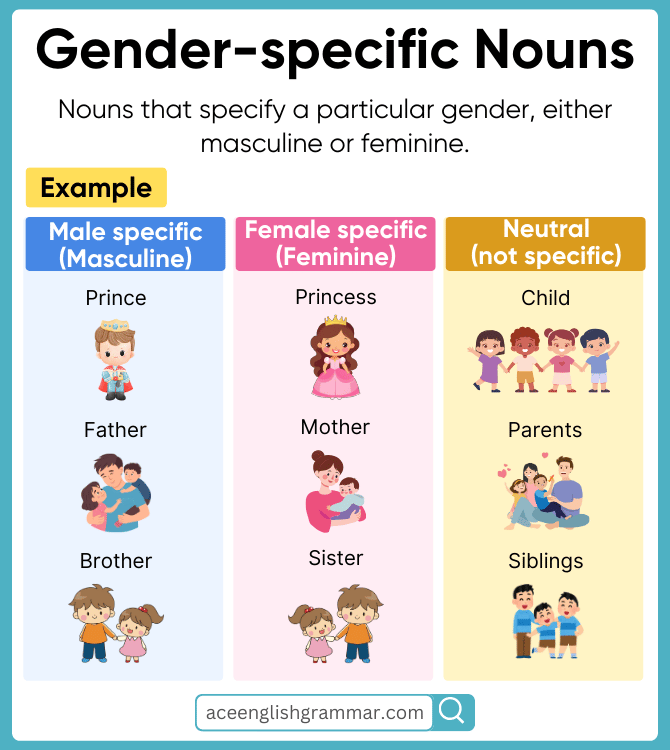
A gender-specific noun is a noun that names a male or female person or animal directly. Words such as father, mother, lion, and lioness show gender through the noun itself, not through an added description.
Compare these sentences:
- The teacher explained the lesson.
- The mother explained the lesson.
The first sentence keeps gender out of the noun because teacher can refer to any gender. The second sentence adds gender through mother, so the reader immediately knows the person is female.
This is the main difference: gender-specific nouns carry gender meaning inside the word, while gender-neutral nouns need extra context if gender matters.
Gender-Specific Nouns Examples
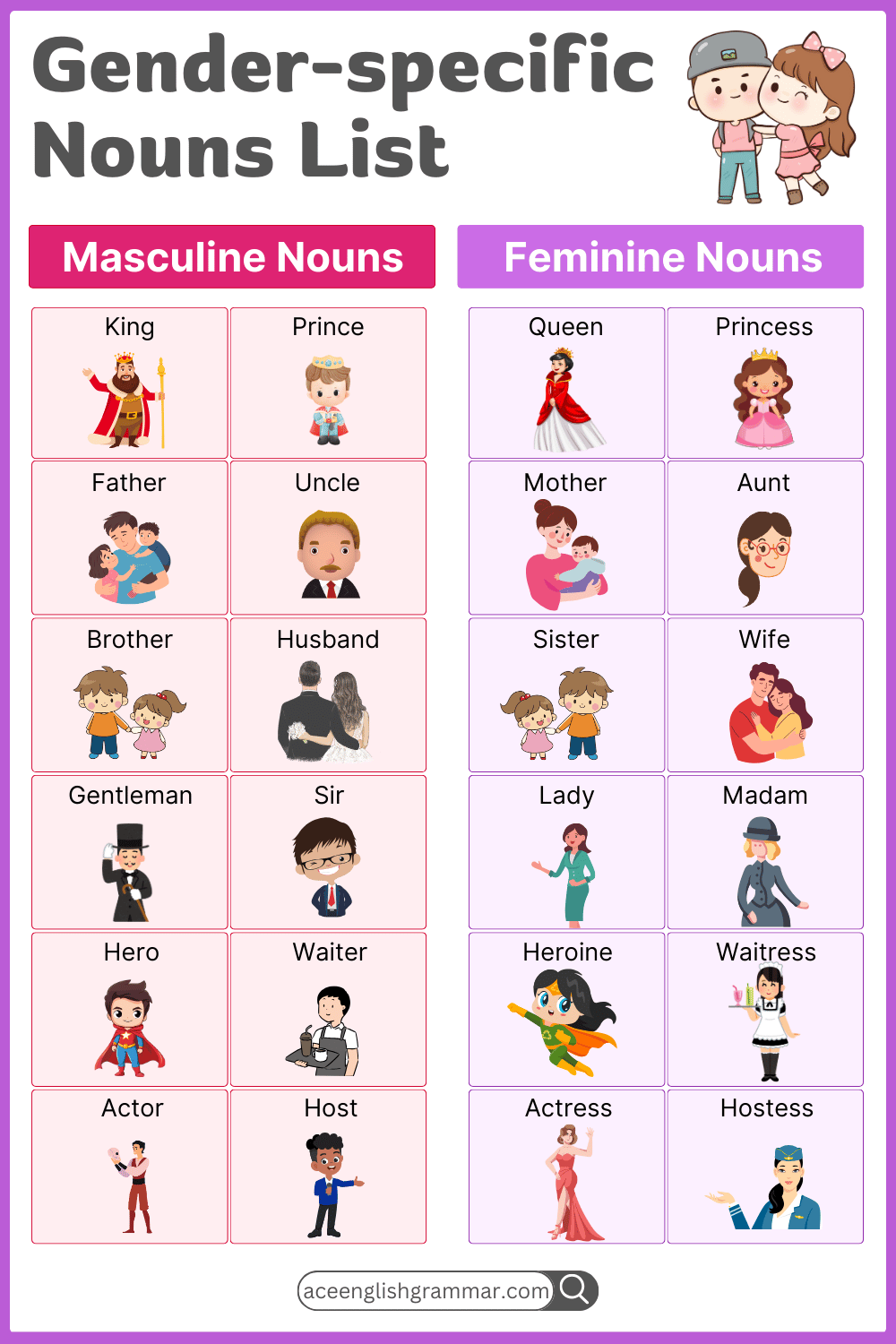
Gender-specific nouns often appear in masculine and feminine pairs. Some pairs are common in daily conversation, while others appear more often in stories, history, royalty, or formal description.
| Masculine noun | Feminine noun |
|---|---|
| King | Queen |
| Father | Mother |
| Brother | Sister |
| Son | Daughter |
| Husband | Wife |
| Uncle | Aunt |
| Nephew | Niece |
| Prince | Princess |
| Emperor | Empress |
| Duke | Duchess |
| Hero | Heroine |
| Bachelor | Bachelorette |
These nouns do more than name a person. They also tell the reader which gender the noun refers to.
- The king addressed the people from the palace balcony.
- Her mother teaches mathematics at a local school.
- The prince greeted the crowd during the ceremony.
- The duchess attended the royal banquet.
Main Types Of Gender-Specific Nouns
Gender-specific nouns are easiest to read when grouped by real use. Family words, animal names, royal titles, and older profession titles do not behave exactly the same way in modern English.
Family And People Nouns
Family nouns are among the most common gender-specific nouns in English. These words usually remain natural because family relationships often depend on gender distinction.
| Masculine noun | Feminine noun |
|---|---|
| Father | Mother |
| Brother | Sister |
| Son | Daughter |
| Uncle | Aunt |
| Nephew | Niece |
| Husband | Wife |
| Bridegroom | Bride |
| Gentleman | Lady |
| Monk | Nun |
- My uncle works as a lawyer.
- Her sister lives in Canada.
- The bride walked into the hall with her father.
In these examples, the gendered noun gives real information. Replacing uncle with relative or bride with person would remove meaning the sentence needs.
Animal Gender-Specific Nouns
English uses separate masculine and feminine nouns for some animals, especially in farming, wildlife writing, breeding, and storytelling.
| Masculine noun | Feminine noun |
|---|---|
| Lion | Lioness |
| Tiger | Tigress |
| Bull | Cow |
| Rooster | Hen |
| Stallion | Mare |
| Ram | Ewe |
| Buck | Doe |
| Gander | Goose |
| Fox | Vixen |
- The lioness protected her cubs.
- A rooster crowed before sunrise.
- The stallion ran across the field.
These forms are more specific than general animal names. Horse names the animal, while stallion and mare identify the animal’s sex.
Royal And Status Titles
Royal, noble, and historical titles often have traditional masculine and feminine forms.
| Masculine noun | Feminine noun |
|---|---|
| King | Queen |
| Prince | Princess |
| Emperor | Empress |
| Duke | Duchess |
| Baron | Baroness |
| Lord | Lady |
- The queen received the ambassador at the palace.
- The emperor expanded his territory.
- The princess appeared at the ceremony.
These nouns remain common because they belong to historical, cultural, and formal title systems.
Professional Titles And Modern English
Some profession nouns once had separate masculine and feminine forms. Modern English now prefers neutral job titles in many formal, academic, and workplace contexts.
| Traditional gendered term | Modern neutral alternative |
|---|---|
| Policeman | Police officer |
| Fireman | Firefighter |
| Chairman | Chairperson or chair |
| Stewardess | Flight attendant |
| Waiter or waitress | Server |
| Mailman | Mail carrier or postal worker |
A gender-specific job title is not always wrong, but it can sound outdated when gender is irrelevant.
- The police officer arrived quickly.
- The firefighter entered the building.
- The chair opened the meeting.
- The flight attendant welcomed the passengers.
The noun should match the purpose of the sentence. If the job is the focus, a neutral title usually works better. If gender is part of a story, quotation, or historical setting, a gender-specific noun may still fit.
Actor is a useful modern example. Traditionally, actor referred to a man and actress referred to a woman. Today, actor is often used as a neutral professional title for all genders, especially in awards, journalism, and entertainment writing.
Gender-Specific Vs Gender-Neutral Nouns
Gender-specific nouns are not automatically better or worse than gender-neutral nouns. The choice depends on whether gender matters to the sentence.
| Gender-neutral noun | Gender-specific noun |
|---|---|
| Parent | Father, mother |
| Sibling | Brother, sister |
| Child | Son, daughter |
| Teacher | Mr., mother, father, woman, man, if context requires it |
| Doctor | Male doctor, female doctor, if relevant |
| Ruler | King, queen |
| Animal | Lion, lioness, rooster, hen |
Compare the difference:
- The parent signed the form.
- The father signed the form.
The first sentence does not identify gender. The second sentence does. If gender is not important, parent may be enough. If the sentence needs the exact family role, father gives clearer meaning.
Rules For Using Gender-Specific Nouns
Gender-specific nouns work best when they add necessary information. They should not be used only because an older form exists.
Use a gender-specific noun when gender affects the meaning.
- The queen addressed the nation.
- The bride entered the hall.
- The lioness stayed close to her cubs.
In each sentence, the gender-specific noun carries useful meaning.
Use a gender-neutral noun when gender is not needed.
- The firefighter rescued the child.
- The teacher marked the essays.
- The doctor explained the results.
These sentences focus on the role, not the person’s gender.
Match pronouns carefully.
- The king gave his speech.
- The queen thanked her supporters.
- The lioness guarded her cubs.
The noun often guides the pronoun. When the noun is gender-neutral, use the pronoun that fits the person or use they when gender is unknown or not relevant.
Common Mistakes With Gender-Specific Nouns
Using Old Professional Titles When A Neutral Title Fits Better
- The stewardess helped the passengers. ❌
- The flight attendant helped the passengers. ✅
The second sentence sounds more modern and professional because gender is not needed.
Treating Neutral Nouns As Gender-Specific
- Teacher is a masculine noun. ❌
- Teacher is a gender-neutral noun. ✅
The noun teacher does not show gender by itself. The sentence needs extra context if gender matters.
Choosing A Gendered Word That Changes The Meaning
- The queen ruled the kingdom.
- The king ruled the kingdom.
Both sentences are grammatically correct, but they do not mean the same thing. The noun changes the gender identity of the ruler.
Using A Gendered Job Title Without Considering Modern Usage
- The chairman called the meeting to order.
- The chair called the meeting to order.
In many modern workplaces, chair or chairperson sounds more inclusive and more current.
How To Identify Gender-Specific Nouns
A simple test is to ask whether the noun itself identifies gender.
- Does the word name a male or female person directly?
- Does it have a masculine or feminine partner?
- Would replacing it with a neutral noun remove gender information?
Examples:
- Brother → sister
- Father → mother
- Lion → lioness
- Rooster → hen
- Duke → duchess
If the noun answers gender through the word itself, it is gender-specific.
Gender-Specific Nouns Exercise
Identify the gender-specific noun in each sentence.
- The prince waved at the crowd.
- My aunt is a talented artist.
- The waitress served dinner quickly.
- The groom looked nervous before the ceremony.
- The heroine saved the village from danger.
- The lioness watched her cubs closely.
- The duke attended the royal banquet.
- The bride thanked her family.
Answers
- Prince
- Aunt
- Waitress
- Groom
- Heroine
- Lioness
- Duke
- Bride
FAQs
Q1. What Are Gender-Specific Nouns?
Gender-specific nouns are nouns that identify a male or female person or animal directly. Examples include father, mother, king, queen, lion, and lioness.
Q2. What Is The Difference Between Gender-Specific And Gender-Neutral Nouns?
Gender-specific nouns show gender through the noun itself, while gender-neutral nouns do not.
- Gender-specific: Brother, sister, uncle, aunt.
- Gender-neutral: Teacher, doctor, student, friend.
Q3. Are Gender-Specific Nouns Still Used In Modern English?
Yes. They remain common in family terms, animal vocabulary, royal titles, literature, and historical writing. Modern English, however, often prefers neutral titles for jobs and official roles.
Q4. What Are Some Gender-Neutral Alternatives For Job Titles?
Common alternatives include police officer, firefighter, flight attendant, server, chair, and chairperson.
Q5. Is Actor A Gender-Specific Noun?
Traditionally, actor was masculine and actress was feminine. In modern English, actor is often used as a gender-neutral professional title.
Conclusion
Gender-specific nouns are useful when gender is part of the meaning, especially in family terms, animal names, royal titles, and storytelling. In professional or formal writing, modern English often favors gender-neutral nouns unless gender adds necessary information. The strongest choice is the noun that gives the reader the right amount of detail without sounding outdated or unnecessarily narrow.
Prv
Download PDF
Get a free PDF with definitions, rules, and examples of gender-specific nouns. Ideal for students and learners. Download now!
Read More