
Type a sentence above and press Convert.
Runs in your browser. Nothing you type is stored.
Most tense tools ask you to pick a target first. You choose past perfect, press a button, and one conjugated sentence comes back. This all tenses converter inverts that. You type a sentence once and read every tense at the same time, so you watch the auxiliary change while the subject and object stay fixed. It converts present tense to past tense, past tense to present tense, and every form in between, in one screen.
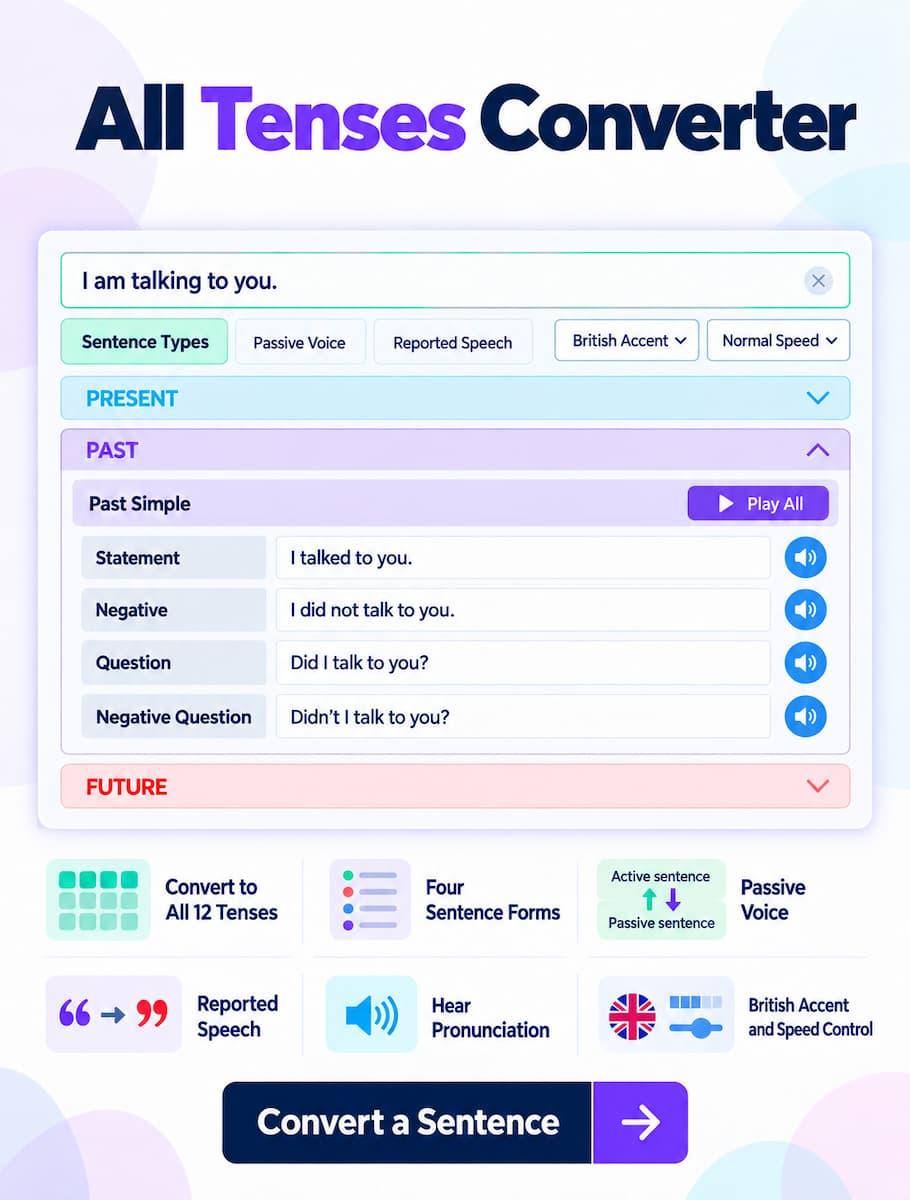
What An All Tenses Converter Does
An all tenses converter conjugates one English sentence across all twelve tenses at once. This tool inflects each tense into four sentence types: statement, negative, question and negative question. One typed sentence therefore yields up to 48 conjugated versions, plus its passive voice and reported speech equivalents.
How Many Tenses English Has
English has twelve tenses, built from three time frames and four aspects. The three time frames are past, present and future. The four aspects are simple, continuous, perfect and perfect continuous. Three multiplied by four gives the twelve forms the converter produces from a single sentence.
| Time frame | Simple | Continuous | Perfect | Perfect continuous |
|---|---|---|---|---|
| Past | Past Simple | Past Continuous | Past Perfect | Past Perfect Continuous |
| Present | Present Simple | Present Continuous | Present Perfect | Present Perfect Continuous |
| Future | Future Simple | Future Continuous | Future Perfect | Future Perfect Continuous |
Convert A Sentence Into All 12 Tenses
Type She eats breakfast at seven and the verb eat conjugates twelve ways while the subject and the time phrase stay untouched:
| Tense | Conjugated sentence |
|---|---|
| Past Simple | She ate breakfast at seven. |
| Past Continuous | She was eating breakfast at seven. |
| Past Perfect | She had eaten breakfast at seven. |
| Past Perfect Continuous | She had been eating breakfast at seven. |
| Present Simple | She eats breakfast at seven. |
| Present Continuous | She is eating breakfast at seven. |
| Present Perfect | She has eaten breakfast at seven. |
| Present Perfect Continuous | She has been eating breakfast at seven. |
| Future Simple | She will eat breakfast at seven. |
| Future Continuous | She will be eating breakfast at seven. |
| Future Perfect | She will have eaten breakfast at seven. |
| Future Perfect Continuous | She will have been eating breakfast at seven. |
Each tense also negates, inverts into a question, and combines both. The contracted negative sits beside the full one, since She does not eat breakfast belongs in formal writing and She doesn’t eat breakfast belongs in speech.
Change Present Tense To Past Tense
To change present tense to past tense, replace the present verb with its past form: She writes becomes She wrote, and They walk becomes They walked. The converter applies this across all four past forms at once, so a present sentence returns its past simple, past continuous, past perfect and past perfect continuous together.
Type She writes stories and the past column reads: She wrote stories (past simple), She was writing stories (past continuous), She had written stories (past perfect), She had been writing stories (past perfect continuous). Irregular verbs like write to wrote are handled from the built-in list, so you never guess the past form.
Change Past Tense To Present Tense
To change past tense to present tense, move the verb from its past form to its present form and adjust subject agreement: She wrote becomes She writes, and They walked becomes They walk. The converter reads the past sentence you type, identifies the verb, and rebuilds it in all three present forms.
Type They finished the project and the present column returns They finish the project, They are finishing the project, and They have finished the project. The third person singular takes its -s ending automatically, so He walked returns He walks rather than He walk.
Change A Sentence Into Future Tense
To change a sentence into the future tense, place will before the base verb: She writes and She wrote both become She will write. The converter produces all four future forms from any sentence you type, whatever tense it started in.
Type She eats breakfast and the future column returns She will eat breakfast, She will be eating breakfast, She will have eaten breakfast, and She will have been eating breakfast. Because will takes the base verb, the future forms stay regular even when the verb is irregular elsewhere.
Why One Sentence Has 48 Forms
English marks time with three time frames and four aspects, which conjugates any verb twelve ways. Each of those twelve then negates and inverts into a question, which produces forty-eight versions of one sentence.
Learners rarely read all forty-eight together. Textbooks drill one tense per chapter, so the kinship between had eaten and will have eaten stays buried fifty pages apart. Read side by side, the shared rule becomes obvious: both take a perfect auxiliary plus the past participle, and only the auxiliary shifts time frame.
Irregular Verbs In Tense Conversion
Irregular verbs are the hardest part of tense conversion, because their past and participle forms do not follow the -ed rule. Go becomes went and gone, write becomes wrote and written, break becomes broke and broken. The converter carries a complete irregular verb list, so it picks the right form rather than adding -ed to a verb that never takes it.
Type He goes to school and the converter returns He went to school for the past simple and He has gone to school for the present perfect, using the two distinct irregular forms. Regular verbs use the same form for both, which is why He walked and He has walked share walked, and irregular verbs split them.
Transformation Of Tenses For Exams
Transformation of tenses is a standard exam task: a sentence is given in one tense and rewritten in another, often with an instruction like “change into past continuous”. The converter runs every transformation at once, so a student checks an answer against all twelve forms rather than one.
Exam questions also test the adverb and time-word changes that follow a tense shift. When a sentence moves to the perfect, yesterday no longer fits, and the converter flags that clash rather than producing a sentence no examiner would accept.
Wh-Question And Yes/No Question Conversion
The converter conjugates both yes/no questions and wh-questions across the tenses. A yes/no question keeps its auxiliary at the front: Does she play? returns Did she play? and Has she played? A wh-question holds its question word in place while the verb phrase moves beneath it.
Type Where does she live? and the converter returns Where was she living?, Where has she lived?, and Where will she live? A wh-question has no statement form, so those cards show the question and negative question only, which matches how the grammar works. Subject questions keep statement word order, so Who called you? becomes Who calls you?
Active To Passive Voice Across Tenses
The converter changes active voice to passive across every tense, and passive back to active. In She wrote the letter, the object the letter becomes the subject, be takes the past form, and write drops to its past participle, giving The letter was written by her.
Type an active sentence and the passive column runs from The letter is written through The letter was written, The letter has been written, and The letter will be written. A toggle drops the by agent when the doer does not matter. A sentence with no object, such as She sleeps, has no passive, and the converter says so rather than inventing one.
Direct To Indirect Speech
The converter changes direct speech to indirect speech, applying the backshift, pronoun shift and time-word shift together. Direct speech I will call you tomorrow reports as She told me that she would call me the next day, with will moving to would and tomorrow moving to the next day.
You set the speaker and the listener, so the pronouns resolve to the people you name rather than a default. A statement reports with said that, and a question reports with asked, which is the change most learners miss when they convert direct speech to indirect speech by hand.
Tense Mistakes The Converter Catches
- Incorrect: She has visited Japan last year. Correct: She visited Japan last year.
- Incorrect: She is knowing the answer. Correct: She knows the answer.
- Incorrect: Did she went home? Correct: Did she go home?
- Incorrect: They has finished the work. Correct: They have finished the work.
- Incorrect: He don’t like cold weather. Correct: He doesn’t like cold weather.
Conjugating your own sentence twelve ways exposes these errors faster than a grammar checker flags them, because eleven correctly conjugated versions sit on the same screen for comparison.
Sentences The Converter Refuses
Accuracy comes from refusing what the conjugation rules do not reach. When a sentence falls outside that range, the converter names the grammatical reason and rewrites your own words into a conjugable clause, which loads with one tap.
- Imperatives carry no subject to agree with the verb. Never talk to me rewrites to You never talk to me.
- Two-clause sentences hold two finite verbs, so each clause conjugates separately. Because she was late, she ran rewrites to She ran.
- Fixed forms such as had better, would rather and used to do not move through the twelve tenses. She used to play tennis rewrites to She played tennis.
- Exclamations and greetings contain no finite verb to inflect. What a beautiful day! rewrites to The day is beautiful.
- Subject-verb disagreement is flagged, never silently corrected. She play tennis rewrites to She plays tennis.
Who Uses A Tense Converter
ESL and EFL learners at CEFR levels A2 to B2 sit at the centre of this tool, since that band covers all twelve tenses and drills sentence transformation daily. IELTS and TOEFL candidates check the perfect continuous forms that speaking and writing tasks reward. Teachers build gap-fills and transformation drills from the forty-eight forms of a single sentence. Writers checking tense consistency convert a shifted sentence back to the tense their draft started in.
Final Thoughts On Converting Sentences Across Tenses
Drilling tenses one chapter at a time hides the rule that links them. Converting a single sentence into all twelve forms, with each negation and question beside it, collapses twelve separate lessons into one screen. Type a sentence you actually say, change it from present to past and back again, and watch which word moves and which words never do.
FAQs
An all tenses converter conjugates one English sentence across every tense at once. Rather than inflecting toward a single target tense, it conjugates the past, present and future together, then negates and inverts each one.
English has twelve tense forms, built from three tenses and four aspects. The three tenses are past, present and future, and the four aspects are simple, continuous, perfect and perfect continuous.
Yes. Yes/no questions and wh-questions both conjugate. A wh-question holds its question word at the front while the auxiliary inverts beneath it, so Where does she live? conjugates to Where was she living? and Where will she have lived?
The converter refuses clauses that carry no finite verb to inflect, no subject to agree with, or two finite verbs at once. Each refusal names the grammatical reason and rewrites your words into a clause that conjugates.
Yes. The tool conjugates in your browser with no account, no word limit and no daily usage cap. Nothing you type is stored or transmitted.
Yes. A transitive clause promotes its object to subject, inflects be for the tense, and drops the main verb to its past participle. An intransitive verb has no object to promote, so the converter explains that instead of inventing a passive.
Present simple, past simple and present perfect carry most spoken and written English. The perfect continuous conjugations surface far less often in speech, though exams test them heavily.
Yes. Teachers type one clause, then copy the forty-eight conjugations into drills and gap-fills. That removes the manual conjugation work behind worksheet preparation.
A tense chart lists the twelve tenses with a fixed textbook sentence for each. A tense converter conjugates your own sentence into those twelve forms, so you read the rule applied to words you chose rather than to I eat an apple.
Modal verbs have no full set of twelve tense forms, so She can swim routes to the Sentence Types tab instead. There it negates to She cannot swim and inverts to Can she swim?, which is the full range English allows for a modal.