
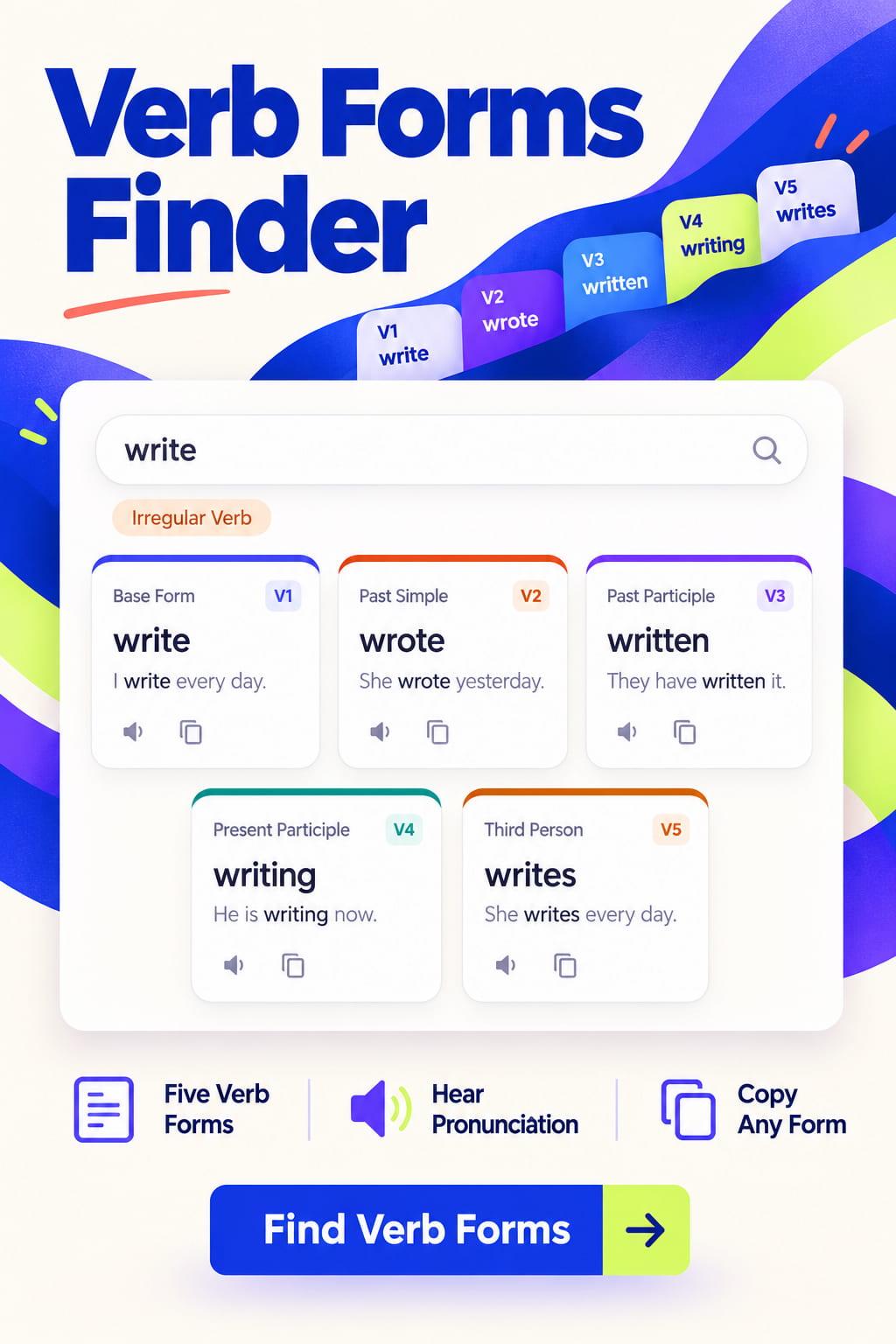
Type any verb and get all five forms: V1, V2, V3, V4, V5, with an example for each.
Start Typing A Verb To See V1 To V5.
Runs in your browser. Nothing you type is stored.
Type a verb and this tool shows every form at once: the base, the past, the past participle, the -ing form and the third person -s. You can type any of those forms too, so “written”, “went” or “studying” each find their base verb and return the full set. It works instantly, in your browser, across more than 8,000 verbs.
Static tables make you scroll a thousand rows to find one verb. This tool finds verb forms the moment you type.
What A Verb Form Finder Does
A verb finder takes one English verb and shows its five forms together. You give it a verb in any form, and it returns all five. Those are the base form (V1), the past simple (V2), the past participle (V3), the present participle or -ing form (V4), and the third person singular (V5). Each form comes with a short example so you see it in use.
The tool also tells you whether the verb is regular or irregular, which is the single most useful thing to know before you use it.
Find Verb Forms Instantly
To find verb forms, type the verb into the box and read the five cards that appear. There is no button to press and no list to scroll. Type “make” and you get make, made, made, making, makes, each on its own card with an example sentence.
The finder accepts messy input on purpose. Type a capital letter, a trailing space or the wrong form, and it still resolves the verb. This matters because learners often know one form of a verb and want the rest.
Find Verb Forms V1 V2 V3
The V1 V2 V3 pattern is how many learners and textbooks label the three core forms of a verb:
- V1 is the base form, the verb as it appears in a dictionary: go, write, eat.
- V2 is the past simple, used for finished past actions: went, wrote, ate.
- V3 is the past participle, used after have and in the passive: gone, written, eaten.
Two more forms complete the set. V4 is the -ing form (going, writing, eating), and V5 is the third person singular with its -s ending (goes, writes, eats). Some materials swap the V4 and V5 labels, so the finder shows the grammatical name first and the V-number second, which keeps it correct whatever your textbook uses.
Find The Three Forms Of A Verb
The three forms of a verb most exercises ask for are V1, V2 and V3: base, past simple and past participle. These are the forms printed in verb tables and tested in exams, because they carry the tense and the voice of a sentence.
For a regular verb, V2 and V3 are identical, both made by adding -ed. Walk gives walked and walked. For an irregular verb, the two forms split, which is exactly where learners get stuck. The finder marks this difference on every result, so you know at a glance whether a verb follows the rule or breaks it.
Regular And Irregular Verbs
Regular verbs form their past and participle by adding -ed, with small spelling changes for doubling and for verbs ending in -y. Study becomes studied, stop becomes stopped, play becomes played. Once you know a verb is regular, all five forms are predictable.
Irregular verbs do not follow that rule, and their past and participle forms have to be learned. The finder carries a complete irregular verb list, so it never adds -ed to a verb that does not take it. Type “begin” and you get began and begun, not the incorrect “beginned”.
- ❌ Incorrect: She goed home. ✅ Correct: She went home.
- ❌ Incorrect: They have eated. ✅ Correct: They have eaten.
- ❌ Incorrect: He writed a letter. ✅ Correct: He wrote a letter.
Find The Past Tense And Past Participle Of A Verb
To find the past tense of a verb, look at its V2 form, and to find the past participle, look at its V3 form. The finder shows both side by side, which is the fastest way to see whether they match or differ.
Take the verb find itself. Its past tense is found and its past participle is also found, so find is irregular but its V2 and V3 happen to share a spelling. Compare that with write, where the past is wrote and the participle is written, two clearly different forms. Seeing both on screen removes the guesswork.
Find The Second Form And Third Form Of A Verb
The second form of a verb is its past simple, and the third form is its past participle. Learners search for these separately because an exercise often asks for one without the other.
The finder answers both at once. Type any verb and the V2 card gives the second form while the V3 card gives the third form, each with an example. For a verb like speak, the second form is spoke and the third form is spoken, and the tool shows the vowel change that many learners miss.
Find Verb Forms Across The Tenses
Knowing the five forms is the first step, and it also helps you find verb tenses in use. Using the forms across the tenses is the next step, because each tense pulls a different form of the verb. The past simple uses V2, the perfect tenses use V3, and the continuous tenses use V4.
If you want to see a full sentence move through every tense rather than a single verb in isolation, a tense converter does that. The finder gives you the raw forms; for full verb conjugation across sentences, a tense converter puts them into working sentences.
How To Use The Verb Finder
- Type a verb into the box, in any of its forms.
- Read the five cards: base, past, past participle, -ing form and third person.
- Check the badge to see whether the verb is regular or irregular.
- Press the speaker icon to hear a form, or the copy icon to copy it.
- Type a new verb to start again. The result updates as you type.
The tool runs entirely in your browser. Nothing you type is uploaded or stored.
FAQs
Q1. What is a verb form finder?
A verb form finder is a tool that shows all the forms of an English verb at once. You type a verb and it returns the base form, past simple, past participle, -ing form and third person singular, each with an example sentence.
Q2. How do I find the forms of a verb?
Type the verb into the finder and read the five cards that appear. You can type any form of the verb, such as “gone” or “going”, and the tool resolves it to the base verb and shows the complete set.
Q3. What are V1 V2 V3 V4 V5?
V1 is the base form, V2 is the past simple, V3 is the past participle, V4 is the -ing form, and V5 is the third person singular. Some books swap the V4 and V5 labels, so the finder shows the grammatical name alongside each number.
Q4. How do I find the past and past participle of a verb?
The past tense is the verb’s V2 form and the past participle is its V3 form, and the finder shows both together. For regular verbs the two are the same, and for irregular verbs they differ.
Q5. Does the finder show irregular verbs correctly?
Yes. The tool carries a complete irregular verb list, so it gives the correct forms rather than adding -ed. Type “swim” and you get swam and swum, not “swimmed”.
Q6. Is the verb finder free to use?
Yes. The tool runs in your browser with no account, no limit and no cost. It recognises more than 8,000 English verbs.
Final Thoughts On Finding Verb Forms
A verb table asks you to hunt for a row. A verb finder gives you the answer as you type, marks the verb regular or irregular, and shows each form in a real example. Type the verbs you actually use, check the ones you are unsure of, and learn the irregular forms that do not follow the rule.