Elliptical sentences leave out words that the listener or reader supplies from the context, and the omitted words are restored without effort. In “I like tea, and she coffee”, the verb “likes” is omitted from the second clause, and nobody misreads the sentence.
The omitted words in elliptical sentences are always recoverable. They appear earlier in the sentence or in the sentence before it, or the situation makes them obvious. Where nothing supplies them, the sentence is incomplete and not elliptical.
Nouns, verbs and verb phrases are omitted under different rules for pronoun case and punctuation. The same omission is a correct reply in dialogue and a fragment in formal writing, which is where most errors begin.
What Are Elliptical Sentences?

An elliptical sentence is a sentence from which one or more words are omitted because the context supplies them. The sentence is grammatical because the full form is recoverable, and the omission is called ellipsis.
Read the second clause against the first, and the omitted word is the one the first clause already contains. Each omitted word is bracketed in its full form.
| Elliptical sentence | Full form |
|---|---|
| I like tea, and she coffee. | I like tea, and she [likes] coffee. |
| Tom can swim, and Anna can too. | Tom can swim, and Anna can [swim] too. |
| Someone called, but I do not know who. | Someone called, but I do not know who [called]. |
Note that ellipsis is the omission of words, and the three dots used as punctuation are a different matter, taught under ellipsis points.
Recoverability in Elliptical Sentences
A word is omitted only when the person listening is able to restore it exactly. Recoverability is the condition behind every elliptical sentence, and the omitted words are supplied from one of three places.
- The earlier clause: Tom can swim, and Anna can too.
- The previous sentence: Who opened the window? Anna.
- The situation: Coffee? (said while holding a pot)
To check an omission, restore the words and read the full sentence.
- Identify the words that remain, such as a subject with no verb after it.
- Restore the omitted words from the earlier clause.
- Read the full sentence. If it is grammatical, the omission is allowed.
Check “I like tea, and she coffee” this way: the restored sentence “I like tea, and she likes coffee” is grammatical, so the omission is allowed.
The restored words must match the form in the earlier clause. “Tom is leaving, and Anna is too” is grammatical because its full form is “Anna is leaving too”. “Tom is leaving, and Anna has too” is ungrammatical, since “Anna has leaving too” cannot be formed.
Types of Elliptical Sentences
Elliptical sentences are named after what they omit, and each omission has its own term.
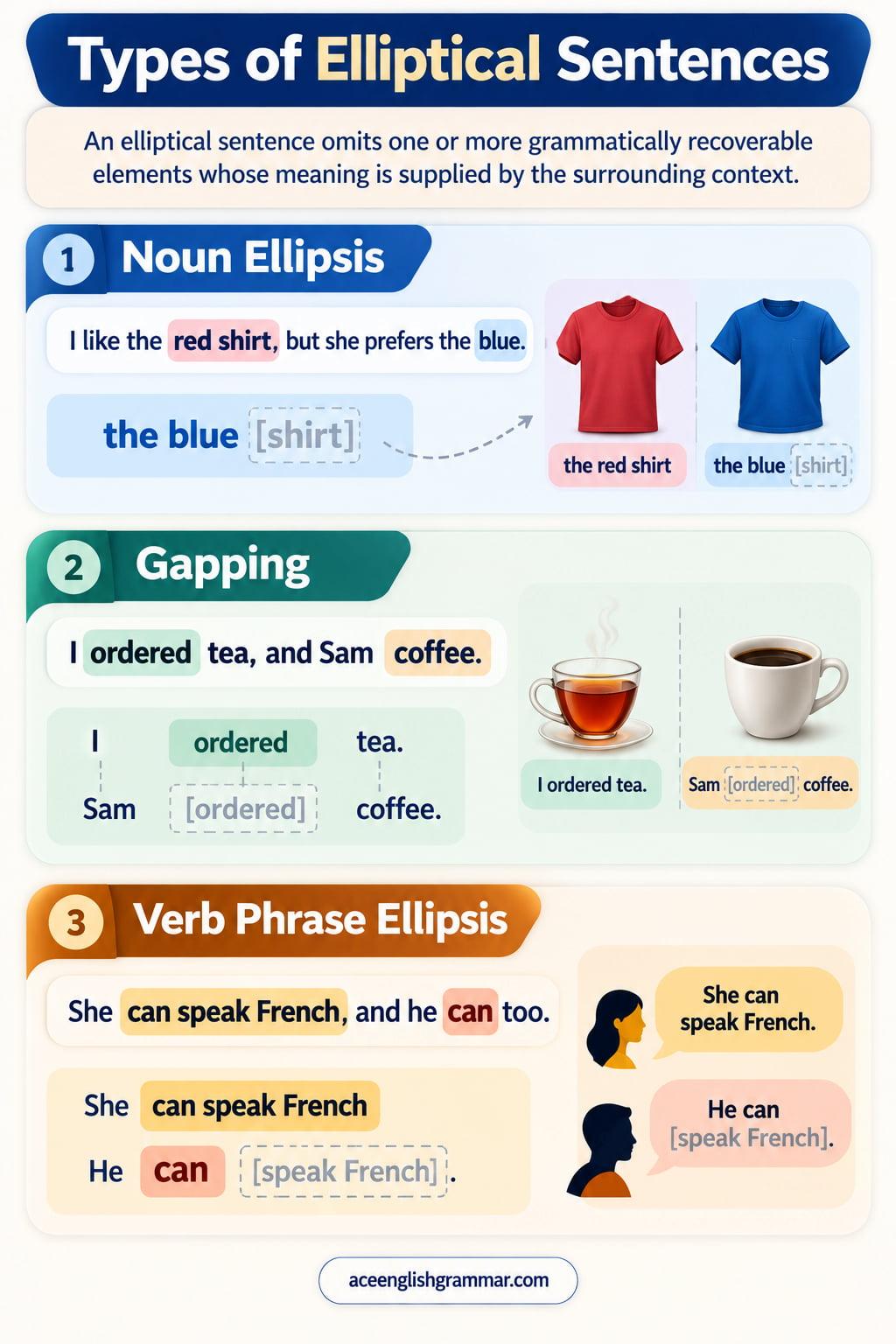
Noun Ellipsis
In noun ellipsis, a noun is omitted from a noun phrase because the same noun appeared earlier. The adjective or determiner before it remains and ends the phrase.
- I like the red shirt, but she prefers the blue.
- Which book do you want? The second.
- Anna has two cars, and Tom has three.
In the first sentence the omitted noun is “shirt”. Note that “the blue one” is not ellipsis, since the word “one” substitutes for the noun instead of omitting it.
Gapping
Gapping omits the verb from the second of two coordinate clauses when it repeats the verb of the first. The remaining words are the subject and the object, and the gap is also called verb ellipsis.
- I ordered tea, and Sam coffee.
- Anna won gold, and Maria bronze.
- Mia prefers cats, and Leo dogs.
The omitted verb must be the same verb, in the same form, as in the first clause.
Verb Phrase Ellipsis
In verb phrase ellipsis, everything after the auxiliary is omitted, and the auxiliary remains. When the first clause is in a simple tense with no auxiliary, “do” is added in the second clause.
- I went to the cinema, but Jerry did not.
- She can speak French, and he can too.
- Tom wanted to leave, but Anna did not want to.
- You should call her if you want to.
The remaining auxiliary agrees with the omitted verb. In the first sentence, the full form is “did not go to the cinema”.
Clause Ellipsis
In clause ellipsis, a whole clause is omitted, and only a word or phrase remains. Sluicing is the form in which a question word is all that remains.
- Someone called, but I do not know who.
- He left early, but nobody asked why.
- She is moving abroad, but she has not decided where.
The omitted clause is restored from the first clause. The full form of “I do not know who” is “I do not know who called”.
Elliptical Sentences in Answers and Dialogue
A reply to a question omits everything the question already contains, and only the new information remains. Each answer has a full form.
- Who broke the window? Tom.
- Where are you going? To the library.
- Have you finished? Not yet.
- Coffee? Please.
The full form of “Tom” is “Tom broke the window”, and the full form of “Not yet” is “I have not finished yet”. These answers are complete in conversation, so they are not sentence fragments.
Elliptical Replies With So and Neither
A reply that agrees with a statement repeats only the auxiliary and the subject. “So” follows an affirmative statement, and “neither” or “nor” follows a negative one.
- I like jazz. So do I.
- She has finished. So have they.
- I never drink coffee. Neither do I.
- He cannot swim. Nor can I.
The auxiliary is in the same tense as the statement, and the subject is placed after it, as in the inverted sentences taught separately. Where the statement has a simple tense, “do” is used.
Note that a reply without inversion is also elliptical: “I do too” agrees with an affirmative statement, and “I don’t either” agrees with a negative one.
Pronoun Case in Elliptical Sentences
After “than” or “as”, the pronoun takes the case it would have if the omitted words were restored. In formal writing, the full form of “George is younger than I” is “George is younger than I am”, so “I” is the subject form.
The case also fixes the meaning of the sentence.
- I like her more than he. (than he likes her)
- I like her more than him. (than I like him)
In informal speech, the object form is used: “George is younger than me”. Formal writing keeps the subject form. The objective personal pronouns are taught separately.
Elliptical Adverb Clauses
An adverb “clause” is shortened when its subject and a form of “be” are omitted after the conjunction.
- When ready, we will begin. (when we are ready)
- She slipped while crossing the street. (while she was crossing)
- If necessary, call me. (if it is necessary)
- Although tired, he finished the race. (although he was tired)
The omitted subject is the subject of the main clause. In “When ready, we will begin”, the subject of both clauses is “we”.
- ❌ When ready, the meeting began.
- ✅ When ready, we began the meeting.
In the first sentence, the restored subject of “ready” would be “the meeting”, which is not what the writer means. The error is a dangling modifier, repaired by making the main-clause subject the person who is ready.
Punctuation in Elliptical Sentences
In gapping, a comma is placed where the verb is omitted. When the clauses are independent, a semicolon joins them, as in the first two examples.
- Mason makes pottery best at night; Viktor, by daylight.
- Mia prefers cats; Leo, dogs.
- I ordered tea, and Sam, coffee.
An elliptical adverb clause that opens a sentence is followed by a comma, as in “When ready, we will begin.”
In verb phrase ellipsis the usual comma before “but” or “and” is kept, and no comma is placed at the omission.
Elliptical Sentences vs Sentence Fragments
An elliptical sentence is grammatical because its omitted words are recoverable. A sentence fragment is a word group that lacks a required element or is a subordinate clause punctuated as a sentence, and the reader cannot restore it.
The same words are elliptical in one context and a fragment in another.
- ✅ Why did you stay home? Because it was raining.
- ❌ We stayed home. Because it was raining.
In the first example, the question contains the main clause: “I stayed home because it was raining”. In the second, the clause “Because it was raining” follows a complete sentence and has nothing to attach to, so it is a fragment in formal writing.
Common Mistakes With Elliptical Sentences
Most mistakes come from omitting words that cannot be restored, or from restoring them in the wrong form.
Dangling clauses: Write “When ready, we began the meeting”, not “When ready, the meeting began”. The omitted subject must be the subject of the main clause.
Mismatched auxiliaries: Write “Tom is leaving, and Anna is too”, not “Tom is leaving, and Anna has too”. The remaining auxiliary must restore to the form in the first clause.
Wrong replies: Write “I do not like tea. Neither do I”, not “I do not like tea. So do I”. A negative statement takes “neither” or “nor”.
Wrong pronoun case: Write “George is younger than I” in formal writing, not “George is younger than me”. The pronoun takes the case it would have in the full sentence.
Elliptical Sentences Exercises
Choose the correct form or restore the omitted words.
- Restore the omitted word: I like tea, and she coffee.
- Restore the omitted words: Tom can swim, and Anna can too.
- Choose the correct reply: I never eat meat. (So do I / Neither do I)
- Choose the correct pronoun: She is taller than (I / me), in formal writing.
- Correct the sentence: When tired, the work was left unfinished.
- Restore the omitted clause: Someone called, but I do not know who.
- Choose the correct auxiliary: Tom has gone, and Anna (has / is) too.
- Is “Not yet” a fragment or an elliptical answer to “Have you finished?”
- Choose the correct pronoun: I trust her more than (he / him), meaning more than he does.
- Which word is omitted: Anna won gold, and Maria bronze?
Answers:
- Likes: she likes coffee.
- Swim: Anna can swim too.
- Neither do I, since the statement is negative.
- I: the full form is than I am.
- When tired, she left the work unfinished: the omitted subject is the subject of the main clause.
- Called: I do not know who called.
- Has: the first clause is in the present perfect.
- An elliptical answer: the question contains the omitted words.
- He: the full form is than he does.
- Won: Maria won bronze.
FAQs
Q1. What is an elliptical sentence?
An elliptical sentence is a grammatical sentence in which words are left out because the surrounding words or the situation make them recoverable. In “Who opened the window? Anna”, the answer omits “opened the window”.
Q2. What is the difference between complete and elliptical sentences?
The difference is that a complete sentence states every required word, while an elliptical sentence omits words that are recoverable. “Anna opened the window” is complete, and “Anna” is elliptical when it answers the question “Who opened the window?”
Q3. What is an elliptical clause?
An elliptical clause is a clause in which words are omitted, such as the subject and a form of “be”. “When ready” is an elliptical clause, and its full form is “when we are ready”.
Q4. What is elliptical cohesion?
The term elliptical cohesion refers to the link between two sentences that is formed when the second omits words that the first contains. In “Anna can swim. Tom can too”, the second sentence omits “swim” and is understood through the first.
Q5. What does elliptical mean in grammar?
The word “elliptical” in grammar refers to omitted words that are restored from the context. An elliptical sentence, clause or answer is grammatical because each omitted word is recoverable.
Read More