Inverted sentences in English change the usual subject before verb order. A normal statement might say: I have never seen such a storm. An inverted sentence moves part of the verb before the subject: Never have I seen such a storm.
You meet inversion in everyday questions, formal writing, dramatic statements, conditional sentences, and literary description. Are you ready? is a basic inverted sentence because the verb comes before the subject. A sentence like Rarely have we seen such courage uses the same kind of movement for emphasis.
By the end, you should be able to recognize inverted word order in real sentences, move the auxiliary verb into the right position, choose when inversion sounds natural, and avoid the mistakes that make formal sentence patterns feel awkward.
What Are Inverted Sentences?
An inverted sentence is a sentence structure in which the verb, auxiliary verb, or verb phrase comes before the subject. This change usually forms a question, adds emphasis, creates a formal conditional, or introduces a scene.
Normal word order places the subject before the verb.
- She is coming to the meeting.
- I have never heard that song.
- A tall tree stood on the hill.
Inverted word order changes that pattern.
- Is she coming to the meeting?
- Never have I heard that song.
- On the hill stood a tall tree.
In the question, is moves before she. In the second sentence, have moves before I because the sentence begins with never. In the third sentence, the place phrase on the hill comes first, and the verb stood appears before the subject a tall tree.
How Inversion Changes Word Order
Most inverted sentences in English depend on subject auxiliary inversion. This means the auxiliary verb moves before the subject.
| Normal word order | Inverted word order | What changes |
|---|---|---|
| You are ready. | Are you ready? | Are moves before you |
| I have never seen this. | Never have I seen this. | Have moves before I |
| She would agree. | Would she agree? | Would moves before she |
| I had known the answer. | Had I known the answer… | Had moves before I |
Auxiliary verbs include forms such as is, are, was, were, have, has, had, will, would, can, could, should, and might.
When a normal sentence has no auxiliary verb, English often adds do, does, or did.
- You like coffee.
- Do you like coffee?
- She understands the rule.
- Does she understand the rule?
- They finished the work.
- Did they finish the work?
The same rule appears in negative adverb inversion.
- She rarely makes mistakes.
- Rarely does she make mistakes.
The word rarely comes first, but the sentence has no auxiliary verb. English adds does and places it before the subject.
Main Types Of Inverted Sentences In English
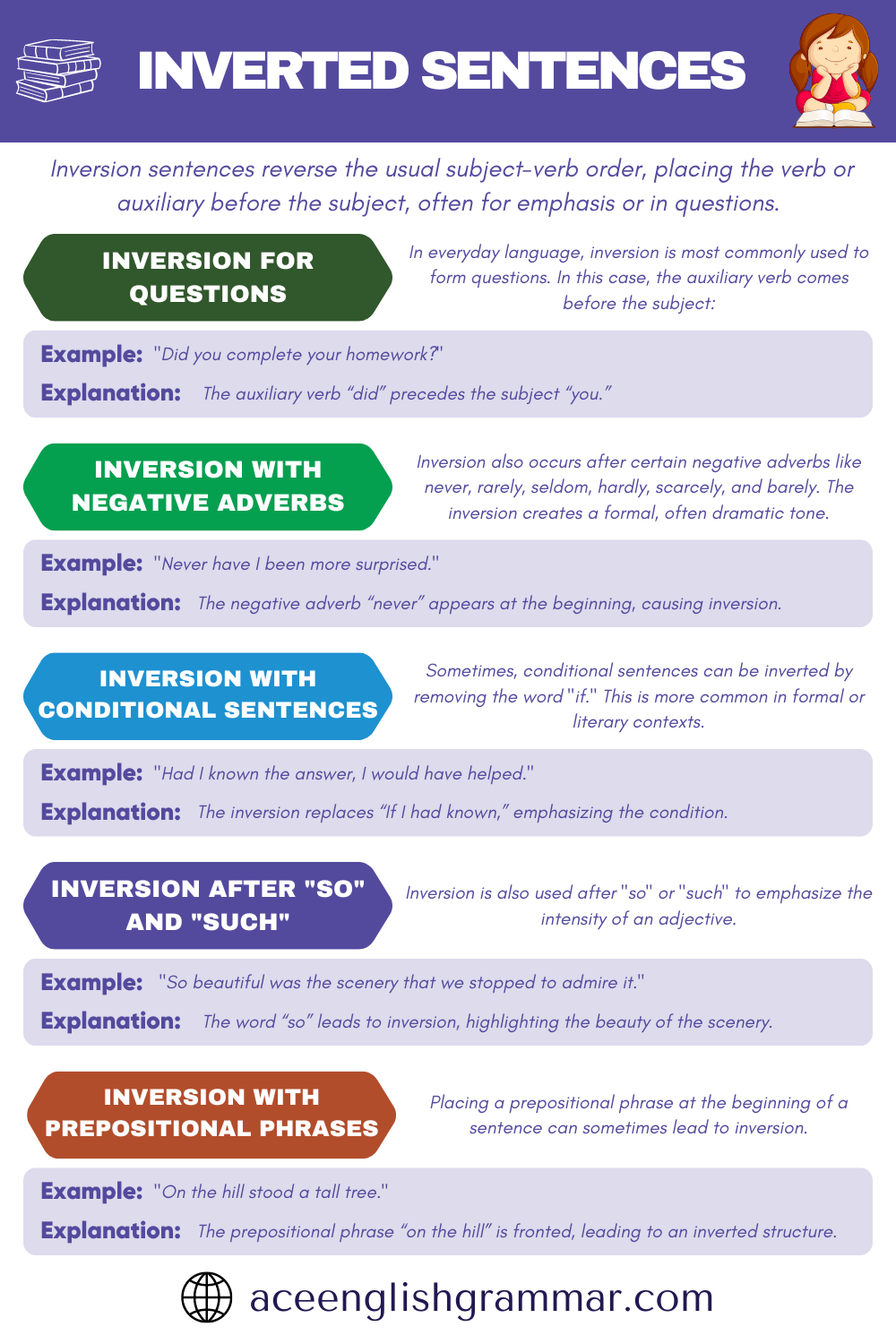
Inversion does not always sound the same. Some forms are common in daily speech, while others sound formal, dramatic, or literary.
Inversion In Questions
Questions are the everyday form of inversion. When English turns many statements into questions, the auxiliary verb moves before the subject.
- Are you joining us?
- Have they finished the project?
- Can she speak French?
- Did he call yesterday?
When the main verb is be, it moves before the subject without do.
- He is your brother.
- Is he your brother?
- They were at home.
- Were they at home?
This is why questions are often the first place learners meet inverted word order.
Inversion With Negative Adverbs And Adverbials
Negative adverbs and negative adverbial phrases often trigger inversion when they come at the beginning of a sentence. This pattern sounds formal and emphatic.
Common triggers include:
- never
- rarely
- seldom
- hardly
- scarcely
- barely
- no sooner
- not only
- under no circumstances
- at no time
- in no way
Normal sentence:
- I have never heard such a strange excuse.
Inverted sentence:
- Never have I heard such a strange excuse.
The negative word never moves to the front, so the auxiliary verb have moves before the subject I.
More examples:
- Rarely do we see such dedication.
- Seldom has a team worked with such focus.
- Hardly had I sat down when the phone rang.
- No sooner had we arrived than it began to rain.
- Under no circumstances should you share your password.
- Not only did she win the race, but she also broke the record.
The trigger only causes inversion when it comes at the beginning. Compare these two sentences:
- I have never seen such behavior.
- Never have I seen such behavior.
The first sentence keeps normal word order. The second sentence uses inversion because never has moved to the front.
Inverted Conditional Sentences
Conditional inversion happens when if is removed and the verb moves before the subject. This form is common in formal English, official notices, academic writing, and polished speech.
Normal conditional:
- If I had known the truth, I would have spoken earlier.
Inverted conditional:
- Had I known the truth, I would have spoken earlier.
The meaning stays the same, but the inverted version sounds more formal. The three most common conditional inversion patterns use had, were, and should.
| Normal conditional | Inverted conditional |
|---|---|
| If I had known earlier, I would have helped. | Had I known earlier, I would have helped. |
| If I were you, I would wait. | Were I you, I would wait. |
| If you should need support, contact us. | Should you need support, contact us. |
More examples:
- Had they arrived earlier, they would have found better seats.
- Were she more experienced, she might handle the role well.
- Should you have any questions, please contact the office.
In everyday speech, the normal if form often sounds warmer and more natural. If you need help, call me feels more conversational than Should you need assistance, contact me.
Inversion After So And Such
Inversion can follow so or such when the sentence emphasizes degree or intensity. This pattern often appears in formal writing, storytelling, and dramatic description.
- So powerful was the storm that trees fell across the road.
- So loud was the noise that everyone stopped talking.
- Such was his anger that no one dared interrupt him.
The normal versions are more conversational:
- The storm was so powerful that trees fell across the road.
- The noise was so loud that everyone stopped talking.
- His anger was so great that no one dared interrupt him.
The inverted form places the intense idea first, which gives the sentence a more dramatic rhythm.
Inversion With Place Expressions
Some inverted sentences begin with a place expression. This structure often appears in description, storytelling, and literature.
- On the hill stood an old stone house.
- Beside the river grew a line of willow trees.
- At the end of the street was a small bakery.
- In the corner sat a quiet old man.
The normal word order would be:
- An old stone house stood on the hill.
- A line of willow trees grew beside the river.
- A small bakery was at the end of the street.
- A quiet old man sat in the corner.
This kind of inversion works best when the sentence introduces a scene, object, or person. The location comes first, then the sentence reveals what is there.
Inversion With Here And There
Sentences beginning with here or there often use inversion when the subject is a noun.
- Here comes the bus.
- There goes your chance.
- Here are the documents.
- There stood a tall building.
With pronouns, the normal order usually remains.
- Here it comes.
- There she goes.
- Here they are.
Do not write:
- Here comes it.
- There goes she.
With pronouns, the subject stays before the verb.
Common Inversion Triggers
Many inverted sentences begin with a trigger word or phrase. Once that trigger comes first, the auxiliary verb usually moves before the subject.
| Trigger | Inverted sentence |
|---|---|
| Never | Never have I seen such courage. |
| Rarely | Rarely does he speak in public. |
| Seldom | Seldom do they miss a deadline. |
| Hardly | Hardly had we left when it started raining. |
| No sooner | No sooner had she arrived than the meeting began. |
| Not only | Not only did he apologize, but he also offered to fix the mistake. |
| Only then | Only then did I understand the problem. |
| Under no circumstances | Under no circumstances should you open that file. |
| Had | Had I known, I would have waited. |
| Should | Should you need assistance, call this number. |
These triggers matter because many mistakes begin with the right opening word but the wrong word order. Never I have seen sounds unnatural because the auxiliary has not moved. The correct form is Never have I seen.
Normal Vs Inverted Sentence Examples
A side-by-side comparison shows the grammar pattern more quickly than a rule alone. Notice how the inverted sentence usually moves an auxiliary verb before the subject.
| Normal sentence | Inverted sentence |
|---|---|
| I have never felt so nervous. | Never have I felt so nervous. |
| She rarely makes mistakes. | Rarely does she make mistakes. |
| We had hardly begun when the lights went out. | Hardly had we begun when the lights went out. |
| If I had known, I would have called you. | Had I known, I would have called you. |
| The old castle stood on the cliff. | On the cliff stood the old castle. |
| The scenery was so beautiful that we stopped. | So beautiful was the scenery that we stopped. |
The inverted versions sound more formal, emphatic, polished, or literary. The normal versions sound more direct and conversational.
When Should You Use Inverted Sentences?
Use inversion when the sentence needs the word order that fits its purpose. Inversion is not only a grammar pattern. It also changes tone.
Use inversion in questions:
- Did you finish the report?
- Are they coming tonight?
Use inversion after negative or limiting expressions:
- Never had she felt so proud.
- Only then did we realize the danger.
Use inversion in formal conditionals:
- Had we arrived earlier, we could have met them.
- Should you need further information, contact the manager.
Use inversion for dramatic description:
- Across the valley echoed the sound of bells.
- At the doorway stood a young soldier.
In casual speech, normal word order is often better. If you want coffee, tell me sounds more natural than Should you want coffee, tell me. The second sentence is grammatical, but it belongs to a more formal setting.
Common Mistakes With Inverted Sentences
After the main patterns are in place, the mistakes become easier to spot. Most errors happen when the trigger word is correct, but the auxiliary verb stays in the wrong position.
Missing the auxiliary verb
Wrong:
- Never I saw such a beautiful place.
Correct:
- Never did I see such a beautiful place.
The word never at the front triggers inversion, but the normal sentence has no auxiliary verb to move. English adds did and places it before the subject.
Putting the subject before the auxiliary
Wrong:
- Rarely she has spoken in meetings.
Correct:
- Rarely has she spoken in meetings.
The auxiliary has must come before the subject she.
Using the wrong conditional order
Wrong:
- Had known I the truth, I would have acted sooner.
Correct:
- Had I known the truth, I would have acted sooner.
In conditional inversion, the pattern is had + subject + past participle.
Inverting after every fronted phrase
Wrong:
- Yesterday did I went to the market.
Correct:
- Yesterday, I went to the market.
Not every fronted word causes inversion. Time expressions such as yesterday, last week, and in the morning usually keep normal word order.
Using formal inversion in casual speech
Too formal for ordinary conversation:
- Should you want coffee, tell me.
More natural:
- If you want coffee, tell me.
The inverted version is correct, but it sounds too formal for a casual offer.
More Examples Of Inverted Sentences In English
Read these examples by noticing the opening word first. In many cases, that opening word explains why the auxiliary moves before the subject.
Questions
- Is your brother at home?
- Have you seen my keys?
- Can they join us later?
Negative adverbs
- Never had the town seen such heavy rain.
- Rarely do children sit so quietly.
- Seldom has a speech moved the audience so deeply.
Limiting expressions
- Only after the test did he realize his mistake.
- Only then did she understand the warning.
- In no way should this rule be ignored.
Conditionals
- Had I received your message, I would have replied.
- Were he more careful, he would avoid these errors.
- Should the weather change, the event will move indoors.
Place expressions
- Behind the house stood a tall oak tree.
- Near the window sat a small black cat.
- Across the field ran a narrow path.
So and such
- So strong was the wind that the windows shook.
- So bright was the light that I had to close my eyes.
- Such was her confidence that nobody questioned her decision.
How To Check An Inverted Sentence
Before you use inversion, check the sentence in three steps.
- Find the trigger.
Look for a question form, negative adverb, limiting phrase, conditional pattern, or descriptive place expression. - Find the verb that should move.
Move the auxiliary verb, modal verb, or form of be before the subject. - Decide whether do, does, or did is needed.
Add do, does, or did when the sentence has no auxiliary verb.
Compare:
- She rarely visits us.
- Rarely does she visit us.
The trigger is rarely. The normal sentence has no auxiliary verb, so does appears before the subject.
In inversion, the opening word often tells you what the sentence wants to do, but the auxiliary verb tells you whether the grammar is working.
FAQs
An inverted sentence in English changes the usual subject before verb order. The verb or auxiliary verb comes before the subject, as in Are you ready? or Never have I seen this before.
We use inverted sentences to form questions, add emphasis, create formal conditionals, and give descriptive writing a more dramatic rhythm. Some forms are common in speech, while others belong more to formal or literary English.
Common examples include:
Did you call her?
Never have I felt so tired.
Had I known, I would have waited.
On the wall hung an old painting.
To invert a conditional sentence, remove if and place had, were, or should before the subject.
If I had known, I would have helped.
Had I known, I would have helped.
Some inverted sentences are common in everyday English, especially questions. Others sound formal or literary, especially sentences that begin with never, rarely, no sooner, had, or were.
Words and phrases such as never, rarely, seldom, hardly, scarcely, no sooner, not only, only then, and under no circumstances often cause inversion when they begin a sentence.
No. Many fronted adverbs keep normal word order.
Yesterday, I met her.
Last week, they moved to London.
Inversion usually happens after negative expressions, limiting phrases, question forms, conditional patterns, or descriptive place structures.