Nominal sentences are sentences in which the predicate is a noun phrase, an adjective or an adverbial and not an action verb. In “My sister is a pilot”, the noun phrase “a pilot” is the predicate.
In English, nominal sentences are formed with the linking verb “be”, or with no verb at all in headlines, exclamations and proverbs. Reading each form in an example sentence is how the subject and its predicate are matched. The predicate that follows “be” is what makes a sentence nominal.
What Are Nominal Sentences?
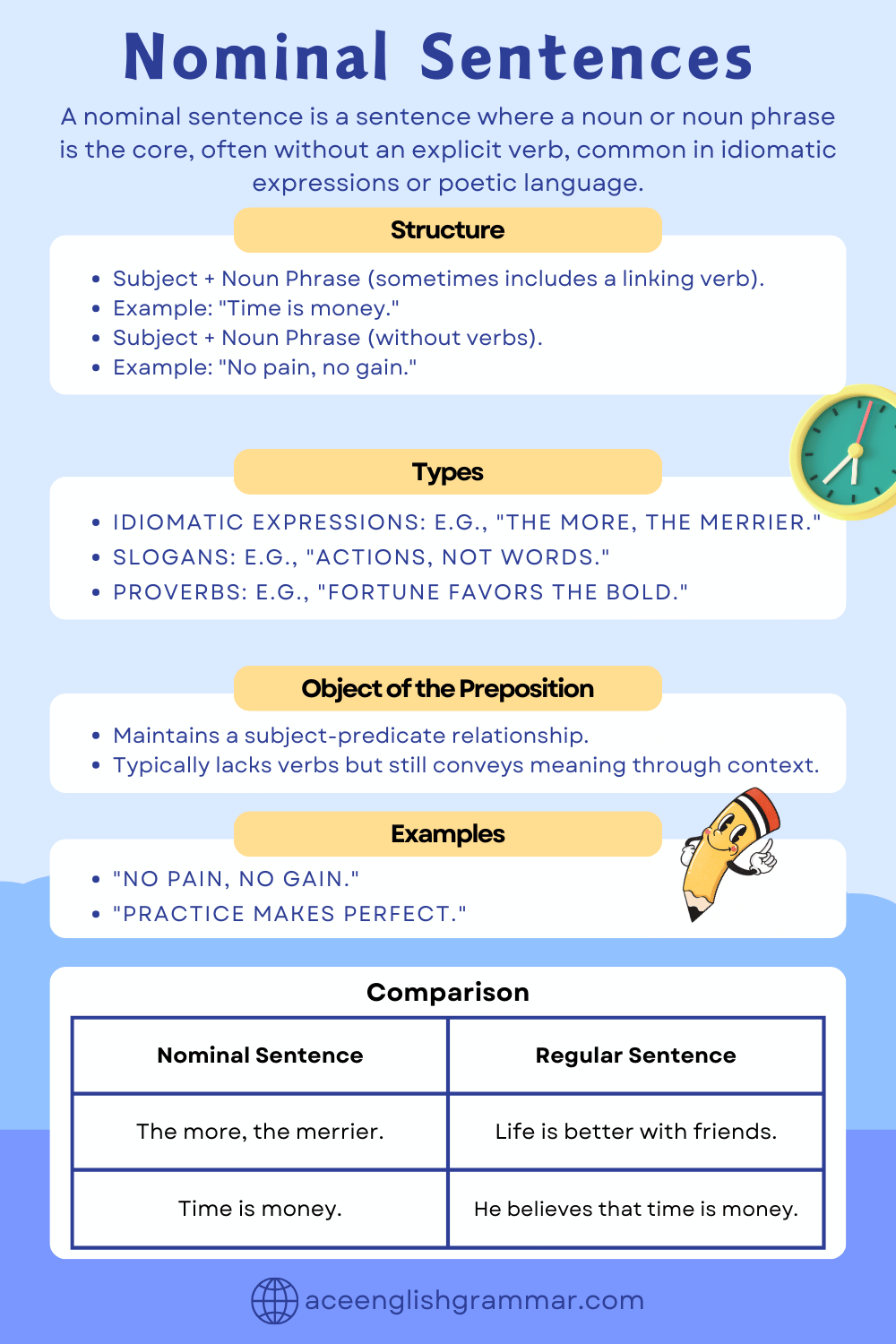
A nominal sentence is a sentence whose predicate is not a verb of action. The predicate is a noun phrase, an adjective or an adverbial, and it complements the subject.
In “The Nile is a river”, the noun phrase “a river” is the predicate, and the linking verb “is” is used to link it to the subject. No action is described, and the sentence states what the subject is.
Nominal sentences correspond to the verbless sentences of Arabic and Russian, in which the verb “to be” is omitted. A noun phrase used as a predicate is also called a predicate nominative, which is covered in noun phrases.
- The sky is blue.
- My neighbor is a dentist.
- The keys are on the table.
Types of Nominal Sentences
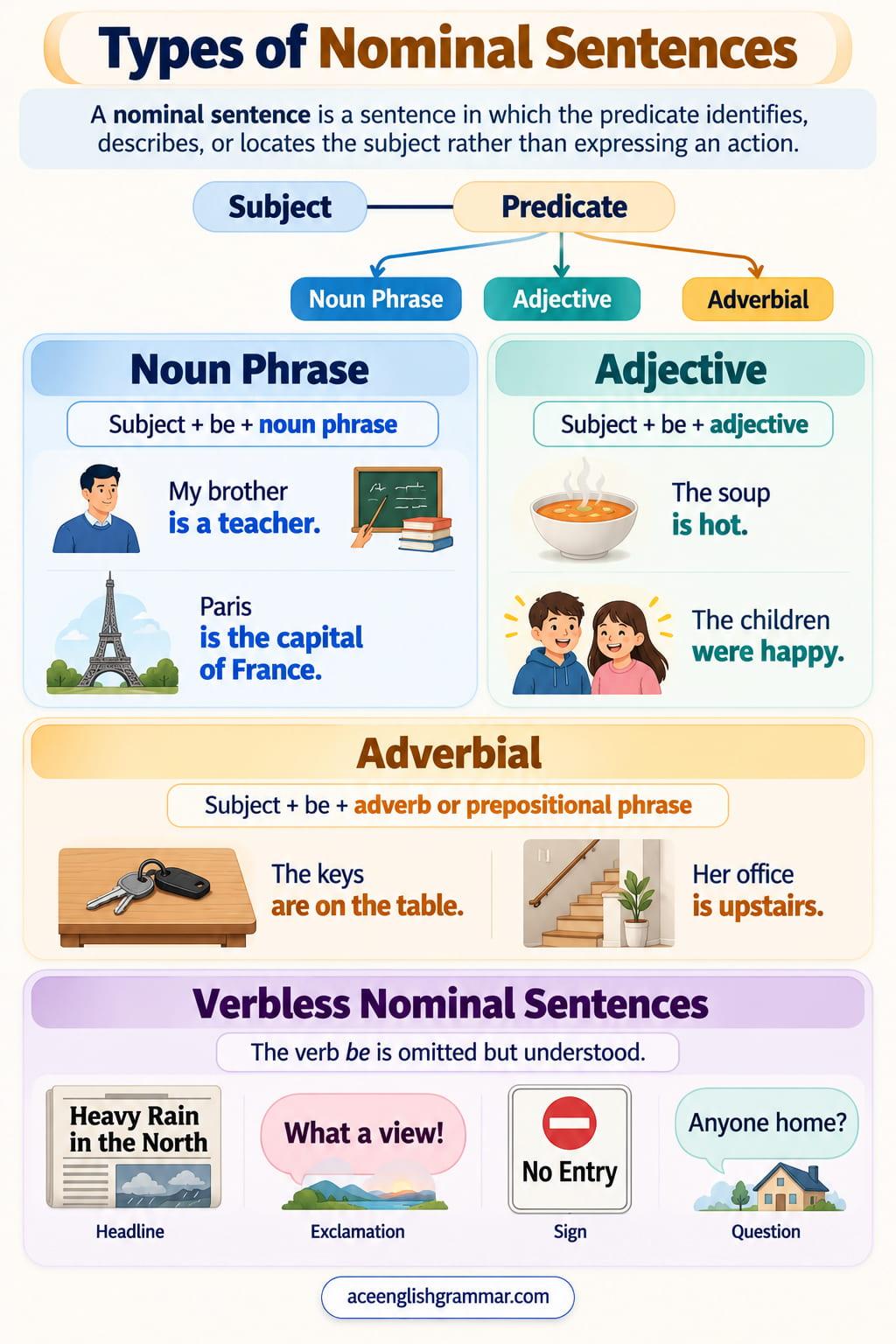
Nominal sentences are classified by the word class of the predicate: a noun phrase, an adjective or an adverbial.
Nominal Sentences With a Noun Phrase
Subject + be + noun phrase
The noun phrase refers to the subject itself, as in “My brother is a teacher”. Sentences of this type are also called predicate nominative sentences. The linking verbs “become” and “remain” are used in the same structure.
- My brother is a teacher.
- Paris is the capital of France.
- They were neighbors.
- She became a pilot.
Nominal Sentences With an Adjective
Subject + be + adjective
The adjective complements the subject, and the sentence expresses a quality or a condition.
- The soup is hot.
- The children were happy.
- The exam was difficult.
- Our teacher is kind.
Nominal Sentences With an Adverbial
Subject + be + adverb or prepositional phrase
The adverb or prepositional phrase states the place or the time of the subject.
- The keys are on the table.
- Her office is upstairs.
- The concert was at eight.
- The meeting is here.
Verbless Nominal Sentences
A verbless nominal sentence omits the verb “be” altogether, and the meaning is complete without it. The omitted verb is understood from the context.
- Headlines: “Heavy Rain in the North” and “New Phone, Lower Price”.
- Exclamations: “What a view!” and “Lovely weather!”
- Proverbs: “The more, the merrier” and “Easy come, easy go”.
- Signs: “No Entry” and “Exit on the Right”.
- Questions: “Which way to the station?” and “Anyone home?”
In careful writing, a full sentence with “be” is used, as in “The weather is lovely”.
Nominal Sentences Examples
Each sentence is shown with its predicate and the type of that predicate.
| Sentence | Predicate | Type |
|---|---|---|
| My mother is a nurse. | A nurse | Noun phrase |
| Mr. Khan is our principal. | Our principal | Noun phrase |
| The Nile is a river. | A river | Noun phrase |
| Dogs are loyal animals. | Loyal animals | Noun phrase |
| We were classmates. | Classmates | Noun phrase |
| The tea is hot. | Hot | Adjective |
| The children are happy. | Happy | Adjective |
| This question is difficult. | Difficult | Adjective |
| Her house is big and bright. | Big and bright | Adjective |
| The library is near the station. | Near the station | Adverbial |
| The party was on Saturday. | On Saturday | Adverbial |
| The exam is tomorrow. | Tomorrow | Adverbial |
| He is here. | Here | Adverbial |
| The girls are in the garden. | In the garden | Adverbial |
| It was a cold night. | A cold night | Noun phrase |
Nominal Sentences in Different Tenses
The tense of a nominal sentence is marked by the form of “be”.
| Tense | Structure | Sentence |
|---|---|---|
| Present simple | Subject + am/is/are + complement | She is a doctor. |
| Past simple | Subject + was/were + complement | She was a doctor. |
| Future simple | Subject + will be + complement | She will be a doctor. |
| Present perfect | Subject + has/have been + complement | She has been a doctor for ten years. |
Negative Nominal Sentences
Subject + be + not + complement
The word “not” follows the form of “be”. The contractions “isn’t”, “aren’t”, “wasn’t” and “weren’t” are used in speech.
- The soup is not hot.
- They were not late.
- He will not be here tomorrow.
Questions With Nominal Sentences
Be + subject + complement?
The form of “be” is placed before the subject, and no auxiliary “do” is added. In the future tense, the order is will + subject + be + complement.
- Is she a doctor?
- Were they late?
- Will he be here tomorrow?
Nominal Sentences vs Verbal Sentences
The predicate of a nominal sentence is a noun phrase, an adjective or an adverbial, and the predicate of a verbal sentence is a verb phrase of action. Verbal sentences are the larger group in English.
| Feature | Nominal sentence | Verbal sentence |
|---|---|---|
| Predicate | Noun phrase, adjective or adverbial | Verb phrase |
| Verb | Linking verb be | Action verb |
| Statement | The sky is blue. | The birds sing. |
| Question | Is the sky blue? | Do the birds sing? |
| Negative | The sky is not blue. | The birds do not sing. |
Nominal Sentences in Other Languages
In Arabic, Russian and Hebrew, the verb “to be” is omitted in the present tense, so the sentence consists of two nominals placed side by side. In Arabic, the first nominal is the mubtada and the second is the khabar.
| Language | Sentence | Word for word | English |
|---|---|---|---|
| Arabic | الطالب مجتهد | The student diligent | The student is diligent. |
| Russian | Он врач | He doctor | He is a doctor. |
| Hebrew | הוא מורה | He teacher | He is a teacher. |
The verb “be” is obligatory in English nominal sentences, apart from the verbless forms.
Common Mistakes With Nominal Sentences
Missing “be”: Write “She is a doctor”, not “She doctor”. A form of “be” is obligatory in a full nominal sentence.
Wrong form of “be”: Write “They are neighbors”, not “They is neighbors”. The form of “be” agrees with the subject.
Missing article: Write “He is a teacher”, not “He is teacher”. A singular noun phrase takes an article.
Article with an adjective: Write “She is happy”, not “She is a happy”. An adjective is used without an article after “be”.
Action verb after “be”: Write “She works” or “She is at work”, not “She is work”. “Be” is not combined with a bare noun of activity.
Nominal Sentences Exercises
Complete each sentence or choose the correct form.
- Complete the sentence: My father ____ a pilot. (is / are)
- Choose the correct sentence: (She doctor / She is a doctor).
- Identify the predicate type: The soup is hot.
- Identify the predicate type: The keys are on the table.
- Correct the sentence: They is my classmates.
- Make the sentence negative: The exam is difficult.
- Make a question: She is a nurse.
- Change to the past tense: He is a student.
- Is the sentence nominal or verbal: The children play in the garden?
- Is the sentence nominal or verbal: The children are in the garden?
Answers:
- Is: “father” is singular.
- She is a doctor: a full nominal sentence is formed with “be”.
- Adjective: “hot” is a quality of the soup.
- Adverbial: “on the table” states the place.
- They are my classmates: the form of “be” agrees with “they”.
- The exam is not difficult.
- Is she a nurse?
- He was a student.
- Verbal: “play” is an action verb.
- Nominal: the predicate “in the garden” is an adverbial.
FAQs
Q1. What is a nominal sentence?
A nominal sentence is a sentence whose predicate is a noun phrase, an adjective or an adverbial and not an action verb, as in “The Nile is a river”. The predicate is joined to the subject by the linking verb “be”.
Q2. Is a verb required in a nominal sentence?
No action verb is required. English nominal sentences are formed with the linking verb “be”, and verbless nominal sentences such as “What a view!” are formed with no verb at all.
Q3. Is a nominal sentence the same as a predicate nominative sentence?
No. A predicate nominative sentence is a nominal sentence with a noun phrase as the predicate. Nominal sentences also include those with an adjective or an adverbial as the predicate.
Q4. Is “nominal” related to nouns in grammar?
Yes. In grammar, “nominal” denotes a noun-type word: a nominal is a noun, a pronoun or a noun phrase, and a nominal predicate is a noun phrase used as the predicate.
Q5. Are nominal sentences used in English?
Yes. Every sentence with “be” and a noun, adjective or adverbial predicate is a nominal sentence, and verbless forms appear in headlines, exclamations and proverbs.
Q6. In which languages are nominal sentences formed without a verb?
Arabic, Russian and Hebrew omit the verb “to be” in the present tense. The sentence “Он врач” is word for word “He doctor”.
Q7. How do you identify a nominal sentence?
The test is whether the predicate after “be” is a noun phrase, an adjective or an adverbial. In “The sky is blue”, the predicate is the adjective “blue”, so the sentence is nominal. In “The birds sing”, the predicate is the action verb “sing”, so the sentence is verbal.
Read More