
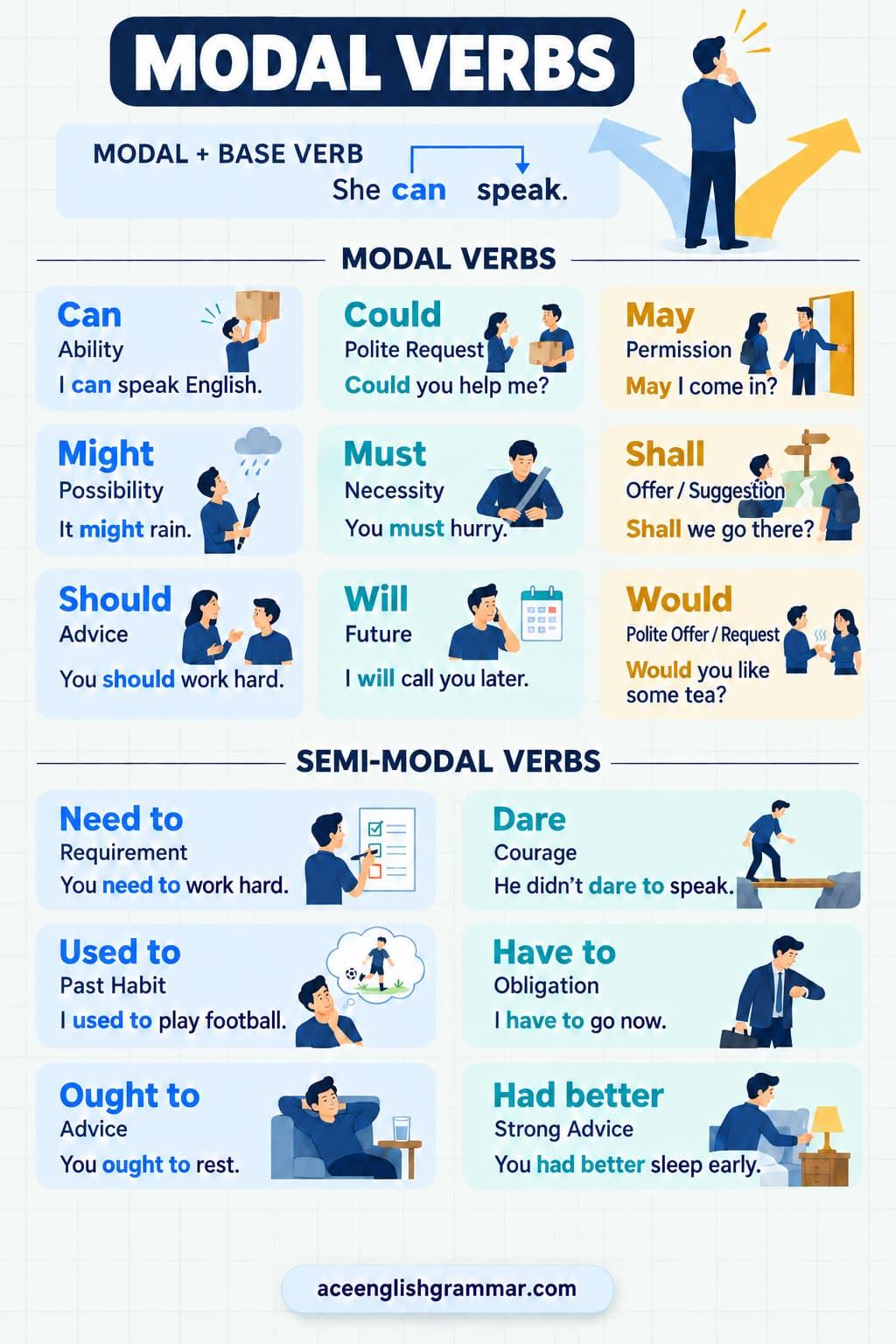
Modal verbs are auxiliary verbs that express possibility, ability, permission, obligation, necessity, prediction, advice, or deduction. English has nine core modal verbs: “can, could, will, would, shall, should, may, might,” and “must”. “Ought to” functions as a tenth modal but takes “to” before the main verb.
Modals are not used alone as main verbs. Each one combines with the base form of a main verb: “can go, will arrive, should try, must leave”.
What Is a Modal Verb?
A modal verb is a type of auxiliary verb. It combines with the base form of a main verb. The combination expresses the speaker’s attitude toward the action: likelihood, permission, ability, or requirement.
Examples of modals in context:
- You must submit the form by Friday. (obligation)
- She can play the violin. (ability)
- It might rain later. (possibility)
- You may leave when you finish. (permission)
- He should apologise. (advice)
Modal verbs do not describe actions themselves. They modify the meaning of the main verb that follows them by adding a modal dimension: attitude, likelihood, or requirement.
The Nine Modal Verbs in English
English has nine core modal verbs. Four of them exist as present-past pairs, and one (“must”) has no past form of its own.
| Present form | Past form | Main functions |
|---|---|---|
| Can | Could | Ability, permission, possibility |
| Will | Would | Prediction, willingness, habitual past |
| Shall | Should | Suggestion, obligation, prediction (formal) |
| May | Might | Permission, possibility |
| Must | (no past) | Obligation, necessity, deduction |
The past forms of these modals are not always used for past time. “Could, would, should, might” also express hypothetical situations or polite requests, not only past reference.
“Ought to” is a modal by function but takes “to” before the main verb, making it different in form from the nine core modals. It is traditionally counted as the tenth modal.
Meanings and Uses of Modal Verbs
Every modal verb has a fixed set of meanings tied to context and register.
Ability: Can and Could
“Can” expresses present or general ability. “Could” expresses past ability or hypothetical ability.
- She can speak three languages. (present ability)
- I could run five kilometres when I was younger. (past ability)
- If I had the time, I could learn Arabic. (hypothetical)
“Be able to” replaces “can” and “could” for the present perfect, future, and infinitive: “I have been able to save money”, “She will be able to attend”, “It is important to be able to swim”.
Permission: Can and May
“Can” is standard for permission in informal English. “May” is formal and preferred in written requests. “Could” is polite and functions in questions.
- Can I borrow your pen? (informal)
- May I speak to the manager? (formal)
- Could I have another cup of tea? (polite)
In traditional grammar, “may” is preferred over “can” for permission, but “can” is now accepted in every register except formal writing.
Possibility: May and Might
“May” and “might” both express possibility, with slight differences in confidence.
- It may rain later. (about 50% likely, standard possibility)
- It might rain later. (weaker or more remote possibility)
“Could” also expresses possibility, in a more theoretical or hypothetical sense than “may” or “might”.
- An earthquake could happen at any time. (theoretical possibility)
In negative sentences, the two mean different things. “May not” means it is possible that something is not the case; “cannot” means the opposite is impossible.
- She may not be at home. (perhaps she is not)
- She cannot be at home. (it is impossible that she is)
Obligation: Must and Have To
“Must” expresses obligation imposed by the speaker. “Have to” expresses obligation imposed by an external source.
- You must wear a helmet. (the speaker is imposing the rule)
- I have to work on Saturday. (an external requirement)
In the negative, the two are not interchangeable and mean opposite things.
- You must not smoke here. (it is prohibited)
- You do not have to smoke here. (it is not required, but it is allowed)
For past necessity, “must” is replaced by “had to”, since “must” has no past form.
- I had to work late yesterday.
Advice: Should and Ought To
“Should” is the standard modal for advice in modern English. “Ought to” is slightly more formal and expresses a stronger sense of moral or logical expectation.
- You should see a doctor about that cough.
- You ought to see a doctor about that cough.
Both express the speaker’s recommendation without full obligation. In most sentences, the two are interchangeable, though “should” is far more frequent in everyday speech.
Prediction: Will and Shall
“Will” expresses prediction, willingness, or the simple future.
- It will rain tomorrow. (prediction)
- I will help you with the report. (willingness)
- She will arrive at seven. (future)
“Shall” is limited in modern English to two uses. It appears in formal legal statements and in first-person questions used to offer suggestions or seek instructions.
- The tenant shall pay the rent by the fifth of each month. (legal)
- Shall we go now? (first-person suggestion)
- Shall I open the window? (offer)
“Shall” is rare in American English. In British English, it still appears in first-person question forms and in legal writing.
Habitual Past: Would
“Would” expresses repeated past actions.
- When we lived in Karachi, my grandmother would tell us stories every evening.
- He would call every Sunday during the holidays.
“Used to” replaces “would” when the situation is a past state rather than a repeated action. “We used to live in Karachi” is correct; “We would live in Karachi” is not.
“Would” for habits requires an explicit past-time frame in the sentence or context. Without one, the meaning is hypothetical rather than habitual.
Deduction: Must and Can’t
“Must” expresses positive deduction. The speaker concludes something is true based on evidence.
- The lights are on. He must be home.
- You have been working since six. You must be tired.
“Can’t” or “cannot” expresses negative deduction. The speaker concludes something is not true.
- He can’t be at the office. It is ten at night.
- That cannot be her brother. He is much taller than she is.
“May, might, could” express weaker deduction for uncertain conclusions.
- She might be at the library.
For past deductions, “must have” plus the past participle is used for positive, and “can’t have” or “couldn’t have” for negative.
- She must have left already. (positive past deduction)
- He can’t have seen us. (negative past deduction)
How Modal Verbs Differ From Other Verbs
There are six grammatical rules that apply to modal verbs and to no other verb in English.
Modals Do Not Take -s in the Third Person
In the third-person singular present, standard verbs take an “-s” ending: “she walks”, “he writes”. Modals do not.
- She can swim. ✓
- She cans swim. ✗
The rule applies to every modal without exception.
Modals Take the Bare Infinitive
The main verb that follows a modal is in its base form, with no “to” between them.
- She must leave now. ✓
- She must to leave now. ✗
The one apparent exception is “ought to”, where “to” is part of the fixed form of the modal itself, not a separate marker.
Modals Have No -ing or -ed Forms
Standard verbs form progressives with “-ing” and past tenses with “-ed” or an irregular pattern. Modals have neither. “Musting, canning, willed, shalled” do not exist in English.
When these forms are needed, full-verb substitutes are used: “be able to” replaces “can”, “have to” replaces “must”, and “be going to” replaces “will” for future reference.
Modals Cannot Be Combined With Each Other
Only one modal can appear in a verb phrase.
- She might will come. ✗
- She might come. ✓
- She will come. ✓
To express combined meanings, semi-modals or full-verb constructions are used. “She will be able to come” replaces the impossible “She will can come”. “You will have to leave early” replaces “you will must leave early”.
Modals Form Questions and Negatives Without Do
In the simple present and past, standard verbs take “do” for questions and negatives: “Do you like tea?”, “You do not like tea.” Modals do not.
In a question, the modal is placed before the subject.
- Can you swim?
- Would you like some tea?
For a negative, “not” is added directly after the modal.
- You cannot swim.
- She should not leave.
Modal Meaning Depends on Context
Most modals express several different meanings, and only the surrounding context makes clear which one applies.
- You must be tired. (deduction: I conclude you are tired)
- You must be quiet. (obligation: you are required to be quiet)
- She may attend the meeting. (permission: it is allowed)
- She may attend the meeting. (possibility: it is uncertain but likely)
The same sentence can have two meanings; the speaker’s intent is clear only from context.
Modal Verbs in Negative and Question Forms
Modals form negatives by adding “not” directly after the modal, and questions by inverting the modal and the subject.
Negatives
Every modal takes “not” directly, and every modal has a contracted negative form used in speech and informal writing.
- Cannot / can’t
- Could not / couldn’t
- Will not / won’t
- Would not / wouldn’t
- Shall not / shan’t
- Should not / shouldn’t
- May not (no standard contraction)
- Might not / mightn’t
- Must not / mustn’t
“Cannot” is written as one word in standard English. “Can not” as two words is only used for emphasis or in special constructions (“You can not only pass but excel”).
Questions
The modal is placed before the subject.
- Can you drive?
- Would you like some tea?
- Should I call her?
- Must we leave now?
Question tags on modal sentences take the same modal.
- You can drive, can’t you?
- She will come, won’t she?
- They should apologise, shouldn’t they?
For modal “must”, the question tag is “mustn’t” for positive statements and “must” for negatives, though “have to” is more common in tag questions.
Present and Past Forms of Modal Verbs
Four of the nine modals appear in present-past pairs: can/could, will/would, shall/should, may/might. The past form does not always refer to past time. Each pair has three main uses.
Real Past Reference
- When I was five, I could recite the alphabet backwards. (past ability)
- He said he would call at nine. (reported speech in the past)
- They said they might arrive late. (reported speech in the past)
Hypothetical or Conditional Meaning
- If I had more time, I would learn Italian.
- She could pass the exam if she studied harder.
- You might regret that decision.
Politeness
- Could you help me with this? (more polite than “Can you help me”)
- Would you mind opening the window? (very polite request)
- Might I ask a question? (formal and polite)
The past form is used to soften the request, without changing the time reference of the sentence to the past.
“Must” has no past form of its own. For past necessity, “had to” is used: “I had to work late yesterday”, not “I musted work late”.
Common Confusions With Modal Verbs
There are four pairs that learners of English confuse most often.
Must vs Have To
“Must” expresses the speaker’s own authority. “Have to” expresses external authority. The distinction is less rigid in some contexts, but it applies when the speaker has authority to impose or waive a rule.
- You must finish this by tomorrow. (I am giving you this deadline)
- You have to finish this by tomorrow. (someone else has imposed it)
In the negative, the two are not interchangeable.
- You must not smoke here. (it is prohibited)
- You do not have to smoke here. (it is not required, but you are allowed)
Can vs May
“Can” originally meant ability. “May” originally meant permission. In modern English, “can” is now used for ability, informal permission, and general possibility.
- Can I use your phone? (accepted in all but the most formal contexts)
- May I use your phone? (more formal, safer for written requests)
In formal writing and traditional grammar, “may” is still preferred for permission. In speech, “can” is far more common.
Should vs Ought To
Both express advice. “Should” is more common in modern English. “Ought to” expresses a stronger sense of moral or logical expectation.
- You should call your mother. (standard advice)
- You ought to call your mother. (advice with a stronger sense of duty)
In most sentences, the two are interchangeable, though “ought to” belongs to a slightly higher register.
Will vs Would
“Will” refers to present, general, or future time. “Would” refers to past habits, hypothetical situations, or polite requests.
- He will help you tomorrow. (future)
- When we were students, he would help us with our essays. (past habit)
- If I were you, I would apologise. (hypothetical)
- Would you close the door? (polite request)
“Would” never refers to a simple past event. “I would go to the market yesterday” is not English; the correct form is “I went to the market yesterday”.
Semi-Modal Verbs
Semi-modals share some grammatical properties with modals but differ in others. English has five main semi-modals: “ought to, need, dare, used to,” and “had better”.
Ought To
“Ought to” expresses advice or expectation, similar to “should”, but is followed by “to” before the main verb.
- You ought to apologise.
- She ought to know better by now.
In modern English, “should” replaces “ought to” in most sentences. “Ought to” is still used in more formal or emphatic advice.
Need
“Need” is used as a modal in questions and negatives, especially in British English. As a modal, it takes no “-s” in the third person and no “to” before the main verb.
- You needn’t wait for me. (modal use)
- Need I say more? (modal use)
- Do you need to leave? (main verb use, with “to”)
Modal “need” is less common in American English, where “don’t need to” is preferred in negatives.
Dare
“Dare” is used as a modal in negative and interrogative forms.
- How dare you speak to me like that! (modal)
- I dare not tell her the truth. (modal)
- He didn’t dare to ask her. (main verb, with “to”)
Modal “dare” is more common in fixed expressions than in everyday speech.
Used To
“Used to” expresses past habits or past states that no longer apply.
- I used to smoke, but I quit last year. (past habit)
- There used to be a bakery on this street. (past state)
The form is fixed as “used to” in affirmative sentences. In negatives and questions with “did”, the “d” is dropped.
- Did you use to live in Lahore?
- I didn’t use to like coffee.
Had Better
“Had better” expresses strong advice with an implied warning or consequence.
- You had better leave before it rains.
- We had better call the doctor.
The form is fixed as “had better” plus the bare infinitive. It refers to present or near-future action, never past. The contraction “‘d better” is standard in speech and informal writing.
Common Errors Learners Make With Modal Verbs
There are seven errors that recur most often when learners use modal verbs in English.
- Using “to” after a modal. “She must to leave” → “She must leave”. Modals take the bare infinitive.
- Adding -s to the third person. “He cans swim” → “He can swim”. Modals have no -s form.
- Combining two modals. “She will can come” → “She will be able to come”. Only one modal per verb phrase.
- Using “must” for external obligation. “I must work Saturday because my boss says so” → “I have to work Saturday”. “Must” expresses the speaker’s own imposition.
- Using “would” instead of “used to” for past states. “She would live in London” → “She used to live in London”. “Would” is only for repeated past actions, not states.
- Using “may” or “might” for past reference alone. “He may came yesterday” → “He may have come yesterday”. Past reference with modals is formed with “have” plus the past participle.
- Adding “do” to modal questions and negatives. “Do you can swim?” → “Can you swim?”. Modals invert directly and take “not” directly.
Frequently Asked Questions
Q1. What are the nine modal verbs in English?
The nine core modal verbs in English are “can, could, will, would, shall, should, may, might,” and “must”. “Ought to” is traditionally added as a tenth modal, and five semi-modals (“need, dare, used to, had better,” and “ought to”) share some properties with the core group.
Q2. What is the difference between modal verbs and auxiliary verbs?
Modal verbs are a subset of auxiliary verbs. All modals are auxiliaries, but not all auxiliaries are modals. The primary auxiliaries “be, have,” and “do” mark tense, aspect, voice, and negation without expressing modality. Modals express possibility, obligation, ability, permission, and related meanings.
Q3. Are modal verbs followed by “to” or the base form?
Modal verbs are followed by the bare infinitive: the base form of the main verb without “to”. “She can go”, “you must leave”, “we should try”. The one apparent exception is “ought to”, where “to” is part of the fixed form of the modal itself, not a separate marker.
Q4. What is the difference between “can” and “may”?
“Can” originally meant ability and now expresses ability, informal permission, and general possibility. “May” originally meant permission and remains the formal choice for permission requests. In modern English, the two are interchangeable for informal permission, but formal writing prefers “may”.
Q5. Do modal verbs have past tense forms?
Four modal pairs exist in present-past forms: “can/could, will/would, shall/should, may/might”. These past forms are not always used for past time. “Could, would, should, might” also express hypothetical meanings or polite requests, not only past reference. For real past necessity, “must” is replaced by “had to”, since “must” has no past form of its own.
Q6. What are semi-modal verbs?
Semi-modals are verbs that share some grammatical properties with modals but differ in others. The five main semi-modals in English are “ought to, need, dare, used to,” and “had better”. Each one functions partly as a modal and partly as a main verb, depending on the sentence and the dialect.
Q7. Can two modal verbs be used together in one sentence?
No. Only one modal can appear in a verb phrase. Combined meanings are expressed with semi-modals or full-verb constructions. “She will be able to come” replaces the impossible “She will can come”. “You will have to leave early” replaces “you will must leave early”.
Q8. What is the difference between “must” and “have to”?
“Must” expresses obligation from the speaker’s own authority. “Have to” expresses obligation from an external source. In the negative, the two mean opposite things: “must not” is a prohibition, while “do not have to” signals the absence of any requirement.
Prv
You may also like:

Leave a Comment