Reciprocal pronouns express mutual action, shared feeling, or a two-way relationship between the people, animals, or things named in the subject. When Emma calls Jack and Jack calls Emma, they call each other. When several teammates thank everyone in the group, they thank one another.
English uses each other and one another to avoid repeating names when the same action or relationship applies in both directions. If the action can be read from one participant to the other and back again, the sentence has reciprocal meaning.
What Are Reciprocal Pronouns?
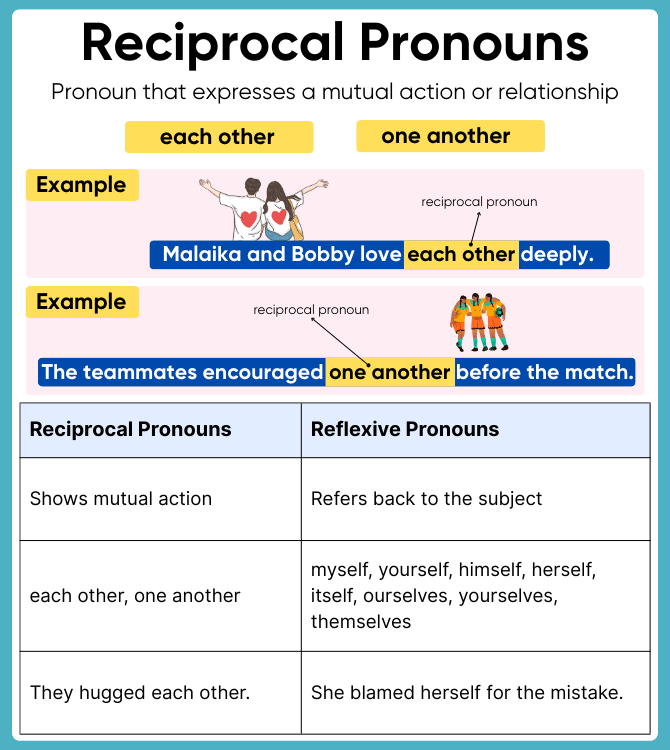
Reciprocal pronouns are pronouns that show mutual action, feeling, or relationship between two or more people, animals, or things named in the subject.
Consider this sentence:
Emma and Jack respect each other.
The sentence carries two connected actions:
- Emma respects Jack
- Jack respects Emma
Instead of repeating both names, English uses each other. The subject contains more than one participant, and the pronoun shows the relationship between them.
The same grammar pattern appears in everyday actions such as greeting, sharing, helping, and responding.
- The two dogs chased each other around the yard.
- The neighbors greeted one another after the meeting.
- The students shared their notes with each other.
In each sentence, the pronoun removes repetition and keeps the sentence natural.
Each Other Vs One Another
The choice between each other and one another often depends on number and formality. Traditional grammar separates the two forms, while modern English often treats them more flexibly.
| Form | Traditional use | Example |
|---|---|---|
| Each other | Two people or things | The twins hugged each other. |
| One another | More than two people or things | The singers listened to one another. |
Modern English often accepts both patterns:
- The classmates helped each other.
- The classmates helped one another.
For grammar tests, schoolwork, or formal explanations, the traditional distinction is safer. In natural writing and speech, choose the form that sounds smoother while keeping the mutual meaning intact.
How They Work In Sentences
Once the reciprocal meaning is clear, the next issue is sentence position. A reciprocal pronoun usually works as the object of a verb or the object of a preposition, not as the subject of the clause.
After A Verb
When the subject shares the action, each other or one another can follow the verb as its object.
- Lily and Ava trust each other.
- The brothers called each other last night.
- The workers thanked one another after the project ended.
In Lily and Ava trust each other, each other is the object of the verb trust. The sentence joins both directions of the relationship without repeating the names.
After A Preposition
Reciprocal pronouns also appear after prepositions such as to, with, beside, from, and at.
- The children talked to one another.
- The friends laughed with each other.
- The chairs stood beside each other.
- The two teams learned from one another.
- The dogs barked at each other.
The preposition belongs to the sentence pattern, while the pronoun keeps the reciprocal relationship clear.
With Plural Subjects
Reciprocal meaning needs more than one participant, so the subject must be plural or refer to a pair or group.
Correct:
- The two boys pushed each other.
- The sisters remind each other about homework.
- The group members listen to one another.
Incorrect:
- Mia smiled at each other.
A singular subject cannot use each other because there is no second participant for the relationship to reach. Just like Emma and Jack respect each other, Mia and Jack smiled at each other works because the subject names two participants.
Possessive Forms: Each Other’s And One Another’s
The same reciprocal meaning can also appear with possession. When the sentence refers to something connected to the participants, such as books, notes, pets, or ideas, the form changes to each other’s or one another’s.
In both possessive forms, the apostrophe comes before s: each other’s and one another’s.
- The girls borrowed each other’s books.
- The students checked one another’s answers.
- The neighbors looked after each other’s gardens.
- The team members remembered one another’s advice.
Write each other’s for possession, not each others.
| Correct | Incorrect |
|---|---|
| They read each other’s messages. | They read each others messages. |
| The children packed one another’s bags. | The children packed one anothers bags. |
| The neighbors fed each other’s cats. | The neighbors fed each others’ cats. |
Since each other works as one phrase, the apostrophe belongs at the end of that phrase: each other’s.
Common Mistakes To Avoid
Most errors with reciprocal pronouns come from three places: writing each other as one word, forming the possessive incorrectly, or confusing reciprocal meaning with reflexive meaning.
| Mistake | Correct form | Why it is wrong |
|---|---|---|
| They know eachother. | They know each other. | Each other is two words. |
| They read each others books. | They read each other’s books. | The possessive form needs an apostrophe before s. |
| We respect ourselves. | We respect each other. | Ourselves points back to the same people, not to a mutual relationship. |
| Each other helped them. | They helped each other. | The pronoun does not work as the subject. |
| Sara likes each other. | Sara and Noor like each other. | The subject must name two or more participants. |
A reliable test is to expand the sentence in both directions.
Tom and Ben trust each other.
The sentence carries two connected meanings:
- Tom trusts Ben
- Ben trusts Tom
If both directions make sense, the pronoun is doing the right work. The mistake with ourselves deserves a closer look because reflexive and reciprocal pronouns both point back to the subject, but they do not describe the same relationship.
Reciprocal Pronouns Vs Reflexive Pronouns
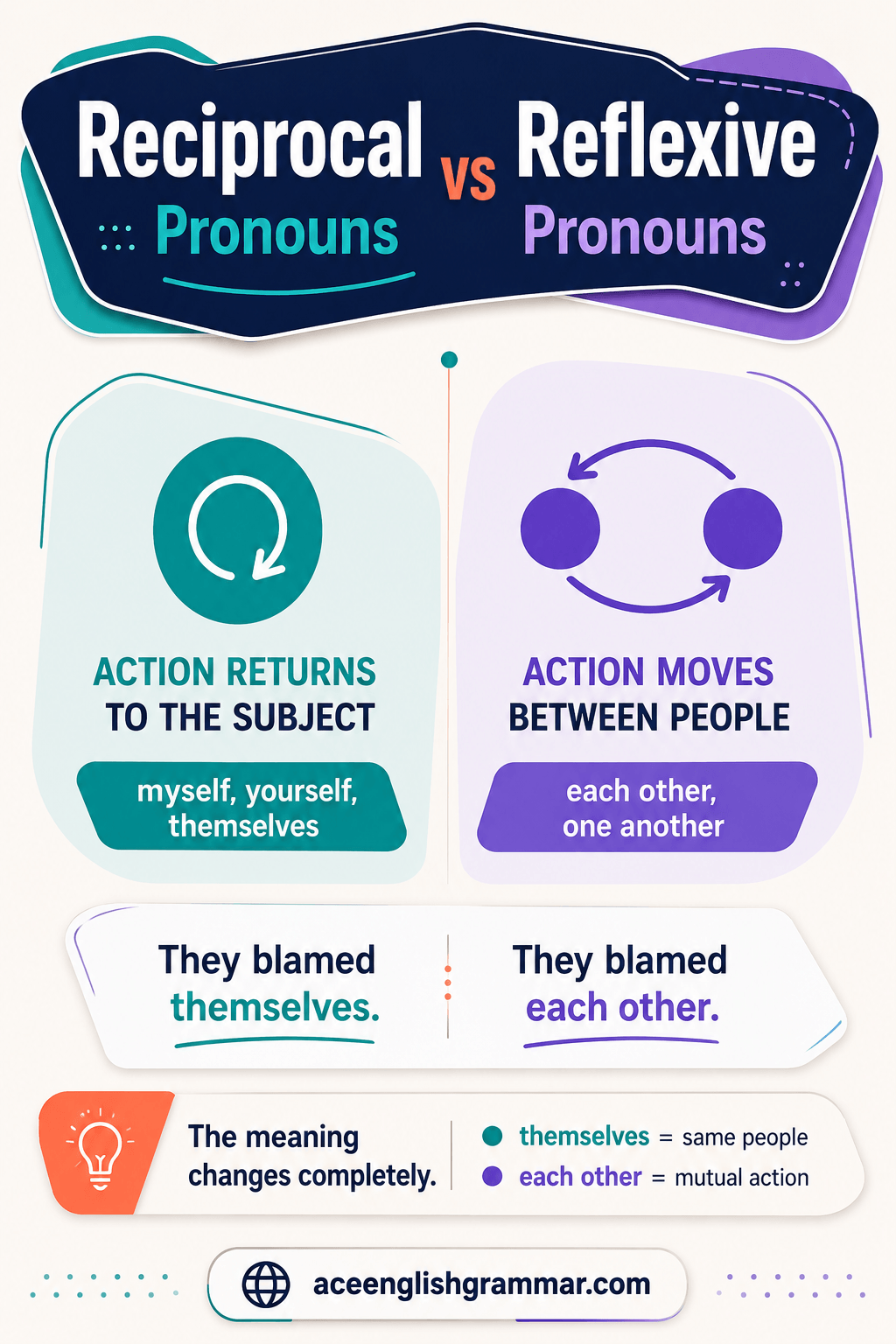
Reflexive pronouns show that the subject does the action to itself.
- Emma looked at herself in the mirror.
- Jack blamed himself for the mistake.
- The cat cleaned itself.
With reciprocal pronouns, the same verb describes a relationship between the participants rather than an action turned back on one person.
- Emma and Jack looked at each other.
- The two friends blamed each other.
- The cats cleaned each other.
The difference becomes clearer when the same verb is used in both patterns.
| Type | Meaning | Forms | Example |
|---|---|---|---|
| Reflexive pronouns | The subject acts on itself | myself, yourself, himself, herself, itself, ourselves, yourselves, themselves | Mia taught herself. |
| Reciprocal pronouns | Two or more participants share the action | each other, one another | Mia and Ava taught each other. |
They taught themselves means each person learned alone or without outside teaching. They taught each other means each person taught the other person.
Examples In Real Sentences
Reciprocal pronouns appear naturally in relationships, group actions, animal behavior, position, and possession.
People And Relationships
In relationship sentences, the pronoun often replaces repeated names, especially with verbs such as respect, know, visit, and greet.
- My parents respect each other.
- The cousins visit each other every summer.
- The two friends text each other after school.
- Lena and Grace know each other well.
- The neighbors greet one another every morning.
Groups And Teams
In group sentences, one another often sounds natural because several people take part in the relationship or action.
- The classmates shared their notes with one another.
- The team members passed one another quick instructions during the final match.
- The workers thanked one another after the busy week.
- The guests introduced themselves to one another before dinner.
- The singers listened to one another during rehearsal.
Animals And Things
These pronouns can also describe animals or things when the relationship works in more than one direction.
- The puppies chased each other across the grass.
- The birds called to one another from the trees.
- The two cats curled beside each other after eating.
- The two magnets pulled toward each other.
- The chairs were placed beside each other.
Possessive Examples
When the sentence points to something connected to both participants, use each other’s or one another’s.
- The sisters borrowed each other’s jackets.
- The editors reviewed one another’s drafts before publishing.
- The neighbors watered each other’s plants.
- The teammates remembered one another’s advice.
- The friends carried each other’s bags.
Practice Exercise
Before choosing an answer, check the subject, the sentence position, and whether the blank needs a possessive form.
Choose each other, one another, each other’s, or one another’s for each blank.
- Emma and Olivia call __________ every evening.
- The students shared __________ notes before the test.
- The team members encouraged __________ after the loss.
- Do you and Ryan understand __________?
- The neighbors looked after __________ pets during the holiday.
- The children listened to __________ during the group activity.
- The two dogs barked at __________ through the fence.
- The singers checked __________ microphones before the show.
Answers
- each other
- one another’s
- one another
- each other
- each other’s
- one another
- each other
- one another’s
FAQs
A reciprocal pronoun shows mutual action or relationship between two or more people, animals, or things named in the subject. In Mia and Ava helped each other, Mia helped Ava and Ava helped Mia.
The two forms are each other and one another. Both carry reciprocal meaning.
Traditionally, each other points to two participants, while one another points to a group. Modern English often uses both in the same way.
No. Reciprocal pronouns need a plural subject or a subject with more than one participant. Emma and Jack trust each other is correct. Emma trusts each other is not correct.
Each other’s is correct for possession. Write They borrowed each other’s books, not each others books or each others’ books.
No. Reflexive pronouns show self-directed action, as in She blamed herself. Reciprocal pronouns show mutual action, as in They blamed each other.
Yes. They often come after prepositions. Natural examples are talk to each other, sit beside one another, learn from each other, and look at one another.
You might also like