Abstract nouns are words such as “honesty”, “freedom” and “anger”. Nobody sees honesty, hears freedom or touches anger, because each word refers to a quality, a state or a feeling and not to an object.
A concrete noun is the opposite: “table”, “river” and “doctor” refer to what the senses perceive. Many abstract nouns are formed from another word, so “bravery” is formed from “brave”, “decision” from “decide” and “friendship” from “friend”.
Once a noun is classed as abstract, its spelling and its grammar depend on the word it is formed from. “Kindness” is formed from “kind”, and in its general sense it takes no article and no plural, as in “Kindness is rare.”
What Are Abstract Nouns?
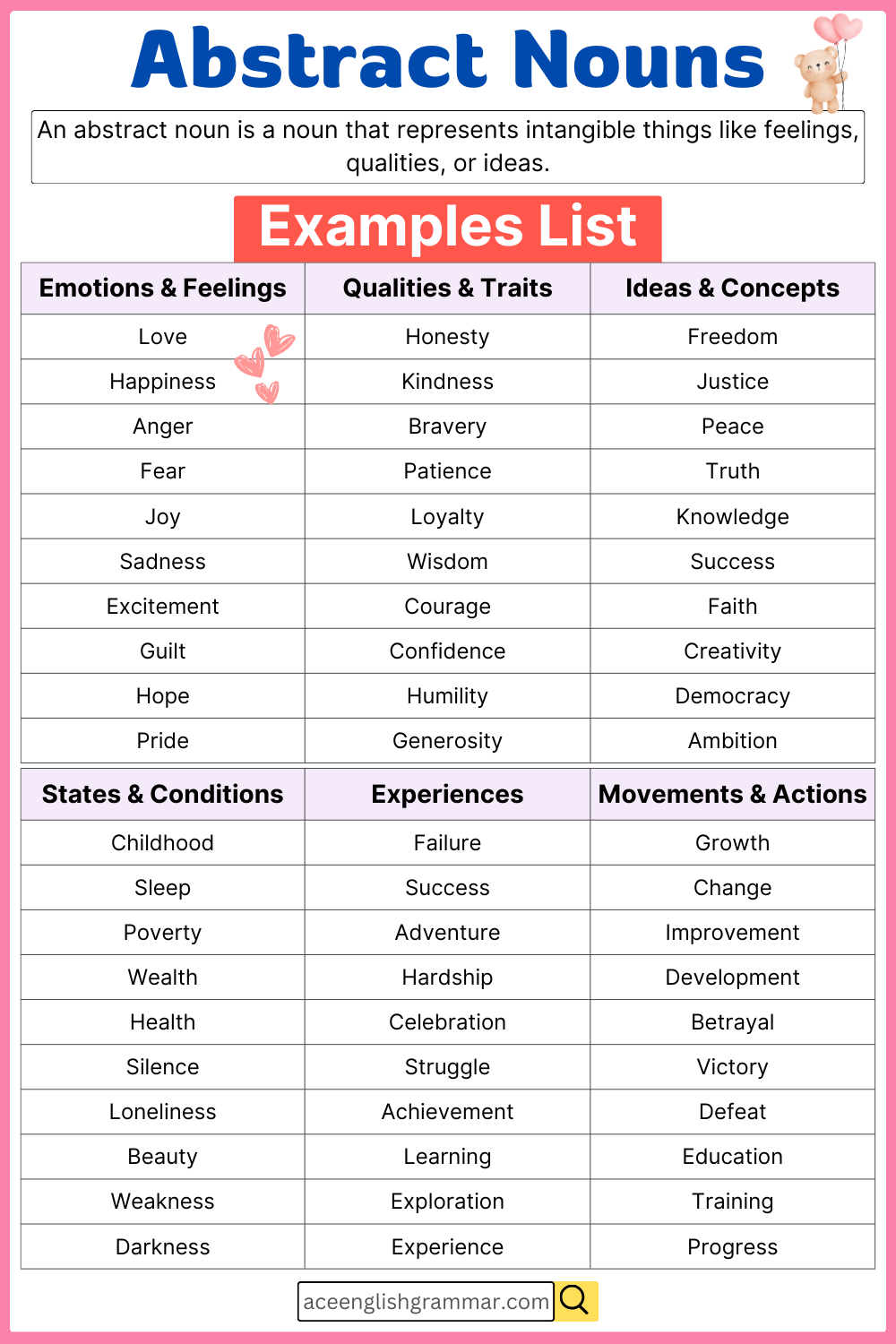
An abstract noun is a noun that denotes a quality, feeling, state, belief or event, none of which has a physical form. It is a common noun, so it begins with a capital letter only at the start of a sentence or inside a title.
In its general sense it is uncountable, which means it takes no plural ending and no article. In “Kindness is shown in small acts”, the word “kindness” refers to a quality, and no sense detects a quality.
- Kindness is shown in small acts.
- Her anger lasted all evening.
- Freedom was the demand of the crowd.
- The arrival of the train was announced at noon.
- He has great respect for his teacher.
Abstract Nouns by Meaning
Abstract nouns refer to a wide range of meanings, from feelings such as “grief” to events such as “arrival”. A noun is placed in a group by its meaning, and some nouns fit two groups: “freedom” is both a condition and a belief.
Emotions and Feelings
A person is described as “jealous”, and the noun “jealousy” is the word for the feeling itself. Nouns of emotion are used when a sentence is about the feeling and not about the person who has it.
- Her grief was visible at the funeral.
- The crowd stood in silence out of fear.
- Their happiness at the news was obvious.
- His jealousy was the cause of the quarrel.
Qualities and Character Traits
When you say that a person is “honest”, you describe the person. The noun “honesty” is the word for the quality itself, and “courage”, “patience” and “beauty” are further examples.
- Her honesty was the reason the manager trusted her.
- The valley’s beauty is famous across the region.
- Intelligence is not the same as wisdom.
States and Conditions
A condition lasts for a period of time, and the noun for it is used with words that measure that time. In “He lived in poverty for ten years”, the noun “poverty” is the condition and “for ten years” is its length. “Health”, “childhood” and “silence” are nouns of the same kind.
- Poverty affects millions of families.
- He enjoyed good health until he was ninety.
- Silence followed the announcement.
Beliefs and Ideals
A belief is a conviction that a person has. A noun such as “faith” or “democracy” refers to that conviction in general, and “justice” and “truth” are two more nouns of belief.
- The court is bound to uphold justice.
- Many citizens value democracy above wealth.
- She has strong faith in science.
Events and Actions
A verb is formed into a noun when a sentence is about the whole action. “The guests arrived” becomes “the arrival of the guests”, and the noun “arrival” refers to the event as a whole. “Decision” and “development” are formed in the same way.
- The arrival of the guests was delayed.
- Their decision surprised the board.
- The development of the vaccine took six years.
The Five Senses Test
You perceive the world through five senses:
- Sight
- Hearing
- Touch
- Taste
- Smell
A noun is concrete when at least one of these senses perceives what it refers to. A noun is abstract when none of them does.
To apply the test to a noun, follow three steps.
- Identify what the noun refers to.
- Ask whether any of the five senses perceives it.
- If any sense does, the noun is concrete. If none does, the noun is abstract.
Apply the steps to these nouns.
- ✅ Table is seen and touched, so it is concrete.
- ✅ Thunder is heard, so it is concrete.
- ✅ Honey is tasted, so it is concrete.
- ❌ Honesty is perceived by no sense, so it is abstract.
- ❌ Anger is perceived by no sense, so it is abstract.
Note that the test is applied to what the noun refers to, not to the evidence of it. A smile is seen, so “smile” is concrete. “Happiness”, which the smile expresses, is abstract.
The same word can pass the test in one sentence and fail it in another, so you apply the test to the noun as it is used. Take “building”.
Compare:
- The building of the bridge took three years. (the act of building, abstract)
- The building is closed on Sundays. (a structure, concrete)
How Abstract Nouns Are Formed
Most abstract nouns are formed by adding a suffix to an adjective, a verb or another noun. “Kind” becomes “kindness”, “decide” becomes “decision” and “friend” becomes “friendship”. A few root words, such as “time” and “love”, are abstract nouns with no suffix at all.
Suffixes Added to Adjectives
An adjective denotes a quality, and a suffix added to it forms the noun for that quality, as in “kind” and “kindness”. The suffix “-ness” is added to the widest range of adjectives. The other suffixes are added to particular adjectives that you learn with the word.
| Suffix | Adjective | Abstract noun |
|---|---|---|
| -ness | Happy, kind | Happiness, kindness |
| -ity | Able, real | Ability, reality |
| -y | Honest | Honesty |
| -cy | Accurate | Accuracy |
| -ence | Intelligent, silent | Intelligence, silence |
| -ance | Elegant, vigilant | Elegance, vigilance |
| -dom | Wise, free | Wisdom, freedom |
| -th | Strong, warm, true | Strength, warmth, truth |
| -ty | Cruel, safe | Cruelty, safety |
| -ry | Brave | Bravery |
Three adjectives take a new stem instead of a regular suffix: “proud” becomes “pride”, “poor” becomes “poverty” and “long” becomes “length”.
Note that a final ‘y’ is changed to ‘i’ before “-ness”, so “happy” becomes “happiness” and “lazy” becomes “laziness”. The spelling “happyness” is an error.
Suffixes Added to Verbs
A verb denotes an action, and a suffix added to it forms the noun for the action or its result, as in “decide” and “decision”. The verb “agree” takes “-ment”, and the verb “invent” takes “-ion”. Each verb takes its own suffix, which you learn with the verb.
| Suffix | Verb | Abstract noun |
|---|---|---|
| -ment | Agree, achieve | Agreement, achievement |
| -ion | Invent, decide | Invention, decision |
| -ation | Educate, imagine | Education, imagination |
| -al | Arrive, refuse | Arrival, refusal |
| -ure | Fail, press | Failure, pressure |
| -ance | Perform, resist | Performance, resistance |
| -ence | Depend, exist | Dependence, existence |
| -age | Marry, pass | Marriage, passage |
Some verbs form the abstract noun with no change at all, as in “love” and “hope”. The word “fear” is a verb in “I fear spiders” and an abstract noun in “Their fear of spiders began early”, so you identify the class from its position in the sentence.
- I fear spiders. (verb)
- Their fear of spiders began early. (abstract noun)
Suffixes Added to Nouns
A noun for a person or an object forms an abstract noun when a suffix is added that expresses a state, a rank or a system of belief. “Child” becomes “childhood”, and the new word refers to a period of life and not to a person.
| Suffix | Noun | Abstract noun |
|---|---|---|
| -hood | Child, brother | Childhood, brotherhood |
| -ship | Friend, leader | Friendship, leadership |
| -ism | Hero, tourist | Heroism, tourism |
| -dom | Star, martyr | Stardom, martyrdom |
| -ry | Rival | Rivalry |
| -ery | Slave | Slavery |
Note that “leadership” is used in two meanings: the quality of a leader, which is abstract, and the group of leaders in an organization, which is a collective noun.
Abstract Nouns vs Concrete Nouns
Abstract nouns and concrete nouns differ in what they refer to, in how they are counted and in how they form a plural. The difference between abstract and concrete nouns starts from the five senses test.
| Feature | Abstract noun | Concrete noun |
|---|---|---|
| Perceived by the senses | No | Yes |
| Counting | Uncountable in the general sense | Countable for most nouns |
| Plural | Only for separate instances | Regular |
| Examples | Honesty, freedom, arrival | Table, river, doctor |
A full list of abstract and concrete nouns lists over two hundred further pairs.
Abstract and Concrete Meanings of One Noun
Some nouns are abstract in one meaning and concrete in another, and you identify the meaning from the sentence. Apply the five senses test to each sentence separately: a concrete meaning refers to a person or an object, and an abstract meaning refers to a quality or a state.
- Beauty fades. (quality, abstract)
- She is a beauty. (a person, concrete)
- Youth is brief. (a stage of life, abstract)
- The youths waited outside the hall. (people, concrete)
- Pleasure is a reason to travel. (feeling, abstract)
- Her pleasures include sailing and chess. (separate activities, countable)
Note that a regular plural identifies the countable meaning. A noun that takes one is being used in a countable sense.
Countable and Uncountable Abstract Nouns
Abstract nouns are uncountable in their general sense and countable when they refer to separate instances, as in “kindness” and “kindnesses”. The article and the plural depend on that difference. In the general sense an abstract noun takes no article.
| Use | Article | Example |
|---|---|---|
| General sense | None | Honesty is rare. |
| Limited to one instance | The | The honesty of the witness impressed the jury. |
| Countable sense with a modifier | A or an | She spoke with a quiet confidence. |
| Plural, separate instances | None | Small kindnesses are remembered. |
Abstract nouns such as “advice” and “knowledge” are always singular and take a singular verb. “Knowledge is power” is therefore correct, and “Knowledge are power” is not.
- ✅ He gave me good advice. ❌ He gave me good advices.
- ✅ Her courage was admired. ❌ Her courages were admired.
- ✅ A piece of advice is enough. ❌ An advice is enough.
Abstract Nouns in Sentences
An abstract noun is placed in a sentence exactly as any other noun is, and its grammatical role depends on its position.
- Subject: Courage is rare in a crisis.
- Direct object: She showed great courage.
- Subject complement: His greatest strength is patience.
- Object of a preposition: He acted with kindness.
- Possessive form: Freedom’s price is high.
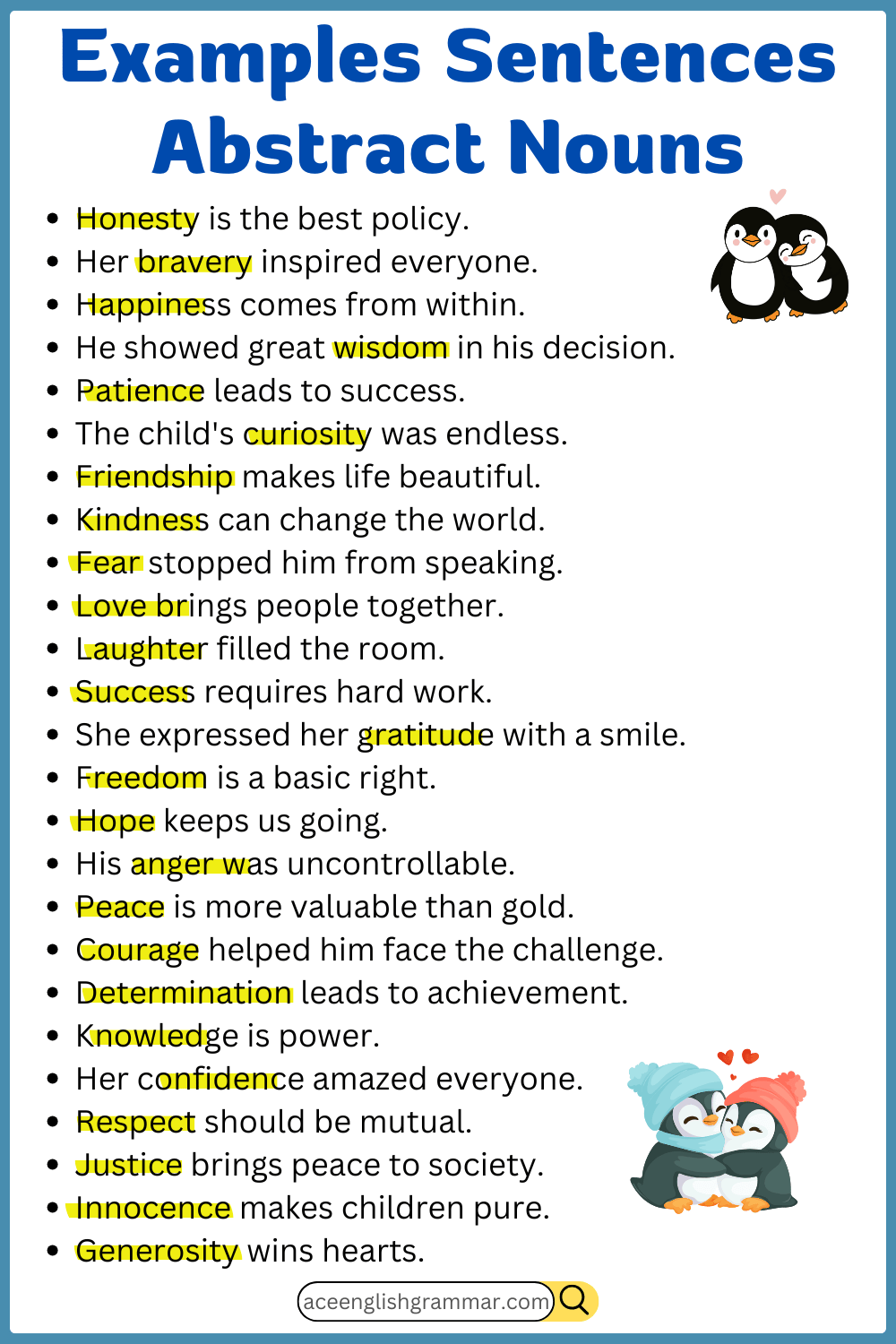
Common Mistakes With Abstract Nouns
Most mistakes with abstract nouns come from treating them as concrete nouns, with a plural ending, an article or a capital letter added without a reason.
Plural endings: Write “advice” and “knowledge”, not “advices” and “knowledges”. A piece of advice counts one instance.
Extra articles: Write “She has courage”, not “She has a courage”. The article is used only with a modifier, as in “a quiet courage”.
Capital letters: Write “She values honesty”, not “She values Honesty”. An abstract noun is a common noun and takes a capital letter only at the start of a sentence or inside a title.
Verb agreement: Write “Her advice was welcome”, not “Her advice were welcome”. The noun is singular whatever its meaning.
Suffix spelling: Write “accuracy”, not “accuratness”. Write “arrival”, not “arrivation”. Each base word takes its own suffix, which you learn with the word.
Abstract Nouns Exercises
Form the abstract noun or choose the correct word.
- Form an abstract noun from “brave”.
- Form an abstract noun from “decide”.
- Form an abstract noun from “friend”.
- Choose the correct sentence: She gave me (an advice / some advice).
- Choose the correct spelling: (happyness / happiness).
- Is the noun in “The thunder frightened the child” abstract or concrete?
- Complete the sentence: Honesty (is / are) valued in every profession.
- Form an abstract noun from “wise”.
- Choose the correct word: (Knowledges / Knowledge) is power.
- Does “building” refer to an act or a structure in “The building of the wall took a year”?
Answers:
- Bravery.
- Decision.
- Friendship.
- Some advice, since “advice” is uncountable.
- Happiness.
- Concrete, since thunder is heard.
- Is, since “honesty” is singular.
- Wisdom.
- Knowledge, which has no plural.
- An act, so the noun is abstract.
FAQs
Q1. What are examples of abstract nouns?
Examples of abstract nouns are honesty, freedom and anger, since no sense detects any of them. Justice, wisdom and friendship are three more, and each refers to a quality, a belief or a state.
Q2. Is love an abstract noun?
Yes, “love” is an abstract noun when it refers to a feeling, as in “Their love of music began early”. It is a verb in “I love music”, so the word class depends on the position in the sentence. As a noun, no sense perceives it.
Q3. Is time an abstract noun?
Yes, “time” is abstract in “Time passes quickly”, since no sense detects it. It stays abstract in the countable sense “three times”, where it counts occasions. A clock is concrete, while time itself is not.
Q4. Is friendship an abstract noun?
Yes, “friendship” is an abstract noun formed from the concrete noun “friend” and the suffix “-ship”. It refers to a relationship, which no sense detects. “Leadership”, “hardship” and “ownership” are formed in the same way.
Q5. Is happy an abstract noun?
No, “happy” is an adjective. The abstract noun is “happiness”, formed by changing ‘y’ to ‘i’ and adding “-ness”. Both words refer to the same quality, but only “happiness” is used in a noun position, as in “Her happiness was obvious”.
Q6. Are abstract nouns capitalized?
No, abstract nouns are written in lower case unless they begin a sentence or stand inside a title. They are common nouns, so “honesty” and “freedom” take no capital letter mid-sentence. A name such as Freedom Square is a proper noun.
Q7. Is an abstract noun a common noun?
Yes, an abstract noun is a common noun, since it refers to a general quality or state and not to a particular person or place. Common nouns divide into abstract and concrete nouns, and proper nouns form a separate class.
Q8. Do we use articles with abstract nouns?
No, an abstract noun takes no article in its general sense, as in “Honesty is rare”. It takes “the” when an of phrase or a clause limits it to one instance. It takes “a” or “an” when an adjective makes it countable, as in “a quiet confidence”.
Q9. Are abstract nouns adjectives?
No, abstract nouns are nouns, and adjectives form a separate class. Many abstract nouns are formed from adjectives, as “kindness” is formed from “kind”, but the noun is used in a noun position, as in “Kindness is rare”.
Download PDF
This PDF provides a detailed definition of abstract nouns, along with examples to help learners understand intangible concepts like emotions, ideas, and qualities. A valuable resource for improving English grammar and vocabulary. Download now for easy reference!
Read More