English treats nouns in two main ways: some nouns name separate things you can count, and others name things you measure, describe, or understand as a whole. A book, chair, or apple can be one item or several items. Water, advice, and furniture do not work the same way because English does not normally count them as individual pieces without adding a measurement word.
This difference affects everyday grammar. It decides whether you write a, an, many, much, a singular verb, or a plural form. By the end, you should be able to recognize countable and uncountable nouns in real sentences, choose words like many, much, a, an, and some with more control, and avoid the noun mistakes that make English sound unnatural.
What Are Countable Nouns?
A countable noun is a noun that names something English treats as a separate unit, so it can appear in singular or plural form and combine with numbers, articles, and plural quantifiers such as many or several.
- A book
- Two books
- An apple
- Several students
The noun changes because the number changes. One item takes the singular form, while more than one item usually takes the plural form.
Common Countable Nouns
| Singular | Plural |
|---|---|
| Chair | Chairs |
| Table | Tables |
| Book | Books |
| Car | Cars |
| Apple | Apples |
| Dog | Dogs |
| Pen | Pens |
| Student | Students |
| Friend | Friends |
| Teacher | Teachers |
| Ticket | Tickets |
| Window | Windows |
Countable nouns appear naturally with numbers and articles.
- I have a book on my desk.
- She bought three apples from the market.
- Two students arrived before class.
- We need several chairs for the meeting.
Rules For Countable Nouns
Countable nouns follow a predictable pattern because English can treat each item as one separate thing.
Use singular and plural forms.
- Singular: a pen, an orange, one chair
- Plural: pens, oranges, three chairs
Use numbers directly before the noun.
- She has two bags.
- We bought five tickets.
- Three dogs were running in the park.
Use many with plural countable nouns.
- Many students attended the lecture.
- There are many chairs in the room.
Use a or an with singular countable nouns.
A singular countable noun usually needs an article, possessive word, or another determiner.
- She bought a pencil.
- He opened the window.
- My friend called me yesterday.
The sentence She bought pencil sounds incomplete because pencil is a singular countable noun. English expects a word such as a, the, this, that, or my before it.
What Are Uncountable Nouns?
An uncountable noun is a noun that names something English does not usually treat as separate countable units. It may refer to a substance, material, abstract idea, activity, quality, or broad category.
- Water
- Milk
- Sugar
- Advice
- Knowledge
- Furniture
- Information
- Music
Uncountable nouns usually stay singular in grammar, even when they describe a large amount.
- There is water in the bottle.
- She gave me useful advice.
- The furniture looks expensive.
- This information is important.
The amount may be large, but the noun form does not normally become plural.
Rules For Uncountable Nouns
Uncountable nouns need different grammar because English treats them as amounts or categories rather than separate items.
Do not use a or an before most uncountable nouns.
- Incorrect: I need a water.
- Correct: I need some water.
- Incorrect: She gave me an advice.
- Correct: She gave me some advice.
Use much with uncountable nouns.
- There is not much sugar left.
- How much information do you need?
Use singular verbs.
- Incorrect: The furniture are new.
- Correct: The furniture is new.
- Incorrect: The information were incorrect.
- Correct: The information was incorrect.
Use some, a lot of, or a little for general amounts.
- I need some water.
- She has a lot of experience.
- There is a little milk in the fridge.
These words let you talk about quantity without forcing the noun into a plural form.
Common Uncountable Nouns
Many uncountable nouns fall into natural groups. Seeing them by type makes the pattern easier to remember.
| Category | Examples |
|---|---|
| Liquids and substances | Water, milk, coffee, oil, sugar, salt |
| Materials | Gold, silver, wood, paper, glass |
| Food as a mass | Rice, bread, cheese, meat, butter |
| Ideas and qualities | Knowledge, advice, courage, honesty, progress |
| General categories | Furniture, equipment, luggage, traffic, weather |
| Activities and fields | Work, research, education, music |
| Feelings and states | Happiness, love, health, energy |
Some of these nouns can look countable in another context, but their common grammar pattern is uncountable. That difference becomes important when the meaning changes.
Difference Between Countable And Uncountable Nouns
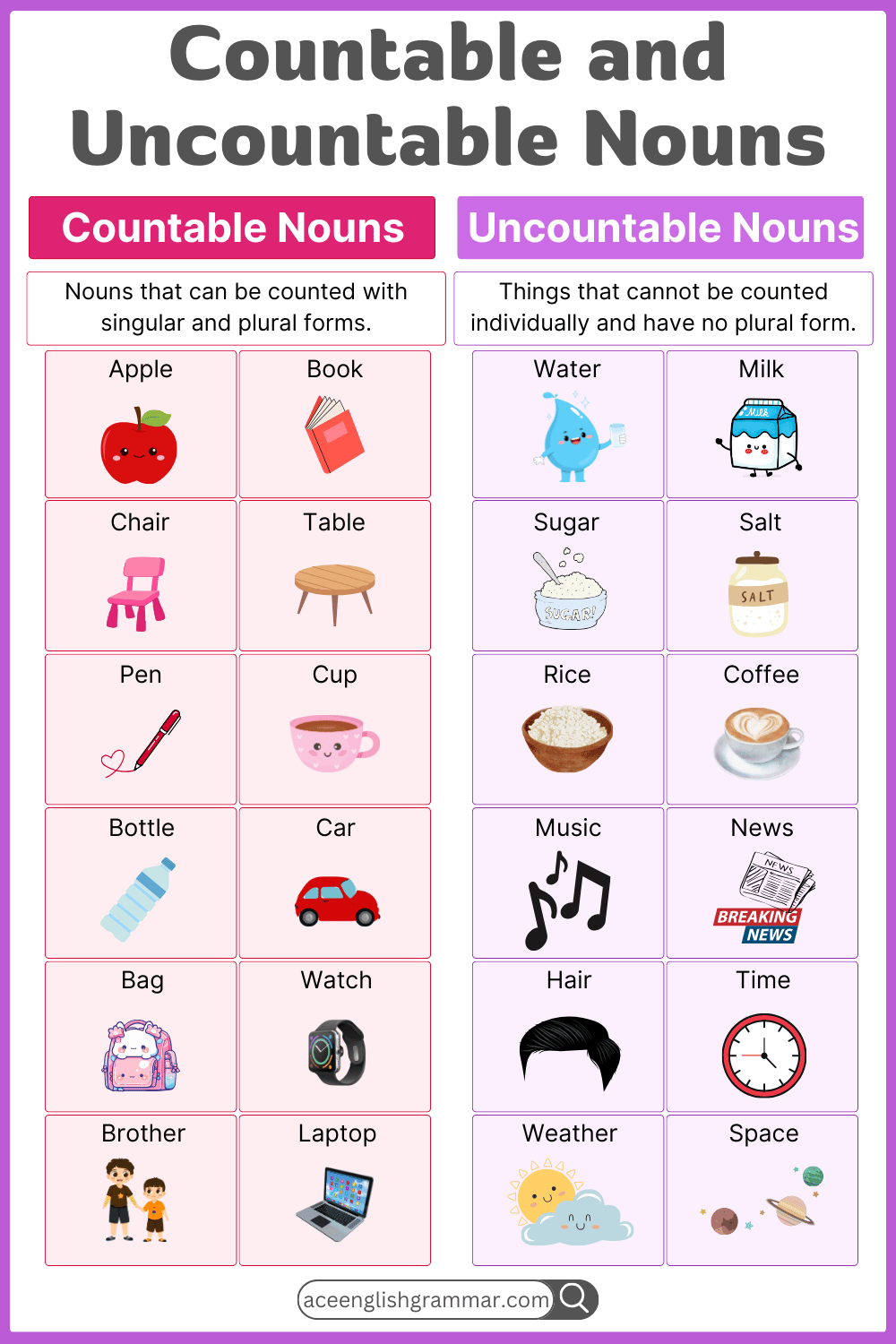
Before you choose a quantifier or verb, decide how English is treating the noun. Countable nouns behave like individual items. Uncountable nouns behave like amounts, materials, ideas, or categories.
| Feature | Countable Nouns | Uncountable Nouns |
|---|---|---|
| Basic idea | Separate units | Whole amount or category |
| Number use | Can take numbers directly | Cannot usually take numbers directly |
| Singular and plural | Has singular and plural forms | Usually has one form |
| Article use | Can use a or an in singular form | Usually does not use a or an |
| Verb agreement | Singular or plural | Usually singular |
| Common quantifiers | Many, few, several | Much, little, some |
| Examples | Book, chair, apple, student | Water, advice, furniture, information |
Compare the sentence movement:
- Countable: I bought two books.
- Uncountable: I bought some furniture.
You can count books directly. You cannot normally say two furnitures. You need a unit phrase if you want to count pieces.
Quantifiers For Countable And Uncountable Nouns
Quantity words are where many noun mistakes happen. English uses different quantifiers depending on whether the noun is countable or uncountable.
Quantifiers For Countable Nouns
Use these with plural countable nouns:
- Many
- Few
- A few
- Several
- A number of
Examples:
- Many students attended the lecture.
- A few chairs were empty.
- Several tickets were sold before noon.
Quantifiers For Uncountable Nouns
Use these with uncountable nouns:
- Much
- Little
- A little
- Some
- A lot of
Examples:
- There is little sugar left.
- She gave me some advice.
- We do not have much time.
A lot of works with both types:
- A lot of books were on the shelf.
- A lot of information was missing.
The noun after the quantifier still controls the grammar. Books takes plural grammar, while information stays singular.
Measurement Words With Uncountable Nouns
Uncountable nouns can still be measured. English does this by counting the unit, container, piece, or serving instead of counting the noun directly.
| Uncountable Noun | Natural Measurement Phrase |
|---|---|
| Water | A glass of water |
| Bread | A loaf of bread |
| Advice | A piece of advice |
| Furniture | A piece of furniture |
| Rice | A bowl of rice |
| Coffee | A cup of coffee |
| Milk | A bottle of milk |
| Cheese | A slice of cheese |
This is why two loaves of bread is correct, but two breads usually sounds wrong when you mean ordinary bread as food. The countable word is loaves, not bread.
More examples:
- She drank two glasses of water.
- He gave me three pieces of advice.
- We bought two pieces of furniture for the living room.
- They ordered four cups of coffee.
The measurement word carries the number. The uncountable noun keeps its normal form.
Nouns That Can Be Countable Or Uncountable
Some nouns can work both ways, but the meaning changes. The grammar depends on whether the noun refers to a general substance or to one separate item, serving, type, or document.
Coffee
- Coffee is popular around the world.
- We ordered two coffees.
In the first sentence, coffee means the drink in general. In the second sentence, two coffees means two cups of coffee.
Paper
- Paper burns easily.
- I submitted three papers.
The first sentence refers to the material. The second refers to documents or academic assignments.
Chicken
- We ate chicken for dinner.
- The farmer owns six chickens.
The first sentence refers to chicken as food. The second refers to individual animals.
Glass
- Glass breaks easily.
- She placed two glasses on the table.
The first sentence refers to the material. The second refers to drinking containers.
This pattern is common in English. When the meaning shifts from material or general category to individual item, the noun can become countable.
Common Mistakes With Countable And Uncountable Nouns
Many mistakes happen because learners apply countable grammar to an uncountable noun, or they choose the wrong quantity word.
Using a or an with uncountable nouns
- Incorrect: He gave me an advice.
- Correct: He gave me some advice.
- Also correct: He gave me a piece of advice.
Advice is uncountable, so it does not take an. If you want to count one item of advice, use a piece of advice.
Adding plural forms to uncountable nouns
- Incorrect: The furnitures are expensive.
- Correct: The furniture is expensive.
- Also correct: The pieces of furniture are expensive.
Furniture names the category as a whole. To count separate items, use pieces of furniture.
Counting uncountable nouns directly
- Incorrect: She bought two breads.
- Correct: She bought two loaves of bread.
The number belongs with loaves, not directly with bread.
Using many and much incorrectly
- Incorrect: There were much students in the hall.
- Correct: There were many students in the hall.
- Incorrect: We received many information.
- Correct: We received much information.
- More natural: We received a lot of information.
Use many with plural countable nouns and much with uncountable nouns. In everyday affirmative sentences, a lot of often sounds more natural than much.
Practical Grammar Notes For Everyday English
The countable and uncountable difference shows up most often in articles, quantity words, and verb agreement.
- Say a chair because chair is a singular countable noun.
- Say some furniture because furniture is uncountable.
- Say many books because books is a plural countable noun.
- Say much information or a lot of information because information is uncountable.
When you are unsure, test the noun with a number. If two + noun sounds natural, the noun is probably countable in that context. If it sounds wrong, look for a measurement phrase.
FAQs
Q1. What are countable and uncountable nouns?
Countable nouns name things English treats as separate units, such as books, chairs, and students. Uncountable nouns name things treated as whole amounts, materials, ideas, or categories, such as water, advice, furniture, and information.
Q2. How do you identify countable and uncountable nouns?
Try placing a number before the noun. Two books sounds natural, so book is countable. Two advice sounds wrong, so advice is uncountable and needs a phrase such as two pieces of advice.
Q3. Can uncountable nouns become countable?
Yes. Some nouns become countable when they refer to servings, documents, types, or individual items. Coffee is usually uncountable as a drink, but two coffees can mean two cups of coffee.
Q4. Why is furniture uncountable?
English treats furniture as a general category, not as separate countable items. Say some furniture, new furniture, or two pieces of furniture, not two furnitures.
Q5. Which words are used with uncountable nouns?
Common words with uncountable nouns include some, much, little, a little, and a lot of. For exact quantity, use measurement phrases such as a glass of water, a piece of advice, or a loaf of bread.
Conclusion
Countable and uncountable nouns do more than name things. They control the grammar around the noun. Countable nouns take numbers, plural forms, and words like many. Uncountable nouns usually stay singular and need words like some, much, or a measurement phrase. Once you learn how English treats the noun, the rest of the sentence becomes much easier to shape correctly.
Download PDF
Understanding the difference between countable and uncountable nouns is essential for proper English usage. To help you learn easily, we have created a PDF guide that includes definitions, key differences, and examples of both types of nouns.
Read More