Common nouns name the general people, places, things, animals, and ideas we talk about every day. Words like teacher, city, book, dog, and courage do not name one specific person or place. They name a general category, which is why they usually stay lowercase inside a sentence.
A sentence often depends on common nouns for its basic structure. In “The teacher opened the book,” teacher names the person doing the action, and book names the thing receiving the action. Neither word gives a specific name, so both are common nouns.
By the end, you should be able to recognize common nouns in real sentences, tell them apart from proper nouns, use capitalization correctly, and avoid the common mistakes that make noun usage look unclear.
What Are Common Nouns?
A common noun is a noun that names a general person, place, thing, animal, or idea. It does not identify a specific name, title, brand, or location.
In a sentence, a common noun can work as the subject, object, or complement.
- The student carried a bag.
- A doctor entered the room.
- The city looked beautiful at night.
In the first sentence, student and bag are common nouns. The sentence tells us about a general student and a general bag, not a named person or a specific branded item.
A common noun becomes a proper noun when the sentence gives a specific name.
- teacher becomes Mr. Ahmed.
- city becomes London.
- school becomes Greenwood High School.
This difference matters because proper nouns need capital letters, while common nouns normally do not.
Common Nouns Examples
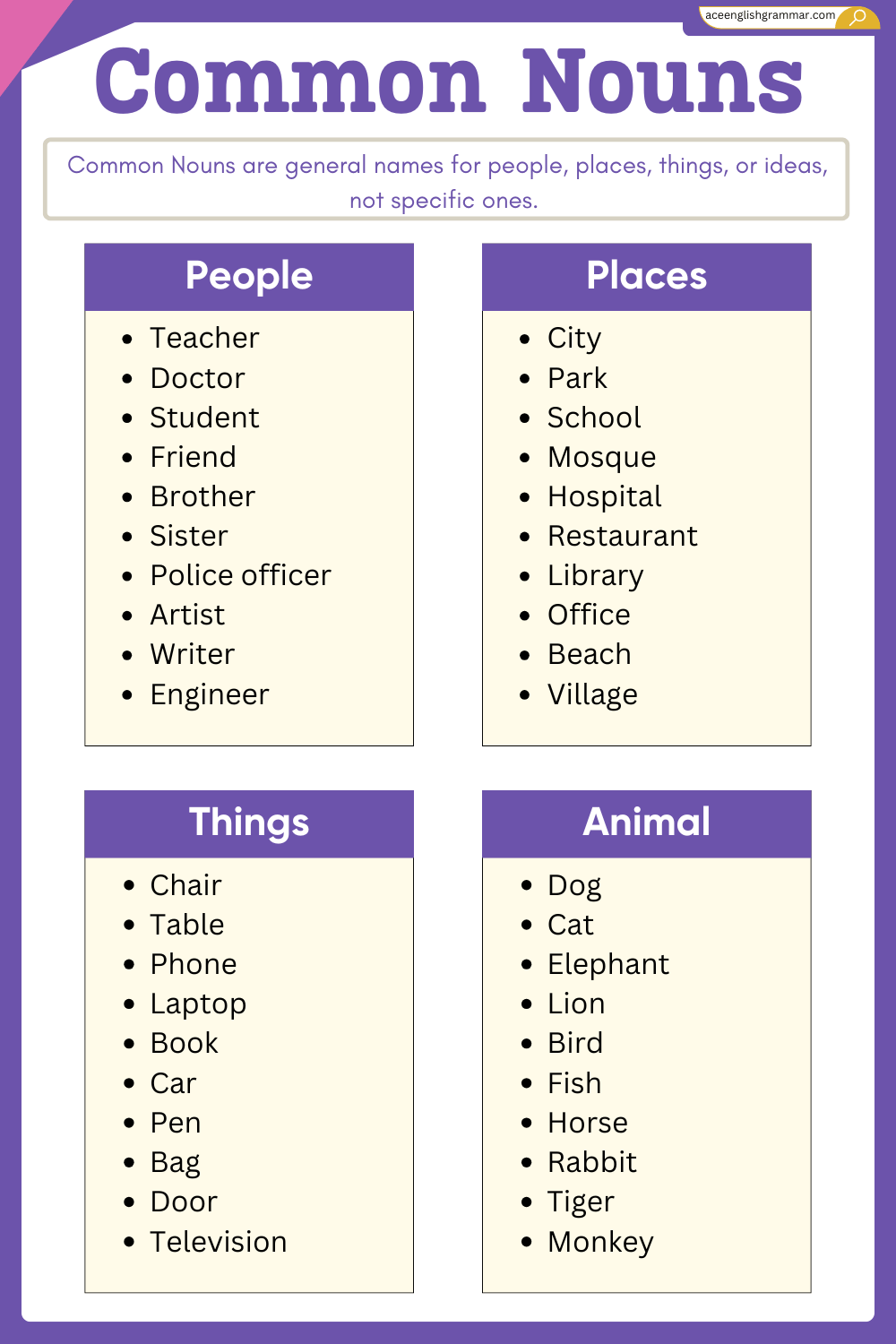
Common nouns are easier to recognize when you group them by what they name. The word may refer to a person, place, thing, animal, or idea, but it still stays general unless it becomes a specific name.
Common Nouns For People
These nouns name people by role, relationship, job, or general identity.
- Boy
- Teacher
- Doctor
- Engineer
- Student
- Nurse
- Artist
- Chef
- Player
- Friend
Examples in sentences:
- The teacher explained the lesson carefully.
- A doctor checked the patient in the hospital.
- The student carried a heavy bag to class.
Common Nouns For Places
Place nouns name general locations where people live, work, study, worship, travel, or spend time.
- School
- Park
- Mosque
- Library
- Market
- Village
- Hospital
- Restaurant
- Office
- Airport
Examples in sentences:
- The children played in the park after school.
- My uncle works in a large office downtown.
- The restaurant stayed busy during the evening.
Common Nouns For Things
These nouns name objects, tools, devices, or everyday items.
- Car
- Table
- Phone
- Laptop
- Chair
- Book
- Bicycle
- Watch
- Television
- Bag
Examples in sentences:
- She placed the phone on the table.
- The book remained open beside the laptop.
- A bicycle leaned against the wall outside.
Common Nouns For Animals
Animal nouns identify creatures in a general way rather than naming one pet, breed, or species title.
- Dog
- Cat
- Elephant
- Horse
- Lion
- Tiger
- Rabbit
- Monkey
- Cow
- Deer
Examples in sentences:
- The dog barked loudly at the gate.
- A monkey climbed the tree quickly.
- The horse ran across the field.
Common Nouns For Ideas And Feelings
Some common nouns name abstract ideas, emotions, qualities, or states. You cannot touch them physically, but they still work as nouns in a sentence.
- Love
- Fear
- Courage
- Honesty
- Wisdom
- Happiness
- Hope
- Knowledge
- Kindness
- Freedom
Examples in sentences:
- Honesty builds trust between people.
- Courage helped the firefighter enter the building.
- Knowledge grows through reading and experience.
Types Of Common Nouns

Common nouns can be grouped by meaning and grammar behavior. These types show whether the noun names something physical, abstract, countable, uncountable, or collective.
Concrete Nouns
A concrete noun names something you can see, hear, touch, smell, or taste.
Examples:
- Apple
- Chair
- Car
- Table
- Flower
Sentence example:
- The child dropped the apple on the floor.
Abstract Nouns
An abstract noun names an idea, feeling, quality, condition, or experience.
Examples:
- Happiness
- Freedom
- Bravery
- Honesty
- Peace
Sentence example:
- Bravery helped the soldier remain calm during danger.
Countable Nouns
A countable noun names something you can count as one item, two items, or more. Countable nouns usually have singular and plural forms.
| Singular | Plural |
|---|---|
| Book | Books |
| Chair | Chairs |
| Student | Students |
| Pen | Pens |
Sentence example:
- Three students entered the classroom early.
Uncountable Nouns
An uncountable noun names something that is not usually counted one by one. These nouns often do not take a regular plural form.
Examples:
- Water
- Milk
- Information
- Air
- Rice
Sentence example:
- The glass contained fresh water.
You would say “some information,” not “some informations,” because information is uncountable in standard English.
Collective Nouns
A collective noun names a group as one unit.
Examples:
- Team
- Family
- Crowd
- Committee
- Flock
Sentence example:
- The team celebrated its victory together.
How Common Nouns Work In Sentences
Common nouns do more than name things. They often carry the main structure of a sentence because they can show who acts, who receives the action, or what something is.
As a subject: The subject performs the action or holds the main position in the sentence.
- The dog barked loudly during the night.
As an object: The object receives the action of the verb.
- Aisha bought a book from the store.
As an indirect object: The indirect object shows who receives something.
- Hassan gave his friend a gift.
As a subject complement: A complement renames or describes the subject after a linking verb.
- Sara is an excellent teacher.
Notice how each common noun has a sentence role. This is why common nouns are not only vocabulary words. They help form the grammar of a complete sentence.
Common Nouns Vs Proper Nouns
The main difference between common nouns and proper nouns is specificity. A common noun names a general category, while a proper noun gives a specific name.
| Aspect | Common Noun | Proper Noun |
|---|---|---|
| Meaning | General name | Specific name |
| Capitalization | Lowercase inside a sentence | Always capitalized |
| Examples | City, teacher, book, school | Karachi, Mr. Ali, Harry Potter, Oxford University |
| Sentence | I visited a city last summer. | I visited Lahore last summer. |
A word can change from common to proper when it becomes part of a specific name.
- river is common, but The Nile River is proper.
- school is common, but Riverdale High School is proper.
- teacher is common, but Mrs. Carter is proper.
Capitalization gives the reader an important signal. If the word names a specific person, place, book, organization, or title, it should usually begin with a capital letter.
Common Mistakes With Common Nouns
Many common noun mistakes come from capitalization, plural forms, or confusion with uncountable nouns. The correction usually becomes easier once you identify whether the noun is general or specific.
Mistake 1: Capitalizing general nouns unnecessarily.
- ❌ My Brother works in a Hospital.
- ✅ My brother works in a hospital.
Brother and hospital are general nouns in this sentence, so they should stay lowercase.
Mistake 2: Forgetting to capitalize proper nouns.
- ❌ She visited paris last year.
- ✅ She visited Paris last year.
Paris names a specific city, so it is a proper noun and needs a capital letter.
Mistake 3: Adding plural endings to uncountable nouns.
- ❌ I need more informations.
- ✅ I need more information.
Information is uncountable in standard English, so it does not normally take the plural ending -s.
Mistake 4: Using a or an before an uncountable noun.
- ❌ She gave me an advice.
- ✅ She gave me advice.
Advice is uncountable, so it does not take an. You can say “a piece of advice” when you need a countable form.
How To Identify Common Nouns
To identify a common noun, look at what the word names and how it behaves in the sentence.
Ask these questions:
- Does the word name a general person, place, thing, animal, or idea?
- Is it not the official name of a specific person, place, brand, title, or organization?
- Does it usually stay lowercase inside a sentence?
- Can it work as a subject, object, or complement?
If the answer is yes, the word is probably a common noun.
For example, teacher is a common noun because it names a general role. Mrs. Wilson is a proper noun because it names a specific person.
FAQs
Q1. What is a common noun in simple words?
A common noun is a general name for a person, place, thing, animal, or idea. Words such as teacher, city, book, and kindness are common nouns.
Q2. What are 10 examples of common nouns?
Ten common noun examples are boy, teacher, school, park, phone, chair, dog, river, courage, and family.
Q3. How do you identify a common noun?
A noun is usually common if it names a general category and does not give a specific name. It also stays lowercase unless it begins a sentence.
Q4. Is school a common noun?
Yes. School is a common noun when it refers to any school. It becomes part of a proper noun in a specific name such as Riverdale High School.
Q5. Can common nouns be capitalized?
Yes, but only in certain positions. A common noun is capitalized at the beginning of a sentence or in a title, not simply because it names an important thing.
Conclusion
Common nouns give English sentences their general names for people, places, things, animals, and ideas. Once you can spot the difference between a general noun like city and a specific name like London, capitalization, sentence structure, and noun usage become much easier to control.
Download PDF
This PDF provides a clear definition of common nouns, their types, usage rules, and examples to help learners understand how common nouns are used in English. A valuable resource for improving grammar skills. Download now for easy learning!
Read More