
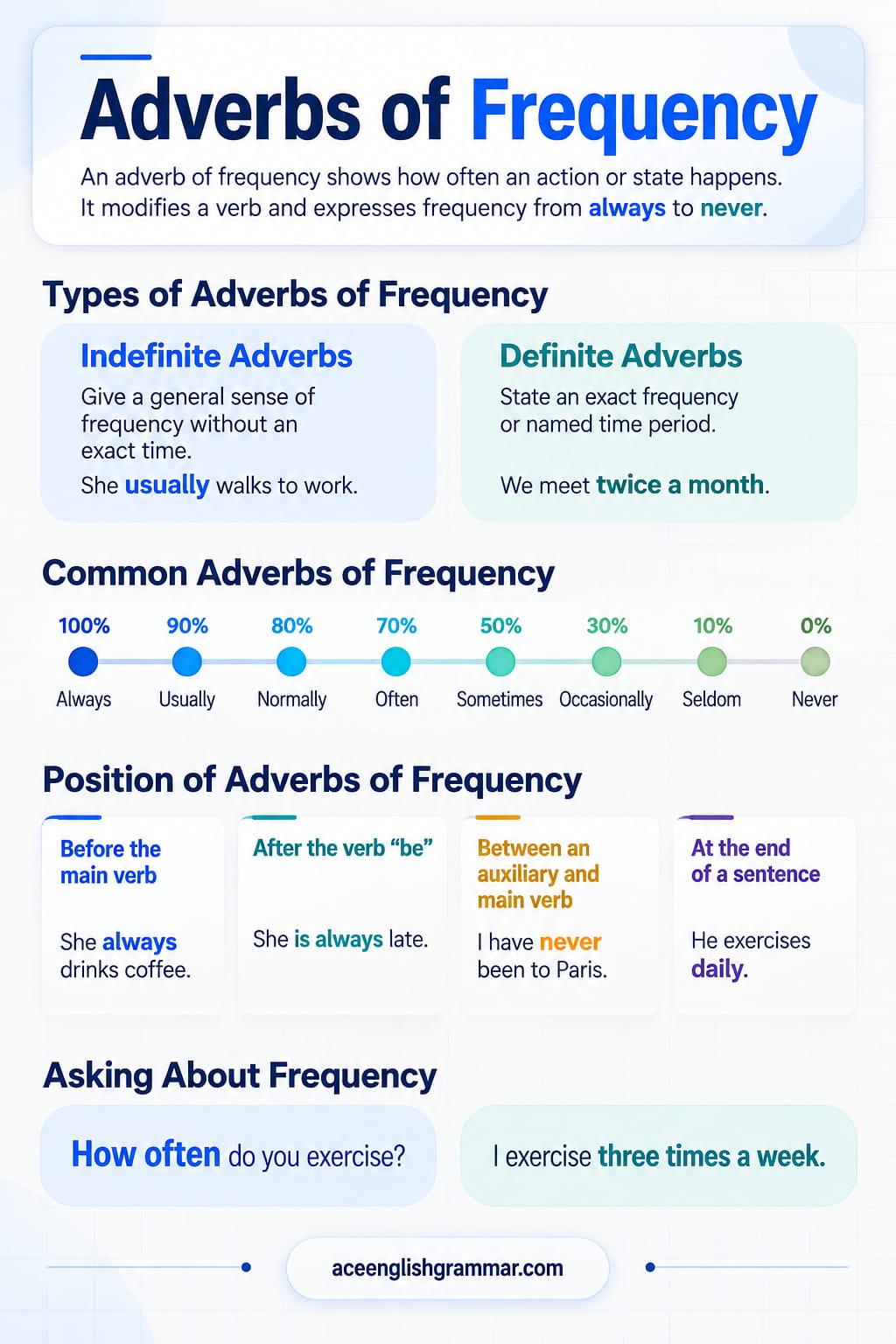
Adverbs of frequency show how often an action or state happens. There are two main groups: indefinite adverbs (always, usually, sometimes, rarely, never) that give a general sense of frequency, and definite adverbs (daily, weekly, monthly) that state an exact frequency.
Most adverbs of frequency have a fixed position in the sentence: before the main verb, after the verb “be,” and between an auxiliary and the main verb. Some also appear at the start or end of a sentence, while a small group cannot appear at the beginning of a sentence at all.
What Are Adverbs of Frequency?
An adverb of frequency is a word that shows how often an action or state happens. Every adverb of frequency modifies a verb, and each one marks a point on a scale from 100% (always) to 0% (never).
Common examples:
- She always drinks coffee in the morning.
- We usually meet on Fridays.
- I sometimes forget my keys.
- He rarely eats meat.
- They never watch television.
Longer expressions with the same function include “once a week,” “twice a month,” “from time to time,” and “every now and then.” These come at the end of the sentence rather than in mid-position.
Common Adverbs of Frequency in English
The most common adverbs of frequency in English, grouped by strength:
- Very high (near 100%): always, constantly, continually
- High (roughly 70–90%): usually, normally, generally, frequently, often
- Medium (around 50%): sometimes
- Low (roughly 10–30%): occasionally, seldom, rarely, hardly ever
- Zero (0%): never
Each of these words has its own position rules and register.
Types of Adverbs of Frequency
Adverbs of frequency divide into two groups.
1. Indefinite adverbs of frequency give a general sense of how often something happens, without stating an exact time. The most common are “always, usually, often, sometimes, rarely,” and “never.”
- She always arrives on time.
- We usually eat dinner at seven.
- I sometimes read before bed.
- He rarely misses a class.
- They never argue in public.
2. Definite adverbs of frequency state an exact frequency by naming a specific time period. Common examples are “daily, weekly, monthly, yearly, hourly, once a week, twice a month,” and “every day.”
- The magazine is delivered weekly.
- We meet twice a month to review progress.
- He exercises daily.
- The tax is paid once a year.
- The bus runs hourly on this route.
Note that definite adverbs come at the end of the sentence, not in mid-position. We say “She exercises daily,” not “She daily exercises.”
The Frequency Scale in English
Indefinite adverbs of frequency form a scale from 100% (always) to 0% (never). The approximate percentages, though not exact measurements, show the relative frequency each word signals.
| Adverb | Approximate frequency |
|---|---|
| Always | 100% |
| Usually | 90% |
| Normally / Generally | 80% |
| Often / Frequently | 70% |
| Sometimes | 50% |
| Occasionally | 30% |
| Seldom / Rarely / Hardly ever | 10% |
| Never | 0% |
Two adverbs at the same percentage level are close in meaning but not identical. “Usually” is standard in everyday speech, while “generally” reads as more formal. “Rarely” is standard in modern English, while “seldom” is literary or formal. These differences are register, not frequency.
Position of Adverbs of Frequency
The position of an adverb of frequency depends on the type of verb it modifies.
Before the Main Verb
Adverbs of frequency come before the main verb.
- I always drink coffee in the morning.
- She usually walks to work.
- They never eat fast food.
- He often forgets his keys.
We say “She always drinks coffee,” not “She drinks always coffee.”
After the Verb Be
With the verb “be,” the adverb comes after the verb, not before.
- She is always late.
- We are usually tired by Friday.
- He is never on time.
- They were often at the library after school.
Compare:
- She always is late. ✗
- She is always late. ✓
Between Auxiliary and Main Verbs
With an auxiliary or modal verb (“have, will, can, must, do”), the adverb comes between the auxiliary and the main verb.
- I have never been to Paris.
- She can usually finish the work by noon.
- They will always help you.
- He does not often visit us.
- We should sometimes take a break.
Note that if two auxiliaries appear, the adverb comes after the first one. We say “She has always been trying,” not “She always has been trying.”
At the Start of a Sentence
Some adverbs of frequency can begin a sentence for emphasis. Only seven adverbs are used in this position: “usually, normally, often, frequently, sometimes, occasionally,” and “generally.”
- Usually, I take the bus to work.
- Sometimes, she stays late at the office.
- Occasionally, we go out for dinner.
Five adverbs cannot start a sentence in modern English: “always, seldom, rarely, hardly ever,” and “never.” These come only in mid-position.
Compare:
- Never I eat meat. ✗
- I never eat meat. ✓
- Always he is late. ✗
- He is always late. ✓
At the End of a Sentence
Definite adverbs of frequency, along with longer phrases, come at the end of the sentence.
- We meet twice a week.
- He goes to the gym daily.
- She calls her mother every Sunday.
- I see him from time to time.
Some indefinite adverbs can also come at the end for emphasis, though this position is less standard than mid-position.
- I go to the cinema often.
- She calls me sometimes.
Asking Questions About Frequency
There are two main ways to ask about frequency in English: “how often” for open questions, and “ever” for yes/no questions.
1. Questions with “how often” invite a frequency answer.
- How often do you exercise?
- How often does she visit her parents?
- How often is the train late?
2. Questions with “ever” ask about experience or possibility.
- Have you ever been to Japan?
- Do you ever eat sushi?
- Is she ever on time?
The answer to a “how often” question uses an adverb of frequency in normal position:
- How often do you exercise? I exercise three times a week.
- How often does she visit? She visits occasionally.
Common Confusions With Adverbs of Frequency
There are four pairs that most commonly confuse learners of English.
Usually vs Generally
Both “usually” and “generally” name high frequency, but they differ in register. “Usually” is standard in everyday speech, while “generally” reads as more formal and appears more in written English.
- She usually arrives early. (everyday speech)
- She generally arrives early. (formal or written)
The two are interchangeable in most contexts.
Sometimes vs Occasionally
Both name a moderate-to-low frequency, but “sometimes” is broader and more neutral. “Occasionally” names a lower frequency, closer to “rarely” but without the negative sense.
- He sometimes forgets his keys. (unpredictable frequency)
- He occasionally forgets his keys. (less frequent)
Note that when the exact frequency matters, “occasionally” is the more precise choice.
Rarely vs Seldom
Both name a very low frequency and are grammatically interchangeable. The difference is register: “rarely” is standard in modern English, while “seldom” is more formal or literary.
- She rarely eats meat. (modern, everyday)
- She seldom eats meat. (formal, literary)
Both mean approximately the same thing, and both come in mid-position.
Hardly Ever vs Never
“Hardly ever” means almost never but not quite: a very low frequency that leaves room for exceptions. “Never” means zero frequency, with no exceptions.
- I hardly ever eat fast food. (very rarely, but a few times have happened)
- I never eat fast food. (zero times, without exception)
Note that “hardly ever” already carries a near-negative meaning and does not take a second negative. We say “I hardly ever eat fast food,” not “I don’t hardly ever eat fast food.”
Common Errors Learners Make With Adverbs of Frequency
There are six errors that most commonly recur when learners use adverbs of frequency in English.
- Putting the adverb after the main verb. We say “She always drinks coffee,” not “She drinks always coffee.” Most indefinite adverbs of frequency come before the main verb.
- Putting the adverb before “be.” We say “She is always late,” not “She always is late.” The adverb of frequency comes after the verb “be.”
- Starting a sentence with “always,” “never,” or “rarely.” We say “I never eat meat,” not “Never I eat meat.” These adverbs cannot open a sentence in modern English.
- Using “hardly ever” with a negative verb. We say “I hardly ever eat meat,” not “I don’t hardly ever eat meat.” “Hardly ever” already carries a near-negative meaning.
- Confusing “sometimes” with “sometime.” “Sometimes” is an adverb of frequency; “sometime” (no final “s”) means “at an unspecified time.” We say “I will call you sometime next week,” not “I will call you sometimes next week.”
- Using a definite adverb in mid-position. We say “She exercises daily,” not “She daily exercises.” Definite adverbs like “daily, weekly, monthly” go at the end of the sentence.
FAQs
Q1. What is an adverb of frequency?
An adverb of frequency is a word that shows how often an action or state happens. Common examples in English include “always, usually, often, sometimes, rarely,” and “never.” Every adverb of frequency modifies a verb and marks a point on a scale from 100% (always) to 0% (never).
Q2. How many types of adverbs of frequency are there?
There are two types of adverbs of frequency in English. Indefinite adverbs (always, usually, often, sometimes, rarely, never) give a general sense of frequency without stating an exact time. Definite adverbs (daily, weekly, monthly, yearly, once a week, twice a month) state an exact frequency by naming a specific time period.
Q3. Where does an adverb of frequency go in a sentence?
The position depends on the verb. An indefinite adverb of frequency comes before the main verb, after the verb “be,” and between an auxiliary or modal and the main verb. A definite adverb of frequency comes at the end of the sentence. Some indefinite adverbs can also start or end a sentence for emphasis.
Q4. Can I start a sentence with “always” or “never”?
No. In modern English, five adverbs of frequency cannot begin a sentence: “always, seldom, rarely, hardly ever,” and “never.” These come only in mid-position between the subject and the main verb, or after “be.” Adverbs like “usually, sometimes, occasionally, generally,” and “normally” can begin a sentence for emphasis.
Q5. What is the difference between “rarely” and “seldom”?
Both name a very low frequency and are grammatically interchangeable. The difference is register: “rarely” is standard in modern everyday English, while “seldom” reads as more formal or literary and is less common in speech. Both go in mid-position, and both mean approximately the same thing.
Q6. What is the difference between “sometimes” and “sometime”?
“Sometimes” (with a final “s”) is an adverb of frequency that means “on some occasions” or “from time to time.” “Sometime” (no final “s”) is an adverb of time that means “at an unspecified point in the past or future.” In “I will call you sometime next week,” the word means an unspecified future time, not a frequency.
Q7. How do I answer a “how often” question?
The answer to a “how often” question uses an adverb of frequency or a definite frequency phrase in normal position. For example: “How often do you exercise? I exercise three times a week.” Or with an indefinite adverb: “How often does she call? She calls occasionally.” The adverb or phrase names the frequency the question asks about.
Read More

Leave a Comment