
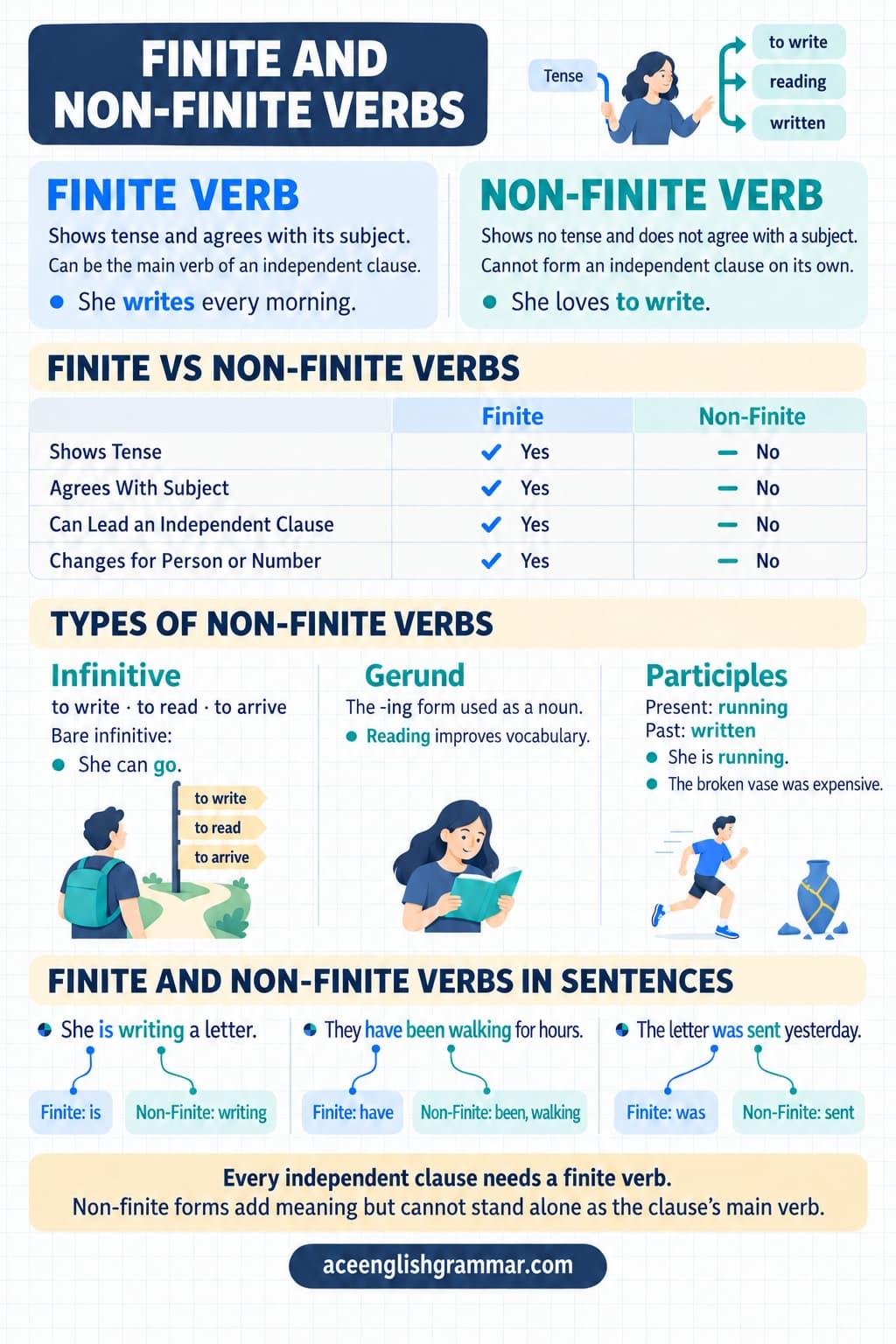
A finite verb shows tense and agrees with a subject. A non-finite verb does neither, and it is never the main verb of an independent clause on its own. Every English clause contains at least one finite verb, while non-finite verbs appear inside subordinate phrases and dependent clauses.
English has three non-finite verb forms: the infinitive (“to write”), the -ing form (“writing”), and the past participle (“written”). Each form has different grammatical uses in the sentence.
What Are Finite Verbs?
A finite verb is a verb form that shows tense and agrees with its subject in person and number. Every independent clause in English contains at least one finite verb, which is the main verb of the clause.
Examples of finite verbs:
- She writes for a magazine. (present tense, agrees with “she”)
- They walked to the park yesterday. (past tense, agrees with “they”)
- The dog is barking loudly. (“is” is finite, agreeing with “the dog”)
- I have finished the report. (“have” is finite, agreeing with “I”)
Finite verbs change form to match the subject and the tense. “She write” is ungrammatical because the verb does not agree with the singular third-person subject; “she writes” is correct.
What Are Non-Finite Verbs?
A non-finite verb is a verb form that shows no tense and does not agree with a subject. It never appears as the sole main verb of an independent clause. Non-finite verbs appear inside phrases and dependent clauses, and their form stays the same regardless of subject or tense.
Examples of non-finite verbs:
- To study hard is important. (“to study” is non-finite; “is” is the finite verb)
- Writing quickly, he finished first. (“writing” is non-finite; “finished” is the finite verb)
- The broken vase was expensive. (“broken” is a non-finite past participle; “was” is finite)
- She wants to leave early. (“to leave” is non-finite; “wants” is finite)
A non-finite verb keeps the same form whether the subject is “I”, “she”, “we”, or “they”. “I want to go” and “they want to go” both use the same infinitive “to go”.
Differences Between Finite and Non-Finite Verbs
Finite and non-finite verbs differ on four grammatical properties.
| Property | Finite verb | Non-finite verb |
|---|---|---|
| Shows tense | Yes | No |
| Agrees with subject | Yes | No |
| Main verb of independent clause | Yes | No |
| Changes form for person and number | Yes | No |
A single verb can be finite in one sentence and non-finite in another, depending on its position and function.
- She writes every morning. (“writes” is finite)
- She loves to write. (“write” here is a bare infinitive, non-finite)
- Writing is her passion. (“writing” is a gerund, non-finite)
Types of Non-Finite Verbs
There are three types of non-finite verbs in English: infinitives, gerunds, and participles. All three appear inside phrases and dependent clauses rather than as the main verb of an independent clause.
Infinitives
The infinitive is the base form of the verb, preceded by “to” in most constructions. The bare infinitive is the same base form without “to”, used after modal verbs and after “let, make, help” in certain patterns.
Examples of infinitives:
- to write, to read, to arrive (with “to”)
- She can go now. (“go” is the bare infinitive after the modal “can”)
- Let me try. (“try” is the bare infinitive after “let”)
- I saw him leave. (“leave” is the bare infinitive after a verb of perception)
Infinitives function as nouns, adjectives, or adverbs in the sentence.
- Noun: To study is important. (“to study” is the subject of the sentence)
- Adjective: I have a plan to help you. (“to help you” modifies “plan”)
- Adverb: She stopped to rest. (“to rest” tells why she stopped)
Gerunds
A gerund is the -ing form of a verb that functions as a noun. It has the same form as a present participle but a different grammatical role.
Common gerund functions in a sentence:
- Subject: Swimming is good exercise.
- Object: I enjoy reading.
- Object of a preposition: He is afraid of flying.
- Subject complement: Her hobby is painting.
Gerunds express the meaning of an action but function grammatically as nouns.
Participles
Participles are non-finite verb forms that combine with auxiliaries to build progressive tenses, perfect tenses, and passive voice, or that modify nouns and clauses. English has two participles: the present participle (-ing form) and the past participle (-ed form for regular verbs, or an irregular form).
Present participle uses:
- Progressive tenses: She is running. (“is” is finite; “running” is non-finite)
- Modifier before a noun: The crying baby needs attention.
- Participial phrase: Writing quickly, he finished first.
Past participle uses:
- Perfect tenses: They have finished the work. (“have” is finite; “finished” is non-finite)
- Passive voice: The letter was sent yesterday. (“was” is finite; “sent” is non-finite)
- Modifier before a noun: The broken vase was expensive.
- Participial phrase: Written by a specialist, the report was thorough.
Uses of Non-Finite Verbs in Grammar
There are four main uses of non-finite verbs inside a sentence.
As Nouns
Gerunds and infinitives can function as nouns in any noun position.
- Subject: Reading improves vocabulary.
- Object: I love studying.
- Subject complement: Her passion is writing.
- Object of a preposition: She is good at drawing.
As Adjectives
Present participles, past participles, and infinitives can modify nouns.
- Present participle: The running water is cold.
- Past participle: The broken window needs repair.
- Infinitive: The person to ask is Sarah.
As Adverbs
Infinitives can function as adverbs, expressing purpose, reason, or result.
- She left early to catch the train. (purpose)
- He works hard to support his family. (reason)
- She grew up to be a doctor. (result)
In Verb Phrases With Auxiliaries
Non-finite verbs combine with finite auxiliaries to form compound verb phrases.
- Progressive: She is running. (“is” finite, “running” non-finite)
- Perfect: They have finished. (“have” finite, “finished” non-finite)
- Passive: The letter was sent. (“was” finite, “sent” non-finite)
- Perfect progressive: We had been waiting. (“had” finite, “been” and “waiting” non-finite)
How Finite and Non-Finite Verbs Combine in Sentences
Many sentences contain both finite and non-finite verbs. The finite verb is the main verb of the clause; non-finite verbs add meaning without opening a new clause.
Compound verb phrases combine one finite auxiliary with one or more non-finite forms.
- She is writing a letter. (“is” finite, “writing” non-finite)
- They have been walking for hours. (“have” finite, “been walking” non-finite)
- The car was repaired by a mechanic. (“was” finite, “repaired” non-finite)
Non-finite phrases appear inside a sentence as modifiers or complements.
- I want to leave. (“want” is the finite verb; “to leave” is a non-finite infinitive)
- She enjoys reading. (“enjoys” is finite; “reading” is a non-finite gerund)
- Written by a specialist, the report was thorough. (“was” is finite; “written by a specialist” is a non-finite participial phrase)
Every English clause needs at least one finite verb. Non-finite forms alone cannot make a complete clause.
Gerund vs Present Participle
Both are -ing forms of a verb, but they have different grammatical roles in the sentence.
- Gerund: functions as a noun. Swimming is my favourite exercise.
- Present participle: functions as an adjective or as part of a verb phrase. The swimming child laughed. She is swimming.
The test is what the -ing form does in the sentence.
- If it functions as a noun (subject, object, complement, or object of a preposition), it is a gerund.
- If it modifies a noun or combines with an auxiliary to form a progressive tense, it is a present participle.
Examples of the distinction:
- Reading is fun. (“reading” is a gerund, subject of the sentence)
- The reading light is bright. (“reading” is a present participle, modifying “light”)
- She loves reading. (“reading” is a gerund, direct object of “loves”)
- She is reading a book. (“reading” is a present participle, part of the progressive)
Common Errors With Finite and Non-Finite Verbs
There are six errors that most commonly recur when learners use finite and non-finite verbs in English.
- Using a non-finite verb as the only verb of a clause. “She writing letters” → “She is writing letters” or “She writes letters”. Every independent clause needs a finite verb.
- Missing “to” before a full infinitive. “I want go home” → “I want to go home”. Most verbs that take an infinitive complement require “to”.
- Using “to” after a modal. “She must to leave” → “She must leave”. Modals take the bare infinitive.
- Confusing gerund and infinitive after certain verbs. “I enjoy to swim” → “I enjoy swimming”. Some verbs (enjoy, finish, avoid, mind, suggest) take a gerund, not an infinitive.
- Wrong past participle form. “The window is breaked” → “The window is broken”. Irregular past participles have to be memorised individually.
- Dangling participle. “Walking home, the rain started” → “Walking home, I got caught in the rain”. The subject of the main clause must be the one performing the action of the participle.
FAQs
Q1. What is the difference between a finite verb and a non-finite verb?
A finite verb shows tense and agrees with its subject in person and number. A non-finite verb shows neither, and it cannot be the main verb of an independent clause on its own. Every English clause needs at least one finite verb.
Q2. What are the three types of non-finite verbs?
English has three non-finite verb forms: the infinitive (“to write”, “to read”), the gerund (the -ing form used as a noun, like “swimming” or “reading”), and the participle (the present -ing form and the past -ed or irregular form). Each form has different grammatical uses in the sentence.
Q3. Can a sentence have more than one finite verb?
Yes. Compound and complex sentences contain more than one clause, and each independent clause has its own finite verb. “She wrote the letter and mailed it” contains two finite verbs, “wrote” and “mailed”, one for each coordinated clause.
Q4. How do I identify a finite verb in a sentence?
Check whether the verb changes with a change in subject or tense. If “She writes” changes to “They write” or “She wrote” when the subject or tense changes, the verb is finite. If the form stays the same regardless of subject or tense, as in “to write” or “writing”, the verb is non-finite.
Q5. Is a gerund a verb or a noun?
A gerund is grammatically a noun formed from a verb. It ends in -ing and functions in the sentence as a noun (subject, object, complement, or object of a preposition), while still expressing the meaning of an action. “Swimming” in “Swimming is good exercise” is a gerund.
Q6. What is a participial phrase?
A participial phrase is a group of words built around a present or past participle, functioning as an adjective to modify a noun. In “Written by a specialist, the report was thorough”, the participial phrase “written by a specialist” modifies the noun “report”.
Q7. Are modal verbs finite or non-finite?
Modal verbs (can, could, will, would, shall, should, may, might, must) are finite. They express modality and combine with a bare infinitive that is non-finite. In “She can go”, “can” is the finite modal and “go” is the non-finite bare infinitive.
Read More

Leave a Comment