
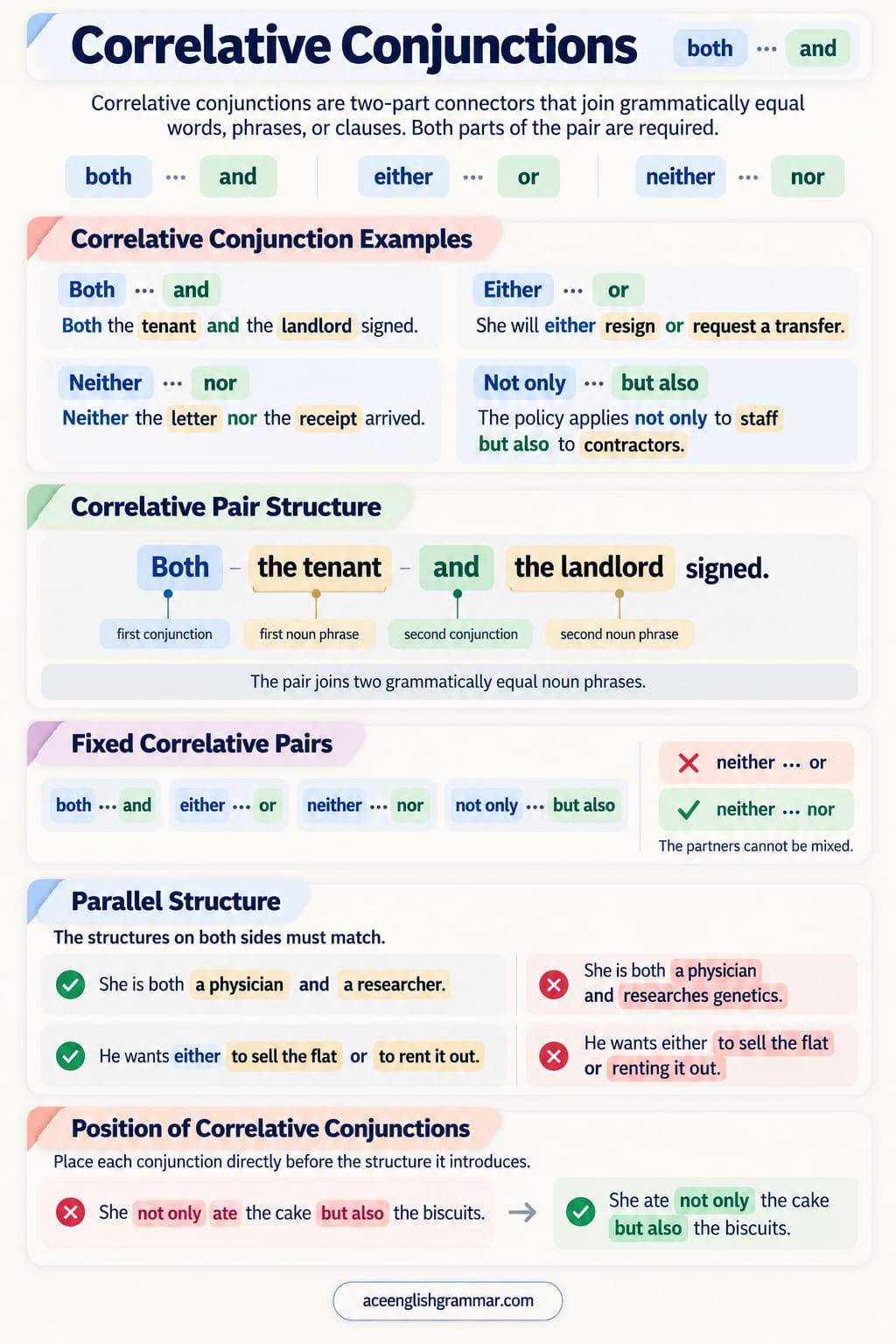
Correlative conjunctions are two-part connectors that join two grammatically equal words, phrases, or clauses. Both halves of the pair are required, and the pairings are fixed: either takes or, and not only takes but also. Around twenty such pairs are in regular use, and each pair is read as a single construction rather than as two separate words.
What Are Correlative Conjunctions?
A correlative conjunction is a pair of words that joins two grammatically equal words, phrases, or clauses, with one half of the pair standing immediately before each one. The two halves work as a unit, and dropping either one leaves the sentence incomplete.
- Both the tenant and the landlord signed.
- She will either resign or request a transfer.
- Neither the letter nor the receipt arrived.
- The policy applies not only to staff but also to contractors.
Note that the pair marks both sides rather than only the join between them. That is what separates a correlative pair from a single conjunction: “the soup and the bread” names two items, while “both the soup and the bread” frames them as a set.
The Meaning and Origin of Correlative
Correlative is an adjective meaning mutually related, where two things depend on each other and neither stands complete alone. It comes from the Latin cor-, meaning together, joined to relatus, meaning related. The pairs themselves are also called correlatives when the word is used as a noun, and it is pronounced kuh-REL-uh-tiv.
The 20 Correlative Pairs
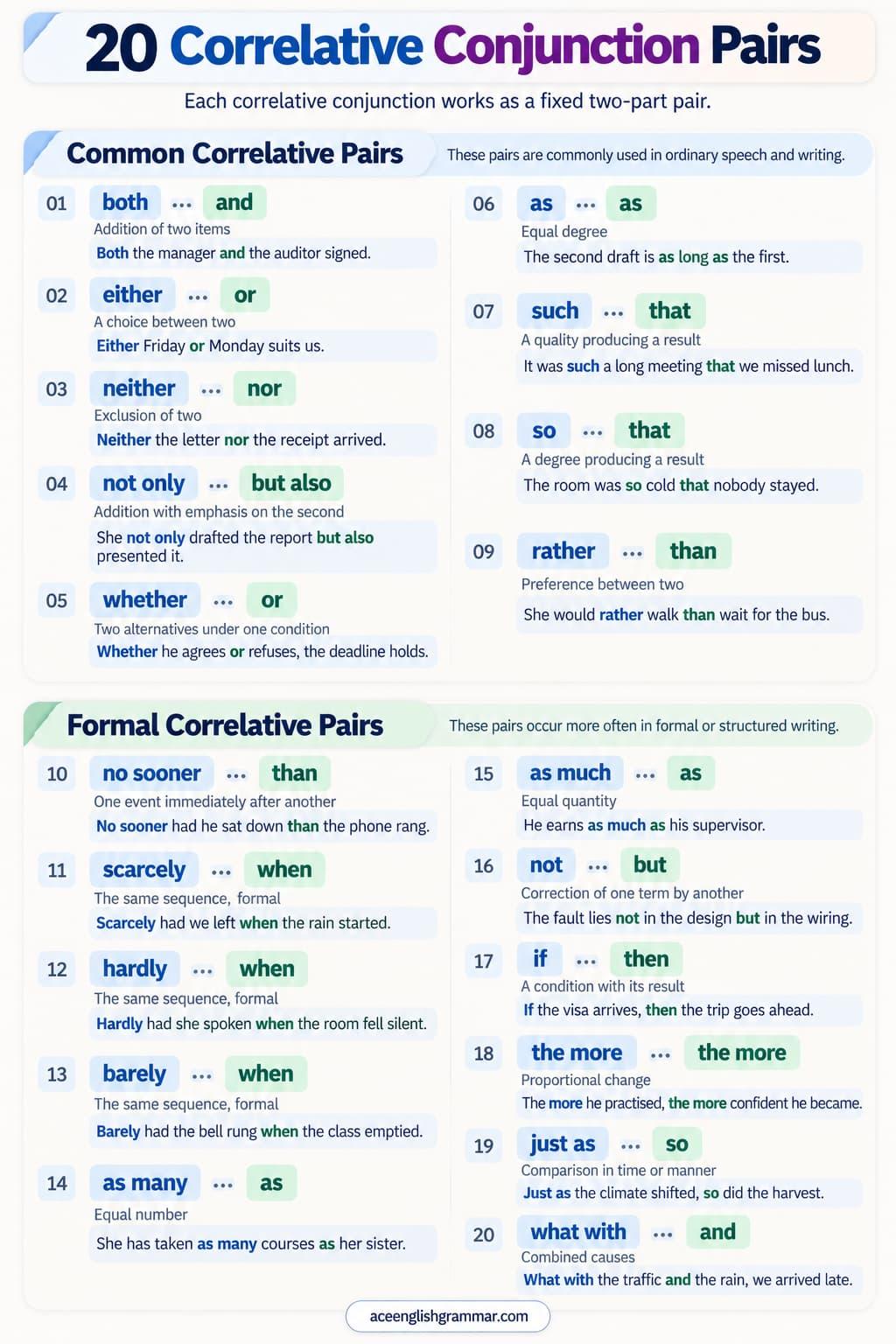
Twenty pairs account for nearly every correlative construction in English. The first nine appear in ordinary speech and writing; the remaining eleven belong to formal registers, and several of them force a change in word order.
| No. | Pair | What it signals | Example |
|---|---|---|---|
| 1 | Both … and | Addition of two items | Both the manager and the auditor signed. |
| 2 | Either … or | A choice between two | Either Friday or Monday suits us. |
| 3 | Neither … nor | Exclusion of two | Neither the letter nor the receipt arrived. |
| 4 | Not only … but also | Addition with emphasis on the second | She not only drafted the report but also presented it. |
| 5 | Whether … or | Two alternatives under one condition | Whether he agrees or refuses, the deadline holds. |
| 6 | As … as | Equal degree | The second draft is as long as the first. |
| 7 | Such … that | A quality producing a result | It was such a long meeting that we missed lunch. |
| 8 | So … that | A degree producing a result | The room was so cold that nobody stayed. |
| 9 | Rather … than | Preference between two | She would rather walk than wait for the bus. |
| 10 | No sooner … than | One event immediately after another | No sooner had he sat down than the phone rang. |
| 11 | Scarcely … when | The same sequence, formal | Scarcely had we left when the rain started. |
| 12 | Hardly … when | The same sequence, formal | Hardly had she spoken when the room fell silent. |
| 13 | Barely … when | The same sequence, formal | Barely had the bell rung when the class emptied. |
| 14 | As many … as | Equal number | She has taken as many courses as her sister. |
| 15 | As much … as | Equal quantity | He earns as much as his supervisor. |
| 16 | Not … but | Correction of one term by another | The fault lies not in the design but in the wiring. |
| 17 | If … then | A condition with its result | If the visa arrives, then the trip goes ahead. |
| 18 | The more … the more | Proportional increase | The more he practised, the more confident he sounded. |
| 19 | Just as … so | Comparison of two situations | Just as the climate shifted, so did the harvest. |
| 20 | What with … and | Two contributing causes | What with the traffic and the rain, we arrived late. |
Note that a pairing is fixed and cannot be mixed. Either takes or, never nor; neither takes nor, never or; and not only takes but also rather than and also. These pairs are sometimes called paired conjunctions, which names the same set.
The Parallel Structure Rule
Whatever follows the first half of the pair must be the same kind of structure as what follows the second. A noun answers a noun, a verb phrase answers a verb phrase, and a prepositional phrase answers a prepositional phrase. Parallelism is the rule that most correlative errors break.
Each half can introduce a single word, a phrase, or a whole clause, and the pair never joins a word to a clause.
Two nouns:
- Both the manager and the auditor signed the agreement.
- Neither the driver nor the guard noticed the open door.
Two verbs or verb phrases:
- He wants either to sell the flat or to rent it out.
- She would rather walk than wait for the bus.
Two adjectives:
- The room was neither warm nor comfortable.
- The report was not only late but also inaccurate.
Two prepositional phrases:
- He looked not in the drawer but under the desk.
- The rule applies both in writing and in speech.
Two independent clauses:
- Either you send the form today, or the application lapses.
- Not only did the train arrive late, but it also left early.
Breaking the match produces the commonest correlative fault.
- ✓ She is both a physician and a researcher.
- ✗ She is both a physician and researches genetics.
- ✓ He wants either to sell the flat or to rent it out.
- ✗ He wants either to sell the flat or renting it out.
- ✓ The policy applies not only to staff but also to contractors.
- ✗ The policy applies not only to staff but also contractors.
Compare:
- ✗ Not only was the report late, but also inaccurate.
- ✓ The report was not only late but also inaccurate.
- ✓ Not only was the report late, but it was also inaccurate.
The second and third versions both work, and they work for different reasons. The second matches two adjectives; the third matches two clauses.
Position of Each Half in the Sentence
Each half of the pair goes immediately before the word it matches. A half placed too early drags an unmatched word into the construction, and the sentence stops being parallel even though both halves are present.
- ✗ She not only ate the cake but also the biscuits.
- ✓ She ate not only the cake but also the biscuits.
- ✗ He either wants to leave or to stay.
- ✓ He wants either to leave or to stay.
- ✗ They both went to the bank and the post office.
- ✓ They went to both the bank and the post office.
The test is to read the word after each half side by side. In the first faulty sentence, not only is followed by a verb and but also by a noun, which is the mismatch. In the corrected version both halves are followed by a noun phrase.
Note that a correctly placed half can still open the sentence, which changes the word order after it.
Sentence Types Formed by Correlative Pairs
A correlative pair builds a compound sentence when it joins two independent clauses, and it leaves the sentence simple when it joins two words or phrases. Neither construction produces a complex sentence on its own, because a correlative pair does not subordinate one clause to another.
| Sentence | What the pair joins | Sentence type |
|---|---|---|
| Both the door and the window were open. | Two nouns | Simple |
| Either you apologise, or I leave. | Two independent clauses | Compound |
| Neither the driver nor the guard noticed. | Two nouns | Simple |
| Not only was the flight delayed, but the gate also changed. | Two independent clauses | Compound |
A complex sentence arises only where a subordinating conjunction joins the correlative construction, which is the work of subordinating conjunctions rather than correlative pairs. The distinction rests on the difference between coordinate and subordinate clauses.
Subject Verb Agreement With Correlative Conjunctions
When a correlative pair creates a compound subject, the verb does not automatically become plural. Three pairs behave differently from one another, and each takes its own rule.
Neither Nor With Singular and Plural Subjects
The verb agrees with the subject closer to it, which is the noun following nor. This is the proximity rule, and it holds for neither nor in every standard variety.
- Neither the players nor the coach was available.
- Neither the coach nor the players were available.
- Neither my brother nor my cousins have replied.
- Neither my cousins nor my brother has replied.
Note that reversing the two nouns changes the verb. Writers who find the result awkward rewrite the sentence rather than accept a jarring verb.
Either Or With Mixed Subjects
Either or follows the same proximity rule as neither nor. The verb matches whichever subject stands nearer to it.
- Either the tenants or the owner pays the levy.
- Either the owner or the tenants pay the levy.
- Either two witnesses or a notary is required.
Compare:
- ✓ Either the files or the invoice is missing.
- ✗ Either the files or the invoice are missing.
Not Only But Also With Compound Subjects
Not only but also takes the proximity rule as well, though the construction resists it more than the other two. The verb matches the subject after but also.
- Not only the students but also the lecturer objects to the change.
- Not only the lecturer but also the students object to the change.
Both and is the one pair that breaks the pattern. It always produces a plural subject, whatever the two nouns are.
- Both the manager and the auditor were present.
- Both training and experience matter in this role.
Pronoun Agreement After Either Or and Neither Nor
A pronoun referring back to a correlative subject follows the same proximity rule as the verb. It agrees with the antecedent nearer to it, which is the noun after or or nor.
- Either the manager or the supervisors must submit their reports.
- Either the supervisors or the manager must submit his report.
- Neither the teacher nor the students brought their books.
- Neither the students nor the teacher brought her book.
Compare:
- ✓ Neither the twins nor their father has lost his temper.
- ✗ Neither the twins nor their father has lost their temper.
Note that singular they is now accepted where the nearer antecedent has no stated gender. “Either the owner or the tenant must renew their lease” reads as standard in current usage, and it avoids the clumsy his or her construction.
Commas With Correlative Pairs
A correlative pair joining two words or phrases takes no comma. A pair joining two independent clauses takes a comma before the second half, on the same principle that governs coordinating conjunctions.
- ✓ She ordered both the soup and the bread.
- ✗ She ordered both the soup, and the bread.
- ✓ Either the contract arrives today, or the sale collapses.
- ✓ Not only did the supplier miss the date, but the invoice was also wrong.
Note that a comma appears before but also only where a full clause follows it. In “not only late but also inaccurate,” the two adjectives take no comma at all.
Fronting and Inversion After Not Only
A correlative pair can open a sentence, with the first half in front and the second half still standing beside what it introduces. Fronting is standard rather than an error, and it changes the word order that follows.
- Not only did she pass the exam, but she also topped the list.
- Neither the argument nor the evidence convinced the panel.
- Either you send the form today, or the application lapses.
Five pairs force inversion once the first half is fronted. The auxiliary moves in front of the subject, exactly as it does in a question, while the sentence stays a statement.
- Not only: Not only was he late, but he also forgot the documents.
- No sooner: No sooner had they arrived than the power failed.
- Scarcely: Scarcely had I finished when the next request came.
- Hardly: Hardly had the ink dried when the terms changed.
- Barely: Barely had she spoken when the audience applauded.
Compare:
- ✓ No sooner had the meeting started than the fire alarm rang.
- ✗ No sooner the meeting started than the fire alarm rang.
- ✓ The meeting had no sooner started than the fire alarm rang.
Note that inversion disappears once the pair moves away from the front of the sentence. The third version keeps standard word order because no sooner no longer opens the clause.
Correlative, Coordinating and Subordinating Conjunctions Compared
All three kinds join clauses, and they differ in how many words the join takes and in whether the two sides keep equal rank.
| Coordinating | Correlative | Subordinating | |
|---|---|---|---|
| Number of words | One | Two, always paired | One |
| Members | For, and, nor, but, or, yet, so | Both and, either or, neither nor, and seventeen more | Because, although, unless, while, since, if |
| Position | Between the two it joins | One part before each side | At the front of the dependent clause |
| Rank of the two sides | Equal | Equal | One depends on the other |
| Example | The soup and the bread | Both the soup and the bread | Unless the soup arrives |
A correlative pair and a coordinating conjunction both leave the two sides independent, and the correlative version marks each side rather than only the join. A subordinating conjunction changes the rank instead, so one clause can no longer stand alone.
- Correlative: Either the invoice arrives today, or the order is cancelled.
- Coordinating: The invoice arrives today, or the order is cancelled.
- Subordinating: Unless the invoice arrives today, the order is cancelled.
Note that several correlative pairs contain a coordinating conjunction as their second half. Or, nor, and but all appear inside correlative pairs, which is why either or is classed as a correlative construction rather than a second use of or. All three kinds stay distinct from conjunctive adverbs, which connect sentences without joining clauses grammatically.
Common Mistakes With Correlative Conjunctions
Six errors account for nearly every correlative fault, and four of them come from breaking parallelism.
1. Mismatching the two halves. Either pairs with or and neither pairs with nor. We write “neither the file nor the folder,” never “neither the file or the folder.”
2. Breaking parallel structure. The structure after the second half must match the structure after the first. We write “not only to staff but also to contractors,” with the preposition repeated on both sides.
3. Dropping but also after not only. Both halves are required. “She not only wrote the script and directed it” replaces the pair with a coordinating conjunction and loses the emphasis.
4. Using a plural verb after neither nor. The verb agrees with the nearer subject, so “neither the players nor the coach was available” takes a singular verb.
5. Adding a comma inside a phrase pair. No comma separates two words or two phrases: “both the soup and the bread,” never “both the soup, and the bread.”
6. Omitting inversion after an opening not only. The auxiliary comes before the subject: “Not only did she pass,” never “Not only she passed.”
Practice Questions
Correct each sentence, or mark it right as written.
- She is both an engineer and teaches part time.
- Neither the students nor the lecturer were informed.
- Not only the roof was damaged, but also the ceiling.
- He would rather resign than to accept the terms.
- Either the keys or the wallet are still in the car.
- No sooner the train left than the storm began.
Answers: 1. She is both an engineer and a part-time teacher, matching two noun phrases. 2. Correct as written, since the verb agrees with lecturer. 3. Not only was the roof damaged, but the ceiling was also cracked. 4. He would rather resign than accept the terms, matching two bare infinitives. 5. Either the keys or the wallet is still in the car. 6. No sooner had the train left than the storm began.
FAQs
Q1. What is a correlative conjunction?
A correlative conjunction is a pair of words that joins two grammatically equal words, phrases, or clauses, with one half standing before each one. Both and, either or, and neither nor are the three most frequent pairs. Around twenty are in regular use, and both halves are required for the construction to work.
Q2. How do you pronounce correlative conjunctions?
Correlative is pronounced kuh-REL-uh-tiv, with the stress on the second syllable and a short e in the middle. Conjunction is pronounced kun-JUNK-shun. British and American speakers stress both words the same way, and the plural adds only the usual z sound at the end.
Q3. How many correlative conjunctions are there in English?
Twenty pairs cover the constructions a writer meets in practice, though grammars differ on where to draw the line. Nine of them appear in ordinary speech and writing, and the remaining eleven belong to formal registers. Counts published elsewhere range from seven to more than thirty, depending on whether comparison pairs such as as much as are included.
Q4. Do correlative conjunctions always come in pairs?
Yes, both halves are required, which is what separates a correlative construction from a single coordinating conjunction. Writing “not only the design” without “but also the wiring” leaves the sentence incomplete. The only flexibility lies in also, which some writers drop after but in informal prose.
Q5. Do correlative conjunctions need commas?
A comma appears only where the pair joins two independent clauses, as in “Either you sign today, or the offer lapses.” Two words or two phrases take no comma at all, so “both the soup and the bread” is punctuated without one. The rule matches the one for coordinating conjunctions.
Q6. What is the difference between coordinating and correlative conjunctions?
A coordinating conjunction is one word standing between the two it joins, while a correlative conjunction is a pair with one half before each side. And joins two nouns in “the soup and the bread,” whereas both and frames them in “both the soup and the bread.” The correlative version marks both sides rather than only the join.
Q7. Can a correlative conjunction start a sentence?
Yes, and opening with not only, neither, or no sooner is standard in formal writing. The opening changes the word order that follows, because the auxiliary moves in front of the subject. We write “Not only did she pass the exam,” never “Not only she passed the exam.”
Q8. Do correlative conjunctions make compound sentences?
A correlative pair produces a compound sentence when it joins two independent clauses, as in “Either you apologise, or I leave.” It leaves the sentence simple when it joins two words or two phrases. No correlative pair creates a complex sentence, because none of them subordinates one clause to another.
Q9. Which verb follows neither nor, singular or plural?
The verb agrees with the subject nearer to it, which is the noun after nor. “Neither the players nor the coach was available” takes a singular verb, and reversing the two nouns produces “neither the coach nor the players were available.” Both and is the exception, since it always takes a plural verb.
Read More

Leave a Comment