
Coordinating conjunctions connect words, phrases, and complete ideas that have equal grammatical value. Words such as and, but, or, yet, and so may look small, but they control how ideas relate inside a sentence. One conjunction can add information, show contrast, offer a choice, explain a reason, or show a result.
In the sentence “I wanted to go outside, but it started raining,” the conjunction but joins two complete ideas. The first clause gives the plan. The second clause changes the direction of the sentence by giving the problem.
By the end, you should be able to recognize FANBOYS in real sentences, choose the conjunction that matches the relationship between ideas, place commas correctly, and avoid the mistakes that make compound sentences sound awkward.
What Are Coordinating Conjunctions?
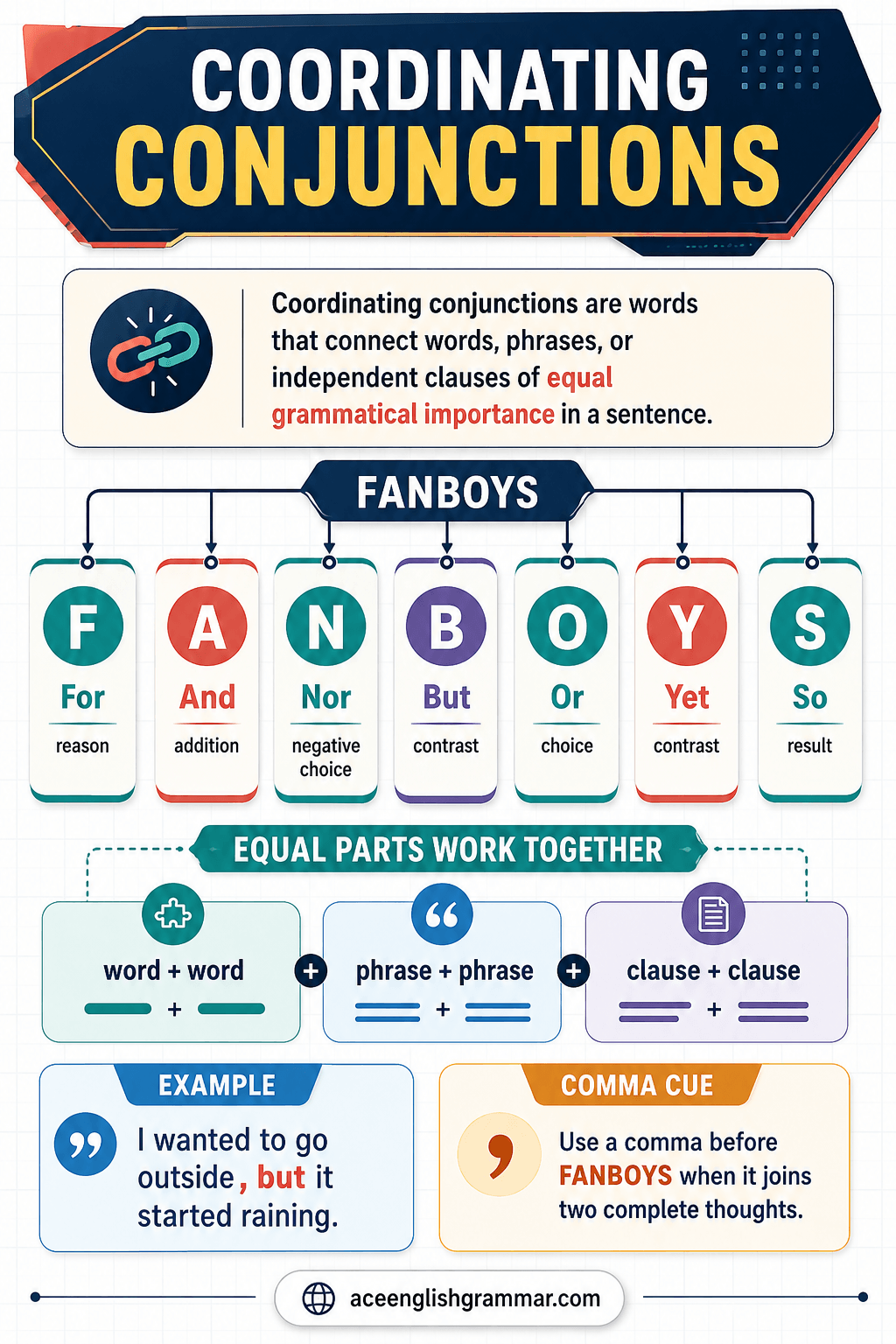
A coordinating conjunction is a conjunction that joins sentence parts of equal grammatical rank, such as two nouns, two phrases, or two independent clauses.
- Tea and coffee
- Before lunch or after work
- I called her, but she did not answer.
The joined parts must be balanced. A coordinating conjunction can join a word with another word, a phrase with another phrase, or a complete sentence with another complete sentence.
An independent clause is a group of words that can stand alone as a complete sentence. When two independent clauses are joined with a coordinating conjunction, they form a compound sentence.
- I wanted to buy the tickets, but they were sold out.
Both sides can stand alone:
- I wanted to buy the tickets.
- They were sold out.
The conjunction but joins them and shows contrast.
FANBOYS Meanings And Examples
The acronym FANBOYS gives you the seven coordinating conjunctions in English. Each one creates a different relationship between the connected words, phrases, or clauses.
| Conjunction | Main Use | Example |
|---|---|---|
| For | Reason or explanation | I stayed home, for I was feeling unwell. |
| And | Addition | She bought apples and oranges. |
| Nor | Negative addition | He did not call, nor did he send a message. |
| But | Contrast | The bag is small, but it is strong. |
| Or | Choice or alternative | You can take tea or coffee. |
| Yet | Surprising contrast | She was tired, yet she kept working. |
| So | Result or consequence | It was raining, so we stayed inside. |
The conjunction choice changes the relationship between ideas. And adds, but contrasts, or gives an option, and so shows what happens as a result.
For gives a reason or explanation. It sounds more formal than because, so it appears more often in polished writing than casual speech.
- She stayed home, for she was feeling sick.
- The roads were empty, for most people had left early.
And adds similar or related information.
- I like tea and coffee.
- She opened the window and turned on the fan.
- He washed the car, and his brother cleaned the garage.
Nor connects a second negative idea. It often follows neither or comes after a negative clause.
- She likes neither tea nor coffee.
- He did not speak, nor did he move.
When nor begins the second clause, the helping verb usually comes before the subject: “nor did he move,” not “nor he did move.”
But shows contrast. It connects ideas that point in different directions.
- The test was difficult, but she passed.
- He is young but very confident.
Yet also shows contrast, but it often carries a stronger sense of surprise.
- She was tired, yet she kept working.
- The task was hard, yet it was worth the effort.
Use but for a general turn in meaning. Use yet when the second idea feels unexpected despite the first idea.
Or presents a choice, option, or alternative.
- Would you like tea or coffee?
- You can call me today or send an email tomorrow.
It can also show a possible consequence.
- Hurry up, or we will miss the bus.
So shows result or consequence.
- The traffic was heavy, so I arrived late.
- It was cold, so we wore jackets.
The first clause gives the cause. The second clause gives the result.
How Coordinating Conjunctions Work In Sentences
Coordinating conjunctions can connect different sentence elements. The main point is balance: the joined parts should have the same grammatical weight.
Joining words:
- I like tea and coffee.
- Do you want the red shirt or the blue one?
- She is kind but firm.
Joining phrases:
- He sat near the window and beside the door.
- We can meet before lunch or after work.
- She spoke with confidence but without arrogance.
Joining independent clauses:
- I wanted to go for a walk, but it started raining.
- The weather was pleasant, so we had a picnic.
- She studied hard, yet she did not pass the exam.
When both sides are complete sentences, punctuation becomes more important. The comma rule depends on what the conjunction is joining, not only on the conjunction itself.
Rules For Coordinating Conjunctions
Join Equal Grammatical Elements
Coordinating conjunctions connect matching sentence parts.
- Word + word: tea and coffee
- Phrase + phrase: in the morning or at night
- Clause + clause: I called, but no one answered.
Avoid joining structures that do not match.
- Weak: She likes swimming and to read books.
- Better: She likes swimming and reading books.
The better sentence keeps both joined items in the same grammatical form.
Use A Comma Between Independent Clauses
Use a comma before a coordinating conjunction when it joins two independent clauses.
- I wanted to attend the concert, but the tickets were sold out.
- The room was quiet, so we started the meeting.
The comma is not there because the word is but or so. It is there because the conjunction is joining two complete sentences.
A comma alone cannot join two independent clauses. That mistake is called a comma splice.
- Incorrect: I wanted to attend the concert, the tickets were sold out.
- Correct: I wanted to attend the concert, but the tickets were sold out.
Do Not Add A Comma Between Two Simple Words Or Phrases
A comma is usually not needed when the conjunction connects only two words or two short phrases.
- She wore a bright and colorful dress.
- He ordered tea or coffee.
- The box was small but heavy.
These sentences do not need a comma because the conjunction is not joining two complete sentences.
Use Commas Clearly In Lists
When a coordinating conjunction connects the final item in a list, commas keep the list readable.
- She bought apples, oranges, and bananas.
- We need eggs, flour, sugar, and butter.
The comma before and is called the Oxford comma. Many style guides recommend it because it prevents confusion in longer or more complex lists.
Keep Parallel Structure
Parallel structure means the connected items follow the same grammatical form.
- Weak: She likes swimming, hiking, and to read books.
- Better: She likes swimming, hiking, and reading books.
Parallel structure makes the sentence smoother because the reader can follow one repeated grammar pattern.
Mixed Examples Of Coordinating Conjunctions
These examples show how different coordinating conjunctions change the movement of a sentence.
Addition with and:
- She likes to read books and watch movies.
- They played basketball and soccer at the park.
- I like both chocolate and vanilla ice cream.
Contrast with but:
- He is quiet but very thoughtful.
- The movie was long, but it was very interesting.
- The sun was setting, but the sky was still bright.
Choice with or:
- Do you want tea or coffee?
- You can play outside or stay indoors.
- We can eat at the restaurant or order takeout.
Negative addition with nor:
- She neither likes coffee nor drinks tea.
- He did not study, nor did he complete the homework.
- The cat is neither black nor white; it is gray.
Unexpected contrast with yet:
- She is tired, yet she keeps working.
- It is a challenging task, yet it is worth the effort.
- He is tired, yet he wants to finish his homework.
Result with so:
- It is cold outside, so wear a jacket.
- The weather is nice, so we will have a picnic.
- He did not study, so he did not pass the test.
Reason with for:
- I stayed indoors, for the storm was getting stronger.
- She spoke softly, for the baby was sleeping.
- They left early, for the road was dangerous at night.
Common Mistakes With Coordinating Conjunctions
Creating A Comma Splice
A comma splice happens when two complete sentences are joined with only a comma. Learners often make this mistake because the ideas feel closely related, but grammar still needs a proper connector.
- Incorrect: I was tired, I went to bed early.
- Correct: I was tired, so I went to bed early.
Choosing The Wrong Conjunction
A conjunction should match the relationship between the ideas. If the second idea contrasts with the first, and will not express the meaning clearly.
- Weak: I wanted to go outside, and it was raining.
- Better: I wanted to go outside, but it was raining.
The stronger sentence uses but because rain creates a problem or contrast.
Breaking Parallel Structure
This mistake happens when the sentence connects items with different grammatical shapes.
- Weak: He enjoys running, swimming, and to cycle.
- Better: He enjoys running, swimming, and cycling.
The corrected sentence keeps all three items in the same form: running, swimming, and cycling.
Overusing And
Too many uses of and can make a sentence crowded and loose.
- Weak: She packed her bag and opened the door and called her friend and left the house.
- Better: She packed her bag, called her friend, and left the house.
The stronger sentence groups the actions into a cleaner list.
Coordinating Conjunctions Vs Subordinating Conjunctions
Coordinating conjunctions connect equal sentence parts. Subordinating conjunctions connect a dependent clause to an independent clause.
| Type | What It Connects | Examples |
|---|---|---|
| Coordinating conjunction | Equal words, phrases, or clauses | And, but, or, so |
| Subordinating conjunction | Dependent clause to main clause | Because, although, when, if |
Compare these sentences:
- I stayed home, for I was sick.
- I stayed home because I was sick.
Both sentences show a reason. The first uses the coordinating conjunction for. The second uses the subordinating conjunction because.
Coordinating Conjunctions Exercises
Once the meanings are clear, practice becomes a test of relationship, not memorization. Choose the conjunction that matches the sentence logic.
- I like both tea ____ coffee.
- And
- But
- Or
- So
- She wanted to go out, ____ it was raining.
- And
- But
- Or
- So
- She studied hard, ____ she could not pass the exam.
- For
- Nor
- But
- So
- You can have tea ____ coffee, whichever you prefer.
- For
- Nor
- Or
- Yet
- He did not like tea, ____ did he like coffee.
- And
- Nor
- But
- So
- The car broke down, ____ they had to call for help.
- And
- But
- Or
- So
- She can either go to the party ____ stay home.
- And
- Nor
- Or
- Yet
- They were hungry, ____ they decided to order pizza.
- And
- Nor
- But
- So
- The movie is long, ____ it is interesting.
- For
- Nor
- But
- So
- You can have the blue shirt ____ the red shirt.
- And
- Nor
- Or
- Yet
Answers
- And
- But
- But
- Or
- Nor
- So
- Or
- So
- But
- Or
FAQs
Q1. What are coordinating conjunctions?
Coordinating conjunctions are conjunctions that connect words, phrases, or independent clauses of equal grammatical rank. The main coordinating conjunctions are for, and, nor, but, or, yet, and so.
Q2. What does FANBOYS stand for?
FANBOYS stands for For, And, Nor, But, Or, Yet, So. These seven words are the main coordinating conjunctions in English.
Q3. When do you use a comma before a coordinating conjunction?
Use a comma before a coordinating conjunction when it joins two independent clauses. For example: “I wanted to go outside, but it started raining.”
Q4. What is the difference between but and yet?
But shows a general contrast. Yet also shows contrast, but it often adds surprise or an unexpected result.
Q5. How are coordinating conjunctions different from subordinating conjunctions?
Coordinating conjunctions connect equal elements. Subordinating conjunctions introduce dependent clauses and make one idea depend on another.
Conclusion
Coordinating conjunctions give sentences balance, direction, and logical movement. When you understand what each FANBOYS word does, comma rules and compound sentences become easier to control. The strongest sentences do not only connect ideas; they show whether those ideas add, contrast, offer a choice, explain a reason, or lead to a result.
Read More

Leave a Comment