Embedded questions place a question inside a longer statement or question, and the word order changes when they do. “Where is the station?” becomes “Do you know where the station is?” with the verb moving behind the subject. The auxiliary do, does or did is deleted altogether, so “What time does it start?” becomes “I wonder what time it starts.” A yes or no question takes if or whether instead, since no question word is present to introduce the clause.
What Are Embedded Questions?
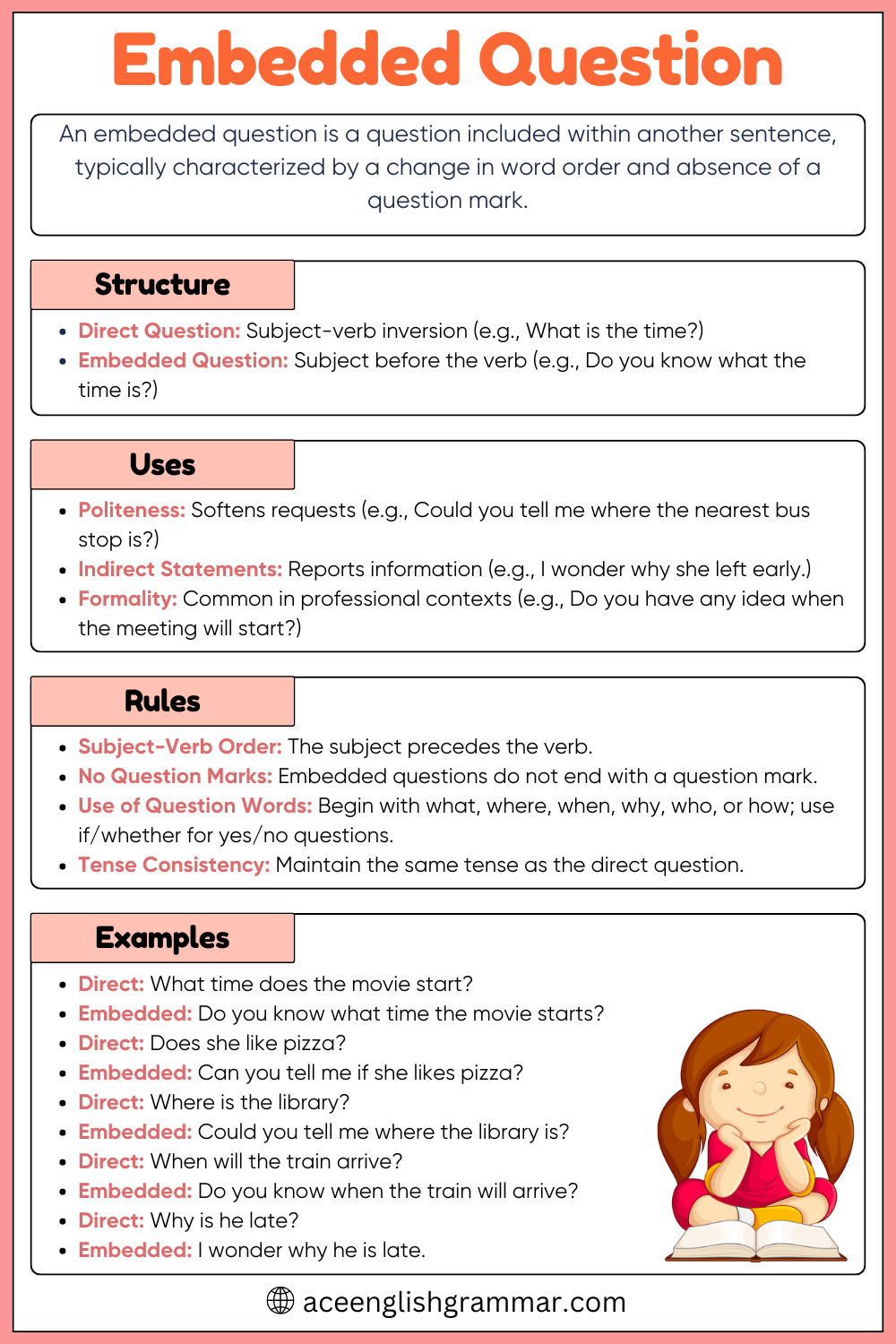
An embedded question is a question placed inside a longer statement or question rather than asked on its own. The inner question loses the reversed word order of a direct question and follows subject before verb instead.
- Direct: Where does she work? Embedded: I wonder where she works.
- Direct: Is the shop open? Embedded: Could you tell me if the shop is open?
- Direct: What did he say? Embedded: Nobody knows what he said.
- Direct: How much is the fare? Embedded: Do you remember how much the fare is?
Note that the outer sentence decides whether the whole thing is a question or a statement. The embedded part never takes question word order, whatever appears around it.
Embedded Questions as Noun Clauses
The embedded part is a noun clause, which means it fills a slot a noun could fill. In “I wonder where she works,” the clause where she works is the object of wonder, and a noun such as the answer would fit the same slot.
- Object of the verb: I forgot where she works.
- Object of a preposition: It depends on what he said.
- Subject of the sentence: Why she left is still unclear.
- Complement after be: The question is whether the shop is open.
Embedded Questions Inside Statements and Inside Questions
Two host sentences are available, and the choice changes the tone rather than the grammar of the inner clause. A statement host reports or admits something, and a question host asks for the information.
Inside a statement:
- I have no idea where the keys are.
- She never told me why the meeting moved.
- Let me know whether the train is delayed.
Inside a question:
- Do you know where the keys are?
- Can you remember why the meeting moved?
- Could you tell me whether the train is delayed?
Note that the inner clause is identical in both columns. Only the opening words differ, which is why one rule for word order serves both host types.
Phrases That Introduce the Embedded Clause
A short set of openers introduces almost every embedded question in ordinary English. Learning the openers is faster than learning the structures one at a time, since the clause behaves the same way after all of them.
| Opener | Host type | Example |
|---|---|---|
| Do you know | Question | Do you know where the office is? |
| Could you tell me | Question | Could you tell me when the bank opens? |
| Can you remember | Question | Can you remember what she said? |
| Would you mind telling me | Question | Would you mind telling me how this works? |
| I wonder | Statement | I wonder why the meeting was moved. |
| I’m not sure | Statement | I’m not sure whether the shop is open. |
| I have no idea | Statement | I have no idea how much it costs. |
| Let me know | Statement | Let me know if the parcel arrived. |
Note that the question openers all end in a verb that takes an object, such as know, tell or remember. The embedded clause supplies that object, which is why the sentence is incomplete without it.
Statement Word Order in the Embedded Clause
The governing rule is a single operation: the subject goes in front of the verb, exactly as in a statement. A direct question reverses that order, and embedding it puts the order back.
- ✓ Do you know where the station is? ✗ Do you know where is the station?
- ✓ Could you tell me when the film starts? ✗ Could you tell me when does the film start?
- ✓ I wonder why she is late. ✗ I wonder why is she late.
- ✓ Nobody knows how the fire began. ✗ Nobody knows how did the fire begin.
Compare:
- Direct question, reversed order: Is she coming?
- Embedded question, statement order: I asked whether she is coming.
Note that grammarians call this cancelled inversion. Inversion is the swap of subject and verb that makes a direct question, and the embedded clause cancels it.
Do, Does and Did in the Embedded Clause
A direct question in the present simple or past simple needs the auxiliary do, does or did. The embedded clause needs no auxiliary at all, so the word is deleted and its tense and person move onto the main verb.
- What time does it start? becomes I wonder what time it starts.
- Where do they live? becomes Do you know where they live?
- Why did he leave? becomes She never explained why he left.
- How much does it cost? becomes Let me know how much it costs.
Compare:
- ✗ I wonder what time does it start.
- ✗ I wonder what time does it starts.
- ✓ I wonder what time it starts.
Note that the third person s and the past tense ending return to the main verb once the auxiliary is gone. Deleting does without adding the s to starts is the frequent error at intermediate level.
If and Whether in Yes or No Embedded Questions
A yes or no question has no question word to introduce the embedded clause, so if or whether takes that position. Both words are correct in most sentences, and whether is the formal choice.
- Is the shop open? becomes I’m not sure if the shop is open.
- Has she replied? becomes Do you know whether she has replied?
- Did the parcel arrive? becomes Let me know if the parcel arrived.
- Will they accept it? becomes We asked whether they would accept it.
Compare:
- ✓ It depends on whether the shop is open.
- ✗ It depends on if the shop is open.
Note that whether alone follows a preposition, and whether alone appears before to plus a verb, as in “I’m not sure whether to accept.” Adding or not is also limited to whether in careful writing, so “whether or not she replied” is standard and “if or not she replied” is not.
Subject Questions That Take No Change
A direct question asking about the subject already uses statement word order and needs no auxiliary. Embedding one of these changes nothing at all, and learners who apply the deletion rule here produce an error.
- Who wrote this? becomes Do you know who wrote this?
- What happened? becomes Nobody can explain what happened.
- Which train leaves first? becomes I’m not sure which train leaves first.
- Whose car blocked the gate? becomes She asked whose car blocked the gate.
Compare:
- ✓ Do you know who wrote this?
- ✗ Do you know who did write this?
- ✗ Do you know who this wrote?
Note that the test is what the question word replaces. Where the question word stands in for the subject, the clause is already in statement order and nothing is moved or deleted.
Question Marks and Full Stops at the End of the Sentence
The final punctuation matches the outer sentence, not the inner clause. A statement host ends with a full stop even though a question is buried inside it.
- ✓ I wonder where she went. ✗ I wonder where she went?
- ✓ Do you know where she went? ✗ Do you know where she went.
- ✓ Let me know whether the shop is open. ✗ Let me know whether the shop is open?
- ✓ Could you tell me what this costs? ✗ Could you tell me what this costs.
Note that a polite request beginning with could or would takes a question mark in standard writing, since the outer sentence is a question in form. British and American style agree on this point.
Embedded Questions in Polite Requests
The most frequent everyday use is softening a direct question to a stranger or a superior. A bare question can sound abrupt, and the opener puts distance between the speaker and the request.
- Direct: Where is the manager? Softened: Could you tell me where the manager is?
- Direct: What does this cost? Softened: Would you mind telling me what this costs?
- Direct: When will the results arrive? Softened: Do you know when the results will arrive?
- Direct: Is this seat free? Softened: I was wondering whether this seat is free.
Note that the past form I was wondering is more distant than I wonder, and more distance reads as more polite. The same pattern appears in “I was hoping you could help,” where the past tense refers to the present moment.
Embedded Questions and Indirect Questions Compared
The two names describe the same structure in most teaching materials, and many sources treat them as interchangeable. A narrower use reserves indirect question for a question reported in the past, where the tense shifts backwards as well.
| Embedded question | Indirect question in reported speech | |
|---|---|---|
| Word order | Statement order | Statement order |
| Auxiliary do, does, did | Deleted | Deleted |
| Yes or no marker | If or whether | If or whether |
| Tense shift | None required | Backshift after a past reporting verb |
| Example | Do you know where she lives? | He asked where she lived. |
Compare:
- Embedded, present reporting verb: I wonder where she lives.
- Reported, past reporting verb: I wondered where she lived.
Note that the word order rule is identical in both. Only the backshift of the tense separates a reported question from an embedded question in the present.
Common Mistakes With Embedded Questions
Five errors take in nearly every misuse. Four of them repeat some part of the direct question that the embedded clause removes.
1. Keeping question word order. We write “Do you know where the station is,” not “Do you know where is the station,” since the embedded clause uses subject before verb.
2. Keeping do, does or did. We write “I wonder what time it starts,” not “I wonder what time does it start,” because the auxiliary has no place in the clause.
3. Deleting the auxiliary without repairing the verb. We write “she wonders where he lives,” not “she wonders where he live,” since the person ending moves to the main verb.
4. Leaving out if or whether. We write “Could you tell me whether she is coming,” not “Could you tell me she is coming,” which changes the meaning into a statement.
5. Ending a statement with a question mark. We write “I wonder where she went,” with a full stop, because the outer sentence is a statement.
Practice Questions
Rewrite each direct question as an embedded question, using the opener supplied.
- Where is the library? (Do you know)
- What time does the train leave? (Could you tell me)
- Is the museum open on Monday? (I’m not sure)
- Why did she resign? (Nobody knows)
- Who painted this? (Do you remember)
- How much do the tickets cost? (Let me know)
- Has the letter arrived? (I was wondering)
- What happened at the meeting? (She asked)
Answers: 1. Do you know where the library is? 2. Could you tell me what time the train leaves? 3. I’m not sure whether the museum is open on Monday. 4. Nobody knows why she resigned. 5. Do you remember who painted this? 6. Let me know how much the tickets cost. 7. I was wondering whether the letter has arrived. 8. She asked what happened at the meeting.
FAQs
Q1. What is an embedded question?
An embedded question is a question placed inside a longer statement or question instead of being asked directly. The inner clause takes statement word order, so the subject stands in front of the verb. “Where is he?” becomes “Do you know where he is?” once it is embedded.
Q2. Why do we use embedded questions?
We use them to soften a direct question and to make a request sound less abrupt. “Where is the manager?” can sound demanding to a stranger, while “Could you tell me where the manager is?” does not. The same structure also reports what somebody asked.
Q3. How do you make an embedded question?
Three operations turn a direct question into an embedded one. Put the subject in front of the verb, delete do, does or did and move the tense onto the main verb, and add if or whether when no question word is present. “What time does it start?” becomes “I wonder what time it starts.”
Q4. Are embedded questions the same as indirect questions?
Yes, in most teaching materials the two names describe the same structure. A narrower use keeps indirect question for a question reported after a past verb, where the tense shifts back as well. The word order rule is the same either way.
Q5. What is cancelled inversion?
Cancelled inversion is the loss of the subject and verb swap that a direct question requires. “Is she late?” inverts the subject she and the verb is, and the embedded version “I wonder whether she is late” puts them back in statement order. Cancelling that inversion is the central rule of the structure.
Q6. How do you answer an embedded question?
Answer the inner question rather than the outer one, since the outer wording is a politeness frame. To “Do you know where the station is?” the expected reply is the directions, not the word yes. A bare yes sounds uncooperative in English even though it fits the grammar.
Q7. When do we use embedded questions?
We use them when asking a stranger for information, when writing formally, and when reporting what somebody else asked. Service and customer settings rely on the structure heavily. Between friends a direct question is normal, so the softened form there can sound stiff.
Read More
- Noun Clauses With Definition and Examples
- Clauses in English With Types and Examples
- Auxiliary Verbs List
- Subordinating Conjunctions With Rules and Examples
- 10 Punctuation Marks With Usage and Rules