
The future perfect continuous tense is used for an action that will have been in progress for some time when a future moment arrives. In “By June, she will have been teaching for ten years”, the teaching begins in the past and is counted up to June. It is formed with will have been plus the “-ing” form.
Most sentences in this tense contain a future reference point, such as “by June” or “by the time we land”. They also contain a length of time introduced by “for” or “since”. Both are left out only when the context supplies them.
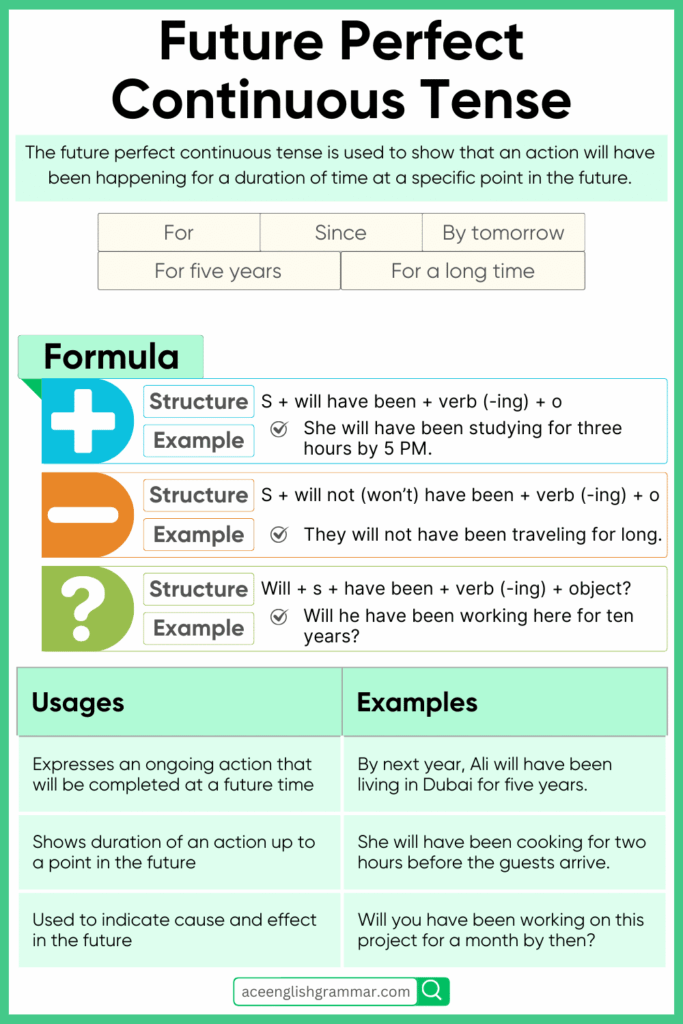
What Is the Future Perfect Continuous Tense?
The future perfect continuous tense is a verb tense that expresses an action in progress over a period of time up to a stated future moment. It is also named the future perfect progressive, and the two names refer to the same form. The tense is future in time, and its verb phrase is both perfect and continuous.
In “By nine o’clock, I will have been waiting for an hour”, the verb phrase is “will have been waiting”, and it has four parts.
- Will: The future modal.
- Have: The perfect auxiliary.
- Been: The past participle of “be”, which makes the form continuous.
- Waiting: The present participle of the main verb.
The waiting begins an hour before nine o’clock, so one hour is the length of the action at that moment.
Future Perfect Continuous Tense Formula
Subject + will have been + present participle
“Will” and “have” are the same for every subject, so the verb phrase does not change with the subject. The present participle is the “-ing” form of the main verb.
| Subject | Auxiliaries | Sentence |
|---|---|---|
| I | Will have been | I will have been reading since noon. |
| You | Will have been | You will have been driving for hours. |
| He, she, it | Will have been | She will have been working all day. |
| We | Will have been | We will have been waiting an hour. |
| They | Will have been | They will have been training since May. |
The usual spelling changes apply to the “-ing” ending.
| Change | Base verb | -ing form |
|---|---|---|
| Doubled consonant | Run | Running |
| Dropped “e” | Write | Writing |
| “ie” becomes “y” | Lie | Lying |
| No change after “y” | Study | Studying |
Affirmative Sentences
Subject + will have been + present participle
- By 2030, I will have been living here for twenty years.
- She will have been driving for six hours by the time she arrives.
- They will have been working on the bridge since January.
“Will” is contracted to “‘ll” after a pronoun, as in “I’ll have been waiting for an hour by then”.
Negative Sentences
Subject + will not have been + present participle
“Not” is placed after “will” and before “have”. With the contraction “won’t”, the formula is subject + won’t have been + present participle.
- He will not have been sleeping for more than an hour when the alarm rings.
- We won’t have been waiting long by the time the bus arrives.
Interrogative Sentences
Will + subject + have been + present participle?
Wh-word + will + subject + have been + present participle?
In a question, “will” is placed before the subject, and “have been” and the participle follow the subject in order.
Yes/no questions:
- Will you have been working here for a year by March?
- Will she have been waiting long when we arrive?
Wh questions:
- How long will they have been traveling by the time they reach Lima?
- What will you have been doing at this time next year?
A short answer ends at “will” and leaves out “have been”: “Yes, I will” and “No, I won’t”.
Negative Interrogative Sentences
Won’t + subject + have been + present participle?
Will + subject + not + have been + present participle?
The contraction “won’t” is placed before the subject, and “not” follows the subject in formal style.
- Won’t he have been driving for hours by then?
- Will they not have been working for a full year by December?
Uses of the Future Perfect Continuous Tense
This tense is used for the duration of an action up to a future moment and for the cause of a future situation.
Duration Up to a Future Moment
The first use states how long an action will have been in progress when a future moment is reached. The action starts before that moment, and its length is stated with “for” or counted from a starting point with “since”.
- By next month, we will have been renting this flat for five years.
- At noon, the team will have been rehearsing for four hours.
- By the end of the course, you will have been studying English for two years.
Whether the action continues after that moment is not stated. The first sentence does not say whether the renting continues after next month.
Cause of a Future Situation
The second use explains a future situation by an activity that goes on before it. The activity is the cause, and the result is stated in the same sentence.
- You will be exhausted tomorrow because you will have been traveling all night.
- The garden will look wonderful in May, since we will have been working on it all spring.
- Her hands will be sore after the concert because she will have been practicing for hours.
Future Perfect Continuous Tense Examples
The formula is the same in every setting, and only the time expression changes.
Work and career:
- By Friday, I will have been working on this proposal for three weeks.
- Our manager will have been leading the department for ten years by 2028.
- The engineers will have been testing the software since early spring.
- By the time the client calls, we will have been waiting for two hours.
- She will have been teaching at this school for fifteen years next September.
In the last sentence, “next September” is the reference point, and fifteen years is the length of the teaching at that point.
Study and training:
- By May, Hana will have been studying Spanish for two years.
- The students will have been preparing for the exam since September.
- By the end of the week, I will have been revising this chapter for six days.
- Our coach will have been training the team for three hours by sunset.
- He will have been learning the piano for a decade by his next birthday.
In the second sentence, “since” is followed by a starting point instead of a length.
Daily life and trips:
- By the time we land, we will have been flying for nine hours.
- It will have been raining for a week by the weekend.
- They will have been living in Toronto for five years in April.
- At six o’clock, I will have been cooking all afternoon.
- Next month, she will have been commuting to the city for a year.
Time words with “all”, such as “all afternoon” and “all night”, take no “for”.
Sport and hobbies:
- By the final, the players will have been competing for two weeks.
- By dusk, the children will have been playing outside since lunch.
- He will have been painting this mural for a month when the festival opens.
- By Sunday, we will have been hiking for three days.
- The band will have been playing for two hours by midnight.
Time Expressions in the Future Perfect Continuous Tense
A future reference point is stated with “by”, “by the time” or “by then”, and a length of time is stated with “for”. The table gives each expression with a sentence.
| Expression | Sentence |
|---|---|
| By + time | By Friday, I will have been working for a week. |
| By the time + present simple | By the time she arrives, we will have been waiting for an hour. |
| By then | By then, they will have been living abroad for years. |
| In + month or year | In June, she will have been teaching for ten years. |
| Next + period | Next year, he will have been running his company for a decade. |
The clause after “by the time” is in the present simple, not the future, because a clause of time refers to the future in the present simple.
- ❌ By the time she will arrive, we will have been cooking for hours.
- ✅ By the time she arrives, we will have been cooking for hours.
Since and For in the Future Perfect Continuous Tense
“For” is followed by a length of time, and “since” is followed by a starting point. The same action is described with either word.
- By July, I will have been working here for six years.
- By July, I will have been working here since 2019.
The two words are not interchangeable within one phrase. A length of time never follows “since”, and a starting point never follows “for”.
- ❌ By July, I will have been working here for 2019.
- ✅ By July, I will have been working here since 2019.
Stative Verbs in the Future Perfect Continuous Tense
A stative verb refers to a state instead of an action, and it does not take the continuous form. Verbs such as “know”, “own” and “belong” are used in the future perfect instead.
Subject + will have + past participle
- ❌ By June, I will have been knowing her for ten years.
- ✅ By June, I will have known her for ten years.
| Stative verb | Future perfect form |
|---|---|
| Know | Will have known |
| Own | Will have owned |
| Love | Will have loved |
| Belong | Will have belonged |
| Understand | Will have understood |
Some verbs are stative in one sense and dynamic in another. “Have” meaning ‘own’ is stative, as in “She will have had the car for years”, while “have” meaning ‘eat’ is dynamic, as in “They will have been having dinner for an hour”.
Future Perfect Continuous Compared With Other Future Tenses
Three future tenses are built with “will”, and each is identified by its verb phrase.
| Tense | Formula | Sentence |
|---|---|---|
| Future continuous | Subject + will be + present participle | At 8 p.m., I will be working. |
| Future perfect | Subject + will have + past participle | By 8 p.m., I will have finished the report. |
| Future perfect continuous | Subject + will have been + present participle | By 8 p.m., I will have been working for six hours. |
Future perfect: This tense is chosen when the sentence states a result or a completed action, as in “By noon, she will have written the report”.
Future continuous: This tense is chosen when the action is in progress at one moment and no length of time is counted, as in “At noon, she will be writing the report”.
To choose among the three, work through these steps.
- Look for a length of time, such as “for three hours” or “since Monday”. If one is present, the future perfect continuous tense is the choice.
- Look for a completed result or a number, such as “three reports”. If one is present, the future perfect is the choice.
- Look for a single moment with no counted length. If that is the meaning, the future continuous is the choice.
You ask “how long” for the first tense and “how many” for the second: “How long will she have been writing?” and “How many reports will she have written?”
Passive Voice in the Future Perfect Continuous Tense
- Active: Subject + will have been + present participle + object
- Passive: Object + will have been being + past participle + by + subject
An example is “The bridge will have been being built for two years by 2030”. The construction is grammatical, but two forms of “be” in a row make it very rare in English.
It is avoided in two ways.
- Active voice, which keeps the duration: The company will have been building the bridge for two years by 2030.
- Future perfect passive, which states completion in place of duration: The bridge will have been built by 2030.
To form the full passive, follow these steps.
- Take the object of the active sentence as the new subject.
- Write “will have been being”.
- Add the past participle of the main verb.
- Add “by” and the doer of the action, if it is needed.
Common Mistakes With the Future Perfect Continuous Tense
Missing auxiliary: Write “I will have been waiting”, not “I will have waiting” or “I will been waiting”. Both “have” and “been” are required.
Wrong verb form: Write “will have been working”, not “will have been work” or “will have been worked”. The main verb ends in “-ing”.
Stative verbs: Write “will have known”, not “will have been knowing”. Stative verbs take the future perfect.
Future in a time clause: Write “By the time she arrives”, not “By the time she will arrive”. A clause of time takes the present simple.
Wrong preposition: Write “since 2019” and “for six years”, not “for 2019”. “For” is followed by a length of time, and “since” is followed by a starting point.
Future Perfect Continuous Tense Exercises
Complete each sentence or choose the correct form.
- Complete the sentence: By December, she ____ (work) here for ten years.
- Choose the correct form: By noon, I (will have been waiting / will have waiting) for two hours.
- Complete the question: How long ____ you ____ (study) by the time you graduate?
- Choose for or since: By May, he will have been teaching (for / since) 2018.
- Correct the sentence: By the time she will arrive, we will have been cooking for hours.
- Choose the correct verb: By June, I (will have been knowing / will have known) her for five years.
- Make the sentence negative: She will have been sleeping for an hour.
- Choose the correct tense: By 5 p.m., they (will have been writing / will have written) three chapters.
- Complete the sentence: At the end of the month, we ____ (live) in this city for a year.
- Make a yes/no question: He will have been driving for six hours.
Answers:
- Will have been working: the sentence states a duration up to December.
- Will have been waiting: “been” is required, and the participle ends in “-ing”.
- Will, have been studying: the question formula is Will + subject + have been + present participle.
- Since: 2018 is a starting point.
- By the time she arrives, we will have been cooking for hours: a clause of time takes the present simple.
- Will have known: “know” is a stative verb.
- She will not have been sleeping for an hour.
- Will have written: “three chapters” is a completed number.
- Will have been living: the sentence states a duration up to the end of the month.
- Will he have been driving for six hours?
FAQs
Q1. How do you identify the future perfect continuous tense?
You identify it by the sequence “will have been” followed by a verb ending in “-ing”, as in “will have been teaching”. A phrase such as “by June” or “for ten years” is present in most sentences.
Q2. What are the helping verbs of the future perfect continuous tense?
The helping verbs are “will”, “have” and “been”. “Will” is the future modal, “have” is the perfect auxiliary, and “been” is the past participle of “be”.
Q3. Can we use shall in the future perfect continuous tense?
Yes, with “I” and “we” in formal British English, as in “I shall have been working here for ten years”. “Will” is the form used with every subject in standard American and everyday British English.
Q4. Does the future perfect continuous tense exist?
Yes. It is a full tense with its own form, subject + will have been + present participle, and it is used in sentences that state a duration up to a future time.
Q5. What is the future perfect continuous tense of go?
The future perfect continuous tense of “go” is “will have been going”, as in “By noon, we will have been going for hours”.
Q6. Where is the future perfect continuous tense used?
It is used wherever an activity is counted up to a future date, such as work anniversaries and project plans. It is also used in predictions that explain a future result.
Read More

Leave a Comment