
The Future Continuous Tense describes an action that will already be happening at a future time. In I will be studying at 8 PM, the sentence does not only point to a future plan. It places the action of studying inside that future moment.
This tense is also called the Future Progressive Tense. It uses will be + verb-ing, as in She will be working tomorrow morning and They will be traveling this time next week. The word will points to the future, while be + verb-ing shows the action in progress.
By the end, you should be able to recognize future continuous meaning in real sentences, build positive, negative, and question forms with control, and avoid the verb mistakes that make this tense sound awkward in writing or speech.
What is Future Continuous Tense?
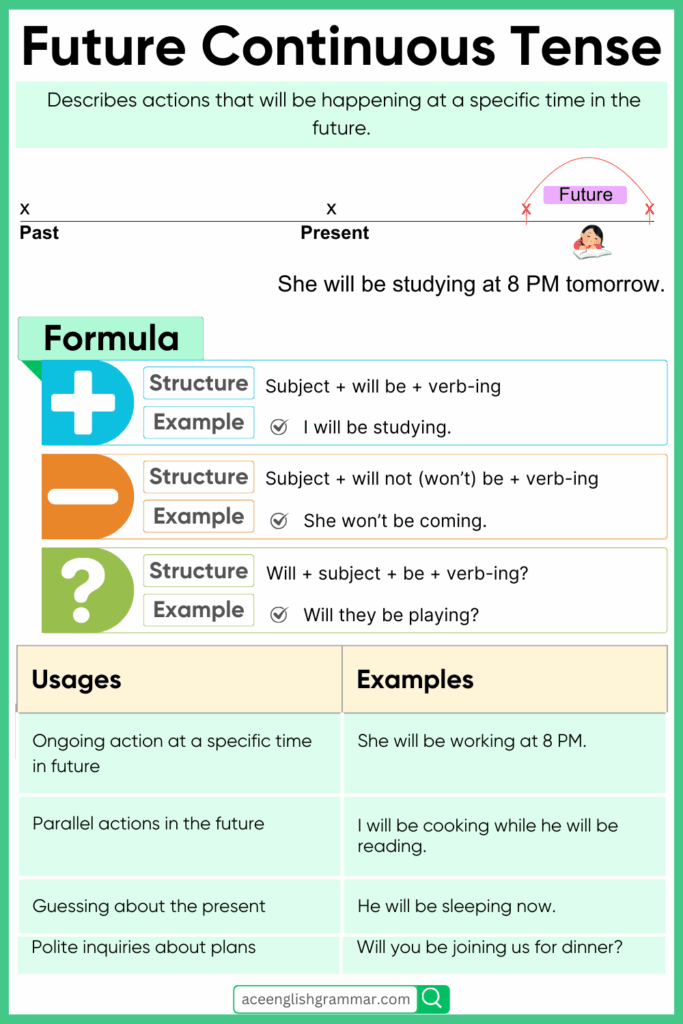
The Future Continuous Tense is a verb tense that shows an action in progress at or around a specific future time. It imagines a future scene and places the subject inside an ongoing action.
- I will be working at 10 PM.
- She will be taking her exam tomorrow morning.
- They will be flying to Paris this time next week.
In each sentence, the action is not presented as complete. The speaker is looking ahead to a future point and showing what will be happening then.
This tense often answers questions such as:
- What will you be doing at 8 PM?
- What will be happening this time tomorrow?
- Will someone be working, studying, traveling, waiting, or sleeping at a certain future time?
The future point matters because it anchors the action. Without that future setting, the sentence may sound less exact.
Future Continuous Tense Formula And Sentence Structure
The main formula is:
Subject + will be + verb-ing
Each part has a job. Will marks future time, be belongs to the continuous structure, and the -ing verb shows the action as ongoing.
| Subject | Structure | Example |
|---|---|---|
| I | Will Be + Verb-Ing | I will be working tonight. |
| You | Will Be + Verb-Ing | You will be studying at noon. |
| He | Will Be + Verb-Ing | He will be driving tomorrow morning. |
| She | Will Be + Verb-Ing | She will be cooking dinner at 7 PM. |
| We | Will Be + Verb-Ing | We will be traveling next week. |
| They | Will Be + Verb-Ing | They will be waiting outside. |
After will be, the main verb must appear in its -ing form.
- I will be write tonight. ❌
- I will be writing tonight. ✅
- She will be cook at 6 PM. ❌
- She will be cooking at 6 PM. ✅
Positive sentences show that the action will be happening at a future time.
Structure: Subject + will be + verb-ing
- I will be reading at 9 PM.
- She will be attending the meeting tomorrow.
- They will be watching the match tonight.
- We will be staying at a hotel next weekend.
- He will be preparing for his interview.
In She will be attending the meeting tomorrow, will points to the future, while be attending shows the action in progress.
Negative sentences show that the action will not be happening at that future time.
Structure: Subject + will not be + verb-ing
- I will not be sleeping at 10 PM.
- She will not be joining the call tonight.
- They will not be traveling tomorrow.
- We will not be using the car this evening.
- He will not be working on Friday.
The shorter negative form is won’t be.
- I won’t be attending the meeting.
- She won’t be studying tonight.
- They won’t be staying long.
Questions ask whether an action will be happening at a future time.
Structure: Will + subject + be + verb-ing?
- Will you be working tomorrow?
- Will she be joining us for dinner?
- Will they be arriving on time?
- Will we be staying near the airport?
- Will he be using the laptop tonight?
With question words, place the question word before will.
- What will you be doing at 8 PM?
- Where will they be staying next week?
- Why will she be leaving so early?
- Who will be speaking at the event?
Short forms are common in speech, emails, messages, and informal writing.
| Full Form | Short Form | Example |
|---|---|---|
| I Will Be | I’ll Be | I’ll be working late tonight. |
| You Will Be | You’ll Be | You’ll be meeting the manager tomorrow. |
| He Will Be | He’ll Be | He’ll be driving at that time. |
| She Will Be | She’ll Be | She’ll be waiting outside. |
| We Will Be | We’ll Be | We’ll be traveling next month. |
| They Will Be | They’ll Be | They’ll be staying with friends. |
| Will Not Be | Won’t Be | I won’t be coming tonight. |
Full forms sound more formal. Short forms sound more natural in everyday English.
When To Use Future Continuous Tense
Once the form is in place, the main question is why English chooses this tense instead of a plain future sentence. The Future Continuous Tense is used when the action is seen as ongoing at a future time, not merely planned or predicted.
Use it for actions in progress at a future time.
- At 9 PM, I will be studying.
- Tomorrow at this time, we will be flying to London.
- She will be working in her office at noon.
- They will be sleeping when we arrive.
- I will be taking my test at 10 AM.
The time expression gives the sentence its future scene. In I will be taking my test at 10 AM, the test is already happening at that time.
Use it for planned or expected future activities.
- I will be meeting the team tomorrow.
- She will be visiting her parents next weekend.
- They will be attending a conference in June.
- We will be staying in Berlin for two nights.
- He will be training with the new staff next week.
These sentences show expected activities as ongoing future events. They sound natural when you are talking about arrangements, schedules, trips, meetings, and planned work.
Use it for polite questions about future plans.
- Will you be joining us for lunch?
- Will you be using the printer this afternoon?
- Will they be staying for dinner?
- Will she be attending the workshop?
- Will you be working from home tomorrow?
These questions often sound softer than direct future questions. Will you be using the car tonight? feels less forceful than Will you use the car tonight?
Use it when one future action is happening around another event.
- I will be cooking when you arrive.
- She will be studying when the guests come.
- They will be sleeping when the flight lands.
- We will be driving when you call.
- He will be presenting when the meeting starts.
The longer action takes the Future Continuous Tense. The shorter event often uses the present tense after when.
Use it for two future actions happening at the same time.
- I will be working while she is studying.
- They will be watching a movie while we are cooking.
- She will be writing emails while he is taking calls.
- We will be traveling while the team is preparing the report.
This structure lets the sentence show two actions happening side by side in a future scene.
Time Expressions And Natural Examples
Time expressions are not just extra details in the Future Continuous Tense. They often anchor the action to the future point where it will be in progress.
| Time Expression | Example Sentence |
|---|---|
| At 8 PM | I will be reading at 8 PM. |
| At This Time Tomorrow | We will be traveling at this time tomorrow. |
| Tomorrow Morning | She will be working tomorrow morning. |
| Next Week | They will be staying in Rome next week. |
| This Time Next Month | I will be starting my new job this time next month. |
| When You Arrive | I will be waiting when you arrive. |
| While You Are Away | We will be taking care of the house while you are away. |
| All Evening | He will be studying all evening. |
Here are more examples in positive, negative, and question forms.
Positive examples
- I will be learning Spanish this time next year.
- She will be preparing dinner when we arrive.
- They will be playing tennis at 5 PM.
- We will be waiting near the station.
- He will be fixing the computer tonight.
- The children will be sleeping by then.
- My parents will be visiting us next weekend.
- The company will be launching a new product next month.
Negative examples
- I will not be watching TV tonight.
- She will not be cooking today.
- They will not be driving at night.
- We will not be staying at that hotel.
- He will not be joining the meeting.
- The students will not be taking the test tomorrow.
- I won’t be using my phone during the exam.
- They won’t be working late on Friday.
Question examples
- Will you be attending the lecture?
- Will she be reading at 9 PM?
- Will they be taking the train?
- Will we be staying there overnight?
- Will he be leading the discussion?
- What will you be doing tomorrow evening?
- Where will they be traveling next month?
- Who will be speaking at the event?
Important Usage Notes And Common Mistakes
Some Future Continuous Tense mistakes happen because learners treat will be like ordinary will. Others happen because not every verb works naturally in a continuous form.
Stative verbs usually do not work in the continuous form.
Stative verbs describe thoughts, feelings, possession, senses, or conditions. They do not usually describe visible ongoing actions.
| Type | Verbs |
|---|---|
| Thinking | Know, Believe, Understand, Remember |
| Feeling | Love, Hate, Prefer, Want |
| Possession | Own, Have, Belong |
| Senses | See, Hear, Smell, Taste |
| State | Seem, Need, Mean |
Avoid the Future Continuous Tense with these verbs when they describe a state.
- I will be knowing the answer tomorrow. ❌
- I will know the answer tomorrow. ✅
- She will be owning two cars next year. ❌
- She will own two cars next year. ✅
- They will be needing more time. ❌
- They will need more time. ✅
Some verbs can be continuous when they describe an action rather than a state.
- I will be having dinner at 8 PM. ✅
- She will be seeing the doctor tomorrow. ✅
Here, having means eating, and seeing means meeting.
Do not use will in future time clauses.
After time words such as when, before, after, until, as soon as, and while, English usually uses the present tense for the future time clause.
- When I will be arriving, I will call you. ❌
- When I arrive, I will call you. ✅
- After she will be finishing work, she will come home. ❌
- After she finishes work, she will come home. ✅
- I will be waiting until you will arrive. ❌
- I will be waiting until you arrive. ✅
The main clause can use the Future Continuous Tense, but the time clause usually stays in the present tense.
- I will be cooking when you arrive.
- They will be sleeping before we reach home.
- She will be working until the office closes.
Do not use the base verb after will be.
After will be, the main verb must take -ing.
- I will be go to school. ❌
- I will be going to school. ✅
- We will be study tonight. ❌
- We will be studying tonight. ✅
- They will be travel tomorrow. ❌
- They will be traveling tomorrow. ✅
Do not add s to the main verb.
The auxiliary will already carries the tense, so the main verb does not change for he, she, or it.
- She will be cooks dinner. ❌
- She will be cooking dinner. ✅
- He will be drives at 9 AM. ❌
- He will be driving at 9 AM. ✅
- It will be rains tomorrow. ❌
- It will be raining tomorrow. ✅
Do not forget be.
The word be is required because it forms the continuous structure.
- I will working tonight. ❌
- I will be working tonight. ✅
- They will traveling next week. ❌
- They will be traveling next week. ✅
- She will studying at noon. ❌
- She will be studying at noon. ✅
Use the correct word order in questions.
In questions, use will + subject + be + verb-ing.
- Will you be comes late? ❌
- Will you be coming late? ✅
- What you will be doing tonight? ❌
- What will you be doing tonight? ✅
- Will she cooking dinner? ❌
- Will she be cooking dinner? ✅
Future Continuous Compared With Other Future Forms
The Future Continuous Tense often becomes clearer when it is compared with other future forms. The difference is usually not only structure. It is the way the sentence presents the future action.
Future Continuous vs Future Simple
The Future Simple talks about a future action, decision, promise, prediction, or fact. The Future Continuous Tense focuses on an action in progress at a future time.
| Future Simple | Future Continuous |
|---|---|
| I will read tonight. | I will be reading at 9 PM. |
| She will call you tomorrow. | She will be calling clients tomorrow morning. |
| They will travel next week. | They will be traveling this time next week. |
| We will watch the match. | We will be watching the match at 8 PM. |
Compare the meaning:
- I will read tonight.
- I will be reading at 9 PM.
The first sentence says the action will happen. The second sentence places the action inside a specific future moment.
Future Continuous vs Present Continuous
The Present Continuous can describe fixed future arrangements. The Future Continuous Tense shows that an action will be happening at a future time.
| Present Continuous For Future | Future Continuous |
|---|---|
| I am meeting Sarah tomorrow. | I will be meeting Sarah at 5 PM tomorrow. |
| She is flying to Madrid next week. | She will be flying to Madrid this time next week. |
| We are having dinner tonight. | We will be having dinner when you arrive. |
The Present Continuous often focuses on the arrangement. The Future Continuous focuses on the action as it unfolds at a future moment.
Future Continuous vs Future Perfect Continuous
The Future Perfect Continuous Tense shows how long an action will have continued by a future time. The Future Continuous Tense only shows the action in progress at that time.
| Future Continuous | Future Perfect Continuous |
|---|---|
| I will be working at 8 PM. | I will have been working for three hours by 8 PM. |
| She will be studying at noon. | She will have been studying for two hours by noon. |
| They will be traveling next month. | They will have been traveling for a week by next month. |
Use the Future Continuous when the action is happening then.
Use the Future Perfect Continuous when the duration before that future point is important.
Quick Grammar Check Before Practice
Before you use this tense in writing, check these points:
- Use will be before the -ing verb
- Keep the same structure for all subjects
- Add not after will in negative sentences
- Put will before the subject in questions
- Use a time expression when the future point needs focus
- Avoid continuous forms with most stative verbs
- Do not use will inside future time clauses after when, before, after, until, or as soon as
These rules keep the sentence accurate without making the structure harder than it is.
Future Continuous Tense Exercises
Fill in the blanks with the correct Future Continuous Tense form.
- He ______ (attend) the meeting at 10 AM.
- She ______ (not stay) at home tonight.
- They ______ (travel) at this time next week.
- We ______ (watch) a movie at 8 PM.
- I ______ (sleep) when you call.
- ______ you ______ (use) the car this evening?
- What ______ she ______ (do) tomorrow afternoon?
- The children ______ (play) in the garden after lunch.
- He ______ (not work) late on Friday.
- Where ______ they ______ (stay) next month?
Answers
- He will be attending the meeting at 10 AM.
- She will not be staying at home tonight.
- They will be traveling at this time next week.
- We will be watching a movie at 8 PM.
- I will be sleeping when you call.
- Will you be using the car this evening?
- What will she be doing tomorrow afternoon?
- The children will be playing in the garden after lunch.
- He will not be working late on Friday.
- Where will they be staying next month?
FAQs About Future Continuous Tense
Q1. What Is The Future Continuous Tense?
The Future Continuous Tense is a verb tense that shows an action in progress at a specific future time. In I will be studying at 9 PM, the studying will already be happening at that time.
Q2. What Is The Formula Of Future Continuous Tense?
The formula is subject + will be + verb-ing.
- She will be working tomorrow.
- They will be traveling next week.
- I will be waiting outside.
Q3. What Are Examples Of Future Continuous Tense?
Here are natural examples:
- I will be reading at 8 PM.
- She will be attending a meeting tomorrow morning.
- They will be flying to Italy this time next week.
- We will be waiting when you arrive.
Q4. When Do We Use Future Continuous Tense?
Use it when an action will be happening at a future time, when you ask politely about future plans, or when one future action will be in progress around another event.
- Will you be joining us later?
- I will be cooking when they arrive.
- They will be working at noon.
Q5. What Is The Difference Between Future Simple And Future Continuous?
The Future Simple says that an action will happen. The Future Continuous Tense says that the action will be happening at a certain future time.
- I will read tonight.
- I will be reading at 9 PM.
Q6. Can We Use Future Continuous Tense With Stative Verbs?
Most stative verbs do not sound natural in the Future Continuous Tense. Use the Future Simple with verbs such as know, believe, need, own, and understand.
- I will know the result tomorrow. ✅
- I will be knowing the result tomorrow. ❌
Q7. What Is The Negative Form Of Future Continuous Tense?
The negative form is subject + will not be + verb-ing.
- I will not be working tonight.
- She will not be attending the class.
- They won’t be traveling tomorrow.
Q8. What Is The Question Form Of Future Continuous Tense?
The question form is will + subject + be + verb-ing?
- Will you be studying tonight?
- Will she be joining the meeting?
- What will they be doing tomorrow?
Read More

Leave a Comment