
The past perfect tense is used for the earlier of two past actions, and it is built from had plus the past participle. In “the train had left before we arrived,” the leaving came first and the arriving came second, so had left takes the past perfect while arrived stays in the past simple. Had is the same for every subject, so no agreement choice arises in this tense. The participle is the third form of the verb, so go gives had gone and eat gives had eaten.
What Is the Past Perfect Tense?
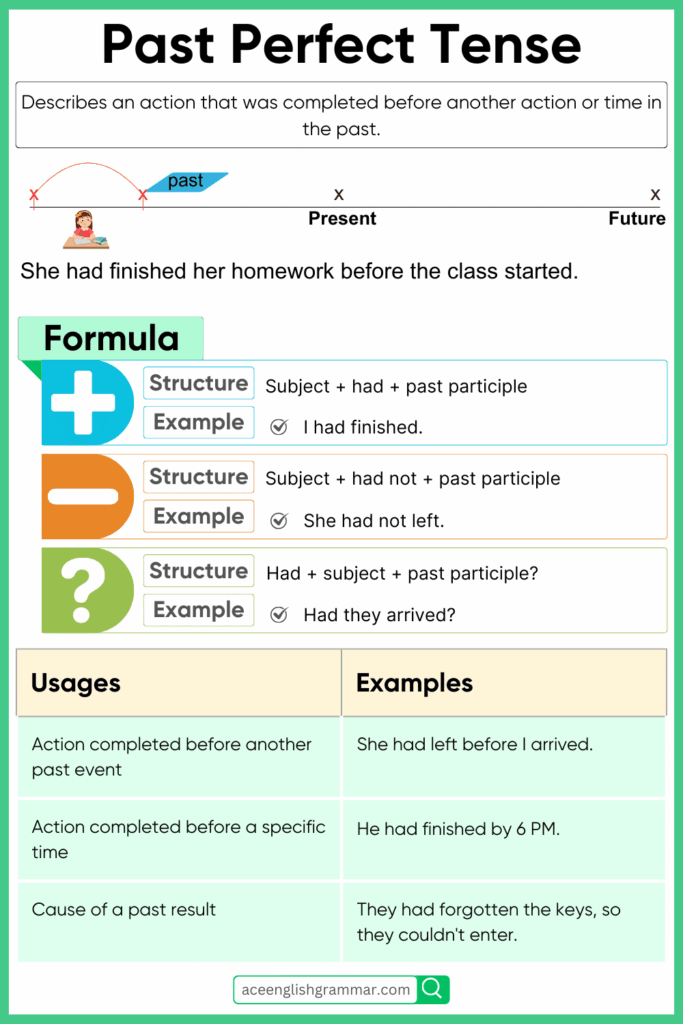
The past perfect tense is a verb form made of had plus the past participle. It is used for an action completed before another past action or before a stated past time. Where a sentence contains two past events, the earlier one takes the past perfect and the later one takes the past simple.
- The meeting had started by the time I reached the office.
- She had never flown before that trip.
- They had not finished the repairs when the rain came.
- Had you met him before the wedding?
Note that this form is also named the past perfect simple, a label that separates it from the past perfect continuous. Both names refer to had plus the participle.
The Past Perfect Formula
The auxiliary is had for every subject in this tense. Had does not change whether the subject is I, she or they, and the main verb takes the participle form in all of them.
| Subject | Auxiliary | Participle | Example |
|---|---|---|---|
| I | had | written | I had written the email already. |
| You | had | seen | You had seen the film before. |
| He, she, it | had | left | She had left by seven. |
| We | had | booked | We had booked the tickets in March. |
| They | had | eaten | They had eaten before the guests came. |
Regular verbs form the participle with -ed, so walk becomes had walked and finish becomes had finished. Irregular verbs use a third form that has to be learned, which gives had gone, had eaten, had written, had taken and had broken.
Note that the past simple form is not the participle, even where the two look alike. Go gives went and gone, so “she had went” is never English while “she had gone” is correct.
Negatives and Questions With Had
The same two parts build every sentence form, and only the position of had changes. Not goes straight after the auxiliary in the negative.
Affirmative: subject + had + participle
- The shop had closed by six.
- We had already paid the bill.
Negative: subject + had + not + participle
- The shop had not closed by six.
- They hadn’t paid the bill.
Interrogative: had + subject + participle
- Had the shop closed by six?
- Had they paid the bill?
Negative interrogative: hadn’t + subject + participle
- Hadn’t she warned you about this?
- Hadn’t the letter arrived by then?
Wh-question: question word + had + subject + participle
- Why had nobody told me?
- Where had they gone before lunch?
Note that the contraction ‘d stands for both had and would, and the next word settles which. “She’d left” contains a participle and means had left, while “she’d leave” contains a base verb and means would leave.
Uses of the Past Perfect Tense With Examples
Every use of this tense depends on a second point in the past. Without that second point, the sentence needs the past simple instead.
The Earlier of Two Past Actions
- By the time the police arrived, the thief had escaped.
- She apologised because she had forgotten the appointment.
Duration Up to a Past Moment With Stative Verbs
- They had known each other for twenty years before the wedding.
- He had lived in Multan since childhood when the job offer came.
Unrealized Hopes and Intentions
- We had hoped to reach Lahore before dark.
- She had intended to apply, but the deadline passed.
Note that the third use states a failure without saying so directly. “We had hoped to reach Lahore before dark” already tells the reader the attempt did not succeed.
Past Perfect With Before and After
Before and after already state which event came first, so the past perfect stops being compulsory once either word is present. Both versions of the sentences here are correct in standard English.
- The train had left before we arrived. The train left before we arrived.
- After she had eaten, she went out. After she ate, she went out.
- He resigned after the audit had begun. He resigned after the audit began.
The rule matters most where no conjunction supplies the order, because the tense alone then states the sequence.
Compare:
- When I arrived, she had left, so the leaving came first and the house was empty.
- When I arrived, she left, so the leaving came second and she walked out as I walked in.
Note that before plus the past perfect also marks an action that never finished. In “she left before I had finished speaking,” the speaking was cut short, which the past simple version does not convey.
Adverbs and Time Expressions With Had
Adverbs of time go between had and the participle rather than in front of the auxiliary. The same position applies to already, just, never, ever, always and previously.
- She had already eaten when we called.
- I had never seen so much rain.
- The parcel had just arrived.
- They had always wanted a garden.
Longer time phrases are placed at the start or the end of the sentence, and the frequent ones are by the time, by then, until then, before then and by a stated date.
- By the time the doors opened, the queue had reached the corner.
- The paperwork had been ready since March.
- She had finished two novels by then.
Note that placing the adverb in front of had reads as spoken English rather than written. “She already had eaten” is understood, and “she had already eaten” is what careful writing uses.
The Past Perfect in Conditionals and Wishes
The unreal past is also built with the past perfect, where had refers to an imagined situation rather than a real earlier event. Three structures take it, and all three describe something that did not happen.
- Third conditional: If I had known about the traffic, I would have left earlier.
- Wish: I wish I had studied harder for that paper.
- If only: If only we had booked the tickets in advance.
The pattern in a third conditional is fixed. The if clause takes the past perfect, and the result clause takes would have plus the participle.
Note that would have never belongs in the if clause. “If I would have known” appears in speech and fails in writing, where “if I had known” is the only correct form.
The Past Perfect in Reported Speech
A past simple sentence and a present perfect sentence both move into the past perfect when reported after a past verb. This is why the past perfect appears so frequently in reported speech.
- Direct: “I saw her yesterday.” Reported: He said he had seen her the day before.
- Direct: “We have finished.” Reported: They told me they had finished.
- Direct: “She didn’t call.” Reported: He said she hadn’t called.
Note that a past perfect sentence does not shift again, since no verb form in English is earlier than this one. “I had left” is reported as “he said he had left,” with the tense unchanged.
Passive Voice With Had Been
The passive inserts been between had and the participle, giving had been plus the past participle. The form suits a completed action whose agent matters less than the result.
- Active: Someone had moved the files. Passive: The files had been moved.
- Active: The committee had approved the plan. Passive: The plan had been approved.
- Active: They had not paid the invoice. Passive: The invoice had not been paid.
Note that the passive keeps the same time relationship as the active. “The invoice had not been paid when the supplier called” still places the non-payment before the call.
Past Perfect Compared With the Other Past Tenses
Three tenses are close to this one in meaning, and the reference point separates them. Each form measures the action from a different moment.
| Past perfect | Past simple | Present perfect | Past continuous | |
|---|---|---|---|---|
| Form | had + participle | second form | have or has + participle | was or were + -ing |
| Reference point | A stated past moment | The time of the action | The present moment | A stated past moment |
| Action status | Finished before that moment | Finished | Finished, with a result now | Still running at that moment |
| Example | She had left by six. | She left at six. | She has left. | She was leaving at six. |
Past Perfect vs Past Simple
The past simple reports one event. The past perfect reports an event that happened before another one, so that second event must appear in the same sentence or in the one before it.
- ✗ Yesterday I had gone to the market. ✓ Yesterday I went to the market.
- ✓ I had gone to the market before the rain started.
Past Perfect vs Present Perfect
Both use a participle, and the auxiliary marks the difference. Have and has connect the action to the present, while had connects it to a past moment.
- She has lived here for ten years, and she still does.
- She had lived there for ten years when the factory closed.
Past Perfect vs Past Continuous
The past continuous shows an action still running at a past moment. The past perfect shows one already finished by then.
- At six she was cooking, so the cooking was under way.
- At six she had cooked, so the cooking was over.
Common Mistakes With the Past Perfect Tense
The frequent error is using this tense where nothing earlier needs marking at all. A single past event takes the past simple, and the past perfect becomes correct only once a second past point is present.
1. Using it for one isolated event. We write “yesterday I went to the market,” not “yesterday I had gone to the market,” because no second past moment is present.
2. Using the past simple form as the participle. We write “she had gone” and “he had written,” not “she had went” and “he had wrote.”
3. Putting would have in the if clause. We write “if I had known,” not “if I would have known,” since the conditional keeps would have for the result clause only.
4. Marking both clauses. We write “after she had eaten, she went out,” not “after she had eaten, she had gone out,” because only the earlier action takes the tense.
5. Placing the adverb in front of had. We write “she had already left,” not “she already had left.”
6. Reading ‘d as had in every case. We write “she’d leave tomorrow” for would and “she’d left by then” for had, and the form of the next verb settles it.
Past Perfect Tense Exercises
Choose the correct form for each sentence.
- By the time we arrived, the film (started / had started).
- She had (wrote / written) three letters before lunch.
- Yesterday I (had visited / visited) my grandmother.
- If I (had known / would have known), I would have told you.
- She had (already eaten / eaten already) when the guests arrived.
- After the meeting (had ended / had been ended), everyone left quickly.
- He said he (saw / had seen) the report the previous week.
- The invoice (had not paid / had not been paid) when the supplier called.
- At six she had cooked, which means the cooking was (over / still going).
- They (had known / knew) each other for years before the wedding.
Answers: 1. Had started, the earlier of two past events. 2. Written, the participle of write. 3. Visited, since no second past point is present. 4. Had known, the if clause of a third conditional. 5. Already eaten, with the adverb between had and the participle. 6. Had ended, since the active form fits an event with no agent. 7. Had seen, the backshift in reported speech. 8. Had not been paid, the passive form. 9. Over. 10. Had known, duration up to a past moment.
FAQs
Q1. Which form of the verb is used in the past perfect tense?
The past participle is used, which is the third form of the verb. Regular verbs take -ed, giving had walked and had finished, while irregular verbs take a separate form, giving had gone, had eaten and had written. The participle never changes for person or number.
Q2. Does the past perfect tense always have had?
Yes, had appears in every past perfect sentence, and it never becomes has or have. The contraction ‘d stands in for it in speech and informal writing, as in “she’d finished.” In the passive the auxiliary becomes had been, and had is still the first word of it.
Q3. Can you use two past perfect verbs in one sentence?
Yes, but only where two separate actions both happened before the same past moment. “She had packed her bags and had called a taxi before the alarm went off” is correct. Where a conjunction such as after already fixes the order, one past perfect is enough and the second clause takes the past simple.
Q4. Can the past perfect be used alone?
No, not in ordinary writing. The tense needs a second past point for the earlier action to precede, and that point can be stated in the same sentence or in the one before it. A past perfect verb with no second point reads as an error, which is why “yesterday I had gone out” fails.
Q5. How do you identify the past perfect tense?
Look for had followed by a past participle. Both parts are needed, so “she had finished” is past perfect while “she finished” is past simple and “she has finished” is present perfect. A marker such as by the time, already or before is present in most of these sentences.
Q6. What is the past perfect tense of go?
The form is had gone for every subject. Go is irregular, so its past simple went and its participle gone are different words, and only the participle works here. The same split gives had eaten for eat, had run for run and had fallen for fall.
Q7. Is would have the past perfect?
No, would have plus a participle is the third conditional result, not the past perfect. “If I had known, I would have called” contains both: had known is the past perfect in the if clause, and would have called is the result. Writing “if I would have known” puts the wrong one in the wrong clause.
Read More

Leave a Comment