
The future perfect tense is used for an action that will be finished before a stated point in the future. In “By Friday, I will have finished the report”, the finishing falls on or before Friday. The tense is formed with will have plus the past participle.
Most sentences in this tense contain a deadline such as “by 6 p.m.” or “by the time you arrive”. The deadline is the reference point, and the action is complete when that point is reached.
What Is the Future Perfect Tense?

The future perfect tense is a verb tense that expresses an action completed before a stated future time. It combines the future modal “will” with the perfect auxiliary “have” and the past participle of the main verb.
Take “By the time you wake up, I will have left”. The leaving comes before the waking, so it takes the future perfect, and the waking is in the present simple.
- By June, she will have graduated.
- They will have sold the house before winter.
- We will have arrived by noon.
Future Perfect Tense Formula
Subject + will have + past participle
“Will” and “have” are the same for every subject, so the verb phrase does not change with the subject. The past participle is the third form of the verb: “finished” for a regular verb and “written” for an irregular one.
| Subject | Auxiliaries | Sentence |
|---|---|---|
| I | Will have | I will have finished by noon. |
| You | Will have | You will have heard the news by then. |
| He, she, it | Will have | She will have left before dinner. |
| We | Will have | We will have saved enough by May. |
| They | Will have | They will have built the bridge by 2030. |
Regular verbs form the participle with “-ed”, as in “worked” and “planned”. For irregular verbs, the third form is learned separately, as in “gone”, “eaten” and “taken”.
Affirmative Sentences
The affirmative follows the structure line at the head of this section, with “will” contracted to “‘ll” after a pronoun.
- By midnight, the guests will have left.
- I**’ll have finished** the book by Sunday.
- The team will have tested the software by Monday.
Negative Sentences
Subject + will not have + past participle
“Not” is placed after “will” and before “have”. With the contraction “won’t”, the formula is subject + won’t have + past participle.
- She will not have finished the essay by tonight.
- They won’t have arrived before the meeting starts.
- I will not have read the whole report by Friday.
Interrogative Sentences
Will + subject + have + past participle?
In a question, “will” is placed before the subject, and “have” and the participle follow the subject in order. In a wh question, the question word comes first: wh-word + will + subject + have + past participle.
- Will you have finished the report by Friday?
- Will they have left before we arrive?
- When will she have completed her degree?
A short answer ends at “will”, with “have” and the participle left out: “Yes, I will” and “No, I won’t”.
Negative Interrogative Sentences
Won’t + subject + have + past participle?
The contraction “won’t” is placed before the subject. In formal style, “not” follows the subject: will + subject + not + have + past participle.
- Won’t he have finished by now?
- Will you not have seen the results by then?
Uses of the Future Perfect Tense
Two uses of the future perfect tense are common in everyday English, and a third refers to the present.
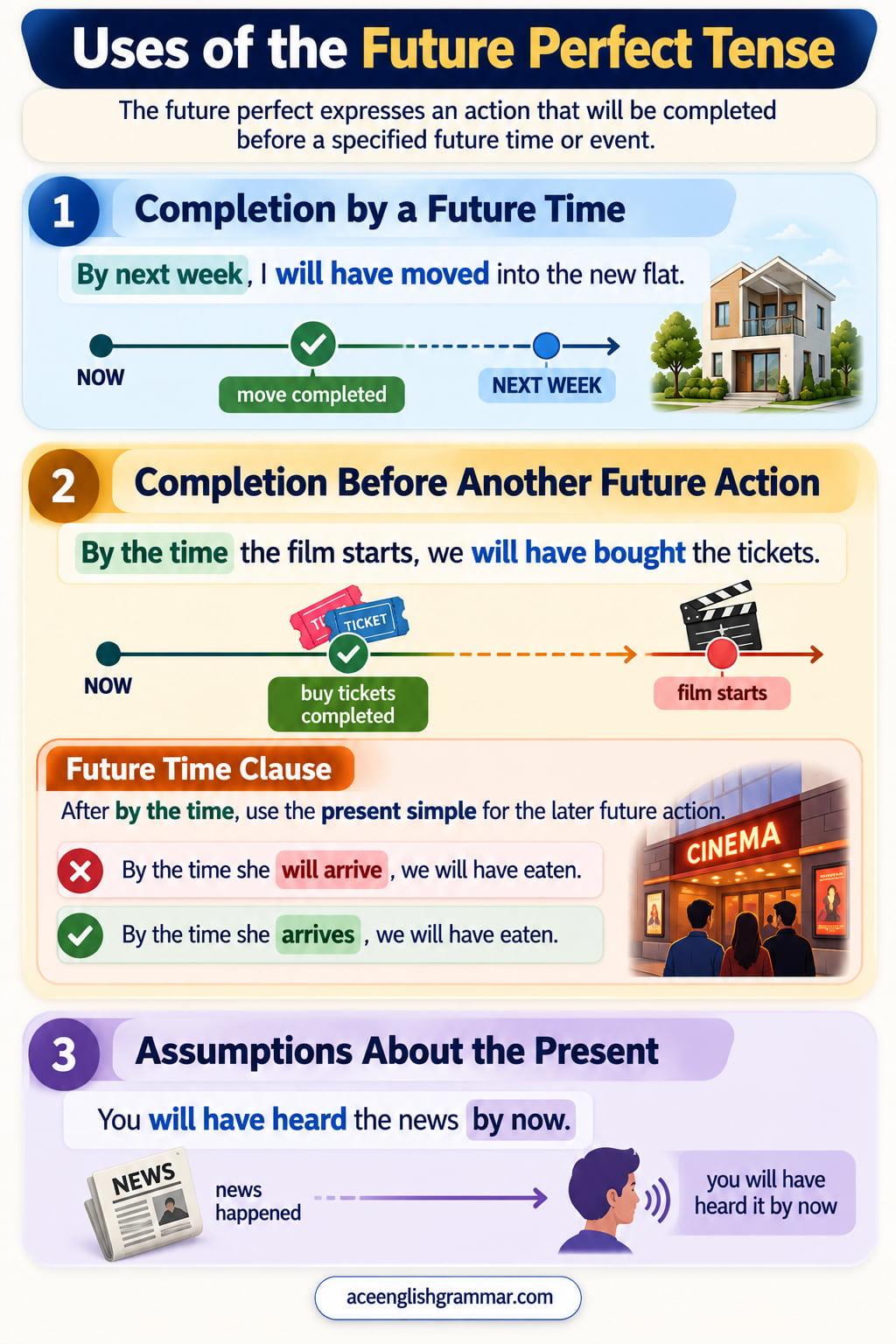
Completion Before a Future Time
The first use states that an action will be finished by a stated time. The time is introduced by “by”, “before” or “by the time”.
- By next week, I will have moved into the new flat.
- The builders will have finished the roof before the rain starts.
- By 2035, scientists will have found a cure.
Completion Before Another Future Action
The second use places one future action before another. The earlier action takes the future perfect, and the later one takes the present simple after “by the time”, “before” or “when”.
- By the time the film starts, we will have bought the tickets.
- She will have cooked dinner before the guests arrive.
The clause after “by the time” is in the present simple, not the future, because a clause of time refers to the future in the present simple.
- ❌ By the time she will arrive, we will have eaten.
- ✅ By the time she arrives, we will have eaten.
Assumptions About the Present
The third use is a confident assumption that something has already happened. No future time is involved.
- You will have heard the news by now.
- They will have reached the hotel already.
Time Expressions in the Future Perfect Tense
A deadline is stated with “by”, “before” or “by the time”, and each expression marks a future moment.
| Expression | Sentence |
|---|---|
| By + time | By 5 p.m., I will have sent the invoice. |
| By the time + present simple | By the time he calls, we will have left. |
| Before + time or clause | They will have finished before sunset. |
| By then | By then, she will have retired. |
| By next + period | By next year, we will have repaid the loan. |
| In + length of time | In ten minutes, the train will have gone. |
“Already”, “just” and “yet” are placed after “have” in this tense: “They will have already left” and “She will not have finished yet”.
Future Perfect Tense Examples
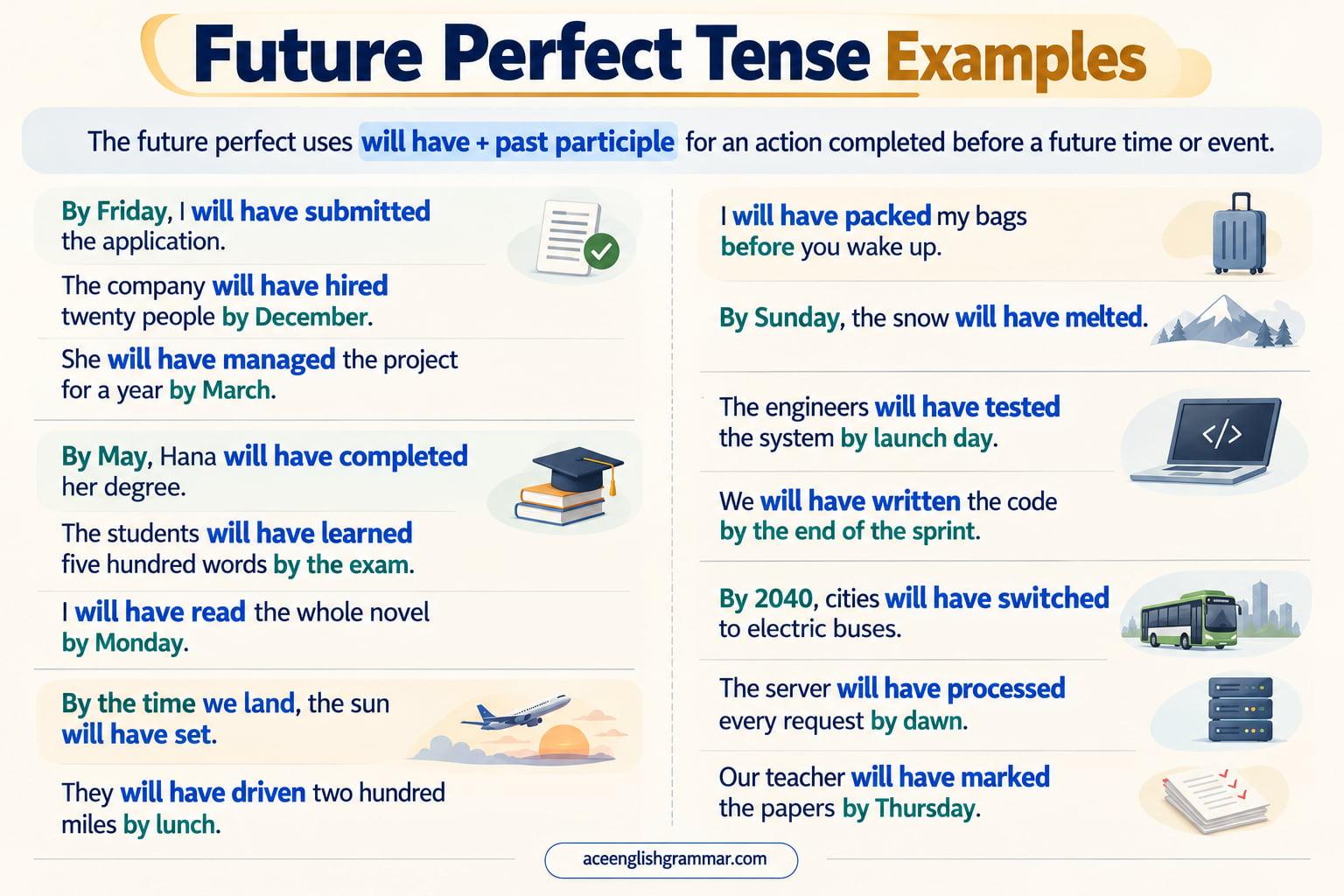
The formula is the same in every setting, and only the time expression changes.
Work and career:
- By Friday, I will have submitted the application.
- The company will have hired twenty people by December.
- She will have managed the project for a year by March.
- The auditors will have checked every account by the deadline.
- By the end of the quarter, we will have doubled our sales.
Study and exams:
- By May, Hana will have completed her degree.
- The students will have learned five hundred words by the exam.
- I will have read the whole novel by Monday.
- By next term, he will have passed the entrance test.
- Our teacher will have marked the papers by Thursday.
Daily life and trips:
- By the time we land, the sun will have set.
- They will have driven two hundred miles by lunch.
- I will have packed my bags before you wake up.
- By Sunday, the snow will have melted.
- She will have cleaned the house before the guests come.
Technology and projects:
- The engineers will have tested the system by launch day.
- By midnight, the update will have installed.
- We will have written the code by the end of the sprint.
- By 2040, cities will have switched to electric buses.
- The server will have processed every request by dawn.
Passive Voice in the Future Perfect Tense
Subject + will have been + past participle
In the passive, the object of the active sentence becomes the subject, and the doer is introduced with “by” when it is needed.
- Active: The workers will have completed the road by May.
- Passive: The road will have been completed by May.
To change a sentence to the passive, follow these steps.
- Take the object of the active sentence as the new subject.
- Write “will have been”.
- Add the past participle of the main verb.
- Add “by” and the doer of the action, if it is needed.
The negative passive is formed with “will not have been”, as in “The road will not have been completed by May”.
Future Perfect Tense Compared With Other Future Tenses
Four future tenses are built with “will”, and each is identified by its verb phrase.
| Tense | Formula | Sentence |
|---|---|---|
| Simple future | Subject + will + base verb | I will finish the report. |
| Future continuous | Subject + will be + present participle | At 8 p.m., I will be writing the report. |
| Future perfect | Subject + will have + past participle | By 8 p.m., I will have finished the report. |
| Future perfect continuous | Subject + will have been + present participle | By 8 p.m., I will have been writing for six hours. |
To choose among the three perfect and continuous forms, work through these steps.
- Look for a completed result or a number, such as “three reports”. If one is present, the future perfect is the choice.
- Look for a length of time, such as “for six hours”. If one is present, the future perfect continuous is the choice.
- Look for a single moment with no deadline. If that is the meaning, the future continuous is the choice.
You ask “how many” for the first tense and “how long” for the second: “How many reports will she have written?” and “How long will she have been writing?”
Common Mistakes With the Future Perfect Tense
Wrong participle: Write “will have gone”, not “will have went”. The main verb takes the past participle, not the past simple.
Missing auxiliary: Write “I will have finished”, not “I will finished” or “I have finished by Friday”. Both “will” and “have” are required.
Future in a time clause: Write “By the time she arrives”, not “By the time she will arrive”. A clause of time takes the present simple.
Stative duration: Write “By June, I will have known her for ten years”, not “will have been knowing”. A stative verb takes the future perfect and not the continuous form.
No reference time: Write “By noon, I will have left”, not “I will have left” alone, when the sentence is about the future. A deadline places the action.
Future Perfect Tense Exercises
Complete each sentence or choose the correct form.
- Complete the sentence: By December, she ____ (finish) her thesis.
- Choose the correct form: By noon, they (will have left / will have went).
- Make the sentence negative: I will have finished the report by Friday.
- Complete the sentence: By the time you ____ (arrive), we will have eaten.
- Make a yes/no question: She will have completed the course by June.
- Correct the sentence: By the time he will call, I will have left.
- Change to the passive: The team will have finished the project by May.
- Choose the correct tense: By 8 p.m., I (will have written / will have been writing) three chapters.
- Complete the question: When ____ they ____ (complete) the bridge?
- Choose the correct participle: By next year, we will have (took / taken) the exam.
Answers:
- Will have finished: the sentence states completion before December.
- Will have left: “left” is the past participle of “leave”.
- I will not have finished the report by Friday.
- Arrive: a clause of time takes the present simple.
- Will she have completed the course by June?
- By the time he calls, I will have left.
- The project will have been finished by the team by May.
- Will have written: “three chapters” is a completed number.
- Will, have completed: the question formula is Will + subject + have + past participle.
- Taken: “taken” is the past participle of “take”.
FAQs
Q1. How do you identify the future perfect tense?
You identify it by the sequence “will have” followed by a past participle, as in “will have finished”. A phrase such as “by Friday” or “by the time” is present in most sentences.
Q2. What are the helping verbs of the future perfect tense?
The helping verbs are “will” and “have”. “Will” is the future modal, and “have” is the perfect auxiliary that is followed by the past participle.
Q3. Can we use shall in the future perfect tense?
Yes, with “I” and “we” in formal British English, as in “I shall have finished by noon”. “Will” is the form used with every subject in standard American English.
Q4. Can we use has in the future perfect tense?
No. The future perfect always takes “have” after “will”, whatever the subject, so “She will has finished” is incorrect and “She will have finished” is correct.
Q5. Is there a passive voice in the future perfect tense?
Yes. The passive is formed with subject + will have been + past participle, as in “The report will have been sent by Friday”.
Q6. What is the difference between the future perfect tense and the future tense?
The difference is that the simple future states that an action will happen, while the future perfect states that it will be complete by a stated time. In “I will finish the report” no deadline is given, and in “I will have finished the report by Friday” one is.
Read More

Leave a Comment