An indefinite pronoun denotes a person, an object or an amount without identifying which one. In “Someone left a bag in the hall”, “someone” is used in place of a person the speaker does not identify.
Agreement with the verb is the part that needs care. The verb after “everyone” is singular, as in “Everyone is here”, and the verb after “both” is plural, as in “Both are here”.
What Is an Indefinite Pronoun?
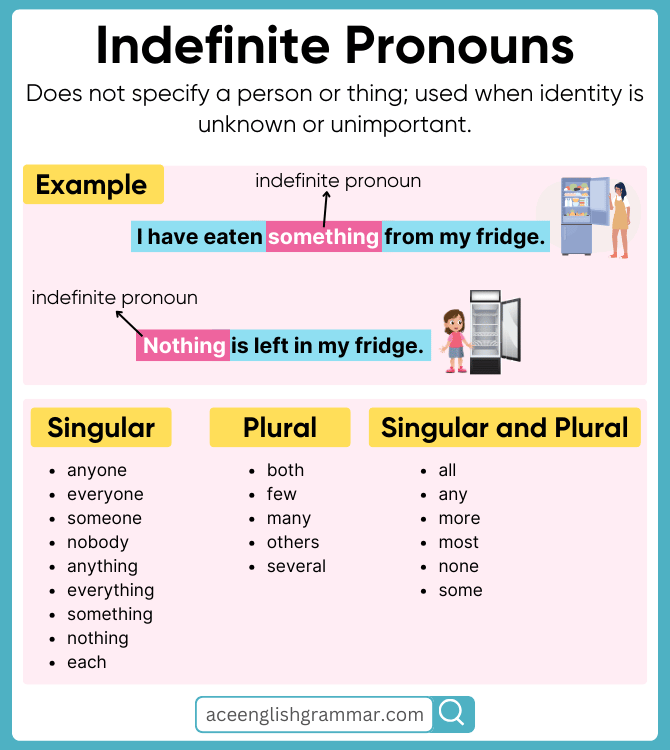
An indefinite pronoun is a pronoun that denotes a person, an object or an amount without identifying which one. It is used in place of a noun that is unknown, unspecific or unnecessary to state.
Look at “Nobody answered the door”. The pronoun “nobody” denotes people in general, and no particular person is identified. A noun such as “the neighbor” would identify a specific person, and a personal pronoun such as “she” would replace that noun.
- Everyone enjoyed the concert.
- I looked for my keys, but I found nothing.
- Some of the guests stayed late.
- Few understood the instructions.
List of Indefinite Pronouns
Indefinite pronouns are grouped by the verb they take. Some are always singular, some are always plural, and some are either, depending on the noun they refer to.
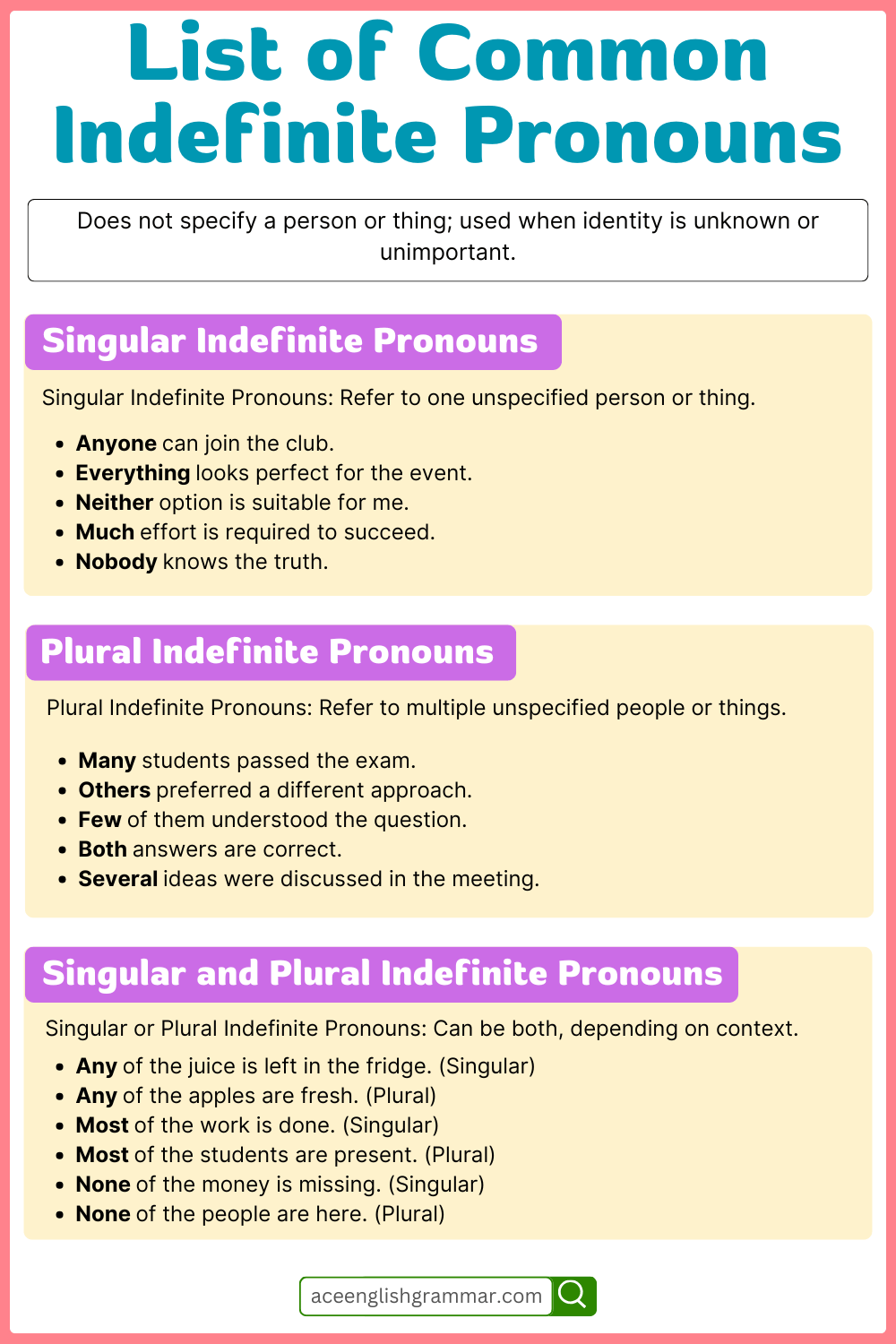
Singular Indefinite Pronouns
These pronouns are followed by a singular verb, even when the meaning is plural.
| Group | Pronouns |
|---|---|
| With “-one” | Anyone, everyone, no one, one, someone |
| With “-body” | Anybody, everybody, nobody, somebody |
| With “-thing” | Anything, everything, nothing, something |
| Others | Another, each, either, neither, little, much, other |
- Everybody is ready.
- Each of the players wears a number.
- Neither of the answers is correct.
- Nothing was missing.
Plural Indefinite Pronouns
These pronouns take a plural verb.
| Pronoun | Sentence |
|---|---|
| Both | Both of the roads are closed. |
| Few | Few have seen the results. |
| Fewer | Fewer are attending this year. |
| Many | Many were disappointed. |
| Others | Others prefer to stay home. |
| Several | Several have already applied. |
Indefinite Pronouns That Are Singular or Plural
Six pronouns are singular or plural depending on the noun that follows “of”:
- All
- Any
- More
- Most
- None
- Some
An uncountable noun takes a singular verb, and a plural noun takes a plural verb.
- All of the water is gone.
- All of the tickets are sold.
- Most of the cake was eaten.
- Most of the cakes were eaten.
Subject-Verb Agreement With Indefinite Pronouns
The verb agrees with the number of the pronoun, not with the noun in the phrase that follows it. Ignore the phrase and find the pronoun.
- ❌ Each of the students have a locker.
- ✅ Each of the students has a locker.
To check the verb, follow these steps.
- Find the indefinite pronoun that is the subject of the sentence.
- Decide whether it is singular, plural or either, from the list of indefinite pronouns.
- If it is either, look at the noun after “of” and match its number.
- Choose the verb form that agrees with the number.
“None” follows step 3: “None of the soup is left” and “None of the guests are staying” are both correct. A singular verb is formal when “none” means “not one”: “None of the guests is staying”.
For more on verb agreement, see subject-verb agreement.
Pronoun-Antecedent Agreement With Indefinite Pronouns
A pronoun that follows an indefinite pronoun is chosen to match it. A singular indefinite pronoun is not marked for gender, so “he”, “she” or “they” is chosen by the writer.
- Everyone brought their own lunch.
- Everyone brought his or her own lunch.
- All the staff brought their own lunch.
“Their” with a singular indefinite pronoun is standard in modern English. “His or her” is the formal alternative, and rewriting the sentence with a plural subject avoids the question: “All the guests brought their own lunch”.
Plural indefinite pronouns take “their” without any decision: “Many forgot their tickets”.
Possessive Forms of Indefinite Pronouns
A singular indefinite pronoun forms the possessive with an apostrophe and “s”.
- Someone**’s** phone is ringing.
- Everybody**’s** opinion was heard.
- No one**’s** name was left off the list.
Note that “others” is already plural, so its possessive is “others'”, as in “Others’ opinions differ”.
Indefinite Pronouns in Negative Sentences
A standard negative statement contains one negative word. A pronoun such as “nobody” or “nothing” is already negative, so a second negative word is not added.
- ❌ I didn’t see nobody.
- ✅ I didn’t see anybody.
- ✅ I saw nobody.
The “any-” pronouns are used after “not” and “never”, and the “no-” pronouns are used without them.
| With a negative verb | With a positive verb |
|---|---|
| I did not hear anything. | I heard nothing. |
| She never tells anyone. | She tells no one. |
| He didn’t meet anybody. | He met nobody. |
Indefinite Pronoun vs Indefinite Adjective
The same word is used as a pronoun or as an adjective. A pronoun is used alone in place of a noun. An adjective, also called a determiner, comes before a noun.
| Word | As a pronoun | As an adjective |
|---|---|---|
| Some | Some are missing. | Some books are missing. |
| Many | Many agreed. | Many people agreed. |
| Each | Each has a key. | Each student has a key. |
| Both | Both were late. | Both trains were late. |
| Several | Several left early. | Several guests left early. |
Definite pronouns: A definite pronoun denotes a specific, known person or object, and an indefinite pronoun does not. In “She found it”, “she” and “it” are identified. In “Someone found something”, neither is.
To tell them apart, check whether a noun follows the word. A word followed by a noun is an adjective, and a word used alone is a pronoun. See determiners for the full list.
Indefinite Pronouns in Sentences
An indefinite pronoun is used in the same functions as a noun.
Subject:
- Somebody is knocking at the door.
- Few of the answers were correct.
Object:
- The teacher asked everyone to sit down.
- I told nobody about the plan.
Object of a preposition:
- She spoke to someone at the bank.
- He is thinking about something else.
Subject complement:
- The prize could be anything.
Common Mistakes With Indefinite Pronouns
Plural verb: Write “Everyone is here”, not “Everyone are here”. “Everyone” and “everybody” denote a group but are followed by a singular verb.
Wrong agreement: Write “Each of the boys has a ticket”, not “Each of the boys have a ticket”. The verb agrees with “each”.
Double negative: Write “I saw nothing” or “I didn’t see anything”, not “I didn’t see nothing”. One negative word is enough.
“Every one” and “everyone”: Write “everyone” for all the people and “every one” for each item in a group, as in “Every one of the cakes was eaten”.
Spelling of “no one”: Write “no one”, not “noone”. The pronoun is two words, though “nobody” is one.
Indefinite Pronoun Exercises
Choose the correct form or complete the sentence.
- Choose the correct verb: Everybody (is / are) invited.
- Choose the correct verb: Both of the answers (is / are) wrong.
- Choose the correct verb: Most of the cake (was / were) eaten.
- Correct the sentence: I didn’t see nobody at the party.
- Choose the correct pronoun: Each of the girls brought (her / their) own book.
- Is “some” a pronoun or an adjective: Some of the apples are rotten?
- Choose the correct verb: Few (has / have) finished the test.
- Choose the correct form: (Someones / Someone’s) phone is ringing.
- Choose the correct verb: Neither of the answers (is / are) correct.
- Is “many” a pronoun or an adjective: Many people came late?
Answers:
- Is: “everybody” is singular.
- Are: “both” is plural.
- Was: “cake” is uncountable, so “most” takes a singular verb.
- I didn’t see anybody, or I saw nobody: one negative word is used.
- Her or their: both are standard, and “their” is the common choice in mixed groups.
- Pronoun: “some” is used alone, in place of a noun.
- Have: “few” is plural.
- Someone’s: the possessive adds an apostrophe and “s”.
- Is: “neither” is singular.
- Adjective: “many” comes before the noun “people”.
FAQs
Q1. What are indefinite pronouns?
The term covers pronouns that denote people, objects or amounts without identifying them, such as “someone”, “nothing” and “several”.
Q2. Is each an indefinite pronoun?
Yes, when it is used alone or before “of”, as in “Each of the players wears a number”. The verb is singular. Before a noun, the word is an adjective.
Q3. Are indefinite pronouns always singular?
No. Pronouns such as “everyone” and “each” are singular, but “both”, “few”, “many” and “several” are always plural.
Q4. Is many an indefinite pronoun?
Yes, when it is used alone, as in “Many agreed”. The verb is plural. Before a noun, as in “many people”, the word is an adjective.
Q5. How many indefinite pronouns are there?
The number is between forty and fifty, depending on whether compound forms such as “anybody” and “anyone” are counted separately. The core list contains about twenty-five words.
Q6. Is “all” an indefinite pronoun?
Yes, when it is used alone or before “of”, as in “All of the tickets are sold”. When “all” comes before a noun, as in “all tickets”, it is an adjective.
Q7. What is the antecedent of an indefinite pronoun?
None is needed, because an indefinite pronoun does not replace an earlier noun. A later pronoun such as “their” in “Everyone brought their lunch” is the one that has to agree with it.
Q8. How do you identify an indefinite pronoun?
You identify it by asking whether the word is used in place of a noun and denotes a person, object or amount that is not identified. “Someone” and “nothing” pass this check, and so does “many” in “Many agreed”.
Read More