English uses words like this, that, these, and those when a speaker points to a specific thing, person, idea, or moment. These words help listeners understand whether something is near or far, singular or plural, current or already mentioned. Instead of repeating the same noun again and again, demonstrative pronouns replace it and make the sentence smoother.
You probably use demonstrative pronouns every day without noticing it.
- This is my seat.
- Those were difficult years.
- That was an excellent idea.
Each pronoun changes according to distance and number, so choosing the correct one is important for natural English.
Quick Answer: What Are Demonstrative Pronouns?
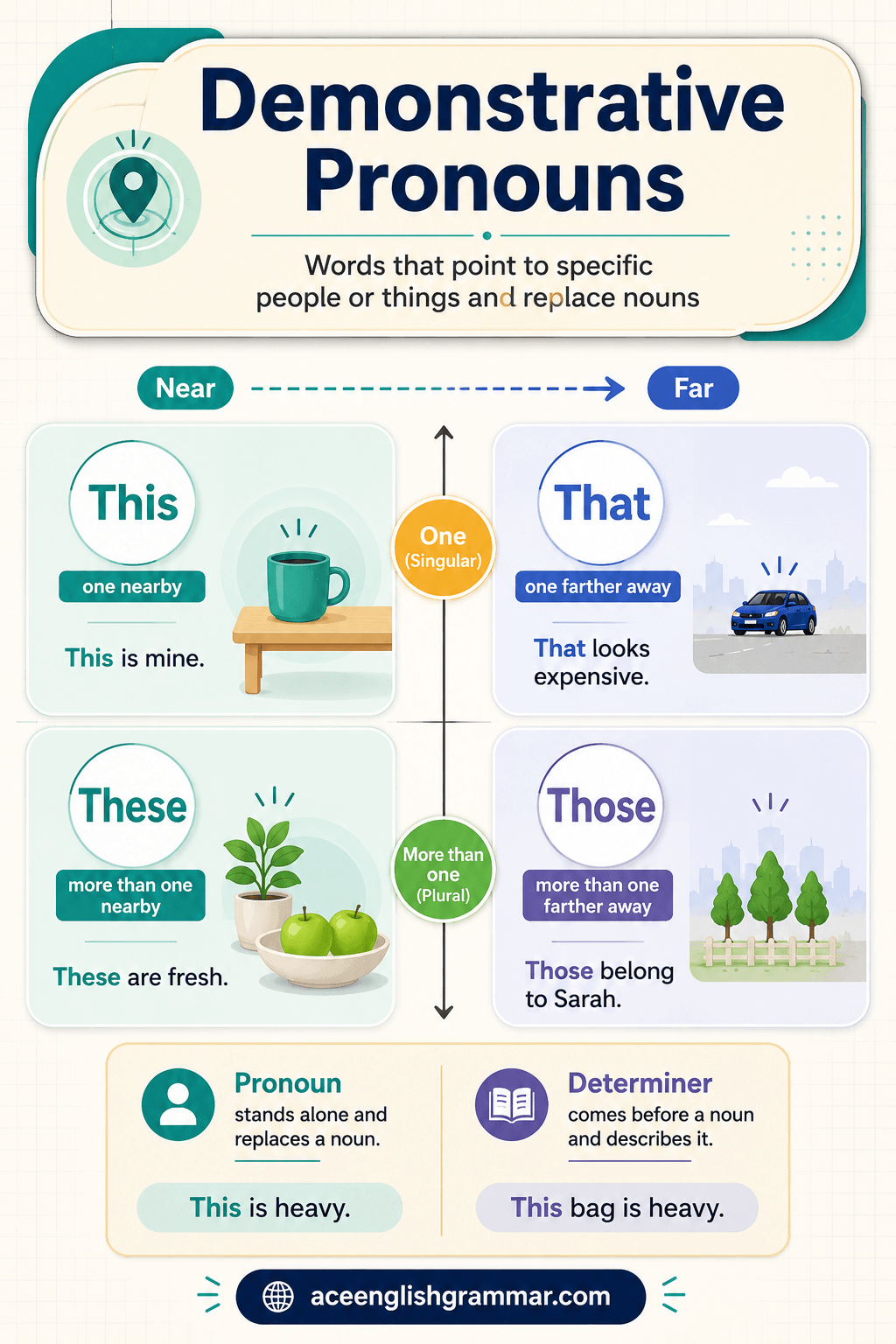
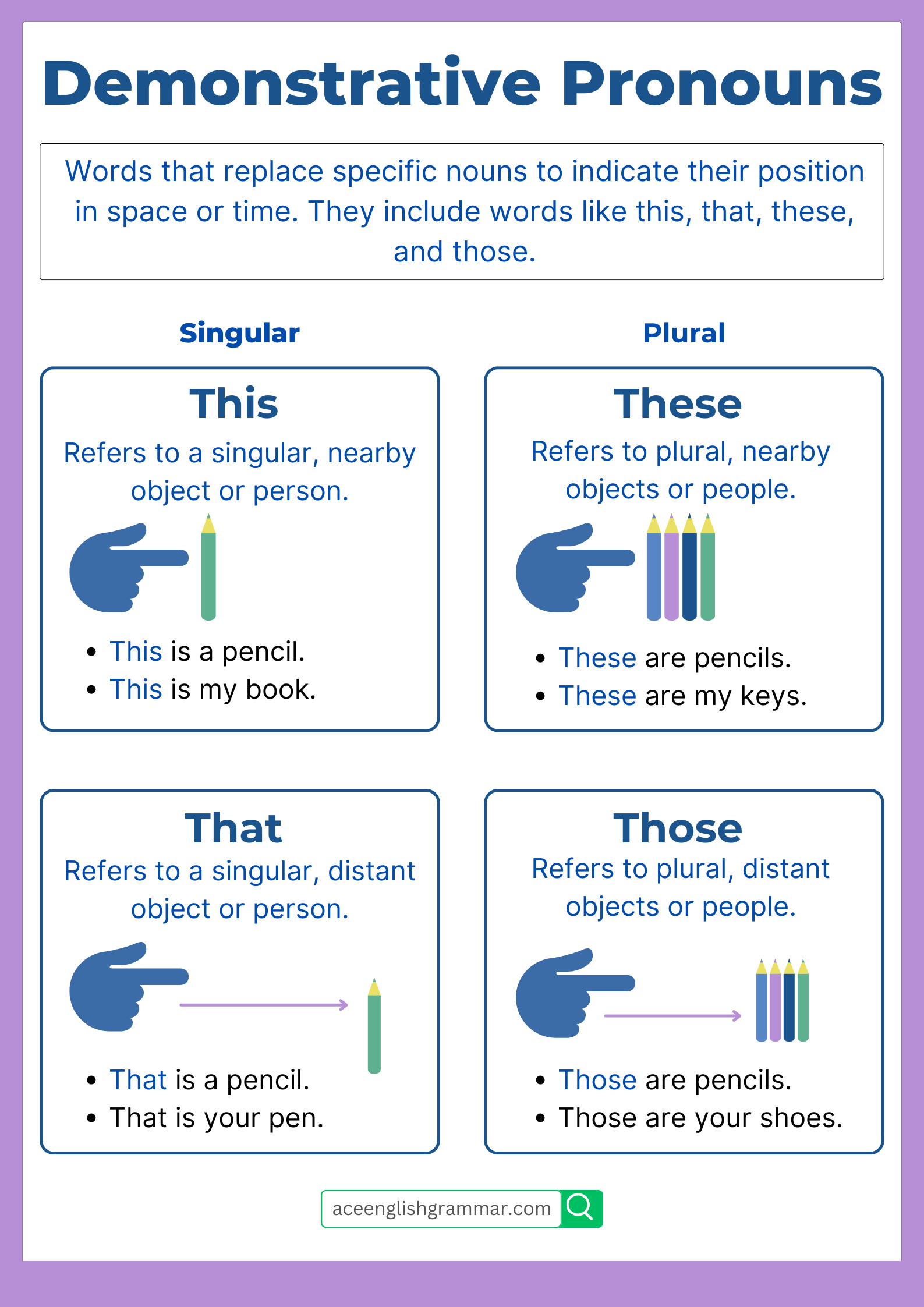
A demonstrative pronoun replaces a noun and points to a specific person, thing, place, idea, or situation.
English has four main demonstrative pronouns:
- This → singular and near.
- That → singular and far.
- These → plural and near.
- Those → plural and far.
Examples:
- This is my notebook.
- That belongs to Sarah.
- These are fresh apples.
- Those were my childhood toys.
Demonstrative Pronouns List
| Demonstrative pronoun | Number | Distance | Example |
|---|---|---|---|
| This | Singular / uncountable | Near | This is my phone. |
| That | Singular / uncountable | Far | That was a mistake. |
| These | Plural | Near | These are my keys. |
| Those | Plural | Far | Those are beautiful houses. |
What Demonstrative Pronouns Do In A Sentence
Demonstrative pronouns replace nouns that are already clear from context. The listener usually knows what the speaker means because the object, idea, or situation has already been mentioned or is visible.
- I bought a new laptop yesterday. This is much faster than my old one.
- We visited several villages during the trip. Those were unforgettable experiences.
In both examples, the demonstrative pronoun points back to something already understood.
They also help speakers avoid repetition.
❌ The movie was exciting. The movie surprised everyone.
✅ The movie was exciting. That surprised everyone.
This, That, These, And Those: Meaning And Use
This
This refers to one person, thing, idea, or situation that feels near in distance, time, or attention.
- This is my favorite book.
- This smells amazing.
- This year has been difficult.
That
That refers to one person, thing, idea, or situation that feels farther away or more distant.
- That is your jacket.
- That building looks old.
- That was a memorable day.
These
These refers to multiple nearby people or things.
- These are my new shoes.
- These belong to my sister.
- These look fresh.
Those
Those refers to multiple distant people or things.
- Those are expensive watches.
- Those were my best memories.
- Can you move those?
Near And Far Reference
Demonstrative pronouns often show physical or emotional distance.
Near Reference
Use this and these for things close to the speaker.
- This is my coffee.
- These are my glasses.
The object may be physically close, emotionally important, or connected to the current moment.
Far Reference
Use that and those for things farther away.
- That is your car over there.
- Those mountains look beautiful.
Distance is not always physical. Sometimes the speaker uses that or those for past events, memories, or emotionally distant ideas.
- That was a difficult period in my life.
- Those were stressful months.
Singular, Plural, And Verb Agreement
Demonstrative pronouns must match the noun in number.
| Singular | Plural |
|---|---|
| This is | These are |
| That is | Those are |
Correct examples:
- This is my bag.
- That was an exciting match.
- These are my books.
- Those were excellent suggestions.
Incorrect agreement creates grammar errors.
❌ These is my jacket.
✅ This is my jacket.
❌ That are my shoes.
✅ Those are my shoes.
Demonstrative Pronouns With Uncountable Nouns
This and that can also refer to singular uncountable nouns.
- This water tastes strange.
- That music sounds relaxing.
- This information is helpful.
- That advice changed my decision.
Because uncountable nouns are treated as singular, they usually work with this or that, not these or those.
Demonstrative Pronouns Vs Demonstrative Adjectives
This is one of the most important grammar differences.
A demonstrative pronoun replaces a noun.
- This is mine.
- Those belong to us.
A demonstrative adjective (also called a demonstrative determiner) comes before a noun and describes it.
- This phone is mine.
- Those shoes belong to us.
| Feature | Demonstrative pronoun | Demonstrative adjective |
|---|---|---|
| Function | Replaces a noun | Modifies a noun |
| Position | Stands alone | Comes before a noun |
| Example | This is expensive. | This watch is expensive. |
| Example | Those are beautiful. | Those flowers are beautiful. |
A quick test helps:
- If the word stands alone, it is usually a pronoun.
- If a noun follows immediately after it, it is usually a demonstrative adjective.
Demonstrative Pronouns For Time And Ideas
Demonstrative pronouns often refer to ideas, situations, conversations, and periods of time.
Present Or Current Situations
This and these usually connect to the present or something happening now.
- This is exactly what I needed.
- These are challenging times.
Past Or Distant Situations
That and those often connect to past events or memories.
- That was a terrible mistake.
- Those were exciting years.
Speakers also use demonstrative pronouns to react to ideas.
- That makes sense.
- This explains everything.
Demonstrative Pronouns In Conversations
Demonstrative pronouns appear naturally in conversations because speakers constantly point to things around them.
Introducing Yourself On The Phone
- Hello, this is Amina speaking.
- Is that Hamza on the line?
Reacting To Situations
- This is unbelievable!
- That sounds interesting.
- These look delicious.
- Those were difficult days.
Common Mistakes With Demonstrative Pronouns
Using The Wrong Number
❌ These is my phone.
✅ This is my phone.
❌ That are your books.
✅ Those are your books.
Confusing Pronouns And Adjectives
❌ This book is expensive. This is expensive book.
✅ This book is expensive.
✅ This is expensive.
Using An Unclear Reference
❌ Sarah told Emma that this was wrong.
The listener may not understand what this refers to.
✅ Sarah told Emma that the plan was wrong.
Or:
✅ Sarah explained the mistake. This upset Emma.
Repeating Nouns Unnecessarily
❌ The cookies are fresh. The cookies smell wonderful.
✅ The cookies are fresh. These smell wonderful.
Demonstrative Pronouns Examples
Here are more examples of demonstrative pronouns in sentences.
- This is my favorite song.
- That was an incredible performance.
- These are too expensive.
- Those belong to our neighbors.
- Can you move those?
- This tastes delicious.
- That looks dangerous.
- These were difficult questions.
- Those are my grandparents.
- This is exactly what I meant.
- That was the right decision.
- These make the room brighter.
- Those were unforgettable moments.
- Who owns this?
- Why are those still here?
Exercise On Demonstrative Pronouns
Fill in the blanks with the correct demonstrative pronoun.
- _____ is my favorite jacket. (this / these)
- _____ are my new shoes. (these / those)
- _____ was an unforgettable trip. (this / that)
- _____ are the books I borrowed yesterday. (these / those)
- _____ is exactly what I wanted. (this / these)
- _____ mountains look beautiful from here. (those / these)
- _____ is your coffee on the table. (this / those)
- _____ were my childhood memories. (these / those)
- _____ smells amazing. (this / these)
- _____ are the keys you were searching for. (these / this)
Answers
- This
- These
- That
- Those
- This
- Those
- This
- Those
- This
- These
Why Demonstrative Pronouns Matter In English
Demonstrative pronouns make communication more natural because they point directly to a person, object, idea, or situation without repeating the noun every time.
They help speakers:
- Avoid unnecessary repetition.
- Show distance and number clearly.
- Refer to present or past situations.
- Connect ideas smoothly in conversation and writing.
- Create shorter and more natural sentences.
Without demonstrative pronouns, English would sound repetitive and less precise.
FAQs
Q1. What are demonstrative pronouns?
Demonstrative pronouns replace nouns and point to specific people, things, places, ideas, or situations.
Q2. What is the difference between “this” and “that”?
This usually refers to something near the speaker, while that refers to something farther away or more distant in time or feeling.
Q3. Can demonstrative pronouns refer to people?
Yes, but they are more commonly used for objects, ideas, and situations.
- Who is that?
- Those are my cousins.
Q4. What is the difference between demonstrative pronouns and demonstrative adjectives?
A demonstrative pronoun replaces a noun.
- This is mine.
A demonstrative adjective comes before a noun.
- This bag is mine.
Q5. Can demonstrative pronouns be used in questions?
Yes.
- What is this?
- Who are those?
- Are these yours?
Download PDF
Get a free PDF with definitions, rules, and examples of demonstrative pronouns. Perfect for students and learners. Download now! 👇👇
Conclusion
Demonstrative pronouns help English speakers point to specific people, objects, ideas, and situations without repeating nouns constantly. Words like this, that, these, and those show distance, number, and context at the same time. Once you understand how they replace nouns and how they differ from demonstrative adjectives, sentence structure becomes much clearer and more natural.
Read More