
The past continuous tense is used for an action that was in progress at a moment in the past, and it is built from was or were plus the -ing form of the verb. “She was reading at eight o’clock” puts the reading around that moment rather than finishing it there. The past simple reports a completed action instead, so “she read at eight o’clock” says something different. Was goes with I, he, she and it, while were goes with you, we and they.
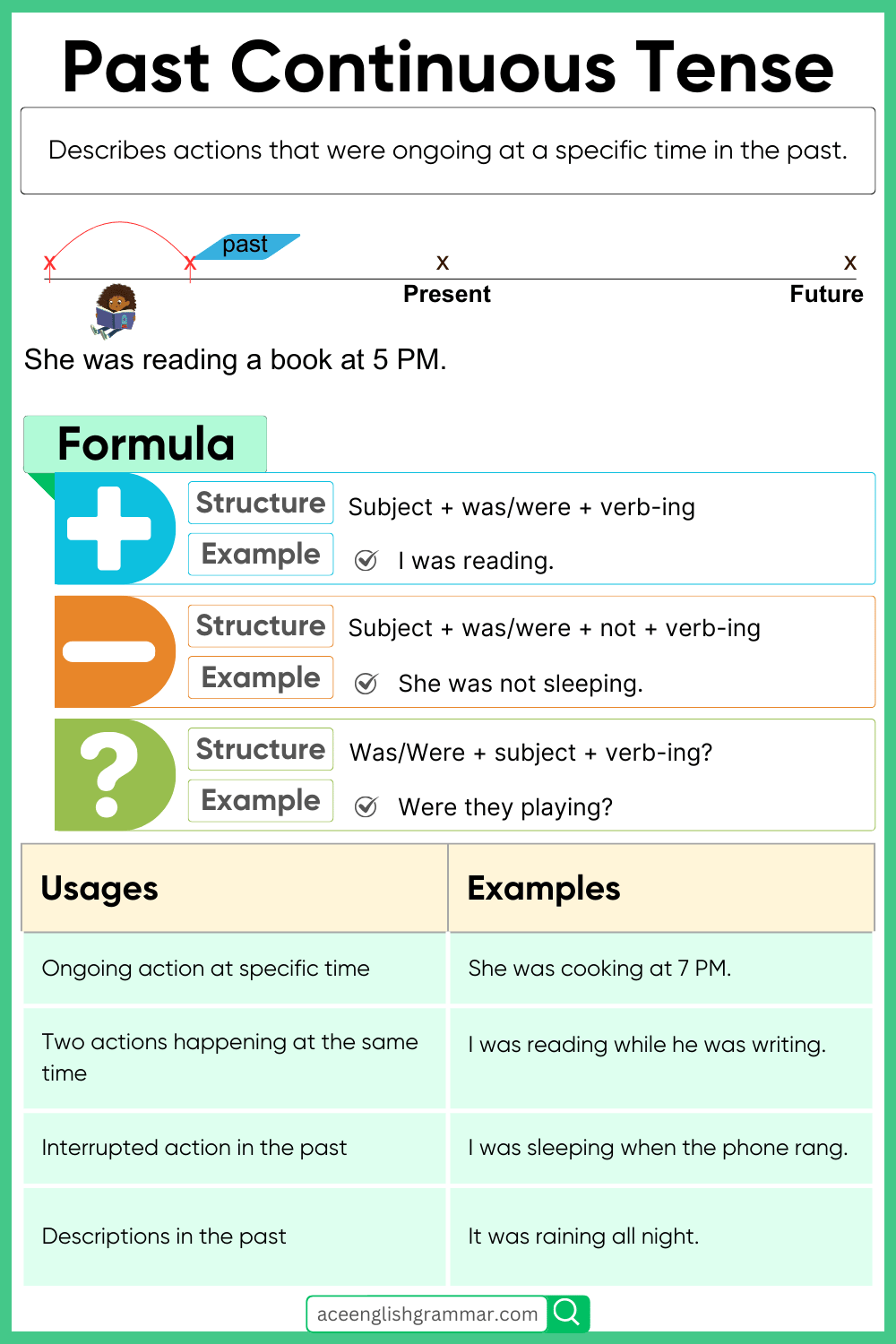
What Is the Past Continuous Tense?
An action that had started and had not finished at a given past moment takes the past continuous tense. The form pairs was or were with the -ing form of the main verb, and the -ing form is what supplies the sense of something still running.
- At midnight we were driving home.
- She was waiting outside the office.
- The children were not sleeping when I checked.
- Were you working late last night?
Note that the same form is called the past progressive in American grammar books. The two names describe one structure, and no rule separates them.
The Past Continuous Formula: Was or Were Plus the -ing Form
One pattern covers every sentence in this tense: subject, then was or were, then the -ing verb. The auxiliary changes with the subject while the -ing form never changes at all.
| Subject | Auxiliary | Example |
|---|---|---|
| I | was | I was writing a letter. |
| You | were | You were sitting by the window. |
| He, she, it | was | She was cooking dinner. |
| We | were | We were waiting for the bus. |
| They | were | They were playing outside. |
Two errors come out of this table more than any others: a plural subject taking was, and a singular subject taking were.
- ✗ They was working. ✓ They were working.
- ✗ He were working. ✓ He was working.
Note that a compound subject joined by and takes were, so “Ali and Sara were waiting” is correct. A singular subject followed by a phrase such as with his friends still takes was, since the phrase does not change the subject.
Spelling Rules for the -ing Form
The -ing ending is added to the base verb, and four spelling patterns cover the verbs that change before it. Learning these prevents the misspellings that appear most in written work.
| Verb pattern | Change | Example |
|---|---|---|
| Most verbs | Add -ing | walk to walking, read to reading |
| Verb ending in silent e | Drop the e | write to writing, make to making |
| One syllable, consonant-vowel-consonant | Double the last letter | run to running, sit to sitting |
| Two syllables stressed at the end | Double the last letter | begin to beginning, prefer to preferring |
| Verb ending in -ie | Change ie to y | lie to lying, die to dying |
The three misspellings that survive into finished writing all ignore one of these patterns.
- ✗ writeing ✓ writing
- ✗ runing ✓ running
- ✗ plaiing ✓ playing
Note that w, x and y are never doubled, which is why play becomes playing and fix becomes fixing. The doubling rule applies to the other consonants only.
Affirmative, Negative and Interrogative Sentences
Four sentence forms are built from the same two parts, and only the position of was or were changes. The word not goes straight after the auxiliary in every negative.
Affirmative: subject + was or were + verb-ing
- I was studying for the exam.
- They were watching the match.
Negative: subject + was or were + not + verb-ing
- I was not studying for the exam.
- They weren’t watching the match.
Interrogative: was or were + subject + verb-ing
- Was he studying for the exam?
- Were they watching the match?
Negative interrogative: wasn’t or weren’t + subject + verb-ing
- Wasn’t she expecting a call?
- Weren’t you living in Karachi then?
Wh-question: question word + was or were + subject + verb-ing
- What were you doing at six?
- Why was the door standing open?
Note that the short forms wasn’t and weren’t belong to speech and informal writing. Formal writing keeps was not and were not in full.
Uses of the Past Continuous Tense
Each use of this tense sets the action against something else in the past: a fixed moment, a second action, a story already under way, or a habit the speaker objects to.
An Action in Progress at a Past Moment
- At nine last night I was revising for the test.
- This time last year they were living in Lahore.
Two Actions Happening at the Same Time
- She was cooking while her brother was setting the table.
- The dog was barking and the baby was crying.
Background Information in a Story
- The rain was falling and the streets were emptying when he reached the gate.
- Everyone was talking quietly until the announcement came.
Repeated Actions With Always and Constantly
- He was always losing his keys.
- They were constantly arguing about money.
Note that the fourth use adds a complaint. “He was always losing his keys” reports irritation, while the past simple version, “he often lost his keys,” reports the frequency without any attitude.
Time Expressions That Signal the Past Continuous
Certain time phrases point to a moment rather than a finished event, and those phrases pull the verb into the past continuous. Recognising them is the fastest way to choose the right tense in an exercise.
- at eight o’clock yesterday
- at that moment
- all morning, all day, all night
- the whole evening
- this time last year
- from three to five
- during the lecture
Compare:
- ✓ At eight o’clock she was eating dinner, which is the moment inside the meal.
- ✓ At eight o’clock she ate dinner, which reports the whole meal as one event.
Note that all morning and all day work with both tenses and change the meaning. “I was working all day” stresses the stretch of time, and “I worked all day” reports the finished day.
Past Continuous and Past Simple With When and While
The two tenses appear in one sentence whenever a short action cuts across a longer one. The longer action takes the past continuous, the short action takes the past simple, and the conjunction decides which clause each tense goes into.
- While I was cooking, the phone rang.
- I was cooking when the phone rang.
- While she was driving home, she saw the accident.
- The lights went out while we were watching the film.
Swapping the two tenses breaks the sentence, because the meeting was over in a second and the walk lasted twenty minutes.
- ✗ While I walked to work, I was meeting an old friend.
- ✓ While I was walking to work, I met an old friend.
The rule behind the pattern is short. While introduces the longer action, so it takes the past continuous. When introduces the shorter action, so it takes the past simple.
Note that when also introduces a past simple clause followed by a past continuous one, as in “When I arrived, she was cooking.” The arrival is the short action and the cooking was already running, which is the same relationship in a different order.
Verbs That Take No Continuous Form
Stative verbs name a state rather than an activity, and a state has no progress to report. These verbs stay in the past simple even where the meaning refers to a past moment.
- Thinking and feeling: know, believe, understand, remember, forget, want, need, prefer
- Liking: like, love, hate, mind
- Possession: have, own, belong, possess
- Senses and appearance: seem, appear, contain, consist
Putting one of these verbs into the continuous gives a sentence no fluent speaker writes.
- ✗ I was knowing the answer at that moment. ✓ I knew the answer at that moment.
- ✗ She was owning two shops then. ✓ She owned two shops then.
Note that a few of these verbs take the continuous with a changed meaning. “I was thinking about the offer” reports mental activity rather than an opinion, and “he was having lunch” means eating rather than possessing.
The Past Continuous in the Passive Voice
The passive of this tense adds being between the auxiliary and the past participle, giving was or were being plus the participle. The pattern suits a process that was under way and whose agent matters little.
- Active: They were painting the house. Passive: The house was being painted.
- Active: The staff were preparing the reports. Passive: The reports were being prepared.
- Active: Someone was following us. Passive: We were being followed.
Leaving out being turns the sentence active again, so “the road was repairing all week” says the road did the repairing.
Note that stative verbs have no passive continuous either. “The house was being belonged to him” is not English, and the past simple passive replaces it.
The Past Continuous in Reported Speech
A past continuous sentence shifts back to the past perfect continuous after a past reporting verb. The -ing form survives the shift, and only the auxiliary changes.
- Direct: “I was waiting outside.” Reported: He said he had been waiting outside.
- Direct: “They were arguing again.” Reported: She told me they had been arguing again.
- Direct: “We were not sleeping.” Reported: They said they had not been sleeping.
Note that the shift is dropped when the reporting happens close to the event or the situation still holds. “He said he was waiting outside” is correct where the person is still out there.
Common Mistakes With the Past Continuous Tense
The auxiliary goes wrong more than the main verb does. Four of the six errors here are a problem with was or were rather than with the -ing form.
1. Dropping was or were. We write “I was reading,” not “I reading,” since the tense needs both parts.
2. Using the past form of the main verb. We write “I was reading,” not “I was read,” because the second part is always the -ing form.
3. Choosing the wrong auxiliary. We write “they were working,” not “they was working,” since were goes with plural subjects and with you.
4. Putting a stative verb in the continuous. We write “I knew him then,” not “I was knowing him then.”
5. Misspelling the -ing form. We write writing and running, not writeing and runing, because the silent e is dropped and the final consonant is doubled.
6. Putting the past simple after while. We write “while I was cooking,” not “while I cooked,” since while introduces the longer action.
Practice Questions
Choose the correct verb form for each sentence.
- At seven o’clock yesterday we (had / were having) dinner.
- While she (studied / was studying), the power went out.
- They (weren’t / wasn’t) listening to the announcement.
- I (was knowing / knew) the answer straight away.
- The house (was painting / was being painted) when we arrived.
- He (was always losing / always lost) his temper, which annoyed everyone.
- (Was / Were) you working late on Friday?
- The spelling of lie in this tense is (lieing / lying).
- She said she (was waiting / had been waiting) outside for an hour.
- When the bell (rang / was ringing), the students were leaving.
Answers: 1. Were having, a moment inside the meal. 2. Was studying, the longer action after while. 3. Weren’t, with the plural subject they. 4. Knew, since know is stative. 5. Was being painted, the passive form. 6. Was always losing, the repeated action with a complaint. 7. Were, with you. 8. Lying, since ie changes to y. 9. Had been waiting, the backshift in reported speech. 10. Rang, the short action that cut across the leaving.
FAQs
Q1. How do you identify the past continuous tense in a sentence?
Look for was or were followed by a verb ending in -ing. Both parts are needed, so “she was cooking” is past continuous while “she cooked” is past simple. A time phrase such as at eight o’clock or all morning marks the moment in most sentences.
Q2. Which form of the verb is used in the past continuous tense?
The present participle is used, which is the base verb plus -ing. Write becomes writing, run becomes running, and lie becomes lying. The participle never changes for person or number, so only was and were vary across subjects.
Q3. What is the difference between the past simple and the past continuous?
The past simple reports a finished action, and the past continuous reports an action still running at a past moment. “She read the letter” means she finished it, while “she was reading the letter” leaves it unfinished. The two appear together when a short action cuts across a longer one.
Q4. What is the difference between the past continuous and the past perfect continuous?
The past continuous places an action in progress at a past moment, and the past perfect continuous places a stretch of action before that moment. “She was working at six” means the work was under way then. “She had been working since two” measures how long the work had run before six.
Q5. Is the past continuous the same as the past progressive?
Yes, the two names describe one tense. British grammar books favour past continuous and American ones favour past progressive, and the formula of was or were plus the -ing form is identical in both traditions.
Q6. What is the past continuous tense of go?
The form is was going or were going, depending on the subject. Go is an irregular verb, but irregularity affects the past simple and the past participle only. Every verb builds this tense from the plain base plus -ing, so see becomes was seeing and eat becomes was eating.
Q7. How do you teach the past continuous tense?
Start with a single past moment and ask what was happening at it, since that question produces the form naturally. Move to pairs of actions with while and when once the structure is steady. Leave stative verbs until last, because they are the exception rather than the pattern.
Read More

Leave a Comment