Intensifiers in English change the strength of a word or expression. Cold becomes very cold, freezing becomes absolutely freezing, and late becomes too late. These small words show whether a description feels mild, strong, extreme, excessive, or only just enough.
Most intensifiers modify adjectives or adverbs, but they do not all behave the same way. Very happy sounds natural because happy can rise or fall in degree. Very perfect sounds wrong because perfect already suggests a complete state. The word after the intensifier decides which phrase sounds natural.
By the end, you should be able to choose between intensifiers like very, really, absolutely, too, so, and enough with more control, recognize why some combinations sound natural, and avoid the mistakes that make a sentence feel exaggerated, weak, or awkward.
What Are Intensifiers In English?
An intensifier is an adverb or adverb phrase that modifies an adjective, adverb, or related expression to show degree, force, excess, or sufficiency. In very cold, the intensifier very strengthens the adjective cold. In warm enough, the intensifier enough shows that the warmth reaches a needed level.
- The room is very quiet.
- She answered extremely carefully.
- The test was rather difficult.
- His answer was completely wrong.
- The coffee is too hot.
- The soup is warm enough.
Most intensifiers come before the word they modify, especially before adjectives and adverbs. A few, such as enough, usually come after the adjective or adverb.
- She is very confident.
- She is confident enough.
That position difference is important. Very confident means a strong degree of confidence. Confident enough means the person has the amount of confidence needed for a purpose.
Main Types Of Intensifiers
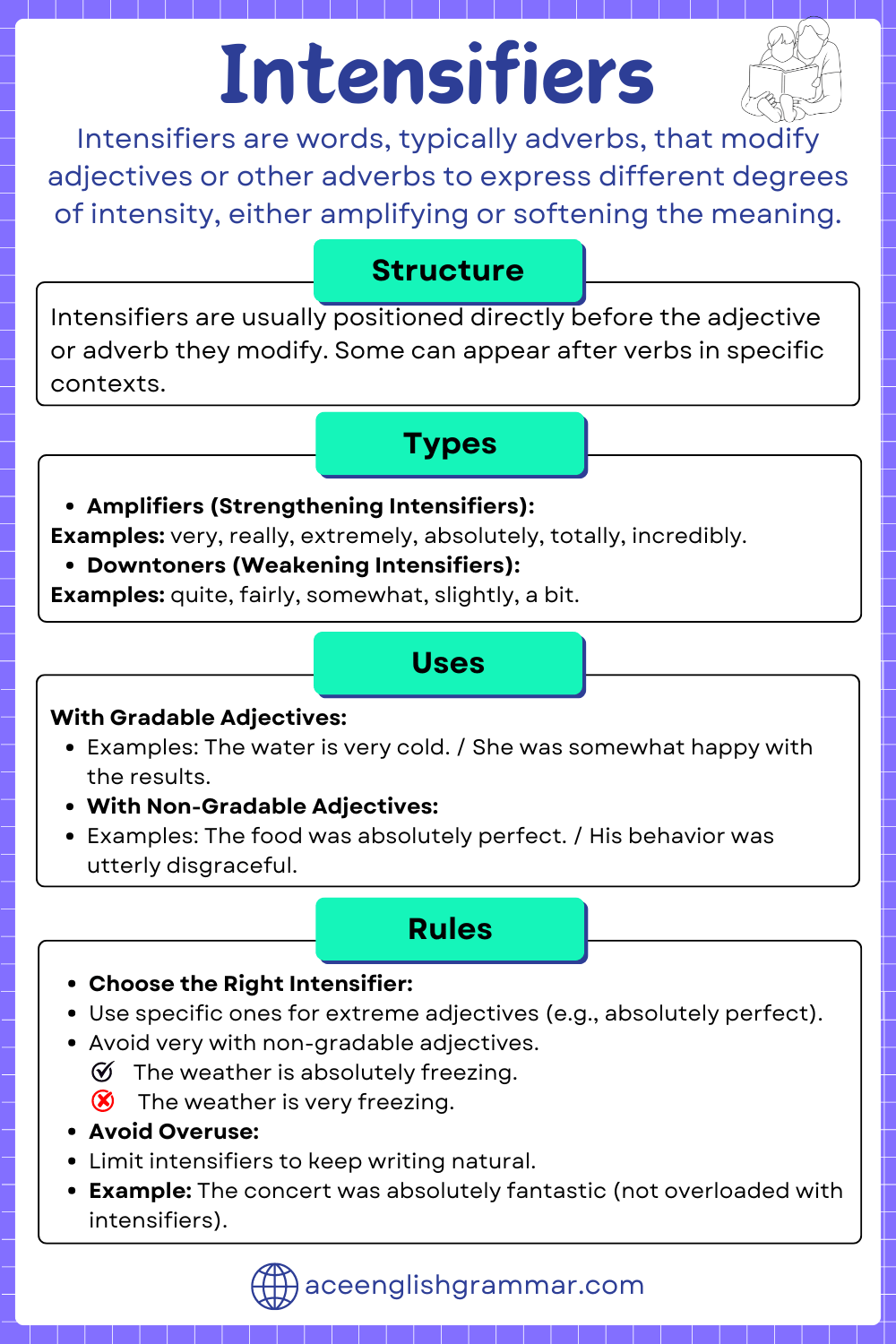
Not all intensifiers carry the same kind of force. Some push the meaning upward, some soften it, and some show that the degree has crossed a limit. Before choosing an intensifier, look at what you want the sentence to say: stronger, weaker, excessive, complete, or sufficient.
| Type | Common Intensifiers | Sentence |
|---|---|---|
| Stronger degree | Very, Really, Extremely | The lecture was very interesting. |
| Softer degree | Slightly, Fairly, Somewhat | He sounded slightly nervous. |
| Complete degree | Completely, Totally, Absolutely | The door was completely closed. |
| Excessive degree | Too | The bag is too heavy. |
| Sufficient degree | Enough | The room is bright enough. |
A sentence can change a lot when the intensifier changes.
- The room is slightly cold.
- The room is very cold.
- The room is too cold.
- The room is warm enough.
The adjective is about temperature in each sentence, but the message is not the same. Slightly cold sounds mild. Very cold sounds stronger. Too cold suggests a problem. Warm enough suggests the temperature reaches an acceptable level.
Intensifiers With Gradable Adjectives
Gradable adjectives describe qualities that can rise or fall in degree. Something can be a little cold, fairly cold, very cold, or extremely cold. That is why words like slightly, fairly, quite, very, and extremely work naturally with them.
- The water is slightly cold.
- The water is quite cold.
- The water is very cold.
- The water is extremely cold.
The adjective cold stays in place, but the intensifier changes the degree. Slightly cold suggests a small amount of coldness, while extremely cold pushes the description much higher.
Common gradable adjectives include:
| Gradable Adjective | Natural Phrases |
|---|---|
| Tired | A bit tired, Very tired, Extremely tired |
| Happy | Quite happy, Really happy, Very happy |
| Big | Fairly big, Very big, Extremely big |
| Expensive | Rather expensive, Very expensive, Too expensive |
| Interesting | Quite interesting, Really interesting, Extremely interesting |
Use gradable adjectives when the quality has a scale. Very tired sounds natural because tiredness can increase. Extremely expensive works because price can move far beyond what someone expected.
Intensifiers With Strong And Non-Gradable Adjectives
Gradable adjectives work because they have a scale. Strong and non-gradable adjectives behave differently. A word like freezing already carries an extreme meaning, so it usually needs a stronger intensifier than very.
Strong adjectives already contain a high degree of meaning:
- Freezing means very cold.
- Boiling means very hot.
- Excellent means very good.
- Awful means very bad.
- Furious means very angry.
These adjectives usually sound natural with intensifiers such as absolutely, completely, totally, utterly, and really.
- The weather is absolutely freezing. ✅
- The weather is very freezing. ❌
- Her answer was absolutely perfect. ✅
- Her answer was very perfect. ❌
- The room was completely silent. ✅
- The room was very silent. ❌
The mistake is not usually the adjective. The problem is the intensifier before it. Very works well with ordinary gradable adjectives, but strong adjectives often need an intensifier that matches their extreme meaning.
Non-gradable adjectives describe complete states, not degrees. Words such as finished, dead, impossible, empty, and unique often resist ordinary degree words.
- The project is completely finished.
- The bottle is totally empty.
- That answer is absolutely impossible.
In everyday speech, people sometimes bend these rules for emphasis, but polished writing usually sounds stronger when the intensifier fits the adjective type.
Intensifiers With Adverbs
Intensifiers in English can also modify adverbs. When they do, they change the degree of an action rather than the quality of a person, place, or thing.
- She answered very quickly.
- He spoke too loudly.
- They worked extremely carefully.
- The driver reacted rather slowly.
- She performed exceptionally well.
In very quickly, the intensifier very strengthens the adverb quickly. In too loudly, the intensifier too shows that the loudness went beyond what was acceptable.
The same rule applies here: the intensifier should fit the meaning of the sentence.
- He spoke quite softly.
- He spoke too softly.
- He spoke loudly enough.
These sentences do not say the same thing. Quite softly describes a moderate degree. Too softly suggests people could not hear him. Loudly enough means his voice reached the needed level.
So, Such, Too, And Enough
Some of the most common intensifiers in English cause mistakes because they follow different sentence forms. The meaning is not the only issue. Position and sentence structure also control the phrase.
So + Adjective Or Adverb
Use so before an adjective or adverb.
- The room was so quiet.
- She ran so fast.
- I was so tired after the trip.
You can also use so + adjective or adverb + that clause to show a result.
- The suitcase was so heavy that I could not lift it.
- He spoke so softly that nobody heard him.
Such + Noun Phrase
Use such before a noun phrase, often with an adjective before the noun.
- It was such a cold morning.
- She told such an interesting story.
- They made such a serious mistake.
Do not use so before this kind of noun phrase.
- She wore such a beautiful dress. ✅
- She wore so beautiful dress. ❌
Too + Adjective Or Adverb
Use too when the degree is more than wanted, needed, safe, suitable, or acceptable.
- The tea is too hot to drink.
- He arrived too late.
- This box is too heavy for me to carry.
Very hot only says the tea has a high temperature. Too hot says the temperature creates a problem.
Adjective Or Adverb + Enough
Enough usually comes after the adjective or adverb it modifies.
- The room is warm enough.
- She is old enough to drive.
- He spoke loudly enough for everyone to hear.
This position makes enough different from most intensifiers. Say tall enough, not enough tall.
Collocations With Intensifiers
Some intensifiers naturally belong with certain adjectives or verbs. These combinations are called collocations. You may understand the grammar, but the phrase can still sound strange if the word pairing is unnatural.
English speakers often say:
- Highly likely
- Highly successful
- Deeply concerned
- Deeply disappointed
- Bitterly cold
- Seriously injured
- Strongly recommended
- Fully aware
The intensifier is not chosen only by strength. It also depends on natural English usage.
- The plan was highly successful. ✅
- The soup was highly tasty. ❌
The second sentence is understandable, but it does not sound natural. For food, English speakers are more likely to say:
- The soup was really tasty.
- The soup was absolutely delicious.
- The soup was very good.
A good test is to read the intensifier and adjective together. If the phrase sounds like something a fluent speaker would say in real writing or speech, it is probably safe. If it sounds translated, stiff, or oddly formal, choose a more natural intensifier.
Formal And Informal Intensifiers
Intensifiers also affect tone. Some sound relaxed and conversational. Others fit academic writing, professional reports, or formal explanations.
| Informal Or Conversational | More Formal Or Polished |
|---|---|
| Really good | Highly effective |
| Pretty hard | Rather difficult |
| Totally wrong | Completely incorrect |
| Way better | Far better |
| A bit strange | Somewhat unusual |
In everyday speech, really, pretty, totally, and way often sound natural.
- That film was really good.
- The test was pretty hard.
- This version is way better.
In formal writing, words such as highly, deeply, strongly, considerably, and significantly often sound more controlled.
- The method is highly effective.
- The results were significantly better.
- The committee was deeply concerned.
- The proposal was strongly criticized.
Choose the intensifier that fits the setting. A casual conversation, a grammar exercise, a business email, and an academic paragraph do not need the same tone.
Intensifiers In Comparisons
Intensifiers often appear before comparative adjectives and adverbs. They show how large or small the difference is.
- This route is much faster.
- Her second essay was far better.
- The new phone is slightly heavier.
- This version is a lot more accurate.
- He arrived much earlier than expected.
Common comparison intensifiers include much, far, a lot, a little, slightly, even, and way.
The choice changes both degree and tone.
- This answer is slightly better.
- This answer is much better.
- This answer is far better.
- This answer is way better.
Slightly better describes a small improvement. Much better and far better show a bigger difference. Way better is informal, so it fits casual speech more than formal writing.
Common Mistakes With Intensifiers
Most intensifier mistakes happen because learners choose the intensifier by strength alone instead of checking the adjective type, sentence form, or word position.
Using Very With Extreme Adjectives
- The lake was absolutely freezing. ✅
- The lake was very freezing. ❌
- The answer was completely wrong. ✅
- The answer was very wrong.
Very wrong can appear in casual English, but completely wrong sounds stronger when the meaning is total. With extreme adjectives such as freezing, perfect, and awful, intensifiers like absolutely often sound more natural.
Using Too When You Mean Very
- The coffee is very hot.
- The coffee is too hot.
These sentences do not carry the same meaning. Very hot describes a high temperature. Too hot means the temperature is a problem.
Putting Enough In The Wrong Position
- She is skilled enough for the job. ✅
- She is enough skilled for the job. ❌
- He drove slowly enough to stay safe. ✅
- He drove enough slowly to stay safe. ❌
Unlike most intensifiers, enough usually comes after the adjective or adverb.
Stacking Too Many Intensifiers
- The show was really, extremely, and absolutely amazing. ❌
- The show was absolutely amazing. ✅
One strong intensifier usually carries more force than several competing ones. Too many intensifiers can make the sentence sound exaggerated instead of expressive.
More Intensifier Examples In Natural Sentences
These sentences show how intensifiers change strength, tone, and meaning in real use.
Stronger Meaning
- The road was very narrow.
- The house looked incredibly old.
- Her voice was extremely calm.
- The match was really exciting.
- His explanation was surprisingly detailed.
Extreme Meaning
- The lake was absolutely freezing.
- The answer was completely correct.
- His behavior was utterly unacceptable.
- The room was totally silent.
- The final scene was absolutely unforgettable.
Softer Meaning
- The instructions were fairly easy.
- She looked slightly worried.
- The meal was quite good.
- He sounded a bit nervous.
- The meeting ended rather suddenly.
Excessive Meaning
- The bag is too heavy.
- The music was too loud.
- The question was too difficult for the class.
- He was driving too fast.
- The shirt is too small.
Sufficient Meaning
- The room is bright enough.
- She spoke slowly enough.
- The soup is warm enough to serve.
- He is confident enough to speak first.
- The explanation was detailed enough for the exam.
FAQs
Q1. What Are Intensifiers In English?
Intensifiers in English are words or phrases that change the strength of adjectives, adverbs, or related expressions. Common examples include very, really, extremely, absolutely, too, and enough.
Q2. What Are Common Intensifiers In English?
Common intensifiers include very, really, quite, fairly, extremely, absolutely, completely, totally, slightly, somewhat, too, and enough. Each one carries a different level of force or degree.
Q3. What Is The Difference Between Very And Absolutely?
Use very with ordinary gradable adjectives, such as very cold or very tired. Use absolutely with strong or extreme adjectives, such as absolutely freezing or absolutely perfect.
Q4. Can Intensifiers Modify Adverbs?
Yes. Intensifiers can modify adverbs. In She spoke very quietly, the intensifier very changes the strength of the adverb quietly.
Q5. What Is The Difference Between Intensifiers And Mitigators?
Intensifiers often make meaning stronger, while mitigators make meaning softer. Extremely cold is stronger than cold. Slightly cold is softer than cold.
Q6. Is Too An Intensifier?
Yes. Too is an intensifier that shows excess. It means the degree is more than wanted, needed, safe, or acceptable, as in too expensive, too late, or too noisy.
Q7. Why Is “Very Freezing” Incorrect?
Freezing already means extremely cold, so it usually takes an intensifier for strong adjectives, such as absolutely freezing. Very freezing sounds unnatural because very normally works with ordinary gradable adjectives like cold.
Final Thought On Intensifiers In English
Intensifiers in English are small words, but they control the force of a sentence. They decide whether a description sounds mild, strong, extreme, excessive, or only sufficient. The safest rule is to look at the word after the intensifier: use very with ordinary adjectives, absolutely with strong adjectives, too for excess, and enough after the adjective or adverb.
Once you know which adjectives take very, which ones need absolutely, and where too and enough belong, intensifiers become choices you can control instead of words you guess. That control makes your sentences more natural, more exact, and easier to trust.
Read More