
The present continuous tense describes an action, situation, or change that is in progress now or around the present time. It uses am, is, or are before the ing form of the main verb, as in She is reading, They are waiting, and I am working today.
This tense does more than show what is happening at this exact second. It can also describe temporary situations, current changes, repeated actions with emotional force, and future plans that are already arranged.
By the end, you should be able to recognize the present continuous tense in real sentences, choose the right am, is, or are form, avoid common mistakes with ing verbs and stative verbs, and use the tense naturally when you describe actions happening now, temporary situations, and planned future events.
What The Present Continuous Tense Means

The present continuous tense is a present verb form that shows an action or situation in progress. The action has already started, and it is still continuing at the time of speaking or around the present period.
- I am writing an email.
- She is talking to her manager.
- They are waiting outside.
- The children are playing in the garden.
In each sentence, the action is not finished. The speaker is describing something that is happening now or continuing near the present moment.
The present continuous tense is also called the present progressive tense. Both names refer to the same form.
Positive, Negative, And Question Forms
The same basic structure changes slightly when you make positive sentences, negative sentences, and questions. Watch how the helping verb moves or takes not.
| Sentence Type | Structure | Example |
|---|---|---|
| Positive | Subject + am/is/are + verb ing | She is writing an email |
| Negative | Subject + am/is/are + not + verb ing | She is not writing an email |
| Question | Am/Is/Are + subject + verb ing? | Is she writing an email? |
In the positive sentence, the subject comes first. In the negative sentence, not comes after the helping verb. In the question, is moves before the subject.
Positive Sentences
A positive present continuous sentence shows that an action is already in progress.
- I am reading a novel.
- She is preparing lunch.
- They are watching a documentary.
- We are learning English.
- The baby is sleeping.
Use am with I, is with a singular subject, and are with you, we, and they.
| Subject | Correct Form | Sentence |
|---|---|---|
| I | Am | I am waiting outside |
| He | Is | He is calling his friend |
| She | Is | She is writing a message |
| It | Is | It is raining heavily |
| You | Are | You are speaking too fast |
| We | Are | We are watching a film |
| They | Are | They are working late |
Negative Sentences
A negative present continuous sentence shows that an action is not happening now.
Structure:
Subject + am/is/are + not + verb ing
- I am not working today.
- She is not attending the meeting.
- They are not watching TV.
- We are not going outside.
- He is not listening carefully.
The word not comes after am, is, or are. The main verb still keeps the ing form.
Questions
To make a question, move am, is, or are before the subject.
Structure:
Am/Is/Are + subject + verb ing?
- Are you reading this book?
- Is he studying for the test?
- Are they coming to the party?
- Am I speaking too loudly?
- Is she working from home today?
Short answers usually repeat the helping verb, not the main verb.
| Question | Positive Answer | Negative Answer |
|---|---|---|
| Are you listening? | Yes, I am | No, I’m not |
| Is he sleeping? | Yes, he is | No, he isn’t |
| Are they playing? | Yes, they are | No, they aren’t |
- Are you working?
Yes, I am. ✅ - Are you working?
Yes, I working. ❌
Short Forms And Contractions
Contractions sound natural in everyday English, especially in speech and informal writing.
| Full Form | Short Form |
|---|---|
| I am | I’m |
| He is | He’s |
| She is | She’s |
| It is | It’s |
| You are | You’re |
| We are | We’re |
| They are | They’re |
| Is not | Isn’t |
| Are not | Aren’t |
- I’m waiting for your call.
- She’s preparing for the exam.
- They’re staying with friends this week.
- He isn’t coming today.
- We aren’t working tomorrow.
In formal writing, full forms can sound more controlled. In conversation, short forms usually sound more natural.
Main Uses Of The Present Continuous Tense
The present continuous tense does not only point to this exact second. It can also stretch across a temporary period, describe a changing situation, or show a future arrangement that already has a fixed plan.
Actions Happening Now
Use the present continuous tense for an action happening at the time of speaking.
- I am typing a message.
- She is washing the dishes.
- They are waiting for the bus.
- The children are playing in the garden.
- It is raining outside.
These actions are already in progress. They started before the sentence and are still continuing.
Temporary Actions
Use the present continuous tense for situations that are true for a short time, not permanently.
- I am staying with my cousin this week.
- She is working night shifts this month.
- They are living in London for the summer.
- We are using a rented office during the renovation.
- He is taking French classes this semester.
These sentences describe temporary situations. They do not describe fixed routines or permanent facts.
Future Arrangements
The present continuous tense can describe a future plan when the arrangement is already decided.
- We are meeting Anna tomorrow.
- She is flying to Paris next week.
- They are visiting their grandparents on Sunday.
- I am having dinner with my manager tonight.
- He is starting his new job on Monday.
A future time word usually appears in these sentences, such as tomorrow, tonight, next week, or on Monday. Without that time reference, the sentence may sound like it is happening now.
Changing Or Developing Situations
Use the present continuous tense for changes that are happening over time.
- The weather is getting colder.
- Your English is improving.
- Food prices are rising.
- The company is growing quickly.
- More people are working from home.
These sentences show movement, progress, or change around the present period. The change is not complete yet.
Repeated Actions With Always Or Constantly
The present continuous tense can describe repeated actions with words such as always, constantly, or forever. This often adds irritation, surprise, or strong feeling.
- He is always losing his keys.
- You are constantly interrupting me.
- They are forever changing the schedule.
- She is always borrowing my charger.
- The printer is constantly breaking down.
Compare these two sentences:
- He loses his keys every week.
- He is always losing his keys.
The first sentence states a habit. The second sentence sounds more emotional, often annoyed.
Time Words Used With Present Continuous Tense
Time words often show whether the action belongs to the present moment, a temporary period, or an arranged future plan.
| Time Word Or Phrase | Sentence |
|---|---|
| Now | I am leaving now |
| Right now | She is studying right now |
| At the moment | They are waiting at the moment |
| Currently | We are currently reviewing the report |
| Today | I am working from home today |
| This week | He is training this week |
| These days | More people are shopping online these days |
| Tonight | We are meeting tonight |
| Tomorrow | She is traveling tomorrow |
Some time words point to the exact moment. Others point to a wider present period.
Verbs That Usually Avoid The Continuous Form
The present continuous tense works best with actions you can imagine happening or unfolding. Some verbs usually describe states, thoughts, feelings, possession, or senses instead of actions in progress. These verbs usually stay in the simple present.
Common stative verbs include:
- Know
- Believe
- Understand
- Want
- Need
- Like
- Love
- Hate
- Prefer
- Own
- Belong
- Seem
- Mean
Use the simple present with these verbs in most situations.
- I know the answer. ✅
- I am knowing the answer. ❌
- She likes this song. ✅
- She is liking this song. ❌
- They own a small house. ✅
- They are owning a small house. ❌
- He understands the rule. ✅
- He is understanding the rule. ❌
Some verbs can change meaning depending on use.
- I think you are right.
- I am thinking about the problem.
In the first sentence, think means believe. In the second sentence, thinking describes an active mental process.
Present Continuous Vs Simple Present
Learners often confuse the present continuous tense with the simple present tense. The choice depends on what the sentence is describing.
Use the simple present for habits, routines, facts, and permanent situations.
Use the present continuous for actions happening now, temporary situations, current changes, and arranged future plans.
| Simple Present | Present Continuous |
|---|---|
| She works from home every Friday | She is working from home today |
| I eat breakfast at 8 a.m. | I am eating breakfast now |
| They live in Manchester | They are living in Manchester for two months |
| He studies English every evening | He is studying English at the moment |
| The shop opens at 9 a.m. | The shop is opening late today |
Ask whether the sentence describes a routine or an action happening around now. That choice usually tells you which tense to use.
- I read novels.
This describes a habit or interest. - I am reading a novel.
The speaker is inside the action now. - She teaches English.
This describes her job or regular activity. - She is teaching English online this week.
This describes a temporary situation.
Spelling Rules For Ing Verbs
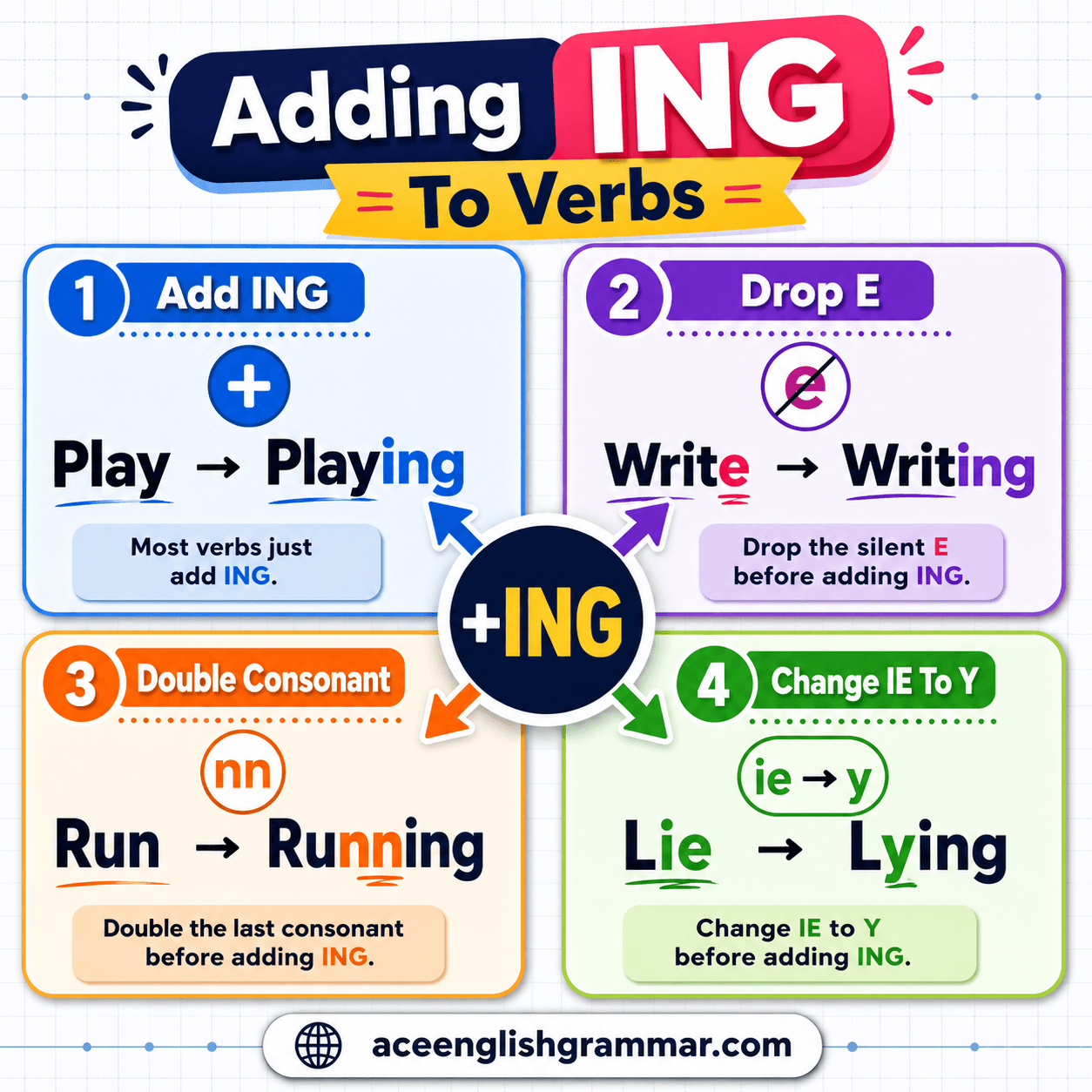
Most verbs take ing directly.
- Read → Reading
- Play → Playing
- Walk → Walking
- Cook → Cooking
Some verbs change spelling before ing is added.
| Rule | Base Verb | Ing Form |
|---|---|---|
| Add ing | Play | Playing |
| Drop final e | Write | Writing |
| Double the final consonant | Run | Running |
| Change ie to y | Lie | Lying |
Drop final e when a verb ends in silent e.
- Make → Making
- Take → Taking
- Drive → Driving
- Close → Closing
Double the final consonant in many short verbs that end with one vowel and one consonant.
- Sit → Sitting
- Swim → Swimming
- Stop → Stopping
- Plan → Planning
Do not double the final consonant when the verb ends in w, x, or y.
- Snow → Snowing
- Fix → Fixing
- Play → Playing
Change ie to y before adding ing.
- Lie → Lying
- Die → Dying
- Tie → Tying
Examples Of Present Continuous Tense
These examples show how the present continuous tense works in statements, negatives, and questions. Notice that every sentence keeps am, is, or are before the ing verb.
Positive Examples
- I am reading the report.
- She is cooking dinner.
- They are walking to school.
- We are watching a documentary.
- He is fixing his bike.
- The dog is sleeping under the table.
- You are speaking very quickly.
- My brother is learning Spanish.
- The team is preparing for the match.
- The guests are arriving now.
Negative Examples
- I am not using your laptop.
- She is not answering her phone.
- They are not coming with us.
- We are not watching TV tonight.
- He is not working this weekend.
- The children are not sleeping yet.
- You are not listening to the instructions.
- The shop is not opening today.
- I am not driving in this weather.
- They are not waiting outside.
Question Examples
- Are you studying now?
- Is she joining the meeting?
- Are they playing tennis?
- Am I saying it correctly?
- Is he wearing a blue jacket?
- Are we leaving soon?
- Is the baby crying?
- Are you working tomorrow?
- Is it raining outside?
- Are the students writing notes?
Common Mistakes With Present Continuous Tense
After the structure and uses are understood, the common mistakes become easier to spot. Most errors happen when the helping verb does not match the subject, the main verb loses its ing form, or a stative verb is forced into a continuous sentence.
Wrong helping verb
- He am writing a letter. ❌
- He is writing a letter. ✅
- We is studying English. ❌
- We are studying English. ✅
Missing ing form
- I am not play football. ❌
- I am not playing football. ✅
- She is write an email. ❌
- She is writing an email. ✅
Wrong question order
- Are she coming to class? ❌
- Is she coming to class? ✅
- They are watching a movie? ❌
- Are they watching a movie? ✅
Wrong verb form after are
- They are eats dinner. ❌
- They are eating dinner. ✅
- You are goes home. ❌
- You are going home. ✅
Stative verb mistake
- I am knowing the answer. ❌
- I know the answer. ✅
- He is wanting a new phone. ❌
- He wants a new phone. ✅
The present continuous tense needs am, is, or are before the ing verb. For stative verbs such as know, want, and understand, the simple present is usually the correct choice.
Practice Exercises
Fill in the blanks with the correct present continuous form.
- He ______ (write) a letter.
- I ______ (not go) to school today.
- ______ they ______ (watch) a movie?
- She ______ (cook) dinner now.
- We ______ (study) for exams.
- The children ______ (play) outside.
- It ______ (rain) heavily.
- You ______ (not listen) carefully.
- ______ he ______ (work) tonight?
- My parents ______ (travel) this week.
Answers
- He is writing a letter.
- I am not going to school today.
- Are they watching a movie?
- She is cooking dinner now.
- We are studying for exams.
- The children are playing outside.
- It is raining heavily.
- You are not listening carefully.
- Is he working tonight?
- My parents are traveling this week.
FAQs
Q1. What Is The Rule Of Present Continuous Tense?
The rule of the present continuous tense is subject + am/is/are + verb ing.
- She is reading.
- I am working.
- They are playing.
The helping verb agrees with the subject, and the main verb takes the ing form.
Q2. When Do We Use The Present Continuous Tense?
Use the present continuous tense for actions happening now, temporary situations, future arrangements, changing situations, and repeated actions with words such as always or constantly.
- I am working now.
- She is staying here this week.
- We are meeting tomorrow.
- The weather is getting colder.
Q3. Can We Use Do Or Does In Present Continuous?
No. Do not use do or does to form the present continuous tense. Use am, is, or are before the ing form of the verb.
- Do you studying? ❌
- Are you studying? ✅
Q4. What Is The Difference Between Simple Present And Present Continuous?
The simple present describes habits, routines, facts, and permanent situations. The present continuous describes actions happening now, temporary situations, current changes, and arranged future plans.
- I work from home every Monday.
- I am working from home today.
Q5. Which Verbs Are Not Used In Present Continuous?
Stative verbs are usually not used in the present continuous tense. These include verbs such as know, want, like, believe, understand, own, and need.
- I need a pen. ✅
- I am needing a pen. ❌
Q6. Is “Are Going” Present Continuous?
Yes. Are going is a present continuous form when it uses are + going.
- They are going to school now.
- We are going to dinner tonight.
Q7. What Is The Difference Between “I Eat” And “I Am Eating”?
I eat describes a habit or regular action. I am eating describes an action happening now.
- I eat breakfast at 8 a.m.
- I am eating breakfast right now.
Read More

Leave a Comment