A dangling modifier is a sentence error that happens when a describing word, phrase, or clause does not connect to the subject it is meant to describe. The sentence may still look grammatical at first, but the meaning points to the wrong noun.
Look at this sentence:
- Running down the street, the backpack slipped off.
The phrase running down the street needs a person, but the sentence places the backpack after the comma. That makes the sentence sound as if the backpack was running. A corrected version would be:
- Running down the street, I felt the backpack slip off.
By the end, you should be able to read an opening phrase, find the missing doer, choose the right correction, and rewrite dangling modifiers so your sentences point to the subject you actually mean.
What Is A Dangling Modifier?
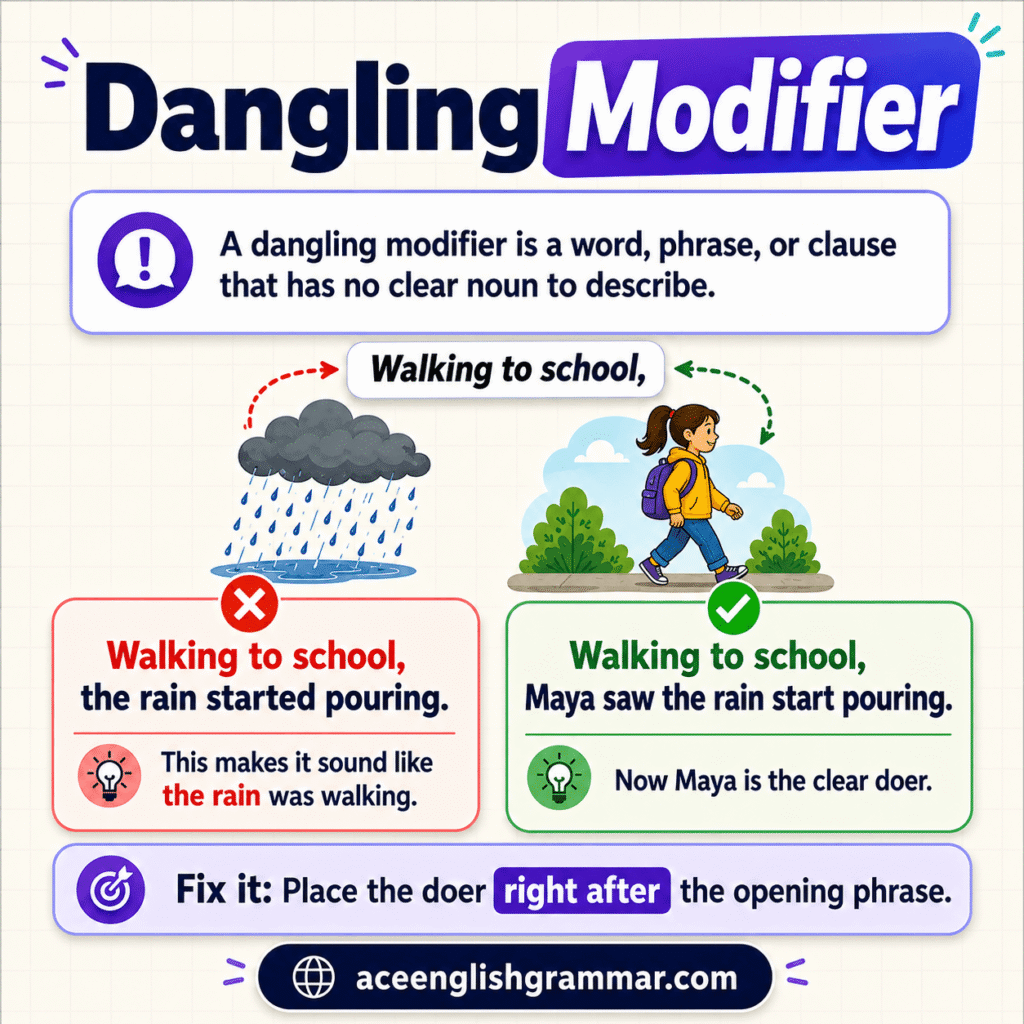
A dangling modifier is a sentence structure error in which a word, phrase, or clause describes a subject that is missing, unclear, or placed in the wrong position. Because the intended subject is not properly named, the modifier attaches to the wrong noun.
Most dangling modifiers appear at the beginning of a sentence. They often start with phrases such as walking to class, after finishing dinner, to pass the exam, or covered in mud. After that opening phrase, the sentence should name the person or thing being described.
- Walking to the bus stop, the rain started falling.
The phrase walking to the bus stop describes a person, but the sentence gives us the rain. Rain cannot walk to the bus stop, so the modifier dangles.
A stronger sentence names the person:
- Walking to the bus stop, Maya felt the rain start falling.
Now the modifier connects to Maya, and the sentence says what it means.
Dangling Modifier Examples
A dangling modifier often creates an odd or funny meaning because the wrong noun seems to perform the action. The problem is not always hard to understand, but it makes the sentence less accurate.
- Covered in chocolate, Sarah ate the cupcake.
This sentence suggests that Sarah was covered in chocolate. If the cupcake was covered in chocolate, the modifier needs to sit closer to cupcake.
- Sarah ate the cupcake covered in chocolate.
Here are a few more examples:
- After studying all night, the exam felt impossible.
- After studying all night, Liam felt the exam was impossible.
The opening phrase describes the person who studied, not the exam. The corrected sentence places Liam after the comma.
- To finish the report on time, the laptop stayed open until midnight.
- To finish the report on time, I kept the laptop open until midnight.
The laptop does not have a goal. The writer does.
- Exhausted after practice, the sofa felt comfortable.
- Exhausted after practice, Noah sank into the comfortable sofa.
The sofa was not exhausted. The corrected sentence gives the description to Noah.
How To Spot The Missing Subject
A modifier at the beginning of a sentence normally looks forward to the first noun after the comma. That noun must be able to perform the action or carry the description.
Use this quick check:
- Find the opening phrase.
- Ask who or what performed the action.
- Look at the first noun after the comma.
- Check whether that noun matches the action or description.
Now test the pattern:
- Hiking through the forest, the birds sounded loud.
The opening phrase is hiking through the forest. The birds are not hiking. A person is hiking, but the sentence does not name that person.
A corrected version names the doer:
- Hiking through the forest, we heard the birds calling loudly.
This same check works for most sentences with an opening phrase. If the noun after the comma cannot logically do the action, the sentence needs revision.
How To Fix A Dangling Modifier
You can repair most dangling modifiers by naming the missing subject, changing the opening phrase, or rewriting the sentence so the description sits next to the right noun.
Put the doer after the modifier.
When the sentence begins with an action phrase, place the person or thing doing the action right after the comma.
- Running late for the meeting, the car would not start.
- Running late for the meeting, I could not start the car.
The car was not running late. The corrected sentence places I after the modifier, so the opening phrase has a logical subject.
Add the missing subject to the opening phrase.
Sometimes the smoother fix is to turn the modifier into a full clause with its own subject.
- After finishing the assignment, the movie started.
- After we finished the assignment, the movie started.
The corrected sentence names we inside the opening clause. Now the movie does not seem to have finished the assignment.
Rewrite the sentence when the structure feels forced.
Some sentences sound awkward even after a small correction. In those cases, rebuild the sentence in a more natural order.
- Having completed the project, a break was needed.
- After the team completed the project, they needed a break.
This version gives the action to the team and keeps the sentence direct.
A good correction does more than fix grammar. It restores the relationship between the modifier and the subject, so the reader does not have to guess who did what.
Common Types Of Dangling Modifiers
Most dangling modifiers come from a few common phrase patterns. The phrase type may change, but the mistake stays the same: the sentence starts with a description and then fails to name the right subject.
Participial Phrases
A participial phrase often begins with an ing or ed verb form. These phrases need a clear subject because they usually describe an action or condition.
- Hiking the mountain trail, the view was stunning.
- Hiking the mountain trail, we saw a stunning view.
The view was not hiking. The corrected sentence places we after the phrase.
- Tired from the long flight, the hotel bed felt wonderful.
- Tired from the long flight, Elena found the hotel bed wonderful.
The phrase tired from the long flight describes Elena, not the bed.
Infinitive Phrases
An infinitive phrase begins with to plus a verb, such as to win, to improve, to finish, or to avoid. These phrases often express a purpose or goal, so the subject must be capable of having that purpose.
- To win the competition, practice must be consistent.
- To win the competition, you must practice consistently.
Practice does not want to win. The person competing does.
- To pass the exam, the notes were reviewed every night.
- To pass the exam, Maria reviewed her notes every night.
The corrected version gives the goal to Maria.
Prepositional Phrases
Prepositional phrases begin with words such as after, before, while, without, by, or with. These phrases can dangle when they imply an action but do not name the person or thing connected to it.
- Without knowing the rules, the game felt confusing.
- Without knowing the rules, we found the game confusing.
The game does not know the rules. The corrected sentence names we as the people lacking that information.
- While driving home, the storm became worse.
- While Emma was driving home, the storm became worse.
Adding Emma to the opening clause removes the confusion.
Dangling Modifier Vs. Misplaced Modifier
A dangling modifier and a misplaced modifier both damage sentence meaning, but they are not the same error.
A dangling modifier lacks the right subject. The sentence does not properly name the person or thing the modifier should describe.
- Running across the yard, the gate slammed shut.
- Running across the yard, the dog heard the gate slam shut.
The gate was not running. The corrected sentence names the dog as the one running.
A misplaced modifier has the right words in the sentence, but the modifier sits in the wrong position. The placement makes the meaning unclear or inaccurate.
- She almost ate the whole pizza.
- She ate almost the whole pizza.
The first sentence suggests she came close to eating the pizza but did not. The second sentence says she ate most of it.
Here is another common misplaced modifier:
- I saw a dog with a telescope.
- With a telescope, I saw a dog.
The first sentence could suggest that the dog had a telescope. The corrected version shows that the speaker used the telescope.
The main difference is easy to remember: a dangling modifier usually has a missing doer, while a misplaced modifier has a misplaced description.
Practice Sentences With Corrections
Read each sentence by checking the opening phrase first. Then ask whether the noun after the comma can logically do the action.
- After reading the instructions, the machine started easily.
- After reading the instructions, I started the machine easily.
The machine did not read the instructions.
- While cleaning the kitchen, the phone rang twice.
- While I was cleaning the kitchen, the phone rang twice.
The phone was not cleaning the kitchen.
- To reach the airport on time, the traffic needed to move faster.
- To reach the airport on time, we needed the traffic to move faster.
Traffic does not have the goal of reaching the airport.
- Sitting on the top shelf, Mia reached for the blue mug.
- Mia reached for the blue mug sitting on the top shelf.
The first sentence makes it sound as if Mia was sitting on the top shelf. The corrected version places the description near mug.
- Having missed the deadline, the email was sent with an apology.
- Having missed the deadline, Daniel sent an apology by email.
The email did not miss the deadline. Daniel did.
These examples show the same grammar pattern from different angles. When the opening phrase has no proper subject, the sentence points to whatever noun comes next, even if that noun makes no sense.
Quick Editing Test
Before keeping an opening phrase, run one final check: can the first noun after the comma actually do what the opening phrase describes?
- Driving through heavy rain, the road became dangerous.
- Driving through heavy rain, we found the road dangerous.
The road was not driving. The corrected sentence gives the action to we.
This habit is especially important with sentences that begin with:
- After finishing
- Before leaving
- While walking
- Without knowing
- To improve
- Having completed
- Covered in
- Tired from
These openings are not wrong by themselves. They only create trouble when the sentence does not name the right subject.
FAQs
A dangling modifier is a word, phrase, or clause that describes a subject that is missing, unclear, or placed in the wrong position. The modifier then attaches to the wrong noun and changes the sentence meaning.
Running down the street, the backpack slipped off.
This is a dangling modifier because it sounds as if the backpack was running. A corrected sentence is:
Running down the street, I felt the backpack slip off.
You fix it by naming the missing subject, placing the doer after the opening phrase, or rewriting the sentence. For example:
After finishing dinner, the TV was turned on.
After finishing dinner, we turned on the TV.
A dangling modifier has a missing or unclear subject. A misplaced modifier has the right subject in the sentence, but the modifier is placed too far from the word it should describe.
In edited English, formal writing, academic writing, and polished blog content, you should avoid them. Some casual sentences may still be understood, but the structure is weak when the modifier points to the wrong noun.
Conclusion
A dangling modifier breaks the connection between a description and the subject it should describe. The sentence may still contain familiar words, but the structure sends the reader toward the wrong noun.
The fix is usually direct: name the doer, move the modifier, or rewrite the sentence in a more natural order. Before you keep an opening phrase, check whether the next noun can actually perform the action. That one habit will catch most dangling modifiers before they weaken your writing.
Read More