
The simple present tense describes what happens regularly, what is generally true, and what stays true in the present. You see it in everyday sentences such as She works in a hospital, Water boils at 100°C, and The train leaves at 8 p.m.
This tense depends strongly on the subject. With I, you, we, and they, the verb usually stays in its base form. With he, she, and it, most verbs take s or es: I work, but She works. In negative sentences and questions, do and does carry the tense, so the main verb returns to its base form: She does not work and Does she work?
By the end, you should be able to recognize simple present forms in real sentences, choose the correct verb ending, build negatives and questions without adding extra s, and use the tense naturally in your own writing.
What Is The Simple Present Tense?
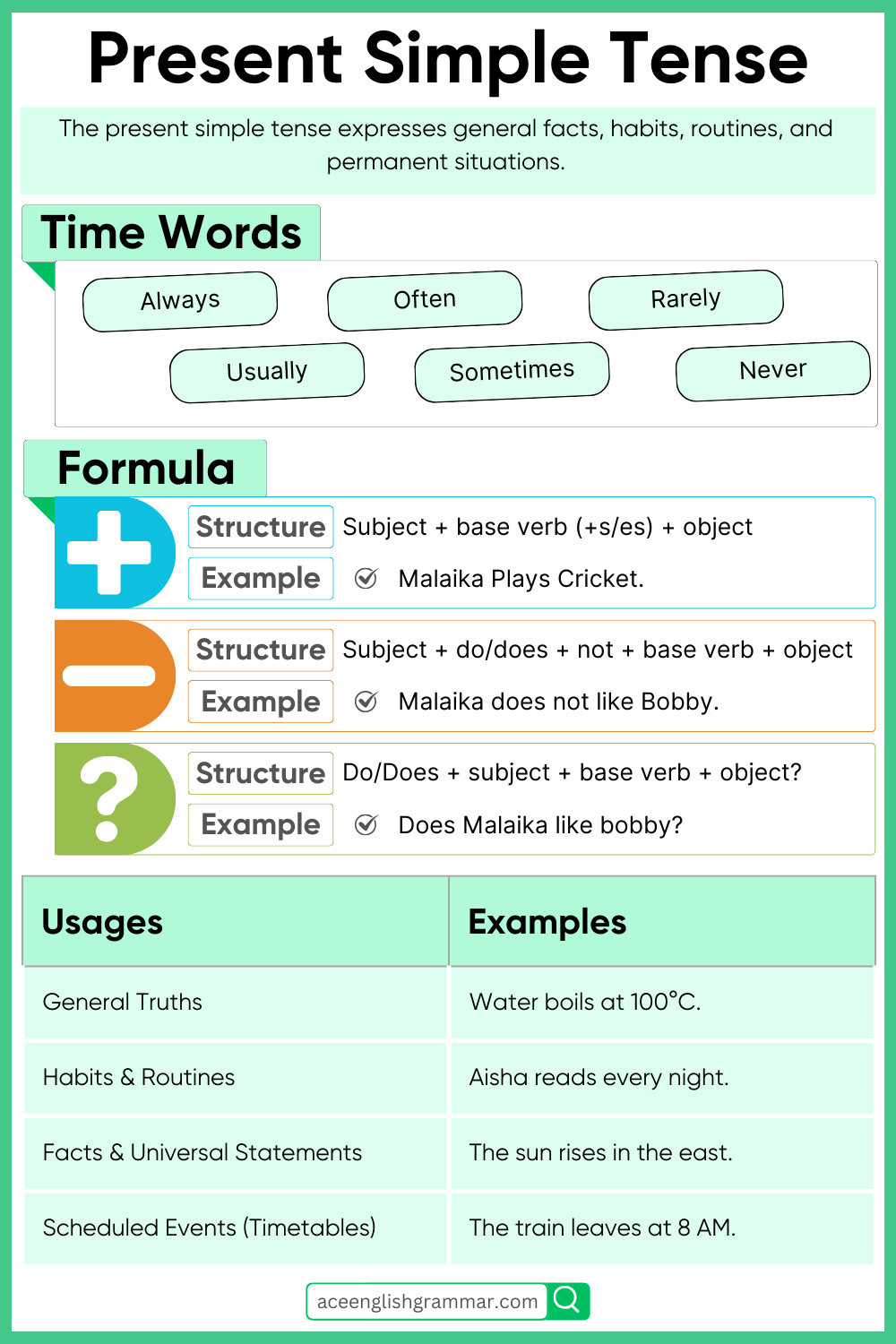
The simple present tense, also called the present indefinite tense, is a present verb form that describes regular actions, general truths, stable situations, feelings, opinions, and fixed schedules. It uses the base verb with I, you, we, and they, and usually adds s or es with he, she, and it.
- I work every day.
- She works every day.
- They live in London.
- He lives near the station.
- The sun rises in the east.
The simple present tense does not usually describe an action happening at this exact moment. For actions happening now, English normally uses the present continuous tense.
- I read before bed.
- I am reading now.
The first sentence describes a routine. The second sentence describes an action happening at this moment.
How The Simple Present Tense Works In A Sentence
The simple present tense depends on three main things:
- The subject of the sentence
- The verb form
- The sentence type, such as affirmative, negative, or question
The subject controls the verb ending in affirmative sentences. In negative sentences and questions, do and does take over that job.
Compare these forms:
- She works in a hospital.
- She does not work in a hospital.
- Does she work in a hospital?
- Where does she work?
Notice how works changes back to work after does. The auxiliary verb does already shows the third-person singular form, so the main verb stays in its base form.
Simple Present Tense Structure
Once the meaning is in place, the form becomes easier to read. The simple present tense changes according to the subject and the sentence type.
Affirmative Sentences
In affirmative sentences, the verb usually stays in its base form. The main change appears with he, she, it, or one singular noun, where the verb normally takes s or es.
| Subject | Verb Form | Example |
|---|---|---|
| I | Base Verb | I work every day. |
| You | Base Verb | You speak English well. |
| We | Base Verb | We study in the evening. |
| They | Base Verb | They play football on weekends. |
| He | Verb + S/Es | He works in an office. |
| She | Verb + S/Es | She teaches science. |
| It | Verb + S/Es | It rains a lot in April. |
More examples:
- I drink coffee in the morning.
- We visit our cousins every summer.
- They watch movies on Fridays.
- He reads the newspaper daily.
- She likes Italian food.
Negative Sentences
Negative sentences in the simple present tense use do not or does not before the base verb.
Use do not or don’t with I, you, we, and they.
Use does not or doesn’t with he, she, and it.
| Subject | Negative Form | Example |
|---|---|---|
| I | Do Not + Base Verb | I do not eat meat. |
| You | Do Not + Base Verb | You do not need a ticket. |
| We | Do Not + Base Verb | We do not work on Sundays. |
| They | Do Not + Base Verb | They do not live here. |
| He | Does Not + Base Verb | He does not drive to work. |
| She | Does Not + Base Verb | She does not like tea. |
| It | Does Not + Base Verb | It does not look safe. |
The main verb must stay in the base form after does not.
- She doesn’t likes coffee. ❌
- She doesn’t like coffee. ✅
- He doesn’t works here. ❌
- He doesn’t work here. ✅
The mistake happens because does already carries the third-person singular form. Once does appears, the main verb should be like, work, go, or watch, not likes, works, goes, or watches.
Questions With Do And Does
Questions in the simple present tense usually begin with do or does.
Use do with I, you, we, and they.
Use does with he, she, and it.
| Question Form | Example |
|---|---|
| Do + I/You/We/They + Base Verb? | Do you speak French? |
| Does + He/She/It + Base Verb? | Does she work here? |
More examples:
- Do you read books every week?
- Do they play chess?
- Does he like pizza?
- Does she walk to school?
- Does it rain here in winter?
The same base-verb rule appears in questions. After does, do not add s or es to the main verb.
- Does he likes tea? ❌
- Does he like tea? ✅
- Does she works in a hospital? ❌
- Does she work in a hospital? ✅
Wh-Questions In The Simple Present Tense
Wh-questions use question words such as what, where, when, why, how, and who.
| Question Word | Example |
|---|---|
| What | What do you do after school? |
| Where | Where does she live? |
| When | When do they arrive? |
| Why | Why does he leave early? |
| How | How do you solve this problem? |
When who is the subject of the sentence, English often does not use do or does.
- Who lives next door?
- Who teaches this class?
- Who knows the answer?
In these sentences, who works as the subject, so the verb follows it directly.
Rules For Adding S, Es, And Ies
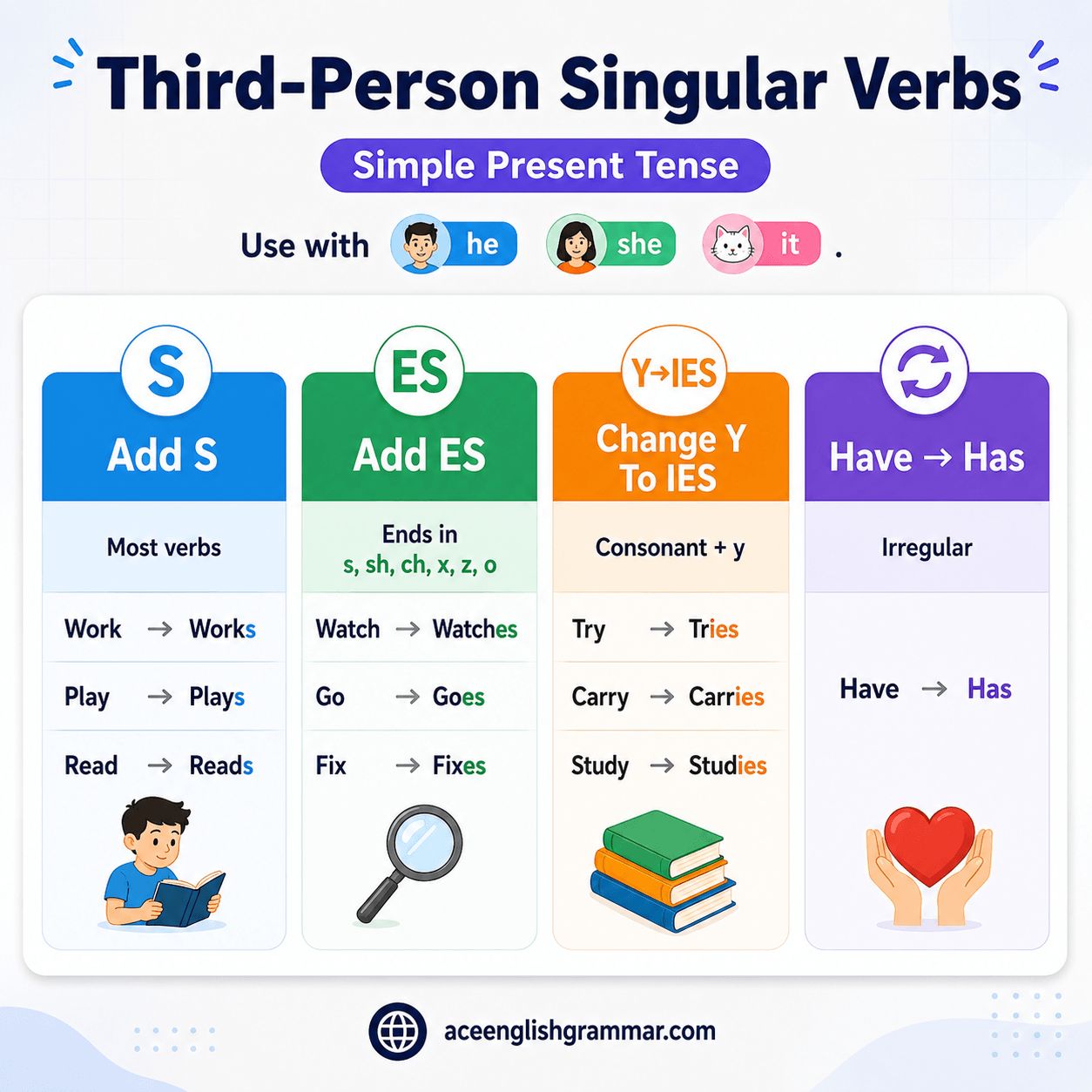
The affirmative form is where spelling changes matter most. After he, she, it, or a singular noun, the verb ending depends on the final letters of the base verb.
| Rule | Base Verb | Third-Person Form | Example |
|---|---|---|---|
| Add S To Most Verbs | Work | Works | She works at a clinic. |
| Add ES To Verbs Ending In S, SS, SH, CH, X, Or O | Watch | Watches | He watches the news. |
| Change Consonant + Y To IES | Try | Tries | She tries hard. |
| Keep Vowel + Y And Add S | Play | Plays | He plays tennis. |
| Change Have To Has | Have | Has | She has two brothers. |
More examples:
- He goes to school by bus.
- She washes the dishes after dinner.
- The baby cries at night.
- Tom carries a black backpack.
- My brother studies medicine.
- The child plays outside.
- Maria has a new laptop.
The y rule depends on the letter before y. If a consonant comes before y, change y to ies: study becomes studies. If a vowel comes before y, add s only: play becomes plays.
Simple Present Tense With Am, Is, And Are
The verb be does not follow the usual do/does + base verb structure. In the simple present tense, be becomes am, is, or are according to the subject.
| Subject | Affirmative | Negative | Question |
|---|---|---|---|
| I | I am ready. | I am not ready. | Am I ready? |
| He | He is tired. | He is not tired. | Is he tired? |
| She | She is a doctor. | She is not a doctor. | Is she a doctor? |
| It | It is cold. | It is not cold. | Is it cold? |
| We | We are friends. | We are not friends. | Are we friends? |
| They | They are late. | They are not late. | Are they late? |
Use am, is, and are for identity, condition, place, age, nationality, description, and other present states.
- I am a student.
- She is from Canada.
- They are at home.
- The room is warm.
- We are ready for the test.
Do not use do or does with be in normal present sentences.
- Does she is happy? ❌
- Is she happy? ✅
- Do they are ready? ❌
- Are they ready? ✅
Uses Of The Simple Present Tense
Form tells you how to build the sentence, but use tells you why the simple present tense is the right choice. This tense often points to regular time, general truth, stable meaning, or a fixed schedule.
Habits And Routines
Use the simple present tense for actions that happen again and again.
- I wake up at 6 a.m.
- She walks to work every morning.
- We eat dinner together.
- They visit their grandparents on Sundays.
- He checks his email after breakfast.
These sentences do not describe one action only. They describe repeated behavior.
Facts And General Truths
Use this tense for facts, scientific truths, and statements that stay generally true.
- The earth moves around the sun.
- Water freezes at 0°C.
- Birds have feathers.
- The moon reflects sunlight.
- Plants need water to grow.
The sentence may describe science, nature, geography, or a common fact. The verb stays in the simple present because the statement is treated as generally true.
States, Feelings, And Opinions
Some verbs describe a state rather than a visible action. These verbs often appear in the simple present tense.
Common state verbs include know, believe, understand, like, love, hate, need, want, own, seem, remember, and prefer.
- I know the answer.
- She likes black coffee.
- They believe the story.
- He owns a small shop.
- We need more time.
These verbs describe thoughts, feelings, possession, or condition. They usually do not show physical movement.
Jobs, Roles, And Permanent Situations
Use the simple present tense for jobs, roles, addresses, long-term situations, and stable facts about someone’s life.
- My sister works as a nurse.
- He lives in Manchester.
- They own a restaurant.
- My uncle drives a taxi.
- She teaches grammar at a college.
The situation may change later, but the sentence treats it as true in the present.
Schedules And Timetables
Use the simple present tense for fixed schedules, public timetables, and planned events with set times.
- The train leaves at 7:30.
- The class starts at 9 a.m.
- The shop opens at 10.
- The movie begins at 8 p.m.
- Our flight arrives on Monday.
This use often refers to the future, but the verb stays in the simple present because the event belongs to a fixed schedule.
Instructions And Directions
The simple present tense also works in instructions, directions, recipes, and ordered actions.
- You mix the flour with water.
- You turn left at the traffic lights.
- First, you press the power button.
- You add salt after the water boils.
- You open the app and enter your password.
This form gives directions in a direct, active way.
Time Expressions In The Simple Present Tense
Time expressions show how often something happens or when a repeated action takes place. They often make the tense easier to recognize in real sentences.
| Time Expression | Example |
|---|---|
| Always | She always drinks tea after lunch. |
| Usually | We usually go shopping on Saturdays. |
| Often | He often calls his mother. |
| Sometimes | They sometimes eat out. |
| Rarely | I rarely watch television. |
| Never | She never skips breakfast. |
| Every Day | I walk every day. |
| Every Week | They meet every week. |
| On Mondays | We study grammar on Mondays. |
| In The Morning | He jogs in the morning. |
| At Night | The baby sleeps at night. |
One-word frequency adverbs usually come before the main verb.
- She always arrives early.
- He often reads at night.
- They never eat fish.
With am, is, and are, frequency adverbs usually come after the verb.
- She is always polite.
- They are usually busy.
- I am often tired after work.
Longer time expressions often come at the beginning or end of the sentence.
- Every Friday, we visit our cousins.
- We visit our cousins every Friday.
- In the morning, she drinks lemon tea.
- She drinks lemon tea in the morning.
Simple Present Tense Vs Present Continuous
Many mistakes happen because both tenses point to the present, but they do not describe the same kind of time. The simple present tense describes habits, facts, states, and schedules. The present continuous tense describes actions happening now or temporary situations around now.
| Simple Present Tense | Present Continuous Tense |
|---|---|
| She works in a bank. | She is working at the moment. |
| I read before bed. | I am reading right now. |
| They live in Paris. | They are staying in Paris this week. |
| He plays football on Sundays. | He is playing football now. |
| The train leaves at 8 p.m. | The train is leaving now. |
Compare the meaning:
- I write emails every morning.
This is a routine. - I am writing an email now.
This is happening at this moment. - She studies biology.
This describes her regular subject or field. - She is studying biology tonight.
This describes a temporary action happening around now.
A good test is to ask whether the sentence describes a regular truth or a current action. If it is regular, stable, or scheduled, the simple present tense is usually the better choice. If it is happening right now, the present continuous tense is usually better.
Common Mistakes In The Simple Present Tense
Most simple present tense mistakes come from one place: the verb changes in affirmative sentences, but it returns to the base form after do, does, don’t, and doesn’t.
Mistake 1: Forgetting S Or ES With He, She, And It
- She work in a hospital. ❌
- She works in a hospital. ✅
- He go to school by bus. ❌
- He goes to school by bus. ✅
The subject she or he needs a third-person singular verb in affirmative sentences.
Mistake 2: Adding S After Does
- Does he likes football? ❌
- Does he like football? ✅
- She doesn’t watches TV. ❌
- She doesn’t watch TV. ✅
After does or doesn’t, the main verb stays in the base form.
Mistake 3: Using Do With He, She, Or It
- Do she live here? ❌
- Does she live here? ✅
- Do it work properly? ❌
- Does it work properly? ✅
Use does when the subject is he, she, it, or one singular noun.
Mistake 4: Using Does With I, You, We, Or They
- Does you know him? ❌
- Do you know him? ✅
- They doesn’t play tennis. ❌
- They don’t play tennis. ✅
Use do with I, you, we, and they.
Mistake 5: Using Do Or Does With Am, Is, And Are
- Do you are ready? ❌
- Are you ready? ✅
- Does he is tired? ❌
- Is he tired? ✅
The verb be forms questions by moving am, is, or are before the subject.
More Simple Present Tense Examples
Affirmative Examples
- I study English every day.
- You speak very politely.
- We live near the river.
- They play cricket on Sundays.
- He drives to work every morning.
- She teaches history.
- The train arrives at 7 p.m.
- My brother reads before bed.
- The dog barks at strangers.
- This shop opens early.
Negative Examples
- I don’t drink coffee at night.
- You don’t need a password.
- We don’t eat meat.
- They don’t watch television often.
- He doesn’t play tennis.
- She doesn’t work on Fridays.
- It doesn’t rain much here.
- My father doesn’t drive fast.
- The bus doesn’t stop here.
- This phone doesn’t charge properly.
Question Examples
- Do you read novels?
- Do they speak English?
- Do we need tickets?
- Does he like pizza?
- Does she live nearby?
- Does it work well?
- Where do you study?
- When does the class start?
- Why does he leave early?
- Who teaches this course?
Simple Present Tense Quick Review Chart
| Form | Structure | Example |
|---|---|---|
| Affirmative | Subject + Base Verb | I work every day. |
| Affirmative With He/She/It | Subject + Verb + S/Es | She works every day. |
| Negative | Subject + Do Not + Base Verb | They do not work here. |
| Negative With He/She/It | Subject + Does Not + Base Verb | He does not work here. |
| Question | Do + Subject + Base Verb? | Do you work here? |
| Question With He/She/It | Does + Subject + Base Verb? | Does she work here? |
| Be Verb | Subject + Am/Is/Are | They are ready. |
| Be Verb Question | Am/Is/Are + Subject? | Are they ready? |
Simple Present Tense Exercises With Answers
Choose the correct simple present tense form for each sentence.
- She ______ (go) to the gym every day.
- ______ you ______ (like) spicy food?
- They ______ (study) in the library.
- I ______ (not eat) junk food.
- He ______ (work) in a hospital.
- My brother ______ (watch) cartoons.
- We ______ (not live) near the school.
- ______ she ______ (speak) French?
- The sun ______ (rise) in the east.
- My parents ______ (visit) us every month.
Answers
- She goes to the gym every day.
- Do you like spicy food?
- They study in the library.
- I don’t eat junk food.
- He works in a hospital.
- My brother watches cartoons.
- We don’t live near the school.
- Does she speak French?
- The sun rises in the east.
- My parents visit us every month.
FAQs
Q1. What Is The Simple Present Tense?
The simple present tense is a present verb form that describes habits, facts, routines, permanent situations, feelings, opinions, and fixed schedules.
- I work every day.
- She likes tea.
- The bus arrives at 6 p.m.
Q2. What Is The Formula Of The Simple Present Tense?
The basic affirmative formula is Subject + Base Verb. With he, she, and it, use Subject + Verb + S/Es.
- I work every day.
- She works every day.
For negatives, use do not or does not before the base verb.
- They do not work here.
- He does not work here.
For questions, place do or does before the subject.
- Do you work here?
- Does she work here?
Q3. When Do We Use The Simple Present Tense?
Use the simple present tense for repeated actions, daily routines, general truths, permanent situations, feelings, opinions, instructions, and scheduled events.
- He exercises every morning.
- Water boils at 100°C.
- She believes the story.
- The train leaves at noon.
Q4. Why Do We Add S Or ES In The Simple Present Tense?
Add s or es when the subject is third-person singular: he, she, it, one person, one thing, or a singular noun.
- He works hard.
- She watches movies.
- The dog runs fast.
Q5. Do We Use S Or ES After Does?
No. After does or does not, the main verb stays in the base form.
- Does she work here? ✅
- Does she works here? ❌
- He doesn’t like tea. ✅
- He doesn’t likes tea. ❌
Q6. What Is The Difference Between Simple Present And Present Continuous?
The simple present tense describes habits, facts, routines, states, and schedules. The present continuous tense describes actions happening now or temporary actions around now.
- She works in a bank.
This is her regular job. - She is working now.
This is happening at this moment.
Q7. What Are Common Time Expressions In The Simple Present Tense?
Common time expressions include always, usually, often, sometimes, rarely, never, every day, every week, on Mondays, in the morning, and at night.
- She always arrives early.
- We study on Mondays.
- He walks in the morning.
Q8. Is Present Indefinite Tense The Same As Simple Present Tense?
Yes. Present indefinite tense and simple present tense usually refer to the same tense. Both names describe the form used in sentences such as I work, She works, They live here, and The class starts at 9 a.m.
Read More

Leave a Comment