Question tags, also called tag questions, are short questions added to the end of a statement to confirm it or to invite agreement. In “She lives in Lahore, doesn’t she?”, the tag “doesn’t she?” turns the statement into a question.
A question tag is formed with the auxiliary verb of the statement, the opposite form (positive or negative) and a pronoun. Reading each tag in a full sentence is how the correct form is chosen in speech. A positive statement takes a negative tag, and a negative statement takes a positive tag.

What Are Question Tags?
A question tag is a short question placed after a statement, separated from it by a comma. It is made of an auxiliary verb and a pronoun, and it is also called a tag question.
In “You are coming to the party, aren’t you?”, the statement “You are coming to the party” is followed by the tag “aren’t you?”. The speaker expects the listener to confirm the statement.
- It is cold today, isn’t it?
- They finished the report, didn’t they?
- You don’t eat meat, do you?
How to Form Question Tags
A question tag is formed in four steps.
- Find the auxiliary verb in the statement. If the statement has none, use “do”, “does” or “did”.
- Reverse positive and negative: a positive statement takes a negative tag, and a negative statement takes a positive tag.
- Replace the subject with the matching pronoun.
- Write a comma before the tag and a question mark after it.
Positive and Negative Statements With Tags
Positive statement + negative auxiliary + pronoun?
A negative statement reverses the formula and takes a positive auxiliary in the tag. The negative auxiliary is contracted in speech, as in “isn’t” and “haven’t”. The full form is used in formal writing: “She is a doctor, is she not?”
- You are tired, aren’t you?
- He has left, hasn’t he?
- You aren’t tired, are you?
- She can’t swim, can she?
Statements Without an Auxiliary Verb
Simple present or past statement + do/does/did + pronoun?
A statement in the simple present or the simple past has no auxiliary, and question tags for such statements are built with “do”, “does” or “did”.
- They live in Dubai, don’t they?
- She works here, doesn’t she?
- You called him, didn’t you?
Tag Questions in Different Tenses
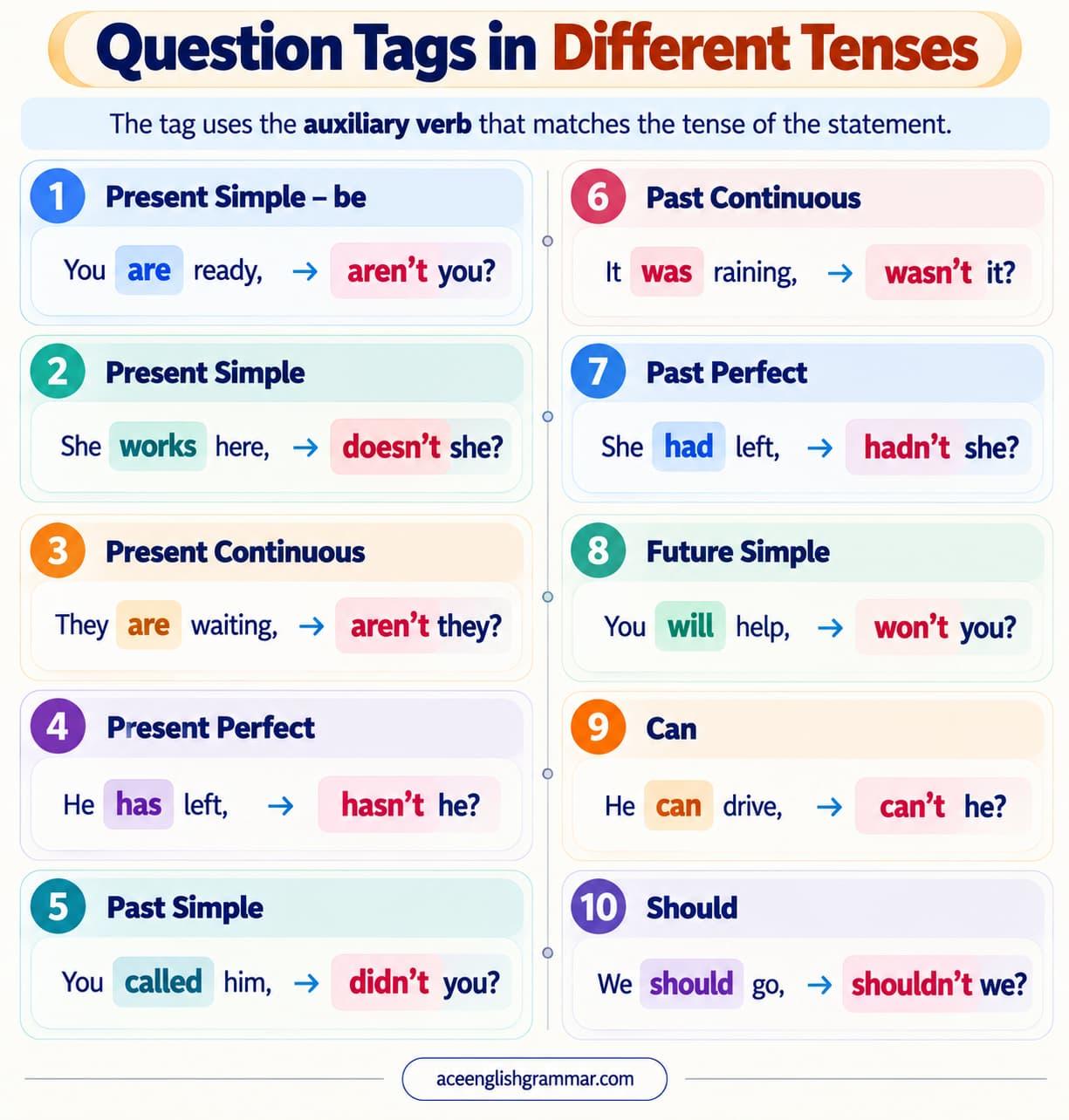
Question tags follow the tense and the auxiliary of the statement.
| Tense | Statement | Tag |
|---|---|---|
| Present simple (be) | You are ready | Aren’t you? |
| Present simple | She works here | Doesn’t she? |
| Present continuous | They are waiting | Aren’t they? |
| Present perfect | He has left | Hasn’t he? |
| Past simple | You called him | Didn’t you? |
| Past continuous | It was raining | Wasn’t it? |
| Past perfect | She had left | Hadn’t she? |
| Future simple | You will help | Won’t you? |
| Modal can | He can drive | Can’t he? |
| Modal should | We should go | Shouldn’t we? |
Exceptions in Question Tags
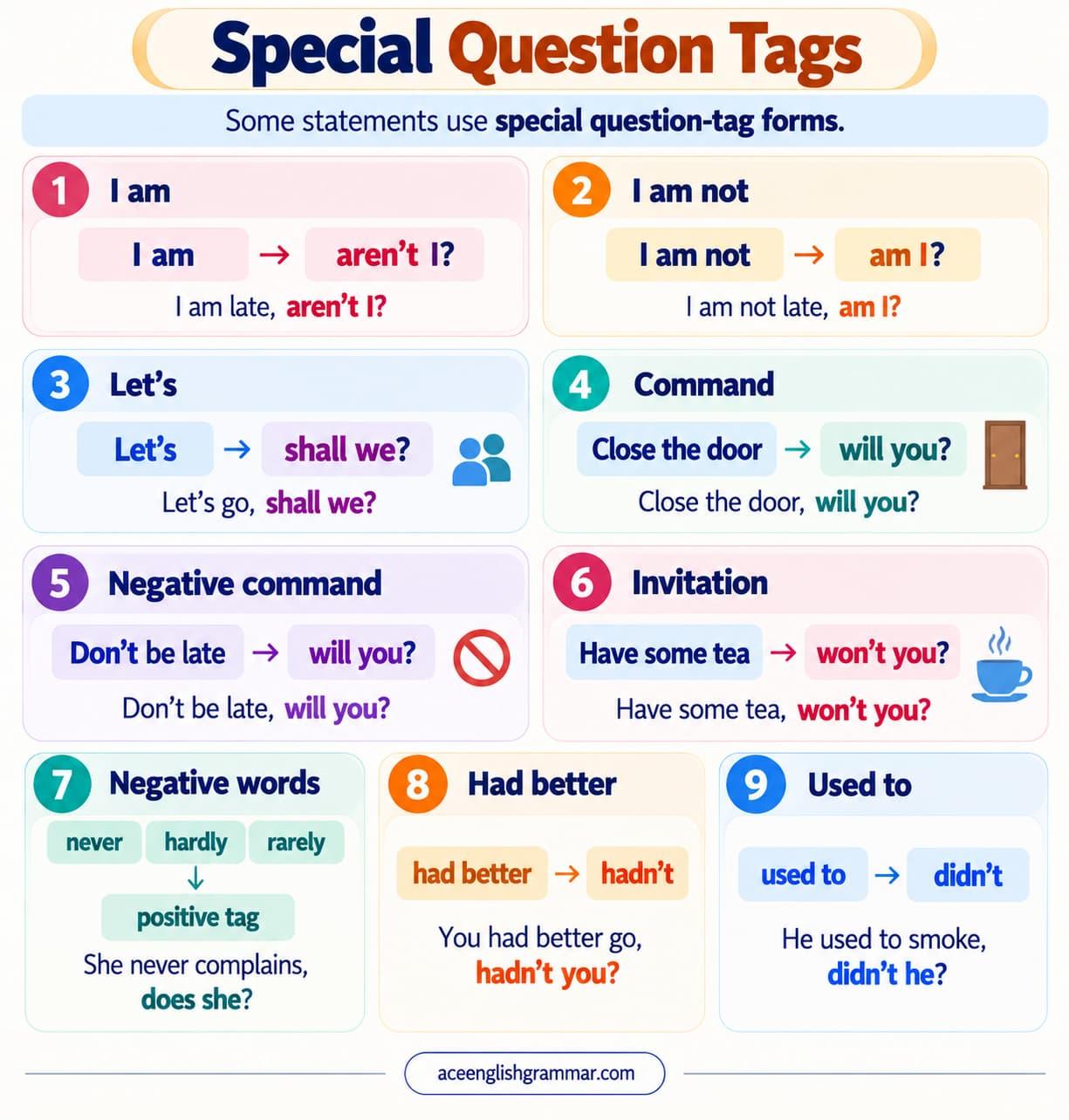
Some statements take a tag that does not follow the standard formula.
| Statement type | Tag | Sentence |
|---|---|---|
| I am | Aren’t I? | I am late, aren’t I? |
| I am not | Am I? | I am not late, am I? |
| Let’s | Shall we? | Let’s go, shall we? |
| Command | Will you? | Close the door, will you? |
| Negative command | Will you? | Don’t be late, will you? |
| Invitation | Won’t you? | Have some tea, won’t you? |
| Negative adverb (never, hardly, rarely) | Positive tag | She never complains, does she? |
| Nobody, nothing, no one | Positive tag | Nobody called, did they? |
| Everyone, someone, anyone, nobody | They | Everyone is here, aren’t they? |
| Everything, something, nothing | It | Something is wrong, isn’t it? |
| There is, there are | There | There is a problem, isn’t there? |
| This, that | It | This is your bag, isn’t it? |
| These, those | They | Those are yours, aren’t they? |
| Had better | Hadn’t | You had better go, hadn’t you? |
| Used to | Didn’t | He used to smoke, didn’t he? |
| Must (obligation) | Mustn’t | You must leave, mustn’t you? |
| Have (main verb, American English) | Don’t | You have a car, don’t you? |
Positive and Negative Question Tags
Positive statement + positive auxiliary + pronoun?
A positive tag after a positive statement expresses surprise, interest or sarcasm. The speaker repeats the statement of another person and adds a tag of the same polarity.
- So you are leaving, are you?
- You think that is funny, do you?
- She won the prize, did she?
Intonation in Question Tags
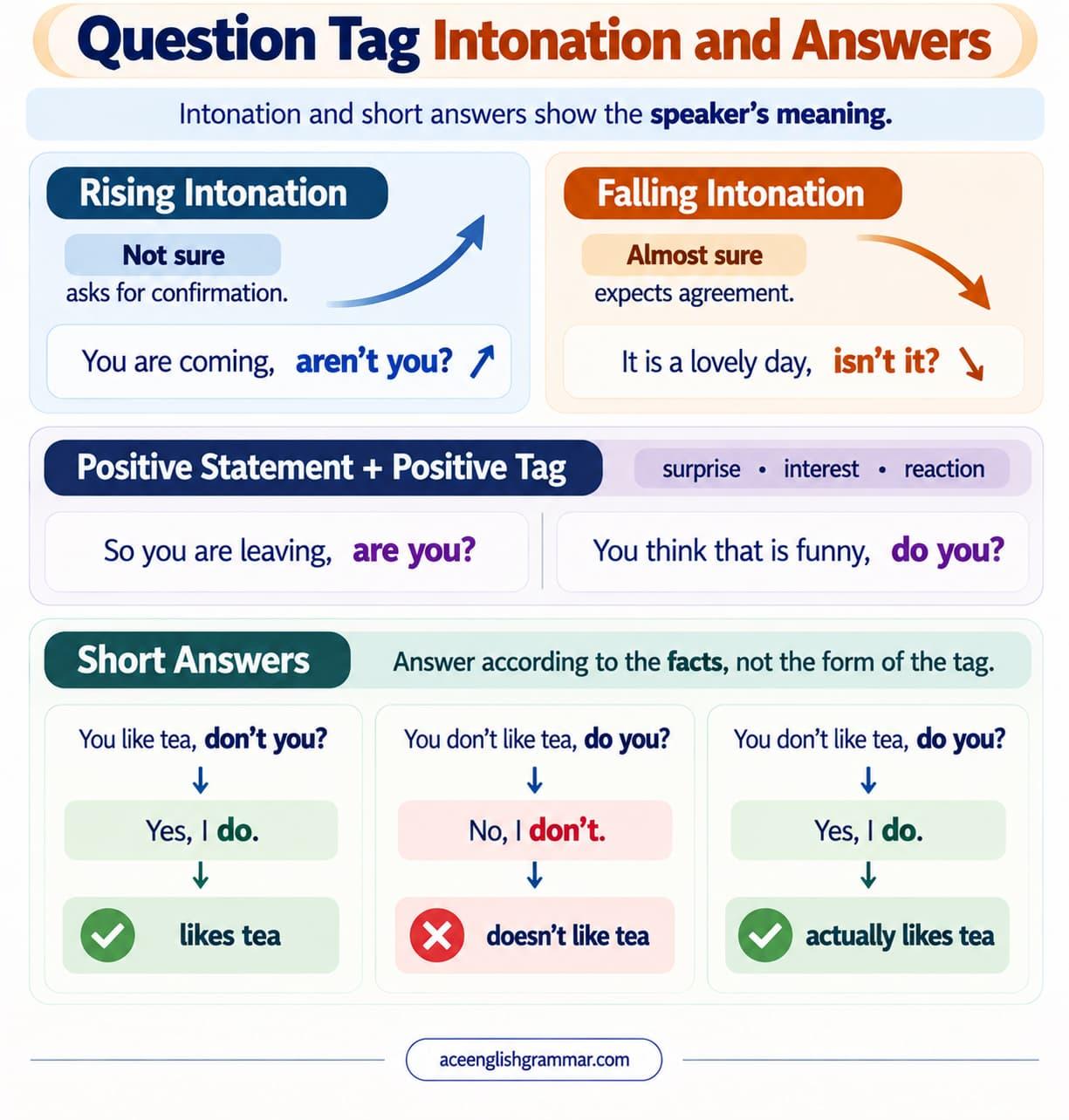
The pitch of the voice on a question tag marks what the speaker expects.
- Rising pitch: The speaker is not sure and wants confirmation. “You are coming, aren’t you?”
- Falling pitch: The speaker is almost sure and expects agreement. “It is a lovely day, isn’t it?”
Short Answers to Tags
The short answer to question tags follows the facts and not the tag. A speaker who agrees with a positive statement says “yes”, and a speaker who agrees with a negative statement says “no”.
- “You like tea, don’t you?” “Yes, I do.” The speaker likes tea.
- “You don’t like tea, do you?” “No, I don’t.” The speaker does not like tea.
- “You don’t like tea, do you?” “Yes, I do.” The speaker corrects the statement and likes tea.
Tag Questions Examples With Answers
These tag questions examples give each statement with its tag and a short answer, so each tag is checked against the facts.
| Statement | Tag | Short answer |
|---|---|---|
| You are coming to the party | Aren’t you? | Yes, I am. |
| She can swim | Can’t she? | Yes, she can. |
| They live in Dubai | Don’t they? | Yes, they do. |
| He doesn’t smoke | Does he? | No, he doesn’t. |
| We have finished | Haven’t we? | Yes, we have. |
| It was cold yesterday | Wasn’t it? | Yes, it was. |
| You didn’t call me | Did you? | No, I didn’t. |
| She will join us | Won’t she? | Yes, she will. |
| They haven’t arrived | Have they? | No, they haven’t. |
| The shop opens at nine | Doesn’t it? | Yes, it does. |
| You don’t mind | Do you? | No, I don’t. |
| He should apologize | Shouldn’t he? | Yes, he should. |
| I am right | Aren’t I? | Yes, you are. |
| Let’s start | Shall we? | Yes, let’s. |
| Open the window | Will you? | Yes, of course. |
| Nobody called | Did they? | No, nobody did. |
| Everything is ready | Isn’t it? | Yes, it is. |
| There is a problem | Isn’t there? | Yes, there is. |
| She never complains | Does she? | No, she doesn’t. |
| You could help me | Couldn’t you? | Yes, I could. |
Common Mistakes With Question Tags
Wrong pronoun: Write “Sara is late, isn’t she?”, not “Sara is late, isn’t Sara?”. The tag takes a pronoun, never a noun.
Same polarity by accident: Write “You are tired, aren’t you?”, not “You are tired, are you?”. A positive statement takes a negative tag, unless the speaker is reacting with surprise.
Wrong auxiliary: Write “She likes tea, doesn’t she?”, not “She likes tea, isn’t she?”. The tag uses “does” because the statement has no auxiliary.
One tag for every sentence: Write “You are coming, aren’t you?”, not “You are coming, isn’t it?”. The tag “isn’t it?” follows only a statement with “it” and a form of “be”.
Amn’t I: Write “I am late, aren’t I?”, not “I am late, amn’t I?”. The form “amn’t” is not used in standard English.
Missing comma: Write “It is cold, isn’t it?”, not “It is cold isn’t it?”. A comma precedes every tag.
Question Tags Exercises
Complete each sentence with the correct tag, or choose the correct form of the question tags.
- Complete the sentence: You are tired, ____?
- Complete the sentence: She doesn’t smoke, ____?
- Complete the sentence: They have finished, ____?
- Complete the sentence: I am late, ____?
- Complete the sentence: Let’s go, ____?
- Complete the sentence: Open the door, ____?
- Complete the sentence: Nobody called, ____?
- Complete the sentence: There is a problem, ____?
- Choose the correct tag: He worked late, (didn’t he / wasn’t he)?
- Correct the sentence: Everyone is here, isn’t it?
Answers:
- Aren’t you: a positive statement takes a negative tag.
- Does she: a negative statement takes a positive tag.
- Haven’t they: “have” is the auxiliary.
- Aren’t I: the standard tag for “I am”.
- Shall we: the tag for “let’s”.
- Will you: the tag for a command.
- Did they: “nobody” takes a positive tag and the pronoun “they”.
- Isn’t there: “there” is repeated in the tag.
- Didn’t he: the statement is in the simple past.
- Everyone is here, aren’t they: “everyone” takes the pronoun “they”.
FAQs
Q1. Where is a question tag placed in a sentence?
A question tag is placed at the end of a statement and is separated from it by a comma, as in “It is cold, isn’t it?”. The tag confirms the statement or invites agreement.
Q2. Is a tag question the same as a question tag?
Yes, both names refer to the same structure: a short question added to a statement, as in “It is cold, isn’t it?”.
Q3. Why are question tags used?
Question tags check information and invite agreement in conversation. A falling tone marks a speaker who expects agreement, and a rising tone marks a real question.
Q4. What is the question tag for “I am”?
The tag for “I am” is “aren’t I?”, as in “I am late, aren’t I?”. The formal tag is “am I not?”.
Q5. Does a negative statement take a negative tag?
No, a negative statement takes a positive tag, as in “You don’t smoke, do you?”. Only a positive statement takes a negative tag.
Q6. Does the answer to a question tag follow the tag or the facts?
The answer follows the facts. In “You don’t like tea, do you?”, the answer “No” means the speaker does not like tea, and the answer “Yes” means the speaker does.
Q7. Is “isn’t it?” the tag for every sentence?
No, the tag “isn’t it?” follows only a statement with “it” and a form of “be”, as in “It is late, isn’t it?”. Every other subject takes its own pronoun and auxiliary.
Q8. Which tag follows a command?
A command takes “will you?”, as in “Close the door, will you?”. An invitation takes “won’t you?”, as in “Have some tea, won’t you?”.
Read More