
Past Tense
Download
Report A Mistake
Only the sentence and its conversion are sent. Nothing identifies you.
Runs in your browser. Nothing you type is stored or sent unless you report a mistake.
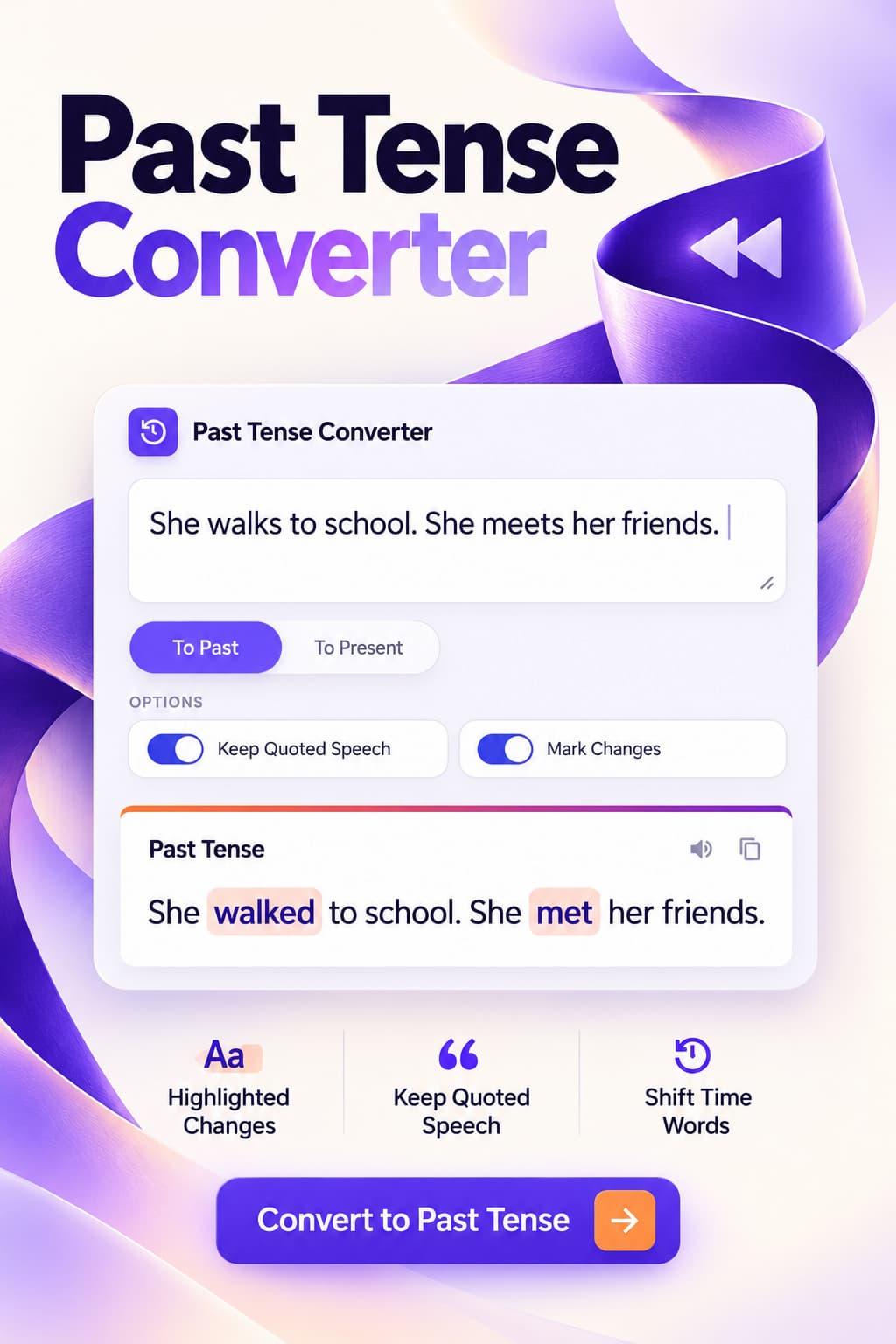
This past tense converter changes a sentence, a paragraph or a full essay from the present tense to the past tense, and it marks every verb it changes. She walks home becomes she walked home, and they are waiting becomes they were waiting. Quoted speech stays exactly as spoken. Switch the direction and the same tool works as a past to present tense converter.
Each changed verb shows its original form when you hover over it or tap it. So you check the whole conversion in seconds instead of comparing two versions line by line.
The converter writes the simple past, the tense British textbooks call the past simple. Walked, went and was are all simple past forms.
What The Present To Past Tense Converter Changes
The rules to change present tense to past tense apply to one word class, the finite verb. The past tense converter rewrites every finite verb in your text and leaves the rest of each sentence untouched. A finite verb is the verb that agrees with the subject and marks time, like walks in she walks home. Infinitives such as to walk and -ing forms such as walking have no tense of their own, so they stay as written.
| Present form | Past form | Sentence |
|---|---|---|
| Walks, walk | Walked | She walks home → she walked home |
| Is, am | Was | The shop is closed → the shop was closed |
| Are | Were | They are late → they were late |
| Has, have | Had | He has finished → he had finished |
| Does, do | Did | She does not agree → she did not agree |
| Can | Could | I can swim → I could swim |
| Will | Would | We will call → we would call |
| May | Might | It may rain → it might rain |
| Must (obligation) | Had to | He must leave → he had to leave |
Contractions follow the same rules. Doesn’t becomes didn’t, and she’s eaten becomes she had eaten.
Change A Paragraph Or Essay With The Past Tense Converter
To make a paragraph past tense, or to change a whole essay to past tense, move every finite verb back one step and keep the order of events the same. A story written in the present, Sara wakes up at six and opens the window, becomes Sara woke up at six and opened the window. The past tense converter matches each verb to its own subject, so the children play outside while their parents cook becomes the children played outside while their parents cooked.
Long sentences hold several verbs, and every one of them moves. Maria thinks the design needs work changes twice, to Maria thought the design needed work. Verbs after who, which and that change as well, so the dog that barks all night belongs to Sara becomes the dog that barked all night belonged to Sara.
The converter identifies nouns and verbs by their position in the sentence. In good cooks prepare food, the word cooks is a noun, so only prepare moves. In she cooks dinner, the same word is the verb and becomes cooked.
Sentence To Past Tense Converter
A single sentence converts the same way as a paragraph, so the tool also works as a sentence to past tense converter. Type a sentence into the box to convert to past tense as you type, with the changed verb marked.
- ✅ She writes a letter changes to she wrote a letter, because write is an irregular verb with the past form wrote.
- ❌ Changing she has visited Japan to she visited Japan skips a step. Present perfect moves to past perfect, so the correct form is she had visited Japan.
- ✅ The -s ending disappears in the past, so he eats an apple changes to he ate an apple. Past verbs other than was and were take one form for every subject.
Continuous sentences change only their helping verb. They are playing chess becomes they were playing chess, and playing stays as written.
General truths need a decision from you. The sun rises in the east becomes the sun rose in the east, which is correct inside a story about one morning. In a science passage, writers keep facts like this in the present, so read these lines again after converting.
How Each Present Tense Moves Into The Past
Each present tense has one matching past tense, and the present simple moves to the simple past. In every form except the present simple, only the helping verb changes, as in has written and had written.
| Present tense | Past tense | Present sentence | Past sentence |
|---|---|---|---|
| Present simple | Simple past (past simple) | She works in a bank | She worked in a bank |
| Present continuous | Past continuous | She is working late | She was working late |
| Present perfect | Past perfect | She has worked here for years | She had worked here for years |
| Present perfect continuous | Past perfect continuous | She has been working all day | She had been working all day |
| Future with will | Future in the past | She will work on Friday | She would work on Friday |
To see one sentence in all 12 tenses rather than the simple past alone, use the all tenses converter. Questions and negatives move the same way through do, does and did. Does she play tennis? becomes Did she play tennis?, and the main verb stays in its base form. A common learner error is to change both verbs, as in did she played, and the converter never produces that form.
Irregular Verbs In Past Tense Conversion
Irregular verbs form the past without -ed. Go becomes went, and buy becomes bought. The past tense converter checks every verb against a list of more than 8,000 English verbs. That list includes every common irregular verb, so the converter never writes goed or buyed. For every form of a single verb, from the base form to the past participle, the verb form finder lists all five with an example sentence for each.
Some verbs keep one spelling in the present and the past, such as put, cut and hit. So with a plural subject, they cut the cake reads the same after conversion. After she, the -s disappears, so she reads the news becomes she read the news. Past read is spelled like the present but pronounced like red.
British and American English spell a few past forms differently. British English accepts both learnt and learned, while American English uses learned, spelled and dreamed. British spelling also doubles a final l, as in travelled and cancelled, where American spelling writes traveled and canceled. The converter writes the British forms by default, and the American Spelling switch writes the American ones.
Quoted Speech And Reported Speech
Words inside quotation marks stay exactly as the speaker said them. “We will launch next week,” the manager says becomes “We will launch next week,” the manager said. Only the reporting verb outside the quotation marks moves into the past.
Turn on Report Speech to change direct speech into reported speech inside the past tense converter. The converter removes the quotation marks, moves each quoted verb back one step, and changes the pronouns. So “I am tired,” she says becomes she said that she was tired. In a dialogue between Nadia and Omar, “Are you coming?” Nadia asks becomes Nadia asked him if he was coming. A quoted statement with two clauses keeps both of them. “I work from home and I am painting the kitchen,” she says becomes she said that she worked from home and that she was painting the kitchen.
For a single sentence, the all tenses converter also gives the reported form beside every tense. Reported speech needs the speaker and the listener, and the converter takes both from your passage. When the passage never says whether a speaker is he or she, the quote stays as written and goes into the list of sentences to check. The same applies when the passage never names the person being spoken to.
Past To Present Tense Converter
The past to present tense converter runs the same rules in reverse. She walked home becomes she walks home, and he had finished becomes he has finished. Was becomes is, or am after I, and were becomes are. The verb takes the -s ending again when the subject is he, she, it or a singular noun.
Verbs tied to a past date stay in the past. In Last year we moved to Karachi. Now we lived near the sea, the converter changes only the second sentence, because last year fixes the first one in the past. Turn off Keep Past Dates when you want the historic present, the style biographies use for Einstein moves to Berlin in 1914.
Conditionals and wishes stay as written in both directions. If I had more time, I would learn French already refers to the present, so moving its verbs would change its meaning.
Sentences The Converter Leaves For You
Some sentences need a human decision, and the past tense converter lists them under the result with the reason for each one. You read the reason, edit the line if needed, and copy the finished text.
- Commands stay as written, because close the door has no tense to move.
- Should, would and might have no further past form, so the converter leaves these sentences unchanged.
- Used to describes a past habit and has no present form. The converter suggests a rewrite with usually instead.
- Future time words beside a past verb read oddly, as in she met him tomorrow, and the converter marks these lines.
- Team names that end in -s are marked for an agreement check when you convert to the present, since Lahore Qalandars refers to one team and to many players.
Download The Past Tense Converter Result As A PDF
Press Download PDF under the result, and the past tense converter saves the converted text as a PDF named after your passage. The file name comes from the opening words of the converted text. A story that starts Sara woke up at six every morning saves as sara-woke-up-six-every-morning-past-tense.pdf. Type your own title above the button, and the file name follows it, as in unit-4-morning-routines-past-tense.pdf.
The PDF keeps your paragraphs and prints every changed verb in bold. A verb chart follows the text, pairing each original form with its new form and counting how many times each change occurs. Sentences marked for checking come next, each with its reason. The original passage closes the document, so a teacher or editor compares both versions on paper.
The PDF is built in your browser, exactly like the conversion. Your text never reaches a server on its way into the file.
Make A Present To Past Tense Worksheet With Answers
Make Worksheet turns the same passage into practice material for a class or for self-study. Each converted sentence is printed in its original tense, numbered, with a ruled line under it for the answer. The answer key sits on a separate page with every changed verb in bold, so you hand out the first page and keep the second.
The instruction matches the direction you chose: Rewrite each sentence in the past tense, or in the present tense when you convert the other way. Sentences marked for checking stay off the worksheet. Reported quotes stay off as well, because their answers change form as well as tense. A long passage fills up to 40 numbered sentences.
A paragraph your students have already read makes the strongest worksheet. The vocabulary is familiar, so every mistake on the page is a tense mistake.
How To Use The Past Tense Converter
- Paste or type your text, up to 2,000 words at a time.
- Choose the direction with the To Past and To Present buttons.
- Set the switches for quoted speech, time words, past dates and spelling.
- Read the result. Each marked verb shows its original form when you hover over it or tap it.
- Check the sentences listed under the result, then copy the text or press Listen to hear it.
- Press Download PDF to save the result, or Make Worksheet for a practice sheet with an answer key.
Shift Time Words changes the time words with the verbs. Tomorrow becomes the next day, and next week becomes the following week. Leave it off when the narrator speaks from a fixed day, as in I start work tomorrow.
A past tense generator and a past tense changer are other names for this tool. It converts the text you paste and never writes new sentences.
The past tense converter runs in your browser. The text you paste never goes to a server, and the tool stores nothing about you.
Questions About Changing Tense
Q1. How do you change present tense to past tense?
You change present tense to past tense by moving each finite verb to its past form. Walks becomes walked, and has becomes had. Irregular verbs form the past in their own way, as in go and went or put and put.
Q2. How do you change a paragraph to past tense?
You change a paragraph to past tense by converting every finite verb, sentence by sentence, while quoted speech stays as spoken. Paste the paragraph or a whole essay into the converter, up to 2,000 words at a time. Then check each marked verb against its original form.
Q3. Does a past tense converter change every verb in a sentence?
No, a past tense converter changes only finite verbs. Infinitives like to go and -ing forms like going stay as they are. In she wants to leave, only wants becomes wanted.
Q4. What happens to “will” and “can” in the past tense?
Will becomes would and can becomes could. So I will call you becomes I would call you, and she can swim becomes she could swim. Shall changes to should in the same way.
Q5. Should quoted speech change to the past tense?
No, quoted speech keeps the speaker’s original words. Only the reporting verb outside the quotation marks moves, as in “I am ready,” she said. To change the quote itself, rewrite it as reported speech: she said that she was ready.
Q6. How do you change past tense to present tense?
You change past tense to present tense by moving each past verb back to its present form and matching it to the subject. She walked becomes she walks, and they walked becomes they walk. Keep verbs tied to a past date in the past.
Q7. Is this past tense converter free?
Yes, the converter is free, with no account and no daily limit. It converts up to 2,000 words at a time, in your browser. The text you paste never leaves your device.
Q8. Can I download the converted text as a PDF?
Yes, the Download PDF button saves the converted text, a chart of changed verbs and your original passage in one file. The file takes its name from the opening words of your text, and a new title renames it. The PDF is built in your browser, so your text stays on your device.
Q9. Does the converter make a past tense worksheet with answers?
Yes, Make Worksheet builds a printable sheet from the passage you converted. Each sentence is printed in its original tense with a line for the answer, and the answer key follows on its own page. The worksheet follows your chosen direction, so it drills past to present conversion too.
Check Each Changed Verb Before You Copy
Convert your text, then read the marked verbs and the listed sentences before you copy the result. Start with a short passage you wrote today, change it to the past, and check each marked verb against its original form. Any verb you disagree with goes back to its original in one edit, and the rest of the conversion stays in place.