
A period is a punctuation mark (.) that ends a declarative sentence. It marks the full stop of a statement and separates it from whatever follows.
The period also closes abbreviations, separates the parts of a decimal number, and divides the elements of a web address. The same mark is called a full stop in British English, and the two names describe identical rules.
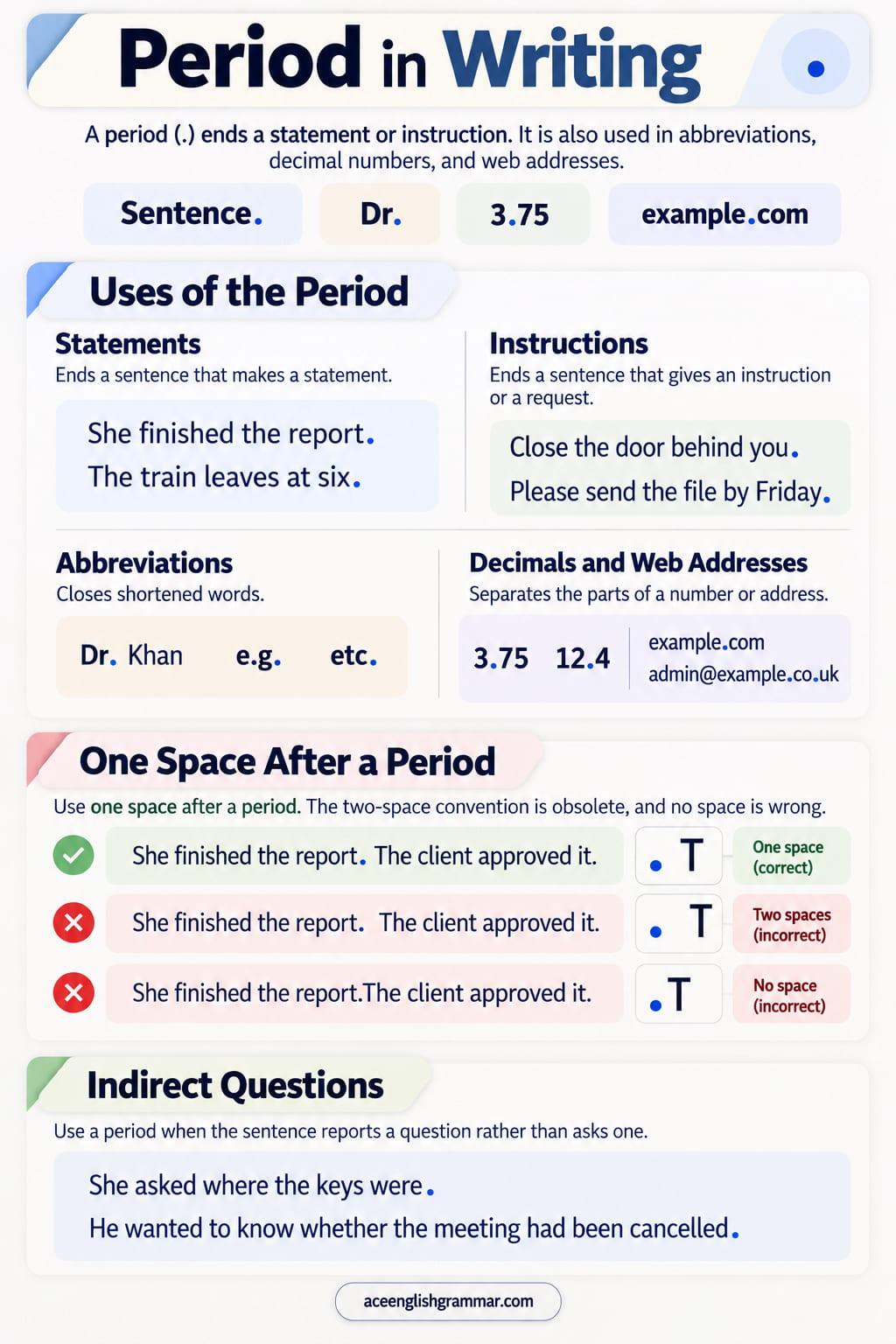
What Is a Period?
A period is a punctuation mark (.) that ends a sentence making a statement or giving an instruction. It is a single dot sitting on the baseline, which distinguishes it from the raised dot used in mathematics.
The mark closes the thought. A reader reaching a period knows the sentence has finished and the next capital letter begins a new one.
- She finished the report.
- The train leaves at six.
- Close the door behind you.
- Nobody answered the phone.
The period is the most frequent punctuation mark in written English, and the one that causes the fewest disputes. Its rules change little between dialects, registers, or style guides.
Period vs Full Stop
The two names describe the same mark. It is a period in American English and a full stop in British English, with no difference in the symbol or its rules.
- American English: period
- British English: full stop
- Both: the same mark (.) with identical placement rules
The term “period” appears in British usage when naming the mark in a technical context, such as a domain name read aloud. “Full stop” is rare in American writing outside quoted British speech.
Note that “full stop” also works as an emphatic phrase in speech, as in “I am not going, full stop.” American speakers use “period” the same way.
Common Uses of the Period with Examples
The period has five established uses in English writing. The most common uses appear here with one example each; each rule is covered in detail later.
- End of a declarative sentence: She finished the report.
- End of an instruction: Close the door behind you.
- After an abbreviation: Dr. Khan arrived at noon.
- In decimals and numbers: The rate fell to 3.75 percent.
- In web and email addresses: Visit example.com for details.
Period at the End of a Sentence
A period ends a declarative sentence, which states a fact or an opinion, and an imperative sentence, which gives an instruction or makes a request.
- She finished the report before midnight.
- The committee approved the budget.
- Close the door behind you.
- Please send the file by Friday.
An indirect question ends with a period rather than a question mark, because the sentence reports a question instead of asking one.
- She asked where the keys were.
- He wanted to know whether the meeting had been cancelled.
- I wonder what time the train arrives.
Note that a polite request phrased as a question takes a period when it expects action rather than an answer. “Would you please sign the form.” reads as an instruction; “Would you like some tea?” asks a genuine question.
Period in Abbreviations and Acronyms
Whether an abbreviation takes periods depends on its type and on the dialect. Three patterns cover nearly every case.
Titles and Initials
Personal titles take a period in American English and no period in British English when the abbreviation ends with the same letter as the full word. Initials in a name always take periods in both dialects.
- American: Dr. Khan, Mr. Shah, Mrs. Ali, Prof. Ahmed
- British: Dr Khan, Mr Shah, Mrs Ali, Prof. Ahmed
- Both: J. R. R. Tolkien, T. S. Eliot, F. Scott Fitzgerald
The British rule turns on the last letter. “Doctor” ends in r and “Dr” ends in r, so no period follows. “Professor” ends in r but “Prof” ends in f, so the period stays.
Acronyms and Initialisms
Acronyms pronounced as words take no periods. Initialisms spoken as separate letters take periods in older and more formal American usage, though the unpunctuated form has become standard.
- No periods: NATO, NASA, UNESCO, laser, radar
- Modern standard: USA, UK, BBC, FBI, PhD
- Formal American: U.S.A., U.K., F.B.I.
Note that “U.S.” retains its periods in American formal writing more than any other initialism, particularly when it modifies a noun, as in “U.S. foreign policy.”
Latin Abbreviations
Latin abbreviations keep their periods in both dialects. Each element of the abbreviation takes one.
- e.g. (exempli gratia, “for example”)
- i.e. (id est, “that is”)
- etc. (et cetera, “and the rest”)
- et al. (et alii, “and others”)
- cf. (confer, “compare”)
Note that “e.g.” and “i.e.” take a comma after the final period in American usage. British usage omits that comma.
Period With Quotation Marks
In American English the period goes inside the closing quotation mark, whether or not it belongs to the quoted words. In British English it goes inside only when it is part of the quotation.
- American: She said, “Come in.”
- American: He called it a “minor setback.”
- British: She said, ‘Come in.’
- British: He called it a ‘minor setback’.
Compare:
- American: The word was “inconclusive.” ✓
- British: The word was ‘inconclusive’. ✓
Note that the American rule comes from typesetting rather than logic. Early printers moved the period inside the closing mark to protect the fragile piece of type at the end of a line, which is covered in full under period placement with quotation marks.
Period With Parentheses and Brackets
The period goes outside the closing parenthesis when the enclosed material forms part of a larger sentence, and inside when the parentheses enclose a complete standalone sentence. The same rule governs square brackets.
- She finished the report (all forty pages).
- She finished the report. (It ran to forty pages.)
- The meeting ran late (as usual).
- The meeting ran late. (This happens every month.)
- She quoted the passage [including the error].
- The report was never published. [The archive holds one copy.]
Periods at the End of Bullet Points
Whether bullet points take a period depends on whether the items are complete sentences. The choice is consistent within a list rather than item by item.
1. Complete sentences take a period on every item.
- The committee met on Tuesday.
- The budget was approved without amendment.
- A follow-up review is scheduled for March.
2. Fragments take no period, including the last item.
- Annual budget review
- Quarterly progress report
- Departmental staffing plan
3. A list completing an introductory stem takes no period until the final item, which closes the sentence.
The committee agreed to:
- review the annual budget
- publish the quarterly report
- appoint two new members.
Note that mixing complete sentences and fragments in one list is the error to avoid. Rewrite the items so they share a grammatical form, then punctuate the whole list to match.
Period and Footnote Numbers
A footnote or endnote number goes after the period, not before it. The superscript figure follows all punctuation except the dash.
- The policy failed within two years.¹
- She called it “a complete reversal.”²
- The study was never replicated (though three attempts were made).³
Compare:
- The policy failed within two years¹. ✗
- The policy failed within two years.¹ ✓
Note that the dash is the one exception. A footnote number goes before a dash rather than after it, since the dash belongs to the sentence that continues.
Period in Numbers, Decimals, and Web Addresses
The period separates whole numbers from decimal fractions, marks the divisions in a web address, and appears in version numbers and file names. None of these uses takes a space on either side.
- The rate fell to 3.75 percent.
- The file measures 12.4 megabytes.
- Visit example.com for details.
- Email the form to admin@example.co.uk.
- The software updated to version 2.1.4.
Note that the decimal separator differs by country. Most of continental Europe and much of South America marks the decimal with a comma, writing 3,75 for what English writes as 3.75.
Period vs Ellipsis
A single period ends a sentence. Three periods form an ellipsis, a separate punctuation mark that shows omitted words or a trailing thought.
- She finished the report. (period: the sentence ends)
- She trailed off… (ellipsis: the thought fades)
- The list ran on: milk, bread, eggs… (ellipsis: the list continues)
Four dots appear when a complete sentence ends and material after it has been cut. The first dot is the period closing that sentence, followed by the three-dot ellipsis.
- “The trial concluded in June…. The appeal followed in August.”
Note that an ellipsis is a single mark with its own Unicode character (U+2026), not three separate periods. Word processors convert three typed periods into it automatically.
Spacing After a Period
One space follows a period before the next sentence begins. The two-space convention comes from typewriters, where every character occupied the same width, and no current style guide requires it.
- She finished the report. The client approved it. ✓
- She finished the report. The client approved it. ✗ (two spaces)
- She finished the report.The client approved it. ✗ (no space)
No space comes before a period, and no space appears inside an abbreviation such as “e.g.” or “U.S.”
Note that proportional fonts made the two-space rule obsolete. The extra space was a workaround for monospaced type and now creates uneven gaps on the page.
How to Type a Period
The period is on every standard keyboard, next to the comma on the bottom row. No shortcut or code is needed on any platform.
| Format | Code |
|---|---|
| Unicode | U+002E |
| HTML entity | . |
| Keyboard | The key right of the comma |
| Ellipsis (three dots) | U+2026 |
| Middle dot | U+00B7 |
Note that two similar characters serve other purposes. The middle dot (·) separates items in a list or marks syllable breaks, and the bullet (•) opens a list item. Neither ends a sentence.
When Not to Use a Period
Five situations take a different mark or none at all.
1. After a direct question. A question mark ends the sentence.
- Where are you going. ✗
- Where are you going? ✓
2. After an exclamation. The exclamation mark replaces the period.
- Watch out. ✗ (when a warning is intended)
- Watch out! ✓
3. After a heading or a title. Headings take no end punctuation.
- Common Uses of the Period. ✗
- Common Uses of the Period ✓
4. After an acronym pronounced as a word.
- She works for N.A.S.A. ✗
- She works for NASA ✓
5. Doubling a period after an abbreviation at the end of a sentence. One period serves both functions.
- The list included pens, paper, envelopes, etc.. ✗
- The list included pens, paper, envelopes, etc. ✓
Common Errors With the Period
Six errors recur most commonly when writers use the period in English.
- Doubling the period after a final abbreviation. We write “pens, paper, envelopes, etc.” not “etc..” One period closes both the abbreviation and the sentence.
- Placing the footnote number before the period. We write “within two years.¹” not “within two years¹.” The superscript follows all punctuation except the dash.
- Mixing sentences and fragments in one bulleted list. We punctuate every item the same way, which means rewriting the items to share a grammatical form first.
- Using two spaces after a period. We use one space. The two-space convention belongs to typewriters and monospaced type.
- Ending an indirect question with a question mark. We write “She asked where the keys were.” not “She asked where the keys were?” The sentence reports rather than asks.
- Using three separate periods for an ellipsis. We use the single ellipsis character, which word processors produce automatically from three typed periods.
FAQs
Q1. What is a period?
A period is a punctuation mark (.) that ends a declarative or imperative sentence. It also closes abbreviations, separates whole numbers from decimals, and divides the parts of a web address. The same mark is called a full stop in British English.
Q2. What is the difference between a period and a full stop?
There is no difference in the mark or its rules. “Period” is the American name and “full stop” is the British name for the same punctuation mark. British writers reach for “period” in technical contexts, such as reading a domain name aloud, while “full stop” is rare in American writing.
Q3. Do abbreviations take a period?
It depends on the type and the dialect. Latin abbreviations such as “e.g.” and “etc.” take periods in both dialects. Acronyms pronounced as words, such as NATO, take none. Personal titles take a period in American English but not in British English when the abbreviation ends with the same letter as the full word, giving “Dr. Khan” and “Dr Khan.”
Q4. Do bullet points need periods?
Only when the items are complete sentences. A list of complete sentences takes a period on every item. A list of fragments takes none, including on the last item. The punctuation stays consistent across the whole list rather than varying by item.
Q5. Does the footnote number go before or after the period?
After. The superscript figure follows the period and every other punctuation mark except the dash, giving “within two years.¹” rather than “within two years¹.” A footnote number goes before a dash, since the dash belongs to the sentence that continues.
Q6. Does the period go inside or outside quotation marks?
In American English it goes inside the closing mark whether or not it belongs to the quoted words: He called it a "minor setback." In British English it goes outside unless it is part of the quotation: He called it a 'minor setback'.
Q7. How many spaces go after a period?
One. The two-space convention comes from typewriters, where every character occupied the same width, and proportional fonts made it obsolete. No current style guide requires two spaces, and the extra space creates uneven gaps on the page.
Read More

Leave a Comment