
Brackets are paired punctuation marks that enclose material inserted into a sentence. The square brackets [ ] mark an editorial addition inside quoted text, which is the function that separates brackets from parentheses.
English writing uses four bracket shapes: square brackets [ ], round brackets ( ), curly brackets { }, and angle brackets < >. Each shape encloses a different kind of material, and the names differ between American and British English.
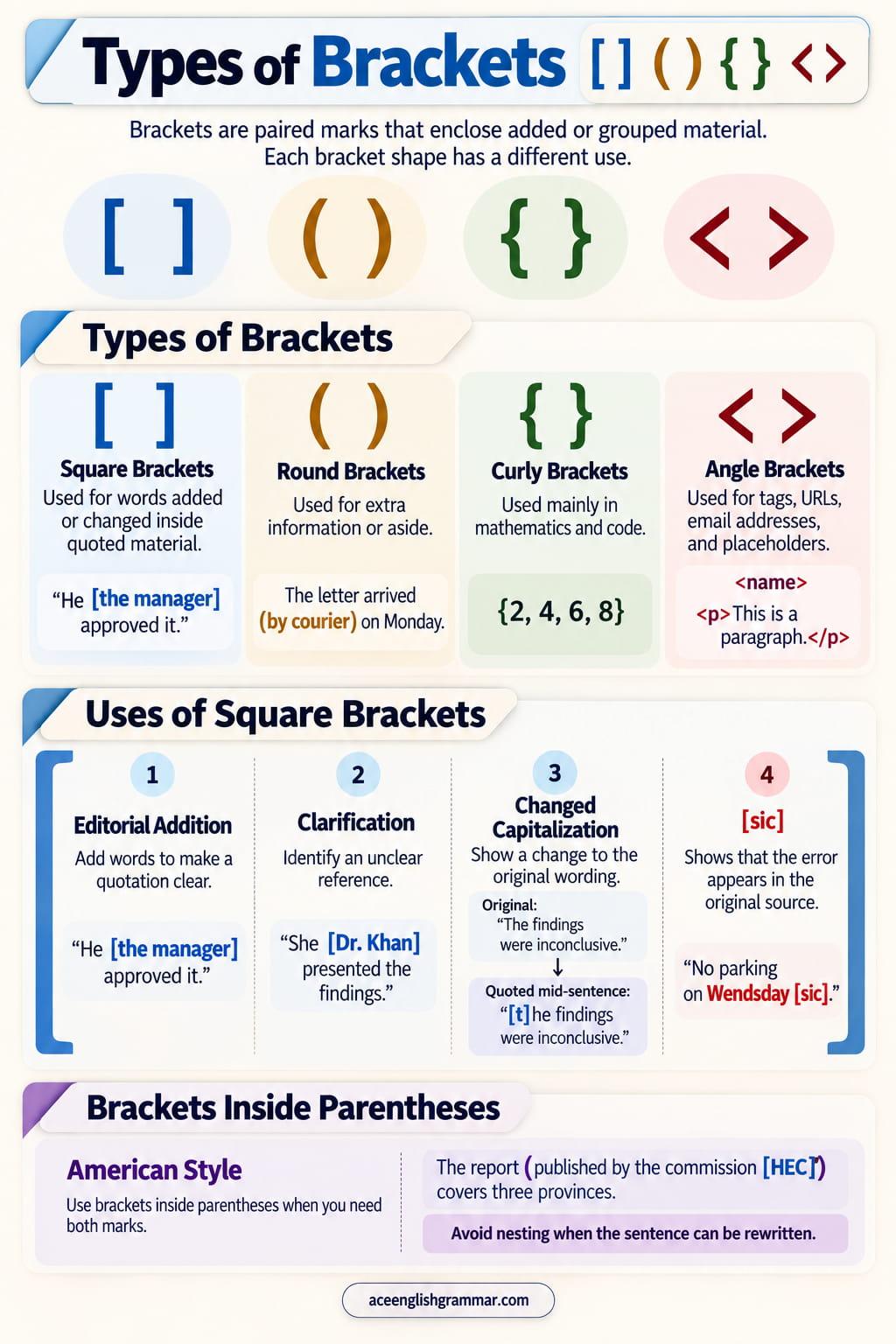
What Are Brackets?
Brackets are paired marks that enclose material added to a sentence. In American English the word means the square marks [ ], while in British English it means the round marks ( ) unless “square” is specified.
The square bracket marks words that the original writer or speaker did not use. This is what separates it from the round bracket, which encloses the writer’s own aside.
- The witness said, “I could hear him [the policeman] but I could not see him.”
- The report noted that “[t]he findings were inconclusive.”
- She wrote that the plan “was doomed from the start [sic].”
- The minister promised “a full review [of the policy] within six months.”
Note that square brackets always signal editorial intervention. A reader seeing them inside a quotation knows the enclosed words came from the editor rather than the speaker.
Types of Brackets in English with Examples
Four bracket shapes appear in English typography, each with its own name and function.
| Shape | American name | British name | Main function |
|---|---|---|---|
| [ ] | Brackets or square brackets | Square brackets | Editorial insertion in quoted text |
| ( ) | Parentheses | Brackets or round brackets | The writer’s own aside |
| { } | Curly braces | Curly brackets | Sets in mathematics and code |
| < > | Angle brackets | Angle brackets | URLs, tags, and placeholders |
Note that only square brackets and parentheses appear regularly in ordinary prose. Curly and angle brackets belong to mathematics, computing, and technical documentation.
Brackets vs Parentheses
The two marks enclose different kinds of material, and the naming differs by dialect. Square brackets hold words added by an editor; parentheses hold words the writer chose.
- Editorial insertion: She said, “He [the manager] approved it.”
- Writer’s own aside: She approved it (after three weeks of delay).
- Editorial insertion: The letter read, “We regret [the] decision.”
- Writer’s own aside: The letter arrived (by courier) on Monday.
The dialect difference concerns the names rather than the functions.
- American English: [ ] are brackets, ( ) are parentheses
- British English: ( ) are brackets or round brackets, [ ] are square brackets
Note that the functions are identical in both dialects. Only the default meaning of the unqualified word “bracket” changes.
Square Brackets in Quotations
Square brackets have five distinct functions inside quoted material. Each one signals a change the editor made to the original wording.
Editorial Insertions
Square brackets enclose a word or phrase added to make the quotation intelligible outside its original context.
- The witness said, “I could hear him [the policeman] but I could not see him.”
- She replied, “They [the trustees] never consulted us.”
- He wrote that “it [the proposal] would cost far more than budgeted.”
Clarification of an Unclear Reference
Square brackets identify a pronoun or vague noun that the surrounding text no longer specifies.
- “She [Dr. Khan] presented the findings to the board.”
- “The city [Lahore] grew faster than any other in the province.”
- “That year [2019] marked the turning point.”
Changing Capitalization or Tense
Square brackets mark a letter or verb form the editor altered so the quotation fits the grammar of the surrounding sentence.
- Original: “The findings were inconclusive.”
- Quoted mid-sentence: The report stated that “[t]he findings were inconclusive.”
- Original: “We reject the proposal.”
- Quoted in past narration: The board confirmed that it “[rejected] the proposal.”
Note that brackets around a changed capital are required under MLA and APA. A silent change is acceptable under Chicago in most contexts, so follow whichever style the piece is written to.
The Marker [sic]
The Latin word “sic” inside square brackets marks an error that appeared in the original. It tells the reader the mistake belongs to the source rather than to the person quoting it.
- The notice read, “No parking on Wendsday [sic].”
- She wrote that the team “was comprised of [sic] five members.”
- The sign said, “Fresh apple’s [sic] 50p.”
Note that “sic” means “thus” in Latin and takes no period inside the brackets. Italics for the word itself are optional and depend on the style guide.
Brackets Around an Ellipsis
Square brackets around an ellipsis show that the omission was made by the person quoting rather than appearing in the original.
- The report concluded that “the policy […] produced no measurable effect.”
- She argued that the plan “was rushed […] and poorly costed.”
Note that the bracketed form is required under MLA when the source itself contains ellipses. Chicago and AP use the bare ellipsis without brackets in most cases.
Brackets in Citations and References
Square brackets enclose reference numbers in several citation systems, and they mark added information in bibliographies.
- The effect was first recorded in 1974 [3]. (numbered citation style)
- Results were replicated across three trials [7, 12, 15].
- Khan, A. [Ed.]. (2024). “Punctuation in Practice”.
- Smith, J. (n.d.). Report title [Unpublished manuscript].
Note that IEEE, Vancouver, and numerical citation systems place the reference number in square brackets, while author-date systems such as APA and Harvard use parentheses.
Curly Brackets and Braces
Curly brackets { } are called braces in American English and curly brackets in British English. They appear in mathematics, programming, and music rather than in ordinary prose.
- Mathematics (sets): The solution set is {2, 4, 6, 8}.
- Programming:
function add(a, b) { return a + b; } - Music: A brace joins two staves played by the same instrument.
- Linguistics: The morpheme {-ed} marks the past tense.
Note that curly brackets are also called squiggly brackets, squiggly braces, or flower brackets in informal and regional use. None of those names is standard in edited writing.
Note that curly brackets have no standard function in English prose. A writer who places them in a sentence almost always needs parentheses or square brackets instead.
Angle Brackets and Chevrons
Angle brackets < > enclose URLs, email addresses, markup tags, and placeholders. They keep the enclosed string separate from surrounding punctuation, which prevents a trailing period from being read as part of the address.
- Email the form to
<admin@example.com>. - The full text is at
<https://example.com/report>. - HTML markup:
<p>This is a paragraph.</p> - Placeholder: Enter your name in the field marked <name>.
Note that angle brackets are also called chevrons, and mathematics uses the same characters as the less-than and greater-than signs.
Brackets Within Brackets
Nested enclosure is avoided wherever the sentence can be rewritten. When a second level is unavoidable, square brackets go inside parentheses in American style, and the order reverses in British style.
- American: The report (published by the commission [HEC]) covers three provinces.
- British: The report [published by the commission (HEC)] covers three provinces.
Compare:
- The study (conducted in Lahore (Punjab) in 2024) found the opposite. ✗
- The study (conducted in Lahore [Punjab] in 2024) found the opposite. ✓
- The study, conducted in Lahore, Punjab, in 2024, found the opposite. ✓ (best)
Note that nesting in mathematics follows a fixed order, running outward from parentheses to square brackets to curly braces, as in 2 × {3 + [4 − (1 + 1)]}.
Punctuation With Brackets
A period, comma, or question mark falls outside the closing bracket when the enclosed material forms part of a larger sentence, and inside when the brackets enclose a complete standalone sentence, following the same rule as punctuation with parentheses.
- She quoted the passage in full [including the error]. ✓ (period outside)
- The report was never published. [The archive holds one copy.] ✓ (period inside)
- After the review [which ran late], we filed the report. ✓ (comma after the closing bracket)
- Did he really say “the whole thing [the merger] was a mistake”? ✓
Note that no comma comes before an opening bracket. When a comma is needed at that point, it moves to after the closing bracket, exactly as with parentheses.
How to Type Each Bracket
Square, curly, and angle brackets sit on standard keyboards, and each pair needs a different key combination.
| Mark | Windows and Mac | Unicode | HTML |
|---|---|---|---|
| [ ] | The two keys right of P | U+005B, U+005D | [ ] |
| ( ) | Shift + 9, Shift + 0 | U+0028, U+0029 | ( ) |
| { } | Shift + [ , Shift + ] | U+007B, U+007D | { } |
| < > | Shift + comma, Shift + period | U+003C, U+003E | < > |
On iOS and Android, all four pairs appear on the numbers-and-symbols keyboard layer. Holding the square bracket key reveals the curly and angle options.
When Not to Use Brackets
Five situations call for a different mark even though brackets look right.
1. For the writer’s own aside. Parentheses enclose the writer’s comment.
- The proposal [all ninety pages] arrived Monday. ✗
- The proposal (all ninety pages) arrived Monday. ✓
2. For essential information. Material the sentence needs carries no enclosure at all.
- The man [who called earlier] is my neighbour. ✗
- The man who called earlier is my neighbour. ✓
3. In ordinary prose for curly or angle brackets. These belong to mathematics, code, and markup.
- She listed three options {tea, coffee, juice}. ✗
- She listed three options: tea, coffee, juice. ✓
4. Around a silent correction in informal writing. A quotation in casual prose is better paraphrased than bracketed.
5. As a second level of parentheses in British style. British convention places the square brackets outside.
Common Errors With Brackets
Six errors recur most commonly when writers use brackets in English.
- Using square brackets for the writer’s own aside. We write “The proposal (all ninety pages) arrived Monday,” not “[all ninety pages].” Square brackets mark an editorial insertion in quoted text.
- Putting the period inside for a fragment. We write “She quoted the passage [including the error],” not “[including the error.]” A period falls inside only when the brackets enclose a complete sentence.
- Placing a comma before the opening bracket. We write “After the review [which ran late], we filed the report,” not “After the review, [which ran late] we filed.” The comma moves to after the closing bracket.
- Adding a period inside [sic]. We write “[sic],” not “[sic.]” The Latin word takes no punctuation inside the brackets.
- Using curly brackets in prose. We write “three options: tea, coffee, juice,” not “{tea, coffee, juice}.” Curly brackets belong to mathematics and code.
- Nesting the wrong way round. We write “(published by the commission [HEC])” in American style. Placing parentheses inside parentheses is wrong in both dialects.
FAQs
Q1. What are brackets?
Brackets are paired punctuation marks that enclose material inserted into a sentence. In American English the word means the square marks [ ], which signal an editorial addition inside quoted text. In British English the unqualified word means the round marks ( ), and the square ones are called square brackets.
Q2. What is the difference between brackets and parentheses?
Square brackets enclose words added by an editor to quoted material; parentheses enclose the writer’s own aside. “He [the manager] approved it” shows an editorial insertion, while “She approved it (after three weeks)” shows the writer’s comment. In British English the names swap, though the functions stay the same.
Q3. What are these [ ] called?
They are called square brackets in both dialects, and simply brackets in American English. They mark an editorial insertion inside a quotation, showing the reader that the enclosed words came from the editor rather than the original speaker.
Q4. What does [sic] mean?
“Sic” is Latin for “thus,” and it marks an error that appeared in the original source. Writing “No parking on Wendsday [sic]” tells the reader the misspelling belongs to the sign rather than to the person quoting it. The word takes no period inside the brackets.
Q5. Does the period go inside or outside brackets?
It falls outside when the enclosed material forms part of a larger sentence: “She quoted the passage [including the error].” It falls inside when the brackets enclose a complete standalone sentence: “The report was never published. [The archive holds one copy.]”
Q6. What are curly brackets used for?
Curly brackets { }, called braces in American English, enclose sets in mathematics, code blocks in programming, joined staves in music, and morphemes in linguistics. They have no standard function in English prose, where parentheses or square brackets belong instead.
Q7. Can I put brackets inside brackets?
Avoid it where the sentence can be rewritten. When a second level is unavoidable, square brackets go inside parentheses in American style: “(published by the commission [HEC]).” The order reverses in British style. Nesting in mathematics runs outward from parentheses to square brackets to curly braces.
Read More

Leave a Comment