
The apostrophe is a punctuation mark (‘) that shows possession or marks letters left out of a contraction. It is the most misused mark in English writing.
There are three main uses of the apostrophe: possession (the girl’s book), contraction (don’t, it’s), and the plural of single letters (mind your p’s and q’s). The mark never forms an ordinary plural, which is the single rule that prevents most apostrophe errors.
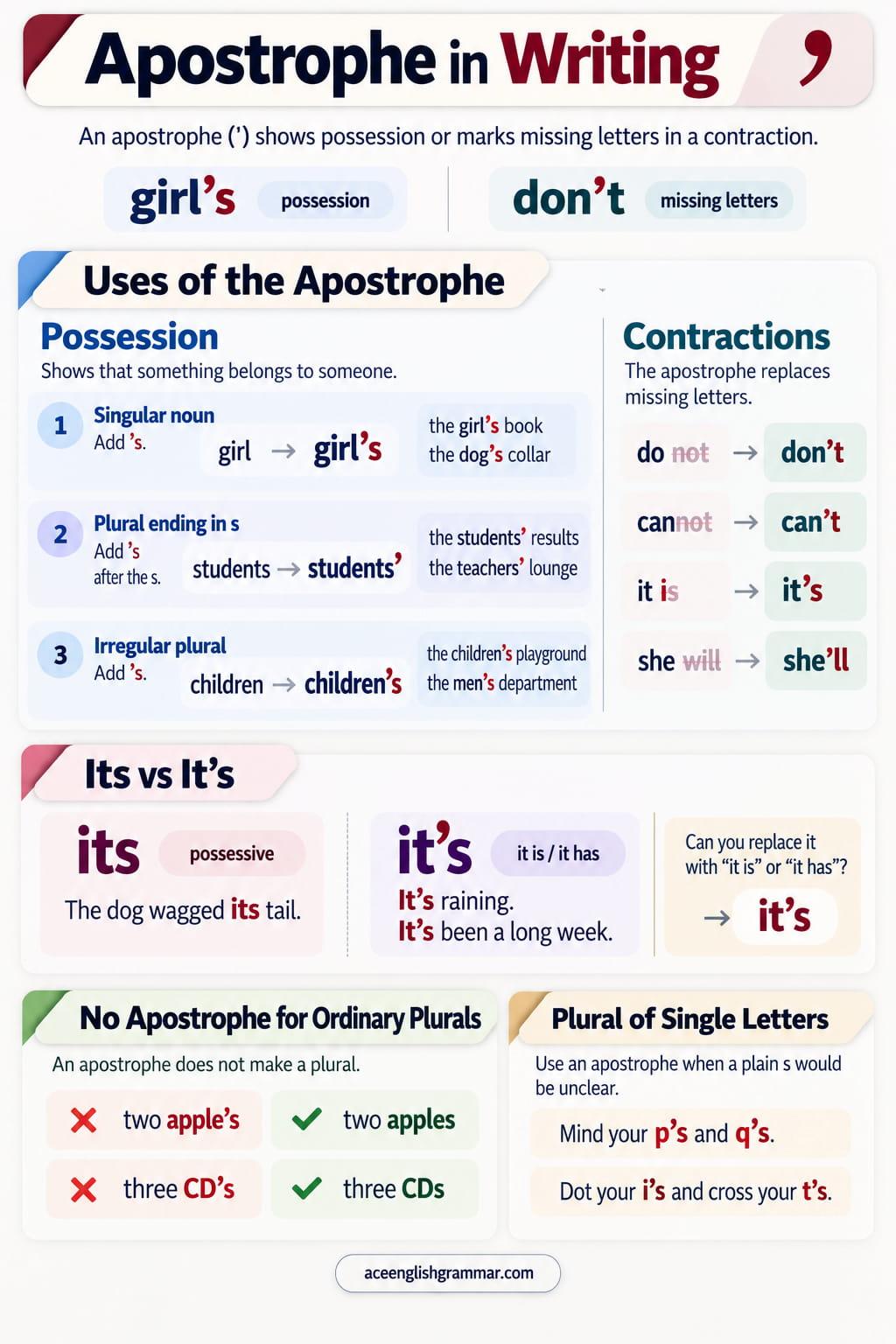
What Is an Apostrophe?
An apostrophe is a punctuation mark (‘) that shows ownership or marks a letter left out of a shortened word. It is set at the top of the line rather than on the baseline, which separates it from the comma.
The apostrophe has two unrelated functions in English. One shows that something belongs to someone; the other shows that letters have been removed. Confusing the two produces the most common punctuation errors in the language.
- The girl’s book was on the table. (possession)
- Don’t wait for me. (contraction of “do not”)
- Mind your p’s and q’s. (plural of a single letter)
- She’s the team’s captain. (contraction plus possession)
Note that an apostrophe never forms an ordinary plural. We write “two apples,” not “two apple’s.”
Common Uses of the Apostrophe with Examples
The apostrophe has three established uses in English writing. The most common uses appear here with one example each; each rule is covered in detail later.
- Possession: the girl’s book, the students’ results
- Contraction: don’t, can’t, it’s, she’ll
- Plural of single letters: Mind your p’s and q’s.
Apostrophe for Singular Possessives
A singular noun takes an apostrophe plus “s” to show possession. The rule holds whatever the noun ends in, and it applies to people, animals, objects, and organisations alike.
- the girl’s book
- the dog’s collar
- the company’s policy
- Ahmed’s car
- the country’s economy
Note that the apostrophe comes before the “s” for every singular noun. The position of the apostrophe is what marks the noun as singular rather than plural.
Apostrophe for Plural Possessives
A plural noun ending in “s” takes an apostrophe after the “s,” with no second “s” added. A plural noun that does not end in “s” takes an apostrophe plus “s,” the same as a singular.
1. Regular plurals ending in s take the apostrophe after the “s.”
- the students’ results
- the teachers’ lounge
- the dogs’ owners
- three weeks’ holiday
2. Irregular plurals not ending in s take an apostrophe plus “s.”
- the children’s playground
- the men’s department
- the women’s team
- the people’s choice
Note that the test is what the plural form looks like before any apostrophe is added. If it already ends in “s,” the apostrophe goes after it; if it does not, add apostrophe plus “s.”
Apostrophe With Names Ending in S
Singular names ending in “s” take either an apostrophe plus “s” or an apostrophe alone, depending on the style guide. Both forms are accepted, and consistency within one document matters more than the choice.
- Chicago and MLA: James’s car, Chris’s idea, Dickens’s novels
- AP style: James’ car, Chris’ idea, Dickens’ novels
- Both: the Joneses’ house (plural family name)
Note that the plural of a name ending in “s” adds “es” before the apostrophe. The family called Jones becomes “the Joneses,” and their house is “the Joneses’ house.”
Compare:
- the Jones’s house ✗ (treats a family as one person)
- the Jones’ house ✗
- the Joneses’ house ✓ (the house of the Jones family)
Joint and Separate Possession
When two people own something together, only the second name takes the apostrophe. When they own separate things, both names take one.
- Joint: Tom and Jerry’s apartment (one apartment they share)
- Separate: Tom’s and Jerry’s apartments (two separate apartments)
- Joint: Ahmed and Sara’s wedding (one wedding)
- Separate: Ahmed’s and Sara’s families (two different families)
Note that the plural form of the noun signals which reading applies. A shared item stays singular; separate items take the plural.
Apostrophe in Contractions
An apostrophe marks the exact spot where letters have been removed from a shortened word. The mark replaces the missing letters rather than sitting at the join between two words.
| Full form | Contraction | Letters removed |
|---|---|---|
| do not | don’t | o |
| cannot | can’t | no |
| it is / it has | it’s | i / ha |
| she will | she’ll | wi |
| they are | they’re | a |
| would have | would’ve | ha |
| of the clock | o’clock | f the cl |
| let us | let’s | u |
Common contraction errors come from placing the apostrophe at the join rather than at the omission.
Compare:
- do’nt ✗ (apostrophe at the join)
- don’t ✓ (apostrophe where “o” was removed)
- could’nt ✗
- couldn’t ✓
Note that contractions suit conversational and general writing. Formal academic and legal writing spells the words out in full.
Its vs It’s and Similar Confusions
Four pairs cause more apostrophe errors than any other point in English. In every pair, the form with the apostrophe is a contraction and the form without it is a possessive.
Its vs It’s
“Its” is the possessive form and takes no apostrophe. “It’s” is the contraction of “it is” or “it has.”
- The dog wagged its tail. ✓ (possessive)
- It’s raining outside. ✓ (it is)
- It’s been a long week. ✓ (it has)
- The dog wagged it’s tail. ✗
Note that the test is to expand the word. If “it is” or “it has” fits the sentence, the apostrophe belongs; if not, it does not.
Your vs You’re
“Your” is the possessive form. “You’re” is the contraction of “you are.”
- Your car is outside. ✓ (possessive)
- You’re late again. ✓ (you are)
- Your late again. ✗
Their vs They’re vs There
“Their” is possessive, “they’re” contracts “they are,” and “there” refers to a place or opens a sentence.
- Their house is on the corner. ✓ (possessive)
- They’re moving in June. ✓ (they are)
- The keys are over there. ✓ (place)
- There are three options. ✓ (sentence opener)
Whose vs Who’s
“Whose” is the possessive form. “Who’s” contracts “who is” or “who has.”
- Whose coat is this? ✓ (possessive)
- Who’s calling? ✓ (who is)
- Who’s taken my pen? ✓ (who has)
- Who’s coat is this? ✗
Note that the possessive pronouns its, your, their, whose, ours, yours, and theirs never take an apostrophe. They are already possessive in form.
Apostrophe With Plurals of Letters and Decades
An apostrophe forms the plural of a single lowercase letter, because the plain “s” would be unreadable. It does not form the plural of a decade, a number, or an abbreviation in modern usage.
1. Single lowercase letters take an apostrophe.
- Mind your p’s and q’s.
- There are two s’s in “possess”.
- Dot your i’s and cross your t’s.
2. Decades, numbers, and abbreviations take a plain “s.”
- the 1990s ✓ (not 1990’s)
- the 80s ✓ (not 80’s)
- three PhDs ✓ (not PhD’s)
- two DVDs ✓ (not DVD’s)
Note that an apostrophe before the decade marks removed digits rather than a plural. Writing “the ’90s” shows that “19” has been cut, which is a contraction rather than a possessive.
Compare:
- the 1990’s ✗ (an apostrophe does not form a plural)
- the 1990s ✓
- the ’90s ✓ (apostrophe marks the missing “19”)
Apostrophe in Time and Measurement Expressions
Expressions of time and measurement take a possessive apostrophe, even though nothing is literally owned. The construction treats the time period as the possessor of the noun that follows.
- a day’s work
- two weeks’ notice
- three months’ salary
- a year’s subscription
- ten minutes’ delay
Note that the singular and plural rules apply exactly as they do to ordinary nouns. One week takes “week’s”; two weeks take “weeks’.”
Compare:
- two weeks notice ✗
- two week’s notice ✗
- two weeks’ notice ✓
Straight vs Curly Apostrophes
Two apostrophe characters appear in digital writing. The straight apostrophe (‘) comes from typewriters and code; the curly or typographic apostrophe (‘) is the correct mark for published prose.
- Straight: don’t, it’s, the girl’s book
- Curly: don’t, it’s, the girl’s book
Note that word processors convert straight apostrophes to curly ones automatically through smart-quote settings. Code editors and plain-text files keep the straight form, which is why text pasted from code looks wrong in a document.
A third mark, the prime (‘), looks similar but has its own use. A single prime marks feet and a double prime (“) marks inches, as in 5’10” for five feet ten inches.
How to Type an Apostrophe
The apostrophe is placed directly on every standard keyboard, next to the Enter key. The curly version requires a shortcut or an automatic conversion setting.
| Mark | Windows | Mac | Unicode | HTML |
|---|---|---|---|---|
| Straight ‘ | The key left of Enter | The key left of Return | U+0027 | ‘ |
| Curly ‘ | Alt + 0146 | Option + Shift + ] | U+2019 | ’ |
| Prime ‘ | Alt + 8242 | Option + Shift + E | U+2032 | ′ |
Word processors convert the straight apostrophe to the curly form through the smart-quotes setting, found under AutoCorrect in Microsoft Word and under Tools then Preferences in Google Docs.
Apostrophe as a Figure of Speech
A second, unrelated sense of the word “apostrophe” belongs to literature rather than punctuation. In rhetoric, apostrophe is a figure of speech in which a speaker breaks off to address an absent person, an abstract idea, or an inanimate object directly.
- O Death, where is thy sting? (the Bible, addressing death)
- Twinkle, twinkle, little star, how I wonder what you are. (addressing a star)
- O Romeo, Romeo, wherefore art thou Romeo? (Juliet addressing an absent Romeo)
- Milton! thou shouldst be living at this hour. (Wordsworth addressing a dead poet)
The two senses share a name by coincidence of Greek origin. The punctuation mark comes from “apostrophos,” meaning turning away in the sense of omitted letters; the figure of speech comes from “apostrophe,” meaning turning away from the audience to address someone else.
Note that a literature course discussing “apostrophe in poetry” means this figure of speech, not the punctuation mark. Exam questions on figures of speech pair it with personification, hyperbole, and metaphor.
When Not to Use an Apostrophe
Five situations take no apostrophe even though writers add one.
1. Ordinary plurals. A plain “s” forms the plural of a noun.
- fresh apple’s ✗
- fresh apples ✓
- two taxi’s ✗
- two taxis ✓
2. Possessive pronouns. These are already possessive in form.
- The book is her’s ✗
- The book is hers ✓
- The choice is their’s ✗
- The choice is theirs ✓
3. Verbs ending in s. A third-person verb takes a plain “s.”
- She run’s every morning ✗
- She runs every morning ✓
4. Decades and plural abbreviations.
- the 1990’s ✗
- the 1990s ✓
- three CD’s ✗
- three CDs ✓
5. Family names on signs and cards. A family name takes a plural, not a possessive.
- Season’s greetings from the Khan’s ✗
- Season’s greetings from the Khans ✓
Note that the misuse of an apostrophe in an ordinary plural is common enough to have its own name. The greengrocer’s apostrophe describes signs reading “fresh apple’s” and “carrot’s 50p.”
Common Errors With the Apostrophe
Six errors recur most commonly when writers use the apostrophe in English.
- Using an apostrophe for a plural. We write “two apples,” not “two apple’s.” An apostrophe never forms an ordinary plural, whatever the noun.
- Confusing its and it’s. We write “The dog wagged its tail,” not “it’s tail.” Expanding the word to “it is” or “it has” settles the question every time.
- Adding an apostrophe to a possessive pronoun. We write “The book is hers,” not “her’s.” The pronouns its, hers, ours, yours, theirs, and whose are already possessive.
- Putting the apostrophe after the s in a singular noun. We write “the girl’s book” for one girl, not “the girls’ book.” The apostrophe position is what marks number.
- Adding an apostrophe to a decade. We write “the 1990s,” not “the 1990’s.” An apostrophe before the digits marks an omission, as in “the ’90s.”
- Placing the apostrophe at the join in a contraction. We write “don’t,” not “do’nt.” The mark goes where the letters were removed.
FAQs
Q1. What is an apostrophe?
An apostrophe is a punctuation mark (‘) that shows possession or marks letters left out of a contraction. It has three uses in English: possession (the girl’s book), contraction (don’t, it’s), and the plural of single letters (mind your p’s and q’s). It never forms an ordinary plural.
Q2. Where does the apostrophe go to show possession?
For a singular noun, the apostrophe goes before the “s”: the girl’s book. For a plural noun already ending in “s,” it goes after the “s”: the students’ results. For an irregular plural not ending in “s,” it goes before an added “s”: the children’s playground.
Q3. What is the difference between its and it’s?
“Its” is the possessive form and takes no apostrophe: “The dog wagged its tail.” “It’s” is the contraction of “it is” or “it has”: “It’s raining.” Expanding the word settles it. If “it is” or “it has” fits the sentence, the apostrophe belongs.
Q4. Do names ending in s take an apostrophe plus s?
Both forms are accepted. Chicago and MLA give “James’s car”; AP style gives “James’ car.” A plural family name adds “es” before the apostrophe, giving “the Joneses’ house” for the house belonging to the Jones family.
Q5. Do decades take an apostrophe?
No. We write “the 1990s” and “the 80s” with a plain “s.” An apostrophe before the digits marks removed numbers rather than a plural, as in “the ’90s,” which shows that “19” has been cut.
Q6. How do I write two weeks’ notice?
Time expressions take a possessive apostrophe following the same singular and plural rules as ordinary nouns. One week takes “a week’s notice”; two weeks take “two weeks’ notice,” with the apostrophe after the “s” because “weeks” is already plural.
Q7. What is apostrophe as a figure of speech?
In literature, apostrophe is a figure of speech in which a speaker addresses an absent person, an abstract idea, or an inanimate object directly, as in “O Death, where is thy sting?” This sense has nothing to do with the punctuation mark. A literature course discussing apostrophe in poetry means this device.
Q8. What is the greengrocer’s apostrophe?
The greengrocer’s apostrophe is the name for an apostrophe wrongly added to an ordinary plural, as in shop signs reading “fresh apple’s” or “carrot’s 50p.” The term comes from the frequency of the error on market stalls and small shop signs in Britain.
Read More

Leave a Comment