
The ellipsis is a punctuation mark made of three dots (…) that shows words have been left out, or that a thought trails off. It is the mark people mean when they ask what the three dots are called.
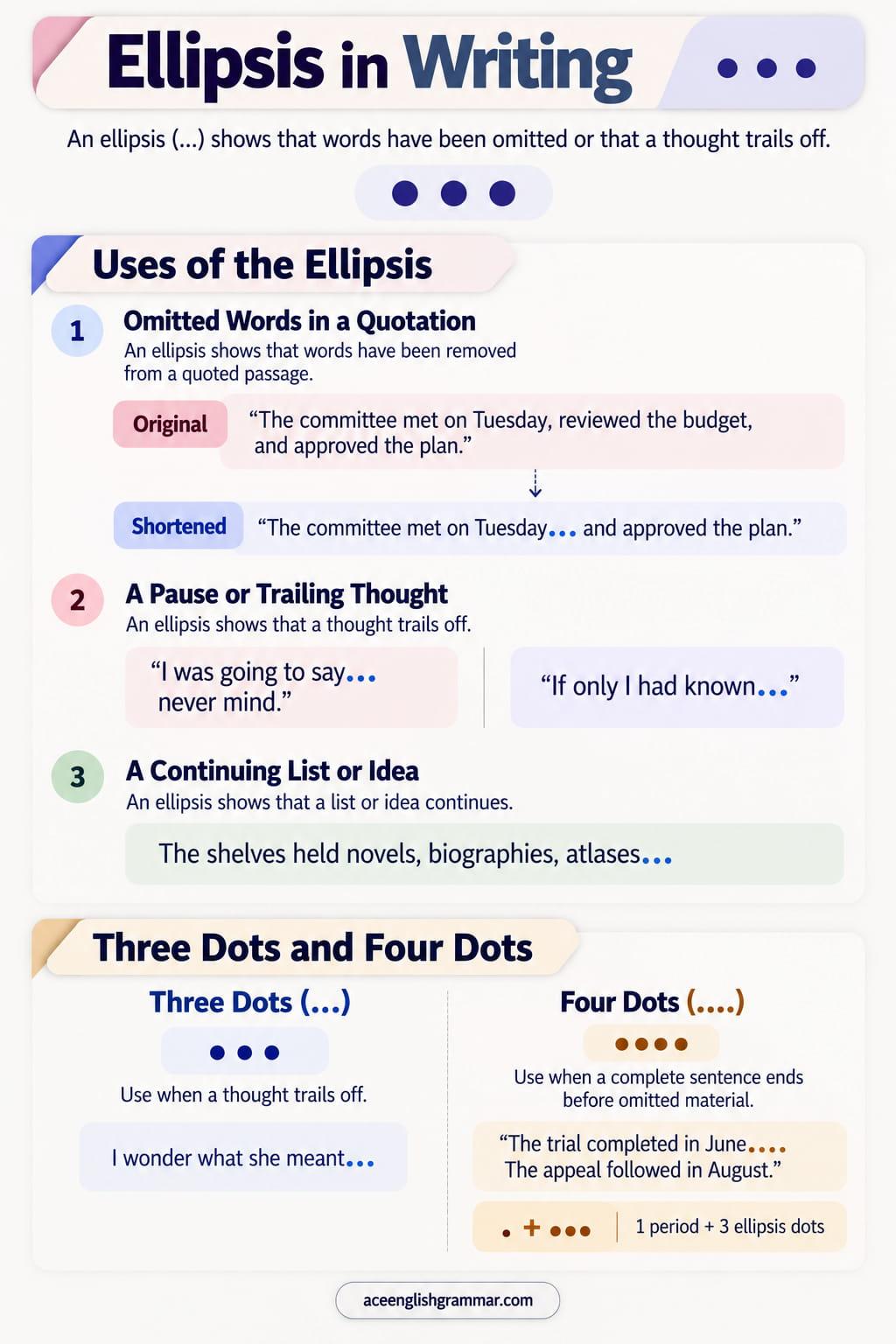
There are three main uses of the ellipsis in English: marking an omission from quoted material, showing a pause or a trailing thought in dialogue, and signalling that a list or idea continues. Spacing, capitalization, and the four-dot rule at the end of a sentence differ between guides and writers.
What Is an Ellipsis?
An ellipsis is a punctuation mark made of three spaced or unspaced dots (…) that marks omitted words or a trailing thought. The three dots are the mark most people search for when they want to know what the three dots are called.
The name comes from the Greek word for omission. The mark tells the reader that something has been left out on purpose, rather than lost by accident.
- She trailed off… and said nothing more.
- The report concluded that the policy “… had no measurable effect.”
- I was going to say something… never mind.
- The list ran on: milk, bread, eggs…
Note that an ellipsis is not the same as an ellipse. An ellipse is an oval shape in geometry; an ellipsis is the three-dot punctuation mark.
Ellipsis vs Ellipses
“Ellipsis” is the singular form and names one three-dot mark. “Ellipses” is the plural form and names more than one of them.
- One mark is an ellipsis.
- Three marks on the page are three ellipses.
- She used an ellipsis to show the cut.
- The manuscript contained dozens of ellipses.
Note that the plural follows the Greek pattern, changing “-is” to “-es,” in the same way “thesis” becomes “theses” and “analysis” becomes “analyses.”
Compare:
- She used an ellipses to trail off. ✗
- She used an ellipsis to trail off. ✓
- The page had four ellipsis. ✗
- The page had four ellipses. ✓
Common Uses of the Ellipsis with Examples
The ellipsis has three established uses in English writing. The most common uses appear here with one example each; each rule is covered in detail later.
- Omitted words in a quotation: The report said the policy “… had no measurable effect.”
- A pause or trailing thought: I was going to say… never mind.
- A continuing list or idea: The shelves held novels, biographies, atlases…
Ellipsis to Show Omitted Words
An ellipsis marks words removed from a passage, so the reader knows the gap is deliberate. This is the mark’s original and most formal function, and it applies to any quoted or reproduced text.
- The original: “The committee met on Tuesday, reviewed the budget, and approved the plan.”
- The shortened version: “The committee met on Tuesday… and approved the plan.”
- The original: “She argued, at considerable length, that the policy had failed.”
- The shortened version: “She argued… that the policy had failed.”
Note that an omission must not change the meaning of the original. Cutting a negative, a qualifier, or a condition and hiding the cut behind an ellipsis misrepresents the source.
Compare:
- Original: “The drug is effective, though only in mild cases.”
- Honest cut: “The drug is effective… in mild cases.” ✓
- Dishonest cut: “The drug is effective…” ✗ (removes the limitation)
Ellipsis in Quotations
Quoted material has specific rules for where the ellipsis goes and whether brackets surround it. The position of the omission decides which rule applies.
Omission in the Middle of a Quotation
An ellipsis replaces the removed words directly, with a space on each side in most styles. The sentence around the gap must still read grammatically.
- The minister said the plan was “ambitious… but achievable within the decade.”
- The review called the film “technically flawless… and emotionally hollow.”
- The study reported that results were “consistent… across all three trials.”
Omission at the Start or End of a Quotation
No ellipsis is needed at the start of a quotation, because the opening quotation mark already shows the excerpt begins mid-source. An ellipsis at the end is used only when the sentence would otherwise read as complete.
- She wrote that the policy was “a failure from the start.” ✓ (no opening ellipsis needed)
- “…a failure from the start,” she wrote. ✗ (unnecessary)
- He promised to “review the matter, consult the board…” ✓ (the sentence continues in the source)
Omission of a Full Sentence
When a whole sentence is cut from a longer passage, a period is added before the ellipsis, producing four dots in total. The first dot is the period ending the preceding sentence.
- “The trial ran for six weeks…. The results were published in March.”
- “She joined the firm in 2019…. By 2023 she was a partner.”
Note that MLA and APA styles place the removed material in square brackets in some contexts, as in “[…]”. Chicago and AP use the bare ellipsis without brackets.
Ellipsis to Show a Pause or Trailing Thought
An ellipsis marks a voice trailing away, a hesitation, or an unfinished thought in dialogue and informal writing. This use is common in fiction, scripts, and conversational prose.
- “I thought you said…” She stopped mid-sentence.
- “Well… I suppose we could try.”
- “If only I had known…“
- He opened the letter, read two lines, and… put it down.
Note that an em dash marks an interruption from outside, while an ellipsis marks a voice fading on its own. The two are not interchangeable in dialogue.
Compare:
- “I was going to say—” she was cut off. ✓ (em dash: interrupted by someone)
- “I was going to say…” she murmured. ✓ (ellipsis: trailed off alone)
Ellipsis at the End of a Sentence
A sentence that trails off ends with three dots alone. A sentence that ends normally before an omission takes a period first, giving four dots in total.
1. Three dots when the thought itself trails away and the sentence never completes.
- I wonder what she meant…
- If only there were more time…
- The shelves held novels, biographies, atlases…
2. Four dots when a complete sentence ends and material after it has been cut.
- “The trial concluded in June…. The appeal followed in August.”
- “She resigned without warning…. Nobody has heard from her since.”
Note that the four dots are a period plus an ellipsis, not a four-dot mark. The period belongs to the sentence that has just finished.
Spacing Around the Ellipsis
Spacing between and around the dots differs by style guide. Three conventions appear in published English, and consistency within one document matters more than the choice.
1. Spaced dots (Chicago Manual): a space between each dot and on both sides.
- She paused . . . then continued.
- The report said the policy . . . had failed.
2. Unspaced dots with surrounding spaces (AP style and most web writing): the three dots run together with a space on each side.
- She paused … then continued.
- The report said the policy … had failed.
3. Unspaced dots with no surrounding space (informal and digital): the mark attaches directly to the preceding word.
- She paused… then continued.
- I was going to say… never mind.
Note that no space comes before the ellipsis when the mark shows a trailing thought attached to a word. A space appears when the ellipsis stands between two complete phrases.
Capitalization After an Ellipsis
The word after an ellipsis keeps whatever capitalization it had in the original source. A lowercase word stays lowercase, and a word beginning a new sentence keeps its capital.
- The report said the policy “was ambitious… but flawed in execution.” ✓ (lowercase continues)
- “The trial concluded in June…. The appeal followed.” ✓ (new sentence: capital)
- She wrote that the plan “failed… Nobody took responsibility.” ✓
Note that square brackets mark a capital that the editor has changed. Writing “[T]he appeal followed” shows that the source had a lowercase “the” at that point.
Ellipsis in Major Style Guides
The four style guides most used in English writing differ on spacing, bracketing, and the four-dot rule. Writers follow whichever guide their field requires.
| Style guide | Spacing | Brackets | Four-dot rule |
|---|---|---|---|
| Chicago Manual | Spaced dots ( . . . ) | No brackets | Period plus ellipsis |
| AP Stylebook | Unspaced with outer spaces ( … ) | No brackets | Period plus ellipsis |
| MLA | Unspaced with outer spaces | Brackets for added ellipses | Period plus ellipsis |
| APA | Unspaced with outer spaces | Brackets in some contexts | Period plus ellipsis |
Note that legal writing follows the Bluebook, which uses spaced dots and requires brackets around any ellipsis the writer adds to a quotation.
Ellipsis in Text Messages and Online Writing
The ellipsis takes on meanings in digital writing that it does not have in formal prose. Readers interpret the mark as hesitation, reluctance, passive disagreement, or an unfinished thought, depending on context.
- “Sure…” (reluctant agreement rather than enthusiasm)
- “I guess that works…” (doubt)
- “We need to talk…” (something unwelcome is coming)
- “Fine…” (resignation)
Note that generational reading of the mark differs sharply. Younger readers tend to read a trailing ellipsis as passive-aggressive, while older writers intend it as a neutral pause, which is a frequent source of misreading in workplace messaging.
Grammatical Ellipsis in Language and Literature
Grammatical ellipsis is a separate concept from the punctuation mark. It names the omission of words that the reader can supply from context, and it happens with no dots on the page at all.
- She can play the piano, and he can [play the piano] too.
- Some students passed the exam; others [did not pass the exam].
- “Where are you going?” “To the shop [I am going to the shop].”
- I ordered coffee and she [ordered] tea.
Note that this use of the term belongs to grammar and linguistics rather than punctuation. A literature course discussing “ellipsis in poetry” means this omission of words rather than the three-dot mark.
How to Type an Ellipsis
The ellipsis has its own Unicode character, separate from three typed periods. Most word processors convert three periods into the single character automatically.
The character codes for the ellipsis across formats:
| Format | Code |
|---|---|
| Unicode | U+2026 |
| HTML entity | … |
| HTML numeric | … |
| Windows Alt code | Alt + 0133 |
| CSS content | \2026 |
| Python / JavaScript | \u2026 |
On Windows
On Windows, the ellipsis is typed with Alt + 0133 using the numeric keypad. Microsoft Word also converts three consecutive periods into the single ellipsis character through AutoCorrect.
- Alt + 0133 on the numeric keypad
- Type three periods in Word, and AutoCorrect converts them
On Mac
On Mac, the ellipsis is typed with Option + Semicolon. This shortcut works across every Mac application.
- Option + semicolon (;) on any Mac keyboard
In Word and Google Docs
Both programs convert three typed periods into the single ellipsis character. The Insert menu offers a direct insertion for writers who prefer it.
- Type three periods and continue typing (automatic conversion)
- Insert > Symbol > Special Characters in Word
- Insert > Special Characters in Google Docs, then search for “ellipsis”
On Mobile Devices
On iOS and Android, the ellipsis appears when the period key is held down on the numbers-and-symbols layer.
- Hold the period key (.) and slide to the ellipsis in the pop-up menu
Ellipsis vs Em Dash
Both marks interrupt the flow of a sentence, but they signal different things. An ellipsis shows a voice fading or words removed; an em dash shows a sharp break or an interruption from outside.
- “I thought we agreed…” (the speaker trails off)
- “I thought we agreed—” (the speaker is cut off by someone else)
- The plan… if it can be called a plan… never worked. (hesitant, uncertain)
- The plan—if it can be called a plan—never worked. (confident, parenthetical)
Note that formal writing prefers the em dash for parenthetical asides and reserves the ellipsis for genuine omission. Using an ellipsis where an em dash belongs makes prose read as tentative.
When Not to Use an Ellipsis
Five situations call for different punctuation even though writers reach for the ellipsis.
1. As a general pause in formal writing. A comma, a semicolon, or a period handles the pause.
- The results were surprising… and the team celebrated. ✗
- The results were surprising, and the team celebrated. ✓
2. To replace “etc.” at the end of a list. Either the ellipsis or “etc.” is used, never both.
- We bought bread, milk, eggs… etc. ✗
- We bought bread, milk, eggs… ✓
- We bought bread, milk, eggs, etc. ✓
3. To cut material that changes the meaning of a quotation. An omission must leave the source’s sense intact.
4. As a parenthetical aside. An em dash or a pair of commas belongs there.
- The plan… drafted last spring… was abandoned. ✗
- The plan—drafted last spring—was abandoned. ✓
5. More than once or twice per page. Repeated ellipses make prose read as uncertain and unfinished.
Common Errors With the Ellipsis
Six errors recur most commonly when writers use the ellipsis in English.
- Using more or fewer than three dots. We write “She paused…” with exactly three dots, not two or five. A fourth dot appears only as the period of a completed sentence.
- Adding an ellipsis at the start of a quotation. We write “a failure from the start,” not “…a failure from the start.” The opening quotation mark already shows the excerpt begins mid-source.
- Combining an ellipsis with “etc.” We write “bread, milk, eggs…” or “bread, milk, eggs, etc.,” never both together. The two carry the same meaning.
- Using an ellipsis for an interruption. We write “I was going to say—” when another speaker cuts in, not “I was going to say…” An ellipsis marks a voice fading on its own.
- Changing the meaning of a quotation through omission. We keep the sense of the original intact, even when cutting for length. Hiding a qualifier behind an ellipsis misrepresents the source.
- Mixing spacing conventions in one document. We follow one style throughout, whether spaced dots or unspaced. Switching between them mid-document reads as careless.
FAQs
Q1. What is an ellipsis?
An ellipsis is a punctuation mark made of three dots (…) that shows words have been left out or that a thought trails off. The name comes from the Greek word for omission. It is the mark people mean when they ask what the three dots are called.
Q2. What are the three dots called?
The three dots are called an ellipsis. One mark is an ellipsis; two or more are ellipses. In informal speech the mark is sometimes called dot-dot-dot or suspension points, but the standard term in grammar and publishing is ellipsis.
Q3. What is the difference between an ellipsis and ellipses?
“Ellipsis” is the singular form and names one three-dot mark. “Ellipses” is the plural and names more than one. The plural follows the Greek pattern of changing “-is” to “-es,” in the same way “thesis” becomes “theses.”
Q4. Do I put a space after an ellipsis?
It depends on the style guide. Chicago sets spaced dots with a space on each side ( . . . ). AP style and most web writing set unspaced dots with a space on each side ( … ). Informal digital writing attaches the mark directly to the preceding word. Consistency within one document matters more than the choice.
Q5. When do I use four dots instead of three?
Four dots appear when a complete sentence ends and material after it has been cut. The first dot is the period ending that sentence, followed by the three-dot ellipsis: “The trial concluded in June…. The appeal followed in August.” A trailing thought that never completes takes three dots alone.
Q6. How do I type an ellipsis?
On Windows, press Alt + 0133 on the numeric keypad. On Mac, press Option + Semicolon. Microsoft Word and Google Docs convert three typed periods into the single ellipsis character automatically. On mobile devices, hold the period key on the numbers layer and slide to the ellipsis.
Q7. What does an ellipsis mean in a text message?
In digital writing the mark signals hesitation, reluctance, or an unwelcome message to come. “Sure…” reads as reluctant agreement rather than enthusiasm. Readers differ sharply by age: younger readers tend to read a trailing ellipsis as passive-aggressive, while older writers intend it as a neutral pause.
Read More

Leave a Comment