
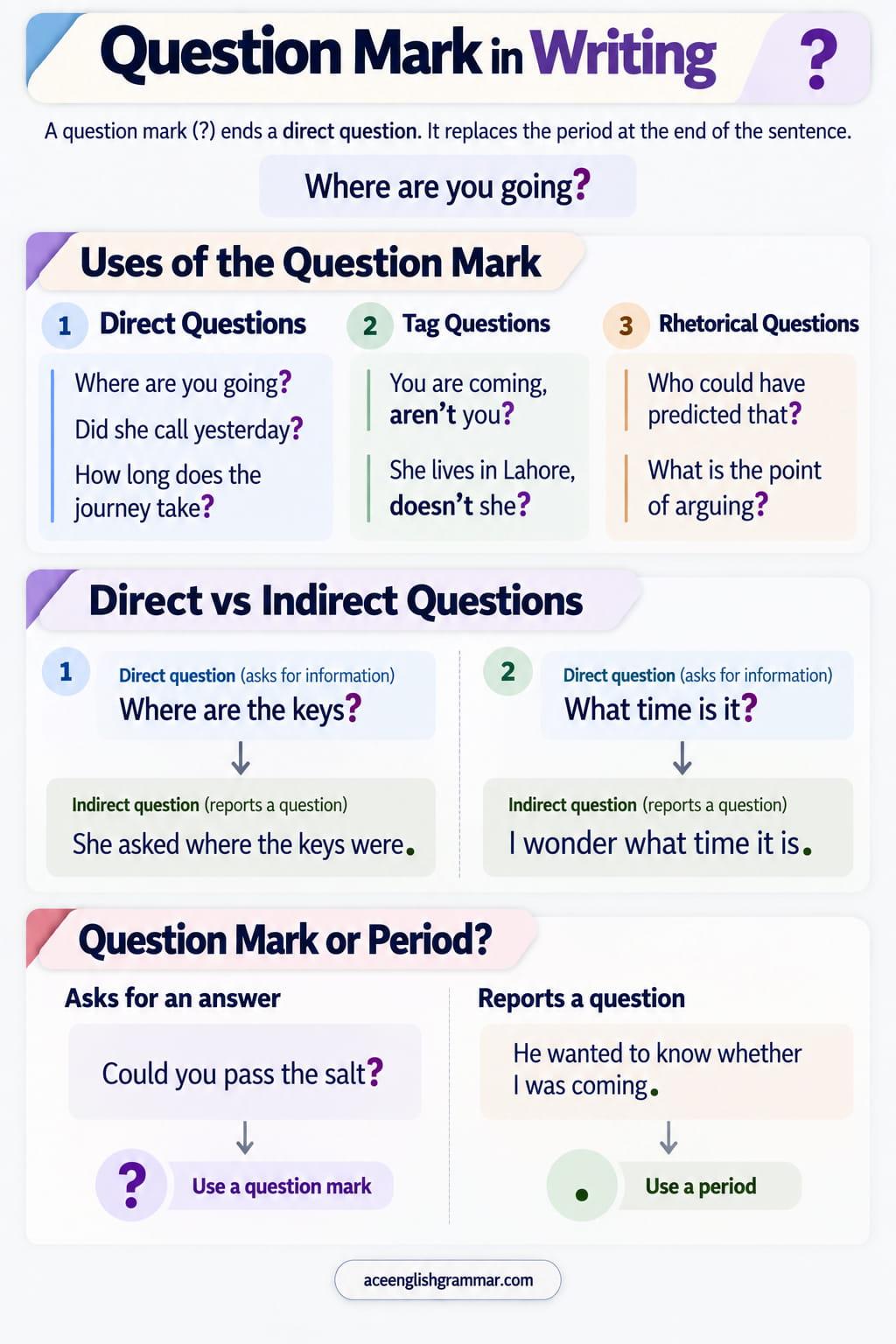
A question mark is a punctuation mark (?) that ends a direct question. It replaces the period at the end of the sentence rather than joining it.
The question mark applies to direct questions only. An indirect question, a polite request phrased as a question, and a statement containing an embedded question all end with a period instead, which is where most errors with the mark begin.
What Is a Question Mark?
A question mark is a punctuation mark (?) that ends a sentence asking a direct question. It is made of a hooked stroke over a dot, and it takes the place of the period in that position.
The mark signals interrogative force. A sentence ending in a period reads as a statement; the same words ending in a question mark ask for an answer.
- Where are you going?
- Did she call yesterday?
- What time does the meeting start?
- You are coming, aren’t you?
Note that the question mark is also called the interrogation mark or the interrogation point, though both names are rare in modern usage. The name and the rules for this mark are identical in British and American English.
Common Uses of the Question Mark with Examples
The question mark has four established uses in English writing. The most common uses appear here with one example each; each rule is covered in detail later.
- Direct questions: Where are you going?
- Tag questions: You are coming, aren’t you?
- Rhetorical questions: Who could have predicted that?
- Uncertain dates or facts: Geoffrey Chaucer (1343?–1400)
Question Mark in Direct Questions
A direct question asks for information and ends with a question mark. Most direct questions invert the subject and the auxiliary verb, or open with a question word such as who, what, where, when, why, or how.
- Did she call yesterday?
- Are you ready to leave?
- Where did you put the keys?
- How long does the journey take?
- Why was the meeting cancelled?
A statement can also function as a question when the speaker raises the intonation. These take a question mark even though the word order stays declarative.
- You are leaving already?
- She said that to your face?
- He finished the whole report in one night?
Note that the question mark depends on the function rather than the word order. Any sentence that asks for an answer takes the mark.
Indirect Questions Take No Question Mark
An indirect question reports a question inside a statement. It ends with a period, because the sentence as a whole makes a statement rather than asking anything.
- Direct: Where are the keys? → Indirect: She asked where the keys were.
- Direct: Are you coming? → Indirect: He wanted to know whether I was coming.
- Direct: What time is it? → Indirect: I wonder what time it is.
Compare:
- She asked where the keys were? ✗
- She asked where the keys were. ✓
- I wonder what time it is? ✗
- I wonder what time it is. ✓
Note that an indirect question keeps statement word order. “She asked where the keys were” does not invert to “where were the keys,” which is the structural signal that no question mark belongs.
Question Mark With Tag Questions
A tag question is a short question added to a statement to invite agreement or confirmation. The statement takes a comma, and the tag takes the question mark.
- You are coming, aren’t you?
- She lives in Lahore, doesn’t she?
- It is cold today, isn’t it?
- They finished on time, didn’t they?
- He cannot swim, can he?
Note that the tag reverses the polarity of the statement. A positive statement takes a negative tag, and a negative statement takes a positive tag.
Compare:
- You are coming, aren’t you? ✓ (positive statement, negative tag)
- You are not coming, are you? ✓ (negative statement, positive tag)
Question Mark With Rhetorical Questions
A rhetorical question is asked for effect rather than for an answer, and it still takes a question mark. The mark reflects the interrogative form, not whether a reply is expected.
- Who could have predicted that?
- What is the point of arguing?
- How many times must I explain this?
- Is the sky blue?
Note that a rhetorical question ending in an exclamation mark is a stylistic choice rather than an error. “How many times must I explain this!” signals frustration and treats the sentence as an exclamation rather than a question.
Question Mark With Polite Requests
A request phrased as a question but functioning as an instruction takes a period rather than a question mark. The distinction turns on whether the speaker expects an answer or compliance.
- Would you please send the report by Friday. ✓ (an instruction)
- Could you pass the salt? ✓ (a genuine request expecting a yes or no)
- Will everyone please take their seats. ✓ (an instruction to a group)
- Would you like some tea? ✓ (a genuine offer)
Note that the period version reads as more formal and directive. Business and legal writing uses it for requests that expect action rather than a reply.
Multiple Questions in One Sentence
A series of short questions in one sentence can each take a question mark, with lowercase letters between them. This treats the series as one sentence with several interrogative parts.
- Who wrote it? when? and for what purpose?
- Did she call? write? send anyone?
- What did you do? where did you go? who did you see?
Where the questions are full sentences, each takes its own question mark and its own capital letter.
- Who wrote it? When was it written? Why does it matter?
- Did she call? Did she leave a message? Did anyone follow up?
A single question mark covers a sentence that asks one question containing a list.
- Did you invite Sara, Ahmed, and Zainab?
- Which of the three options do you prefer: the first, the second, or the third?
Note that the lowercase series is acceptable under Chicago, while many house styles require a full sentence for every question mark. The full rules for multiple questions in one sentence cover each pattern with examples.
Question Mark With Quotation Marks
A question mark goes inside the closing quotation mark when the quoted words form the question, and outside when the surrounding sentence asks it. The rule is the same in British and American English.
- She asked, “Are you ready?” ✓ (the question is hers)
- Did he really say “a minor setback”? ✓ (the question is the writer’s)
- He asked, “Where are the keys?” and left. ✓
- Who wrote “The Road Not Taken”? ✓
Note that no comma or period follows a question mark inside a quotation. We write She asked, "Are you ready?" and waited. not She asked, "Are you ready?," and waited.
Question Mark With Parentheses
A question mark goes inside the parentheses when the enclosed material asks the question, and outside when the main sentence does.
- He agreed to pay (can you believe it?) without argument. ✓
- Did you read the whole report (all forty pages)? ✓
- She finally replied (after three weeks?) with a single line. ✓
- Who approved the budget (the one from March)? ✓
A question mark in parentheses on its own marks uncertainty about a date or a fact.
- Geoffrey Chaucer (1343?–1400) wrote The Canterbury Tales.
- The manuscript dates from 1490 (?) and has never been authenticated.
Question Mark With an Exclamation Mark
A sentence that is both a question and an exclamation takes one mark in formal writing. Informal writing combines them as “?!” or “!?”, and a single character exists for the combination.
- What on earth were you thinking? ✓ (formal)
- What on earth were you thinking! ✓ (formal)
- What on earth were you thinking?! (informal)
The combined character is the interrobang (‽), designed in 1962 and available in Unicode as U+203D. It appears rarely in published English.
Note that no sentence takes both a question mark and a period. The question mark already ends the sentence.
Question Mark in Dialogue
In dialogue, the question mark stays inside the quotation marks and replaces the comma that would otherwise separate the speech from the tag. The speaker tag that follows begins with a lowercase letter.
- “Where are you going?” she asked.
- “Did you finish the report?” he said, looking up.
- “Are you serious?” Sara replied.
Compare:
- “Where are you going?,” she asked. ✗
- “Where are you going?” she asked. ✓
- “Where are you going?” She asked. ✗ (tag should be lowercase)
Note that a tag beginning with a proper noun keeps its capital, as in "Are you serious?" Sara replied.
Spacing and Capitalization After a Question Mark
One space follows a question mark before the next sentence, matching the rule for periods and exclamation marks. The next word takes a capital when it begins a new sentence.
- Where are you going? We are leaving soon. ✓
- Did she call? Nobody answered the phone. ✓
- Where are you going ? ✗ (no space before the mark)
- Where are you going? we are leaving soon. ✗ (missing capital)
Note that the two-space convention after end punctuation comes from typewriters and no current style guide requires it.
The Question Mark Symbol and How to Type It
The question mark symbol (?) is on the number row of every standard keyboard, reached with Shift and the forward slash. The inverted form used in Spanish requires a code.
| Mark | Windows | Mac | Unicode | HTML |
|---|---|---|---|---|
| ? | Shift + / | Shift + / | U+003F | ? |
| ¿ inverted | Alt + 0191 | Option + Shift + / | U+00BF | ¿ |
| ‽ interrobang | Alt + 8253 | Character Viewer | U+203D | ‽ |
Copy the marks directly from here:
? ¿ ‽
In Spanish an interrogative sentence opens with the inverted mark and closes with the standard one, as in “¿Dónde está la biblioteca?” In English only the closing mark appears.
When Not to Use a Question Mark
Five situations take a period even though the sentence looks interrogative.
1. An indirect question. The sentence reports a question rather than asking one.
- She asked where the keys were? ✗
- She asked where the keys were. ✓
2. A polite request expecting action. The sentence instructs rather than asks.
- Would you please send the report by Friday? (acceptable but softer)
- Would you please send the report by Friday. ✓ (standard in formal writing)
3. A statement containing a question word. The question word introduces a clause, not a question.
- I know what you did last summer? ✗
- I know what you did last summer. ✓
4. After a question mark, a second mark. The question mark already ends the sentence.
- Where are you going?. ✗
- Where are you going? ✓
5. A title that states rather than asks. A declarative heading takes no mark.
- A Guide to Punctuation? ✗
- A Guide to Punctuation ✓
Common Errors With the Question Mark
Six errors recur most commonly when writers use the question mark in English.
- Ending an indirect question with a question mark. We write “She asked where the keys were,” not “She asked where the keys were?” The sentence reports a question rather than asking one.
- Adding a period after the question mark. We write “Where are you going?” not “Where are you going?.” The question mark replaces the period at the end of a sentence.
- Adding a comma after a question mark in dialogue. We write
"Are you ready?" she asked.not"Are you ready?," she asked.The question mark does the work of both marks. - Capitalizing the speaker tag after a question mark. We write
"Are you ready?" she asked.not"Are you ready?" She asked.The tag continues the sentence. - Placing the mark outside quotation marks when the quote asks the question. We write
She asked, "Are you ready?"notShe asked, "Are you ready"?The mark goes with the words it belongs to. - Using multiple question marks for emphasis. We write “What were you thinking?” not “What were you thinking???” One mark is standard in every register outside informal messaging.
FAQs
Q1. What is a question mark?
A question mark is a punctuation mark (?) that ends a sentence asking a direct question. It replaces the period in that position and signals that the sentence asks for an answer. The mark is also called the interrogation mark, though that name is rare in modern usage.
Q2. Do indirect questions take a question mark?
No. An indirect question reports a question inside a statement and ends with a period. “She asked where the keys were” takes a period because the sentence as a whole makes a statement. Only a direct question, such as “Where are the keys?”, takes the mark.
Q3. How do I punctuate multiple questions in one sentence?
A series of short questions can each take a question mark with lowercase letters between them: “Who wrote it? when? and for what purpose?” Where the questions are full sentences, each takes its own capital: “Who wrote it? When was it written?” A single question containing a list takes one mark at the end.
Q4. Does the question mark go inside or outside quotation marks?
It goes inside when the quoted words form the question and outside when the surrounding sentence asks it. She asked, "Are you ready?" places it inside because she asked it. Did he really say "a minor setback"? places it outside because the writer is asking.
Q5. Do rhetorical questions need a question mark?
Yes. A rhetorical question takes a question mark because the mark reflects the interrogative form rather than whether a reply is expected. “Who could have predicted that?” ends with the mark. An exclamation mark is a stylistic alternative that signals frustration instead.
Q6. Can I use a question mark and an exclamation mark together?
Formal writing takes one mark or the other. Informal writing combines them as “?!” or “!?”, and a single character called the interrobang (‽) exists for the combination, available in Unicode as U+203D. It appears rarely in published English.
Q7. How do I type an upside-down question mark?
The inverted question mark (¿) is typed with Alt + 0191 on Windows and Option + Shift + forward slash on Mac. In Spanish an interrogative sentence opens with the inverted mark and closes with the standard one, as in “¿Dónde está la biblioteca?” In English only the closing mark appears.
Read More

Leave a Comment