Intensive pronouns add emphasis to a noun or pronoun already named in a sentence. In The teacher herself checked the papers, herself points back to the teacher and puts extra focus on who performed the action.
The sentence remains complete without the pronoun: The teacher checked the papers. The core meaning stays in place, but the special emphasis on the teacher disappears. That optional emphasis is what separates an intensive pronoun from a pronoun that the sentence actually needs.
These forms often confuse learners because they look exactly like reflexive pronouns. The difference comes from sentence role, not spelling. An intensive pronoun adds emphasis. A reflexive pronoun works as the object of the verb or the object of a preposition.
What Are Intensive Pronouns?
An intensive pronoun is a pronoun ending in self or selves that emphasizes a noun or pronoun already named in the same sentence. It refers back to that word, but it does not function as the object of the verb.
Example:
I myself spoke to the manager.
In this sentence, myself refers back to the subject I. It does not receive the action of the verb spoke. The core sentence remains complete as I spoke to the manager.
An intensive pronoun adds focus, contrast, or personal responsibility. It can make a sentence sound more direct, especially when the writer wants to stress that a particular person or thing performed the action.
Intensive Pronouns List
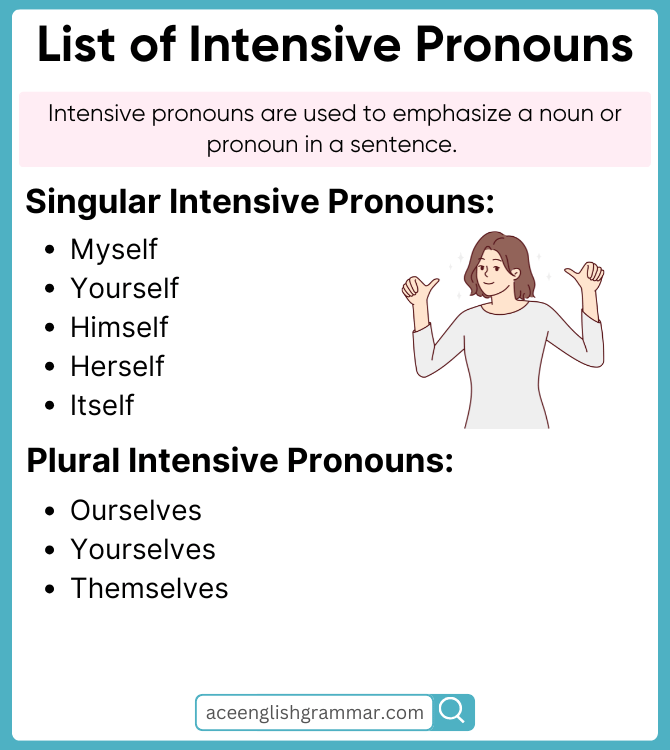
English uses eight common self and selves forms as intensive pronouns.
| Singular intensive pronouns | Plural intensive pronouns |
|---|---|
| myself | ourselves |
| yourself | yourselves |
| himself | themselves |
| herself | |
| itself |
These same forms can also work as reflexive pronouns. Their spelling stays the same, but their grammar role changes according to the sentence structure.
How Intensive Pronouns Work In Sentences
Intensive pronouns give extra weight to a noun or pronoun that is already present. They often show personal involvement, direct responsibility, contrast, or surprise.
- The mayor herself opened the new library.
- We ourselves packed every box.
- The machine itself stopped during the test.
- You yourself said the plan was risky.
Each sentence already has the grammar it needs before the intensive pronoun appears. The pronoun adds emphasis to the subject, but it does not complete the verb’s meaning.
In The mayor herself opened the new library, the action is still complete without herself. The added pronoun makes the mayor’s personal involvement stand out.
The Removal Test
The removal test is the most reliable way to identify an intensive pronoun. Remove the pronoun from the sentence. If the sentence remains complete and keeps the same basic meaning, the pronoun is adding emphasis rather than carrying a required grammar role.
With intensive pronoun:
Sara herself called the office.
Without intensive pronoun:
Sara called the office.
The sentence remains grammatically complete, so herself is intensive.
With intensive pronoun:
They themselves built the fence.
Without intensive pronoun:
They built the fence.
The action does not change. The only difference is the stronger focus on they.
Sentence Position With Intensive Pronouns
Sentence position gives another clue after the removal test. Intensive pronouns often sit close to the noun or pronoun they emphasize, especially when the writer wants the emphasis to appear immediately.
After the subject:
- I myself made the decision.
- The owner himself answered the phone.
- The students themselves cleaned the classroom.
Intensive pronouns can also appear later in the sentence when the rhythm sounds more natural or when the writer wants the emphasis to land near the end.
Later in the sentence:
- I made the decision myself.
- The owner answered the phone himself.
- The students cleaned the classroom themselves.
Both positions can be correct. The more important question is what the pronoun is doing. If it emphasizes a noun or pronoun already named and the sentence remains complete without it, the pronoun is intensive.
Intensive Pronoun Examples
The examples below show intensive pronouns in different sentence positions. Some appear directly after the subject, while others come later for a smoother natural sentence flow.
- I myself wrote the final report.
- You yourself should check the answer.
- He himself repaired the broken gate.
- She herself admitted the mistake.
- The house itself is older than the village.
- We ourselves planned the whole trip.
- You yourselves chose this topic.
- They themselves paid for the repairs.
- The chef himself served the guests.
- The children themselves painted the wall.
- The phone itself was not damaged.
- My father himself taught me how to drive.
- The witnesses themselves confirmed the story.
- The company itself denied the rumor.
- The artist herself signed the painting.
In each example, the intensive pronoun has a noun or pronoun to refer back to. Without that antecedent, the pronoun has no proper anchor in the sentence.
Intensive Pronouns Vs Reflexive Pronouns
The main confusion comes from form. Intensive and reflexive pronouns use the same words, but grammar is decided by role, not spelling.
| Feature | Intensive pronoun | Reflexive pronoun |
|---|---|---|
| Main function | Adds emphasis | Acts as an object |
| Sentence role | Optional emphasis marker | Required part of the sentence structure |
| Removal | Can be removed | Usually cannot be removed without changing the sentence |
| Example | She herself cooked dinner. | She cooked herself dinner. |
In She herself cooked dinner, herself emphasizes she. The sentence remains complete as She cooked dinner.
In She cooked herself dinner, herself is part of the action. It tells who received the dinner. Removing it changes the sentence because the pronoun is working as an object.
The same pronoun can change role from one sentence to another:
- He himself fixed the bike.
Himself adds emphasis to he. - He fixed himself a snack.
Himself receives the action in the sentence.
That is why sentence role matters more than the word form alone.
Rules For Using Intensive Pronouns
Intensive pronouns need a noun or pronoun to point back to. They should add emphasis, not replace a regular subject or object pronoun.
Use Them To Emphasize A Named Subject
An intensive pronoun must refer to a noun or pronoun already present in the sentence.
Correct:
Fatima herself fixed the chair.
Here, herself refers back to Fatima and adds emphasis to the person who performed the action.
Incorrect:
Herself fixed the chair.
The second sentence is wrong because herself has no named subject to emphasize.
Do Not Use Them As Regular Objects
Many writers choose myself because it sounds formal, but formality does not decide the pronoun. After a preposition such as to, the sentence usually needs an object pronoun such as me, him, her, us, or them.
Incorrect:
He gave the file to myself.
Correct:
He gave the file to me.
Correct intensive use:
I myself gave him the file.
In the last sentence, myself refers back to I and adds emphasis. It is not the object of to.
Avoid Repeating The Same Emphasis
One strong intensive pronoun is usually enough. Extra emphasis can make a sentence heavy.
Heavy:
The students themselves solved the problem by themselves.
Better:
The students themselves solved the problem.
The better sentence keeps the focus on the students without repeating the same idea.
Common Mistakes With Intensive Pronouns
Most mistakes happen when a writer treats an intensive pronoun as a subject or object. The sentence may sound formal at first, but the grammar role is wrong.
Mistake 1: Using Myself Instead Of Me
Incorrect:
Please send the details to myself.
Correct:
Please send the details to me.
Use myself when it refers back to I, not when the sentence needs the object pronoun me.
Correct:
I myself checked the details before sending them.
Mistake 2: Starting A Sentence With Himself Or Herself
Incorrect:
Himself solved the problem.
Correct:
Zaid himself solved the problem.
An intensive pronoun needs an antecedent, which is the noun or pronoun it refers back to. In the correct sentence, Zaid is the antecedent of himself.
Mistake 3: Confusing Intensive And Reflexive Use
The same pronoun may be intensive in one sentence and reflexive in another.
Intensive:
We ourselves hosted the event.
Here, ourselves emphasizes we.
Reflexive:
We enjoyed ourselves at the event.
Here, ourselves is the object of enjoyed.
Mistake 4: Adding Emphasis Where It Sounds Forced
Intensive pronouns work best when the emphasis has a reason. They can show personal involvement, contrast, responsibility, or surprise.
Forced:
The pencil itself is on the desk.
More natural:
The principal herself answered the complaint.
The second sentence gives the emphasis a purpose because the person named is important to the action.
Intensive Pronoun Exercise
Use the sentence subject to choose the correct intensive pronoun. Each answer should refer back to a noun or pronoun already present in the sentence.
- I _____ baked this cake.
- She _____ painted the room.
- The manager _____ approved the policy.
- You _____ should check the answer.
- The students _____ organized the event.
- He _____ repaired the chair.
- The machine _____ shut down.
- We _____ planned the trip.
- The artist _____ designed the cover.
- They _____ chose the final name.
Answers
- myself
- herself
- himself or herself
- yourself
- themselves
- himself
- itself
- ourselves
- himself or herself
- themselves
Final Thoughts
Intensive pronouns give extra focus to a noun or pronoun without changing the sentence’s basic structure. They work best when the subject deserves attention, contrast, or personal responsibility.
The safest test is removal. If the sentence remains complete without myself, yourself, himself, herself, itself, ourselves, yourselves, or themselves, the pronoun is probably intensive. Used well, intensive pronouns make emphasis sound natural instead of forced.
FAQs
An intensive pronoun is a self or selves pronoun that emphasizes a noun or pronoun already named in the sentence.
The doctor herself called me.
Here, herself emphasizes the doctor.
The intensive pronouns are myself, yourself, himself, herself, itself, ourselves, yourselves, and themselves.
Use the removal test. If the sentence remains complete without the pronoun, the pronoun is intensive.
Ali himself built the shelf.
Ali built the shelf.
The second sentence remains complete, so himself is intensive.
An intensive pronoun adds emphasis, while a reflexive pronoun works as an object.
Intensive:
She herself wrote the letter.
Reflexive:
She wrote herself a letter.
In the first sentence, herself emphasizes she. In the second sentence, herself receives the action.
Yes. An intensive pronoun can be removed without breaking the sentence. The sentence keeps its basic meaning, but the special focus disappears.
Yes. Itself is an intensive pronoun when it emphasizes a noun already named in the sentence.
The building itself was not damaged.
Here, itself emphasizes the building.
Read More